Conflict Resilience: How to Fight Without Breaking
When conflict hits, we often burn our own houses down trying to win. Learn to manage the heat of anger and use disagreements to build stronger bonds.
Лучшая цитата из Conflict Resilience: How to Fight Without Breaking
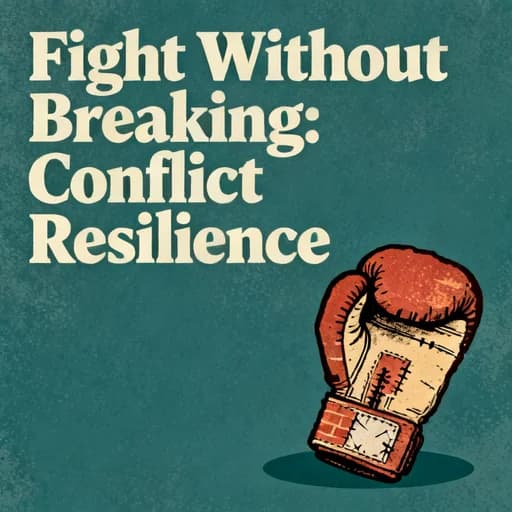
If your house is burning down, you do not run after the person who set the fire to catch and punish them; your first job is to go back and put out the fire. That fire is your anger, and it is the internal state that is actually doing the damage to your life in real-time.
Generated with BeFreed
How to Fight Without Breaking






Часто задаваемые вопросы
This happens because of a physiological process called "flooding." When you feel threatened during a conflict, your amygdala hijacks your brain, flooding your system with stress hormones like cortisol and adrenaline. This causes your prefrontal cortex—the area responsible for rational thinking—to go offline. Essentially, your body enters survival mode, treating a relational threat like an eye-roll with the same intensity as a physical threat, which causes your IQ to drop and leads to reactive behaviors like yelling or shutting down.
The metaphor, from Zen teacher Thich Nhat Hanh, suggests that when you are angry, your "house" is on fire. Chasing after the person who made you angry is like running after an arsonist while your home burns down. Your primary responsibility is to return to yourself and "put out the fire" of your own anger first. By focusing on regulating your internal state rather than punishing the other person, you prevent the anger from destroying your peace, health, and connections.
The most effective way to prevent an immediate escalation is to use a "soft start-up." Since conversations usually end the way they begin, you should avoid "you" statements that sound like attacks or blame. Instead, shift the focus to "I" statements that describe your feelings and needs. For example, instead of saying "You always forget the bills," you could say, "I feel stressed when I see a late notice, and I need us to find a better system." This invites collaboration rather than triggering the other person's defensive survival mode.
The key difference lies in the intent and the "return time." Stonewalling is a form of shutdown that acts as a wall, leaving the other person stranded and causing resentment to build. In contrast, a "structured pause" is a tool for conflict resilience. It involves naming your overwhelm by saying something like, "I am starting to feel flooded and I need a minute," and then setting a specific time to return to the conversation. This allows your nervous system to calm down without breaking the connection.
The Bagel Method is a tool for compromise that distinguishes between "non-negotiables" and flexible areas. The "hole" of the bagel represents your core values and essential needs that you cannot give up. The "dough" represents the flexible areas where you can give and take. Often, we treat the entire argument as a non-negotiable, but by identifying the specific core need—such as a need for respect or order—you can often find many flexible ways to satisfy that need in the "dough" of the compromise.
Создано выпускниками Колумбийского университета в Сан-Франциско
"Instead of endless scrolling, I just hit play on BeFreed. It saves me so much time."


"I never knew where to start with nonfiction—BeFreed’s book lists turned into podcasts gave me a clear path."


"Perfect balance between learning and entertainment. Finished ‘Thinking, Fast and Slow’ on my commute this week."
"Crazy how much I learned while walking the dog. BeFreed = small habits → big gains."
"Reading used to feel like a chore. Now it’s just part of my lifestyle."

"Feels effortless compared to reading. I’ve finished 6 books this month already."
"BeFreed turned my guilty doomscrolling into something that feels productive and inspiring."

"BeFreed turned my commute into learning time. 20-min podcasts are perfect for finishing books I never had time for."
"BeFreed replaced my podcast queue. Imagine Spotify for books — that’s it. 🙌"

"It is great for me to learn something from the book without reading it."
"The themed book list podcasts help me connect ideas across authors—like a guided audio journey."
"Makes me feel smarter every time before going to work"
Создано выпускниками Колумбийского университета в Сан-Франциско
"Instead of endless scrolling, I just hit play on BeFreed. It saves me so much time."
"I never knew where to start with nonfiction—BeFreed’s book lists turned into podcasts gave me a clear path."
"Perfect balance between learning and entertainment. Finished ‘Thinking, Fast and Slow’ on my commute this week."
"Crazy how much I learned while walking the dog. BeFreed = small habits → big gains."
"Reading used to feel like a chore. Now it’s just part of my lifestyle."
"Feels effortless compared to reading. I’ve finished 6 books this month already."
"BeFreed turned my guilty doomscrolling into something that feels productive and inspiring."
"BeFreed turned my commute into learning time. 20-min podcasts are perfect for finishing books I never had time for."
"BeFreed replaced my podcast queue. Imagine Spotify for books — that’s it. 🙌"
"It is great for me to learn something from the book without reading it."
"The themed book list podcasts help me connect ideas across authors—like a guided audio journey."
"Makes me feel smarter every time before going to work"
"Instead of endless scrolling, I just hit play on BeFreed. It saves me so much time."
"I never knew where to start with nonfiction—BeFreed’s book lists turned into podcasts gave me a clear path."
"Perfect balance between learning and entertainment. Finished ‘Thinking, Fast and Slow’ on my commute this week."
"Crazy how much I learned while walking the dog. BeFreed = small habits → big gains."
"Reading used to feel like a chore. Now it’s just part of my lifestyle."
"Feels effortless compared to reading. I’ve finished 6 books this month already."
"BeFreed turned my guilty doomscrolling into something that feels productive and inspiring."
"BeFreed turned my commute into learning time. 20-min podcasts are perfect for finishing books I never had time for."
"BeFreed replaced my podcast queue. Imagine Spotify for books — that’s it. 🙌"
"It is great for me to learn something from the book without reading it."
"The themed book list podcasts help me connect ideas across authors—like a guided audio journey."
"Makes me feel smarter every time before going to work"
"Instead of endless scrolling, I just hit play on BeFreed. It saves me so much time."
"I never knew where to start with nonfiction—BeFreed’s book lists turned into podcasts gave me a clear path."
"Perfect balance between learning and entertainment. Finished ‘Thinking, Fast and Slow’ on my commute this week."
"Crazy how much I learned while walking the dog. BeFreed = small habits → big gains."
"Reading used to feel like a chore. Now it’s just part of my lifestyle."
"Feels effortless compared to reading. I’ve finished 6 books this month already."
"BeFreed turned my guilty doomscrolling into something that feels productive and inspiring."
"BeFreed turned my commute into learning time. 20-min podcasts are perfect for finishing books I never had time for."
"BeFreed replaced my podcast queue. Imagine Spotify for books — that’s it. 🙌"
"It is great for me to learn something from the book without reading it."
"The themed book list podcasts help me connect ideas across authors—like a guided audio journey."
"Makes me feel smarter every time before going to work"