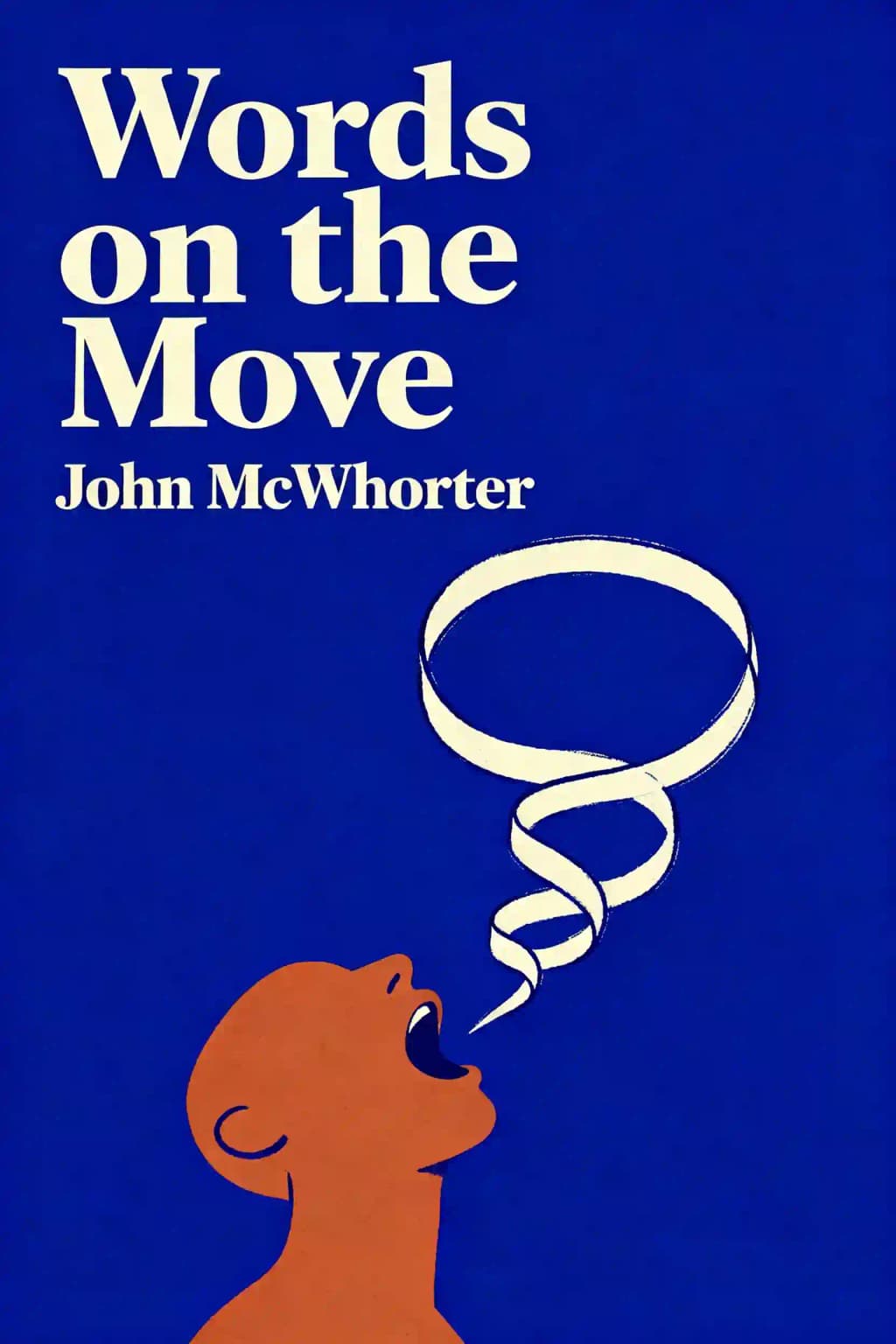
Words on the Move
Обзор книги Words on the Move
In "Words on the Move," linguist John McWhorter reveals why your grandmother's complaints about "literally" aren't valid. Language evolution isn't decay - it's natural adaptation. This Columbia professor's witty exploration makes you question: is your resistance to linguistic change actually logical?
Ключевые темы в Words on the Move
- linguistic evolution
- semantic drift
- pragmatic markers
- language change
- etymological history
Цитаты из Words on the Move
Language does far more than convey information-it expresses our humanity.
Words rarely maintain their original meanings over time.
Stability being the exception rather than the rule.
Words don't just change meaning-sometimes they lose independence entirely.
Персонажи в Words on the Move
- John McWhorterAuthor and linguist who explores language evolution
- MacbethLiterary character used to show semantic drift
- DuncanKing in Shakespeare's play used as a case study
Об авторе
Об авторе книги Words on the Move
John Hamilton McWhorter V, author of Words on the Move: Why English Won’t—and Can’t—Sit Still, is a Columbia University linguistics professor, cultural commentator, and bestselling author renowned for making language evolution accessible to general audiences.
A Stanford-trained linguist specializing in creole languages and linguistic simplicity, McWhorter bridges academic rigor with engaging storytelling, as seen in his 20+ books like The Power of Babel (a natural history of language) and Woke Racism (a critique of modern antiracism frameworks).
He hosts the Lexicon Valley podcast, writes a weekly New York Times newsletter, and has created six linguistics courses for The Great Courses. A frequent contributor to The Atlantic and Wall Street Journal, McWhorter’s insights on race, culture, and language have been featured on NPR’s Fresh Air, The Colbert Report, and TED Talks.
His work Winning the Race earned an NAACP Image Award nomination, while Our Magnificent Bastard Tongue has been widely adopted in linguistics curricula. Words on the Move builds on his signature theme of language as a dynamic, living system, reflecting his 25-year career decoding linguistic patterns for mainstream audiences.
Скачать резюме книги «Words on the Move»
Получите резюме книги «Words on the Move» в формате PDF или EPUB бесплатно. Распечатайте или читайте офлайн в любое время.
Часто задаваемые вопросы об этой книге
Words on the Move explores how language evolves through shifts in word meanings, grammar, and pronunciation. John McWhorter argues that change is inevitable, using examples like slang adoption and the redefinition of words like “literally.” He challenges purist views, showing how English has transformed from Old English to modern internet-driven communication.
Linguistics enthusiasts, language students, and educators will appreciate McWhorter’s insights. It’s also accessible to general readers curious about why terms like “cool” or emojis become mainstream. The book suits anyone interested in how cultural shifts and human creativity shape communication.
Yes. McWhorter blends scholarly research with witty analogies, making complex linguistic concepts engaging. Critics praise its fresh perspective on language’s fluidity, though some find his categorization of changes overly simplistic. The Blinkist summary offers a 15-minute overview for time-constrained readers.
McWhorter identifies mechanisms like semantic drift (e.g., “awful” shifting from “awe-inspiring” to “terrible”) and grammatical simplification. He emphasizes that languages evolve organically, driven by usage rather than rigid rules, and compares this process to biological adaptation.
- FACTUAL framework: Words transition through functions (Factuality, Ambition, Correction, Tangle, Upending, Laziness, Identity).
- Cultural influence: Language mirrors societal changes, like technology shaping abbreviations (e.g., “LOL”).
- “Language lives, as we do. Let’s love it as what it is—something always becoming, never still.”
- McWhorter humorously compares static language to an “inflatable doll,” advocating for embracing linguistic vitality.
Some linguists argue McWhorter’s “simplicity” metrics are subjective, citing exceptions in non-European languages. Others note occasional forced examples, like the FACTUAL acronym’s uneven application.
The book contextualizes modern trends like emojis and vocal fry as natural extensions of historical patterns. McWhorter shows how digital communication continues language’s evolutionary trajectory, making it essential for understanding 21st-century discourse.
A Columbia University linguistics professor and prolific author, McWhorter combines academic rigor with media-savvy commentary. His expertise in Creole languages and race relations enriches the book’s interdisciplinary approach.
Unlike The Power of Babel (global language history) or Losing the Race (sociopolitical analysis), this book focuses on English’s mechanical evolution, offering bite-sized case studies ideal for casual readers.
Yes. McWhorter’s analysis of slang, texting, and grammatical shifts helps readers decode workplace jargon, social media trends, and generational dialects, fostering adaptability in personal and professional settings.
- Language change is inevitable and creative, not degenerative.
- Prescriptive rules often ignore historical context (e.g., Shakespeare’s invented words).
- Modern innovations like hashtags follow centuries-old patterns.