Глава 1
The Secretive Firm Shaping Our World
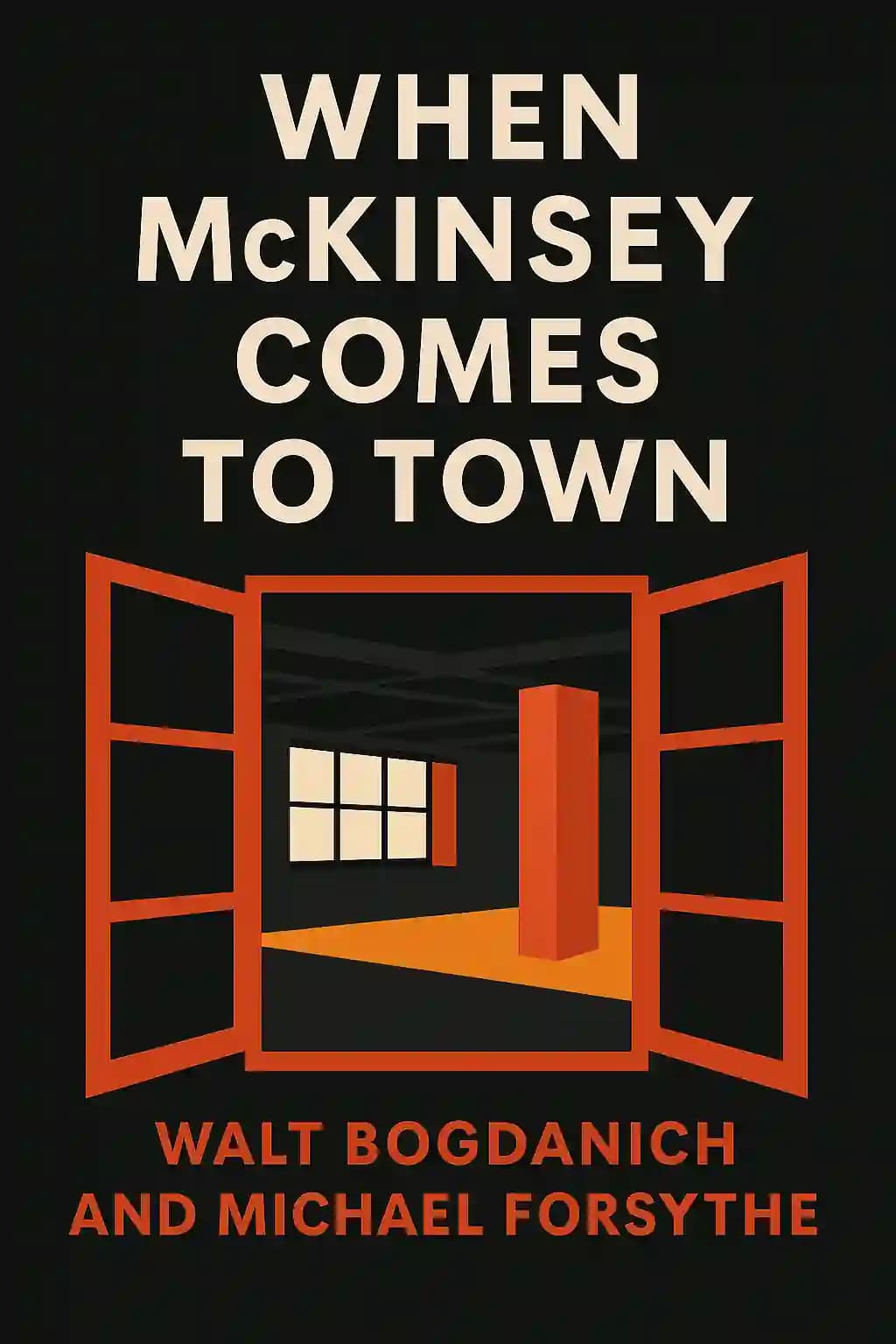
McKinsey & Company operates in the shadows of global power, yet its fingerprints appear on countless aspects of modern life. From the soaring executive compensation that created historic wealth inequality to the opioid crisis that devastated communities across America, this elite consulting firm has wielded extraordinary influence while maintaining remarkable secrecy. Founded in 1926, McKinsey has grown into a global juggernaut with 34,000 employees and unparalleled access to corporate boardrooms and government offices worldwide. The firm attracts the brightest minds from top universities with a compelling pitch: not just wealth and prestige, but the chance to "make positive, lasting change in the world." Yet as Walt Bogdanich and Michael Forsythe reveal in their groundbreaking investigation, McKinsey's actual impact often contradicts its lofty rhetoric. The book has become required reading for business students and policymakers alike, with The Economist calling it "the most comprehensive account of McKinsey to date" and former McKinsey consultant Anand Giridharadas describing it as essential for understanding "how power really works in America."
Глава 2
When McKinsey Comes to Town: The Human Cost
What happens when McKinsey consultants arrive at a workplace? In Gary, Indiana, steelworkers found out the hard way. Once a symbol of industrial America's promise, U.S. Steel's massive plant had provided middle-class jobs for generations. But when CEO Mario Longhi hired McKinsey in 2014, promising to restore the company through "a relentless focus on economic profit," the results were devastating. The firm's "Carnegie Way" transformation plan led to layoffs, demotions, and according to workers, compromised safety protocols.
After maintenance worker Charles Kremke was electrocuted, angry union members protested with signs demanding McKinsey's removal. Months later, Jonathan Arrizola-a thirty-year-old navy veteran and father of two who had complained about McKinsey cutting back workers-was also electrocuted. For both deaths, U.S. Steel paid only $14,500 in fines. Meanwhile, investors filed a class-action lawsuit calling the Carnegie Way a "sham" that left the company with inexperienced skeleton crews working up to 90 hours weekly, with maintenance teams "jury-rigging" failing machines rather than making proper repairs.
A similar pattern emerged at Disneyland after executive Paul Pressler hired McKinsey in the mid-1990s. After a year-long study, McKinsey's "Transforming Maintenance" report recommended cutting costs, eliminating jobs, and moving most maintenance workers to overnight shifts. McKinsey argued for replacing veteran workers' "intuition" with "science"-a data-driven approach prioritizing cost savings over established safety practices. When consultants questioned daily safety inspections of lap bars, maintenance supervisor Bob Klostreich objected strongly: "The reason [lap bars] don't fail is because we check them every night."
Five months after implementing McKinsey's recommendations, a fatal accident occurred when an untrained supervisor attempted to dock the Columbia riverboat, causing a metal cleat to tear loose and kill visitor Luan Dawson. More accidents followed, including the death of Marcelo Torres on Big Thunder Mountain after maintenance failures led to a catastrophic axle failure. State inspectors found numerous deficiencies, including failure to follow proper procedures and inadequate response to warning signs.
In both cases, McKinsey escaped accountability. No lawsuits targeted the firm, no government agencies accused them of wrongdoing. Consultants were simply doing what they were paid to do: give advice, not orders. This arrangement allows McKinsey to avoid public scrutiny when things go wrong, while also taking no public credit when clients succeed.
Глава 3
The Values Paradox: Idealism Meets Reality
For the brightest college graduates, McKinsey offers an irresistible proposition: the chance to tackle the world's toughest problems while earning extraordinary compensation. The firm's selectivity is legendary-accepting only 1-2 percent of some 200,000 annual applicants. Unlike other elite employers, McKinsey offers something beyond riches and status: the promise that recruits can use their talents for a higher purpose, to "make the world a better place" through "change that matters."
This values-driven approach particularly appeals to idealistic young graduates concerned about social issues. New consultants can earn up to $195,000 in their first year, with those who remain eventually becoming partners earning millions. The firm honors requests from new hires to avoid certain industries, allowing them to align work with personal values.
McKinsey's values are portrayed as "guardian angels" that rein in mistakes and excess. The firm holds "Values Day" events globally where senior partners expound on applying these principles in daily work. The foremost principle is "Put client interests ahead of the firm's," followed by "observe high ethical standards." Yet this creates an inherent tension: what happens when clients sell harmful products, mistreat immigrants, or support corrupt governments?
Former consultant Roge Karma observed that unlike product companies with allegiance to their offerings and people, McKinsey's "entire job is to make shareholders more money." Though McKinsey allows consultants to refuse morally objectionable assignments, this shifts ethical choices to junior staff rather than leadership, and declining work can harm advancement prospects.
The firm largely escaped public scrutiny until 2018, when media investigations revealed McKinsey had helped raise the stature of authoritarian governments, worked with sanctioned Russian companies, Chinese state-owned enterprises, and implemented Trump's harsh immigration policies. Most shocking was McKinsey's work helping companies sell more opioids amid a deadly epidemic, resulting in a $600 million settlement.
Tom Peters, co-author of "In Search of Excellence" and former McKinsey consultant, declared himself "appalled" and no longer proud to list the firm on his CV. In response, McKinsey implemented a new code of professional conduct in 2019 emphasizing "the wider implications of our actions on society." Yet old habits persisted-in 2021, McKinsey banned employees from supporting protests against Kremlin critic Alexei Navalny's treatment, only to backtrack after public pressure.
Глава 4
The Architects of Inequality
How did America transform from a society with relatively modest income differences to one with staggering wealth inequality? McKinsey played a pivotal role in this transformation, beginning with a 1950 executive compensation study for General Motors that revealed worker wages were rising faster than executive pay-a situation McKinsey helped reverse.
McKinsey consultant Arch Patton's compensation studies, published in Harvard Business Review and Fortune, sparked competition among executives to avoid being at the bottom of pay scales. Patton's work justified higher executive pay by linking it to company profits and introduced tax-advantaged compensation like stock options. By 2020, CEO pay had ballooned from 20 times a worker's income to 351 times, creating unprecedented inequality.
American corporations transformed dramatically from stable, employee-focused conglomerates to entities primarily serving Wall Street's short-term demands. When Japanese products challenged American manufacturers, GM sought McKinsey's help, but instead of addressing quality-control issues, they embarked on costly reorganizations that accomplished little while workers paid through job losses.
The fealty of corporations to Wall Street destroyed traditional job security. "It was the corporate downsizing of the late 1980s that first broke the traditional covenant that traded job security for loyalty," wrote McKinsey consultants in "The War for Talent." Job-hopping became a badge of honor rather than taboo, with McKinsey charts declaring: "The old reality: Employees are loyal. The new reality: People are mobile and their commitment is short term."
With declining union membership (from 34% in 1954 to just 10% in 2020), companies began outsourcing middle-class jobs first to southern states, then overseas. McKinsey became offshoring's biggest cheerleader, boasting of "unparalleled experience in advising organizations on how, where and with whom to partner" for global outsourcing. The firm aggressively promoted India as "Offshore-istan," evaluating 28 low-wage countries for infrastructure, talent, cost, and business environment.
While manufacturing and desk jobs disappeared overseas, McKinsey advocated for ever-higher executive pay, arguing "talented managers expect to make a lot of money." The firm's influence on executive compensation can be seen at Enron, run by a former McKinsey partner with the firm's consultants deeply involved. Enron's top five executives took in nearly $300 million in one year alone before the company collapsed amid fraud allegations.
When asked how he felt about his role in starting the march toward higher executive compensation, McKinsey's Arch Patton offered a one-word reply: "Guilty."
Глава 5
Playing Both Sides: The Consulting Conflict Machine
McKinsey has mastered the art of working both sides of contentious issues, creating lucrative conflicts of interest that would be unacceptable in most professions. In Illinois, the firm first provided pro bono work to help reimagine poverty programs, then secured contracts worth over $75 million to help expand Medicaid services through managed care-during a severe budget crisis when social services were starving for funding.
These contracts raised serious concerns: they were awarded without competitive bidding, contained secrecy provisions limiting transparency, and McKinsey helped write specifications for a $63 billion managed care procurement while having deep financial ties to that industry. McKinsey had billed managed care companies over $200 million, and four of the seven winning contractors were later acquired by McKinsey clients.
McKinsey replicated this strategy across states. In Arkansas, Blue Cross Blue Shield offered the state $1.5 million if it would hire McKinsey to evaluate Medicaid. The state added another $1.5 million and awarded McKinsey an "emergency" no-bid contract. McKinsey later participated in interviewing Arkansas's Medicaid director candidate, Andy Allison, who subsequently awarded McKinsey over $100 million in no-bid contracts. Allison later joined McKinsey just six months after leaving his state position.
The firm's dual role as adviser to both regulated companies and their regulators created clear conflicts of interest. McKinsey simultaneously advised at least nineteen drug companies subject to FDA regulation, billing them approximately $400 million over three years, while collecting $130 million in FDA contracts. The firm actively recruited former FDA officials with regulatory knowledge and relationships with district offices.
This dual role was particularly evident in the controversial approval of Biogen's Alzheimer's drug Aduhelm. McKinsey billed the FDA $11.6 million for advice on drug approvals while billing Biogen nearly $10 million during the same period. Kevin Sneader, McKinsey's managing partner, publicly praised Aduhelm despite an FDA advisory panel's near-unanimous rejection of the drug.
When government auditors threatened to terminate a lucrative contract that allowed McKinsey to get millions in FDA business without competitive bidding, the firm refused to provide requested records. A GSA division director intervened at McKinsey's request, removed the contracting officer seeking audit records, and unilaterally awarded McKinsey the contract-with prices exceeding market rates by up to 193%. This unjustified price inflation cost taxpayers an estimated $69 million.
Глава 6
Implementing Trump's Immigration Crackdown
In late autumn 2019, two hundred McKinsey employees gathered in the Washington D.C. office to address mounting criticism of the firm's work with Immigration and Customs Enforcement (ICE). The controversy had first erupted when The New York Times mentioned McKinsey's ICE contract, causing internal uproar and threats of resignation. Though McKinsey's managing partner Kevin Sneader had assured staff the work was merely "administrative" and had ended, a ProPublica investigation revealed McKinsey had recommended cutting food, medical care, and supervision for detainees to accelerate deportations.
McKinsey's $20+ million contract with ICE began during Obama's presidency but continued into Trump's administration, with consultants embedded at ICE headquarters. When Trump signed executive orders authorizing a border wall and directing ICE to hire 10,000 new officers to deport undocumented immigrants, project leader Richard Elder told concerned team members: "ICE is changing direction, and it's McKinsey's job to change with it."
When questioned about the ethics, Elder responded with McKinsey's standard justification: "We don't do policy. We do execution." One young team member pushed back, saying this logic could "justify working for any despot, even the Nazis"-ultimately leading to his departure from the firm.
Just weeks into the Trump administration, McKinsey delivered a "Talent Management" presentation directly addressing Trump's executive order, proposing a "super one-stop hiring" process to reduce hiring time by 30-50% to help meet the 10,000-agent goal. Despite McKinsey's later claims that their work "did not change in any material way after the transition," their own slides clearly showed they were helping implement Trump's immigration policies.
McKinsey claimed ICE could save $385 million annually, primarily by renegotiating contracts with private detention center operators. Their cost-cutting proposals included reducing food quality at facilities, which ICE officials resisted, putting "a human face" on what the cuts would mean. When a senior ICE official objected to "shaving pennies from meals," McKinsey partner Tony D'Emidio reportedly complained to the official's boss about "obstructionism."
The ProPublica/New York Times expose created profound ethical conflicts for McKinsey associates with personal connections to immigration issues. At a tense town hall meeting, senior partner Nora Gardner acknowledged consultants' anger while appealing for understanding. Mobasshir Poonawalla, whose undocumented brother faced deportation, challenged leadership to reject such work based on values rather than politics.
Scott Elfenbein, deeply troubled by the disconnect between McKinsey's public statements and internal evidence, sent a mass email to 1,200 colleagues including CEO Sneader, demanding the firm apologize and "stop using legality as the barometer for ethicality." His email sparked a rebellion, with hundreds of consultants worldwide expressing support.
Глава 7
Turbocharging the Opioid Epidemic
In 2002, McKinsey targeted the pharmaceutical industry with a groundbreaking strategy article that would reshape drug marketing. The firm criticized the inefficient "pinball wizard" sales model where pharmaceutical representatives randomly bounced between doctors' offices, with minimal differentiation in compensation between top and bottom performers. Instead, McKinsey proposed a data-driven approach, advocating for sophisticated analysis of prescription databases to "target physicians who are most likely to prescribe more of a given drug over time." This seemingly innocuous strategy would later become a blueprint for disaster.
This innovative targeting approach immediately caught Purdue Pharma's attention, initiating what would become a devastating partnership. Between 2004-2019, Purdue paid McKinsey an astounding $83.7 million for marketing advice that would dramatically accelerate OxyContin sales and fuel the opioid crisis. McKinsey assembled an elite team for this project, including Martin Elling, a Harvard law graduate who became a powerhouse in McKinsey's pharmaceutical practice, and two medical doctors whose credentials lent credibility to their recommendations.
When OxyContin entered the market in 1996, Purdue marketed it as a revolutionary continuous pain treatment, emphasizing its supposed low addiction risk - claims that would prove catastrophically false. The drug's powerful euphoric effects, combined with Purdue's aggressive introduction of higher doses (including 80mg and 160mg tablets), created perfect conditions for widespread addiction. McKinsey's sophisticated data analysis helped identify and target doctors most likely to prescribe opioids, effectively creating a precision-guided missile that would devastate communities across America.
As government investigators began circling Purdue, the company made strategic moves for political protection, including hiring former New York Mayor Rudy Giuliani, which helped them avoid felony charges in 2007. McKinsey proved invaluable in this period, helping Purdue counter mounting negative publicity and orchestrating FDA approval for a reformulated "abuse-deterrent" OxyContin - a modification that did nothing to address the fundamental addiction risks. As the crisis deepened and users increasingly turned to heroin and fentanyl, McKinsey proposed increasingly aggressive marketing approaches, including promoting OxyContin as providing "freedom" and "peace of mind" while strategically targeting nurse-practitioners and physician assistants who were more accessible to sales representatives.
McKinsey's data analysis identified profitable "pockets of growth" even as national attention focused on the escalating crisis. One particularly troubling example was Fort Wayne, Indiana, where opioid deaths surged while sales representatives reaped rewards. A single Purdue representative there generated $2 million in first-quarter sales alone, earning a vacation to Aruba and a $36,000 bonus. By 2013, McKinsey's recommendations had become remarkably aggressive, suggesting "turbocharged" sales tactics that included circumventing pharmacy restrictions through mail-order delivery, doubling down on targeting heavy prescribers, and even proposing rebates to distributors based on the number of overdoses attributed to their sales.
The crisis ultimately reached a breaking point when McKinsey consultants Elling and Arnab Ghatak were discovered discussing the purging of records to conceal the firm's involvement. The fallout was massive: McKinsey paid over $600 million to settle government investigations, while Purdue filed for bankruptcy and the Sackler family agreed to pay $4.5 billion in settlements. The human cost proved even more staggering: 750,000 deaths in an epidemic that continues to claim lives daily, destroying families and communities across America. The crisis has left an indelible mark on American society, fundamentally changing how the medical community approaches pain management and highlighting the devastating consequences of prioritizing profits over public health.
Глава 8
Climate Contradictions: Green Talk, Fossil Fuel Profits
McKinsey positions itself as deeply committed to environmental sustainability, publishing dozens of urgent climate reports warning that climate change would be "as severe in impact as weapons of mass destruction." This public environmental advocacy helps McKinsey attract thousands of well-educated, environmentally conscious young recruits concerned about a future where melting ice caps could submerge coastal cities.
Yet this public stance stands in stark contrast to the firm's client roster. Erik Edstrom embodied the ideal McKinsey recruit-a military veteran who led an Army platoon in Afghanistan, a top-scoring athlete at West Point, and an Oxford graduate with degrees in environmental change management and business. Deeply affected by Al Gore's climate change documentary, Edstrom joined McKinsey's Melbourne office hoping to focus on environmental issues.
Instead, he discovered McKinsey's proud history of serving fossil fuel companies-from its first mega-client Mobil Oil in the 1950s to ongoing relationships with major coal miners like BHP and Rio Tinto. Despite McKinsey's public commitment to "protecting the planet," Edstrom was shocked when the Australia office circulated a video celebrating how they helped an Asian coal mine increase production by 26 percent, describing it as "turning a coal mine into a diamond" and "one of the most profitable projects in our company."
Edstrom joined McKinsey's "Green Team" to raise awareness about climate threats. During a corporate retreat to the Great Barrier Reef, consultants witnessed firsthand the coral's death. When the Green Team suggested McKinsey's fossil fuel clients contributed to this destruction, "that message fell on deaf ears."
After the managing partner spoke about ethics, Edstrom publicly questioned whether serving arms manufacturers aligned with company values. Shortly after, he was "counseled to leave" McKinsey. Before departing, Edstrom sent a scathing farewell email calling McKinsey "an amoral institution" that helps coal companies stay profitable while claiming environmental concern-"greenwashing."
McKinsey's client list includes many of the world's biggest polluters, generating hundreds of millions in fees. Since 2010, McKinsey has worked for at least 43 of the 100 companies responsible for the most carbon emissions since 1965, collectively accounting for 36% of global greenhouse gas emissions from fossil fuels in 2018. Major clients include Chevron (number three historic polluter, generating $50+ million in fees in 2019), Saudi Aramco (number one polluter), ExxonMobil, BP, Shell, Gazprom, and Qatar Petroleum.
In 2018, Dominic Barton, McKinsey's former managing partner who had touted the firm's green credentials, became chairman of Teck Resources-North America's largest producer of metallurgical coal. After Barton joined, McKinsey's business with Teck exploded to about $20 million in 2019, with projects including "Coal Processing Optimization" and "Drill and Blast."
By March 2021, frustrated young consultants sent an open letter to leadership declaring: "The climate crisis is the defining issue of our generation. Our positive impact in other realms will mean nothing if we do not act as our clients alter the earth irrevocably."
Глава 9
The Global Reach of a Secretive Power
McKinsey's culture of secrecy forms the foundation of its business model. Consultants take a vow of silence about clients from their first days, creating an accountability vacuum since the firm answers only to clients, not government oversight. Despite these barriers, nearly one hundred current and former McKinsey employees spoke with the authors-not out of disloyalty but because they were principled individuals drawn to McKinsey's stated values who became disillusioned by the gap between the firm's words and actions.
While McKinsey emphasizes its good deeds in reports like "Creating Change That Matters," hiring idealistic people who value more than money has become a double-edged sword. When these consultants witness contradictions between McKinsey's lofty rhetoric and its actual business practices, they begin asking uncomfortable questions.
The firm's global reach is staggering. McKinsey has advised virtually every major pharmaceutical company along with their regulators, plus health insurers, universities, weapons makers, private equity firms, media companies, and more. With operations in over 65 countries, McKinsey consultants influence both despots and democratic leaders, advising military and justice ministries in fifteen nations and helping manage sovereign wealth funds worth over $1 trillion.
In Saudi Arabia, McKinsey became so deeply embedded that the Planning Ministry became known as the "Ministry of McKinsey," with some consultants even using government email addresses. The firm's consultants became ubiquitous in the corridors of power, advising on ambitious "giga-projects" like NEOM, a futuristic city on the Red Sea featuring drone taxis, an artificial moon, and robotic dinosaurs.
When Mohammed bin Salman began consolidating power, McKinsey shifted from working with various ministries to gaining unprecedented access to the Royal Court itself. "There was no question about working with MBS," one former consultant admitted. "They were all in." Even after the murder of journalist Jamal Khashoggi made Saudi Arabia "radioactive" to many businesses, McKinsey chose to attend the "Davos in the Desert" conference weeks after the killing, and their Saudi revenue actually increased in 2019.
Despite McKinsey's global managing partner Kevin Sneader stating they would "walk" if a client was found to be a murderer, in Saudi Arabia, "McKinsey most definitely did not walk." As one former consultant suggested, perhaps the firm should "find a way to do less harm."