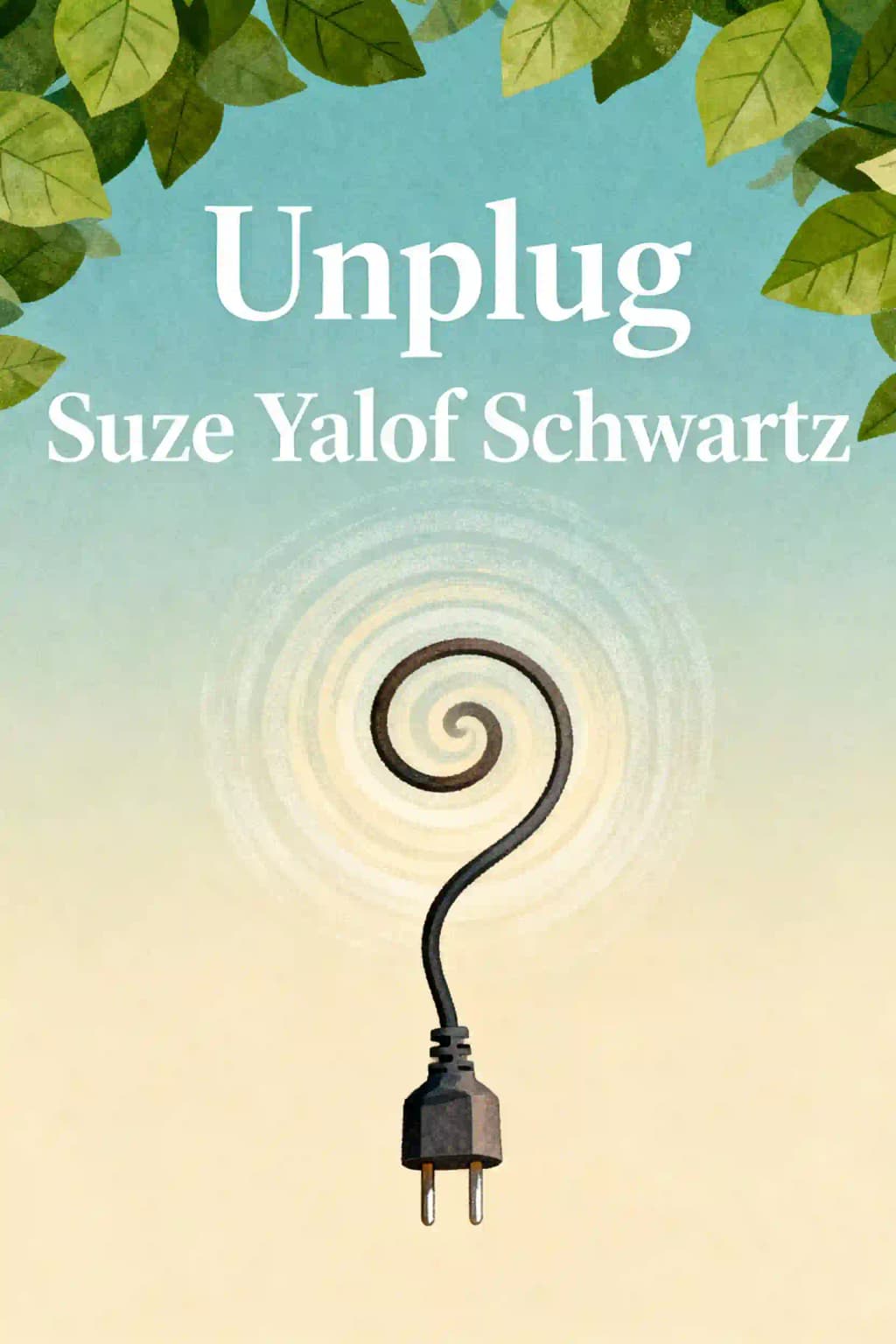
In a chaotic digital world, "Unplug" offers a 30-minute meditation solution endorsed by Arianna Huffington. Former fashion editor Schwartz transforms mindfulness into an accessible practice for busy skeptics, proving you don't need hours - just moments - to revolutionize your mental wellbeing.
Suze Yalof Schwartz, born on February 10, 1967, is the bestselling author of Unplug: A Simple Guide to Meditation for Busy Skeptics and Modern Soul Seekers and the founder of Unplug Meditation, recognized as the world’s first secular drop-in meditation studio.
Formerly a fashion editor at prestigious publications including Vogue, Elle, Marie Claire, and Glamour, Schwartz transitioned from styling celebrities to demystifying meditation following a profound three-minute meditation experience in 2012.
Her book translates mindfulness into easily understandable techniques, embodying her dedication to making meditation practical and accessible for contemporary lifestyles. Schwartz is also the creator of the Unplug Meditation app.
A frequent guest on prominent television programs such as Good Morning America, The Today Show, and The Oprah Winfrey Show, she effectively merges media expertise with the promotion of mindful living. Her previous publication, Getting Over John Doe, uniquely combines personal development with fashion insights.
Acknowledged by The New York Times as a self-care innovator, Schwartz's Los Angeles-based studio, established in 2014, has transformed the wellness landscape by providing accessible walk-in sessions that convert stress into tranquility in less than 30 minutes.
Unplug is a practical guide to meditation designed for busy individuals seeking calm in a hyper-connected world. It dismantles myths about meditation (like needing to sit still for hours) and offers science-backed strategies to integrate short, effective sessions into daily routines. The book emphasizes accessibility, with techniques ranging from breathwork to guided visualizations, all aimed at reducing stress and improving focus.
This book is ideal for overwhelmed professionals, meditation skeptics, or anyone new to mindfulness. It’s particularly valuable for time-crunched individuals seeking actionable tools to manage stress, enhance productivity, or navigate modern digital distractions. Schwartz’s relatable tone—rooted in her transition from fashion editor to meditation advocate—resonates with pragmatic readers.
Yes, especially if you want a no-nonsense introduction to meditation. Schwartz combines neuroscience, personal anecdotes, and bite-sized practices (as short as 3 minutes) to demonstrate how stillness can transform mental clarity and emotional resilience. Its strength lies in debunking meditation’s “woo-woo” reputation, making it approachable for modern lifestyles.
Schwartz advises beginning with 1–3 minute sessions, focusing on breath or a sensory anchor (like sound). She encourages embracing distractions rather than fighting them and offers apps/studio resources for guided support. The goal is consistency, not perfection.
Some readers may find the advice overly basic if they’re already experienced in meditation. The book prioritizes brevity over depth, which suits beginners but might leave advanced practitioners wanting more nuanced techniques.
While The Power of Now explores philosophical depth, Unplug focuses on actionable, time-efficient practices. Schwartz’s guide is ideal for those seeking quick stress relief, while Tolle’s work delves into existential mindfulness.
With rising digital burnout and AI-driven productivity pressures, the book’s emphasis on “unplugging” aligns with global trends toward mental health prioritization. Its strategies help navigate constant connectivity without abandoning technology.
Schwartz’s fashion-industry background and founder role at Unplug Meditation Studio inform her secular, design-forward approach. She strips away spiritual jargon, presenting meditation as a tool for modern efficiency—akin to a mental fitness routine.
Stress is optional: By dedicating minutes daily to mindfulness, you regain control over reactions to chaos. The book’s micro-meditations (e.g., “Traffic Light Practice”) make calm achievable amid busy schedules.
Почувствуйте книгу через голос автора
Превратите знания в увлекательные, богатые примерами идеи
Захватите ключевые идеи мгновенно для быстрого обучения
Наслаждайтесь книгой в весёлой и увлекательной форме
It's only weird if you make it weird.
Meditation is not weird or religious.
Unplugging gives you the power to respond calmly and rationally.
Start with the maximum amount of time you know you'll stick to daily.
Разбейте ключевые идеи Unplug на понятные тезисы, чтобы понять, как инновационные команды создают, сотрудничают и растут.
Погрузитесь в Unplug через яркие истории, превращающие уроки инноваций в запоминающиеся и применимые моменты.
Задавайте любые вопросы, выбирайте свой стиль обучения и создавайте идеи, которые действительно вам подходят.

Создано выпускниками Колумбийского университета в Сан-Франциско
"Instead of endless scrolling, I just hit play on BeFreed. It saves me so much time."
"I never knew where to start with nonfiction—BeFreed’s book lists turned into podcasts gave me a clear path."
"Perfect balance between learning and entertainment. Finished ‘Thinking, Fast and Slow’ on my commute this week."
"Crazy how much I learned while walking the dog. BeFreed = small habits → big gains."
"Reading used to feel like a chore. Now it’s just part of my lifestyle."
"Feels effortless compared to reading. I’ve finished 6 books this month already."
"BeFreed turned my guilty doomscrolling into something that feels productive and inspiring."
"BeFreed turned my commute into learning time. 20-min podcasts are perfect for finishing books I never had time for."
"BeFreed replaced my podcast queue. Imagine Spotify for books — that’s it. 🙌"
"It is great for me to learn something from the book without reading it."
"The themed book list podcasts help me connect ideas across authors—like a guided audio journey."
"Makes me feel smarter every time before going to work"
Создано выпускниками Колумбийского университета в Сан-Франциско

Получите резюме книги «Unplug» в формате PDF или EPUB бесплатно. Распечатайте или читайте офлайн в любое время.
Picture a high-powered fashion editor melting down over the wrong clothes at a photo shoot-screaming, crying, creating chaos that scorches everyone around her. Now imagine that same person years later, facing armed police officers with guns drawn, yet responding with three deep breaths and calm, decisive action. What bridged these two moments? Not therapy, not medication, not a personality transplant-just the simple practice of learning to unplug. This transformation reveals something profound about our modern predicament. We live in a state of constant emergency, our nervous systems hijacked by an endless stream of emails, notifications, deadlines, and demands. Whether it's a wardrobe mishap or an actual crisis, our brains react identically-flooding us with stress hormones, triggering fight-or-flight responses, and leaving us exhausted and reactive. But what if there was a way to step off this roller coaster? What if you could shift from panic to presence in seconds, not through willpower but through practice?
Unplugging isn't mindless scrolling - it's consciously disconnecting from what's amping you up and restarting from a neutral place. We generate roughly fifty thousand thoughts daily, what Buddhists call "monkey mind" - relentless chatter jumping from dry cleaning to existential questions. This noise creates fog between actual experience and our reactions. When unexpected situations arise, we default to ingrained responses: your boss criticizes you (*What an idiot*), you lose your wallet (*I'm such a mess*), traffic crawls (*Everyone's incompetent*). These automatic reactions escalate stress rather than resolving anything. Meditation teaches a different relationship with thoughts. You can't prevent thoughts any more than you can stop ocean waves, but you can learn to surf them skillfully. Think of your mind like an email inbox - spam keeps arriving, but you don't need to open each message. The formula: focus on a single point (breath, object, phrase), let distractions drift away, notice when thoughts resurface, gently refocus, repeat. That space between thoughts is where genuine peace resides.
Despite overwhelming evidence, most people don't meditate. We've built barriers based on misconceptions-that it takes too much time, requires "shutting off" your brain, or demands sitting perfectly still in lotus position. Let's demolish these myths. Meditation isn't weird or religious. You don't need crystals, incense, or chanting. While the practice has five-thousand-year roots in Taoist China and Buddhist India, it isn't tied to any religion. Christians, Jews, Muslims, and atheists all practice effectively. Unlike prayer, which sends thoughts outward, meditation goes inward-connecting you with your own truth. You don't need hours either. Harvard neuroscientist Sara Lazar proved that just twenty-seven minutes daily for eight weeks physically alters brain structure. But even five minutes makes a measurable difference. The key is consistency, not duration. The biggest myth? That meditation turns you into a blissed-out space cadet. Actually, regular meditators become more functional and productive. As billionaire Ray Dalio puts it: "More than anything in my life, meditation was the biggest ingredient of whatever success I've had." Here's the truth: you're not supposed to clear your mind or stop thoughts. That's impossible. The real goal is letting thoughts arise, then letting them go and returning to your focus point. Even frustrating sessions where your mind races are valuable-you're building that "redirect muscle" with every return to the breath.
Meditation physically reshapes your brain. Neuroscientist Sara Lazar discovered that fifty-year-old meditators had as much gray matter in their frontal cortex as twenty-five-year-olds. Just eight weeks of daily practice produced measurable changes in brain regions controlling learning, memory, focus, emotional regulation, and empathy. The benefits are profound. Meditation shrinks the amygdala (reducing anxiety), lowers cortisol, increases activity in the brain's "happy zone" (left prefrontal cortex), and reduces mind-wandering that fuels worry. Studies show it provides relief from depression and anxiety comparable to antidepressants - without side effects. The health impact is equally impressive. Since up to 95% of illnesses are caused or worsened by stress, meditation's stress-reducing effects matter. Research from the Benson-Henry Institute found two-thirds of subjects lowered their blood pressure. One practitioner saw chronically high readings drop to 106/76 through just thirty minutes of practice four to five times weekly. Most remarkably, Nobel Prize winner Elizabeth Blackburn's research showed that twelve minutes of daily meditation for eight weeks increased telomerase activity by 43% - the "immortality enzyme" that repairs telomeres and slows aging at a cellular level. Beyond physical health, meditation transforms presence. Harvard psychologist Ellen Langer proved that mindfully engaged people are perceived as more charismatic and attractive. When you're fully present, people feel it - and they're drawn to it.
Morning meditation works best because your brain remains in the receptive theta brainwave state, and it gets done before daily chaos intervenes. The formula: get up, get it done. But any consistent time works - after school drop-off, during lunch, or immediately after work. Forget rigid posture rules. Sit comfortably on a cushion, chair, couch, or folded blanket. Cross-legged or feet on the floor - just keep legs at or below hip level so they don't fall asleep. You can even lie down if sitting is uncomfortable, though you might drift off. Location doesn't matter once you close your eyes. Powerful sessions happen in parking lots, airport lounges, or office break rooms. The only requirements: relative quiet, safety, and no interruptions. Set yourself up by silencing your phone and creating a pre-meditation ritual - touching the spot between your eyebrows, using orange essential oil, or whatever signals your brain it's time to shift gears. Common challenges have simple solutions. If legs fall asleep, move them or try a chair. When external noises distract you, they're opportunities to notice and return to the breath. Some days feel peaceful, others chaotic. Both are natural. The only bad meditation is the one you don't do.
Once you experience meditation's benefits, mini-meditations provide quick hits of focus, calm, and joy throughout your day - all under five minutes. The one-minute UNPLUG meditation reconnects you with yourself: Unplug your devices, Notice how you're feeling, Pick a point of focus, Let it go, Understand thoughts will come and go, Get on with your day. The "Espresso Meditation" delivers calm through three sets of seven breaths - first inhaling and exhaling through your nose, then inhaling through nose and exhaling through mouth, finally inhaling and exhaling through mouth. The sixty-second Mood Lifter uses gratitude as an instant antidote. Close your eyes, think of three people or things you're grateful for, then open your eyes. You cannot feel grumpy and grateful simultaneously. The Starbucks Meditation transforms waiting in line into practice - focus on feet connecting to ground, take mindful steps, make eye contact with your barista and smile, stay present with breath, then truly savor your drink. The STOP meditation helps when your mind wanders: Stop what you're doing, Take a breath, Observe the situation, Proceed with renewed awareness. The Traffic Meditation dissolves frustration through ABC - Attention to the road, Body scan, Connect with breath. Repeat "It is what it is" three times.
The ultimate secret is consistency and duration. Five minutes daily physically transforms your brain-increased gray matter in areas linked to self-awareness, compassion, and introspection. Your response to problems shifts from reactive to responsive, and you gain the ability to take inner vacations anytime, anywhere. Worried meditation "isn't working"? Type-A personalities struggle without a scorecard. Sometimes you'll connect to bliss, sometimes you'll just breathe, sometimes it's you versus your racing mind. It all counts. Brain scans show positive effects even during unfocused sessions. Experienced teachers advise releasing judgment-meditation is like weather, constantly changing and all perfectly okay. The irony: making time to meditate actually gives you more time. Regular practitioners complete tasks more efficiently, make better decisions faster, and experience fewer time-wasting emotional reactions. Your breath isn't just keeping you alive-it's the gateway to presence, peace, and power. Five minutes a day steps you off the stress roller coaster into a calmer, more intentional life.