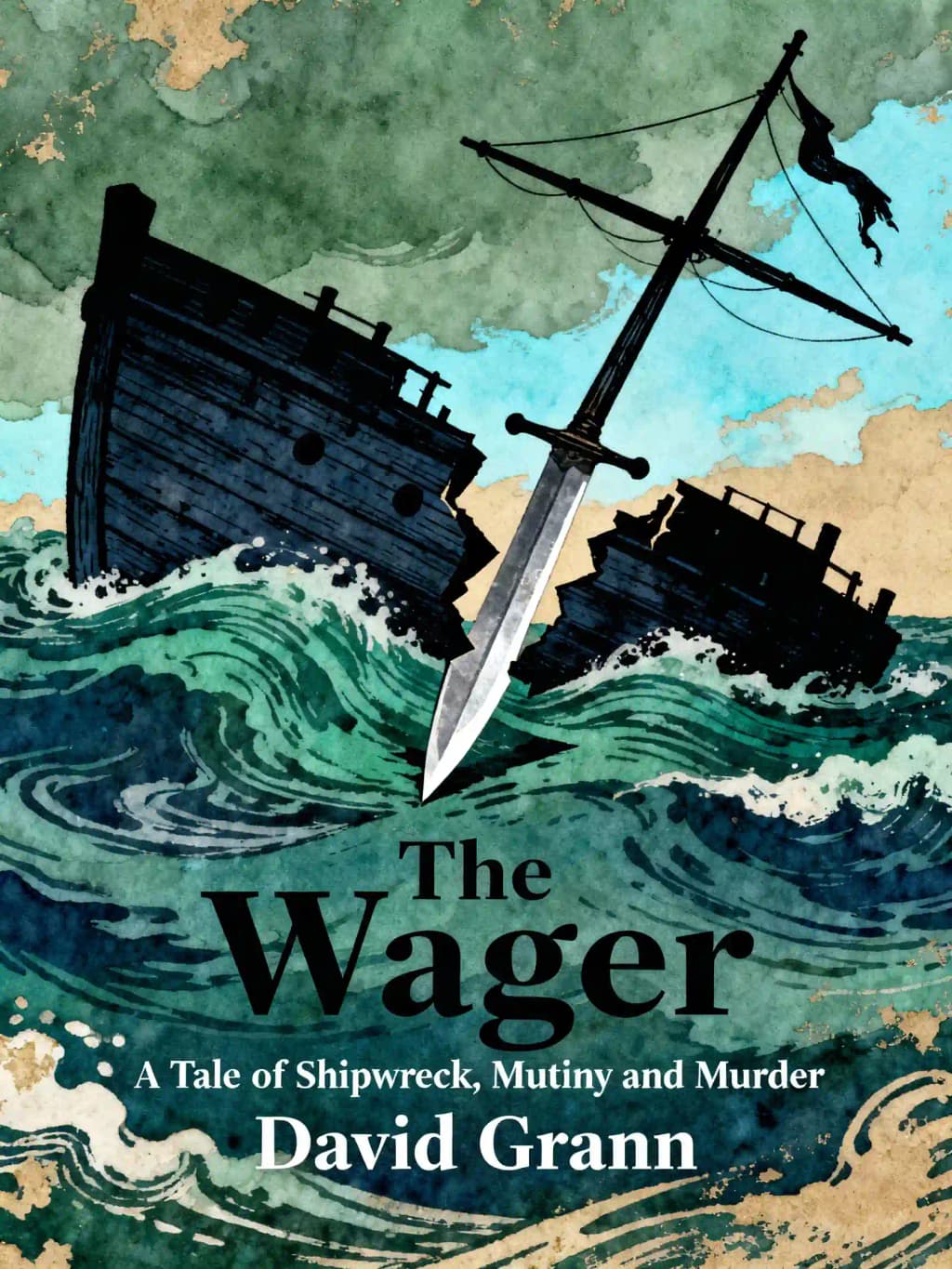
The Wager
A Tale of Shipwreck, Mutiny and Murder
Обзор книги The Wager
In 1740, the British warship Wager shipwrecked, unleashing mutiny, murder, and cannibalism. David Grann's meticulously researched tale reveals how multiple survivors told conflicting stories - including Lord Byron's grandfather, whose haunting journal inspired this unforgettable maritime mystery.

Ключевые темы в The Wager
- maritime survival
- naval mutiny
- imperial ambition
- leadership collapse
- extreme isolation
Цитаты из The Wager
The most compelling stories are often those where humans are pushed to their absolute limits.
Imperial ambition prevailed over practical concerns.
The ship became both prison and academy.
The captain's authority was absolute.
Death stalked the fleet before it had even left port.
Персонажи в The Wager
- David CheapFirst Lieutenant who becomes Captain of the Wager
- John ByronMidshipman and gentleman volunteer on the Wager
- George AnsonCommodore and leader of the naval expedition
- Reverend WalterThe expedition's chaplain and journal writer
Об авторе
Об авторе книги The Wager
David Elliot Grann, bestselling author of The Wager: A Tale of Shipwreck, Mutiny and Murder, is a Pulitzer Prize-finalist journalist and master of narrative nonfiction.
A staff writer for The New Yorker, Grann specializes in unearthing forgotten historical episodes, blending exhaustive research with gripping storytelling. His works, including Killers of the Flower Moon (a National Book Award finalist) and The Lost City of Z, explore themes of obsession, injustice, and human endurance.
The Wager continues this tradition, reconstructing an 18th-century maritime catastrophe through firsthand accounts and archival evidence.
Grann’s accolades include the Edgar Award and George Polk Award, and his books have consistently topped The New York Times bestseller list. Killers of the Flower Moon and The Lost City of Z have become modern classics in historical true crime and adventure literature.
Скачать резюме книги «The Wager»
Получите резюме книги «The Wager» в формате PDF или EPUB бесплатно. Распечатайте или читайте офлайн в любое время.
Часто задаваемые вопросы об этой книге
The Wager recounts the 1741 shipwreck of the HMS Wager during Britain’s imperial conflict with Spain, tracing the crew’s brutal survival on a Patagonian island, their split into rival factions, and the shocking court martial that followed. David Grann reconstructs the chaos of mutiny, starvation, and conflicting survivor testimonies, revealing how truth becomes entangled with survival narratives.
Fans of historical nonfiction, maritime adventures, and true survival stories will find this book gripping. It appeals to readers interested in psychological resilience, leadership under pressure, and the moral complexities of human behavior in extreme conditions, with prose that rivals Patrick O’Brian’s naval epics and Jon Krakauer’s survival accounts.
Yes, the book chronicles the true 18th-century disaster of the HMS Wager, part of Commodore George Anson’s squadron during the War of Jenkins’ Ear. Grann draws from ships’ logs, court-martial transcripts, and survivor accounts to document the crew’s ordeal and the Admiralty’s investigation into alleged mutiny.
Grann’s account is rigorously researched, using primary sources like lieutenant David Cheap’s logs and trial records. His portrayal of the crew’s struggles, internal power dynamics, and the trial’s revelations aligns with documented events, though he highlights contradictions in survivor testimonies that question objectivity.
Key themes include the fragility of truth under duress, the clash between survival instincts and morality, and the corrosive effects of imperial ambition. Grann examines how trauma distorts memory and how narratives are weaponized—both by survivors seeking vindication and authorities enforcing discipline.
Like Endurance, The Wager delves into extreme survival and leadership crises but focuses more on the aftermath of disaster—particularly how conflicting stories shape history. Its investigative depth mirrors Killers of the Flower Moon, uncovering systemic injustice through meticulous archival work.
Grann relied on 18th-century naval logs, court-martial transcripts, diaries, and British Admiralty records. These documents, often sealed for centuries, provide insights into the crew’s hierarchies, decision-making, and the Admiralty’s efforts to suppress mutinous narratives.
Some reviewers note that the dense historical detail may overwhelm casual readers. However, most praise Grann’s ability to balance scholarly rigor with page-turning suspense, though the ambiguity of the mutiny’s true events leaves unanswered questions.
Grann blends narrative flair with journalistic precision, crafting scenes rich in visceral detail (e.g., storms, starvation) while contextualizing events within imperial Britain’s naval culture. His pacing mirrors a thriller, making complex history accessible without oversimplifying.
The book dissects how survivors’ conflicting accounts—shaped by trauma, self-preservation, and loyalty—complicate historical understanding. Grann emphasizes that the “mutiny” label served the Admiralty’s interests, while sailors framed their actions as justified rebellion.
While specific awards aren’t listed in sources, Grann’s prior works (Killers of the Flower Moon, The Lost City of Z) have won Edgar Awards and National Book Award nominations, establishing his reputation for critically acclaimed nonfiction.
Grann leverages his investigative journalism background to unearth forgotten histories, as seen in Killers of the Flower Moon. His focus on marginalized perspectives—here, ordinary sailors caught in imperial machinery—aligns with his career-long scrutiny of power imbalances.