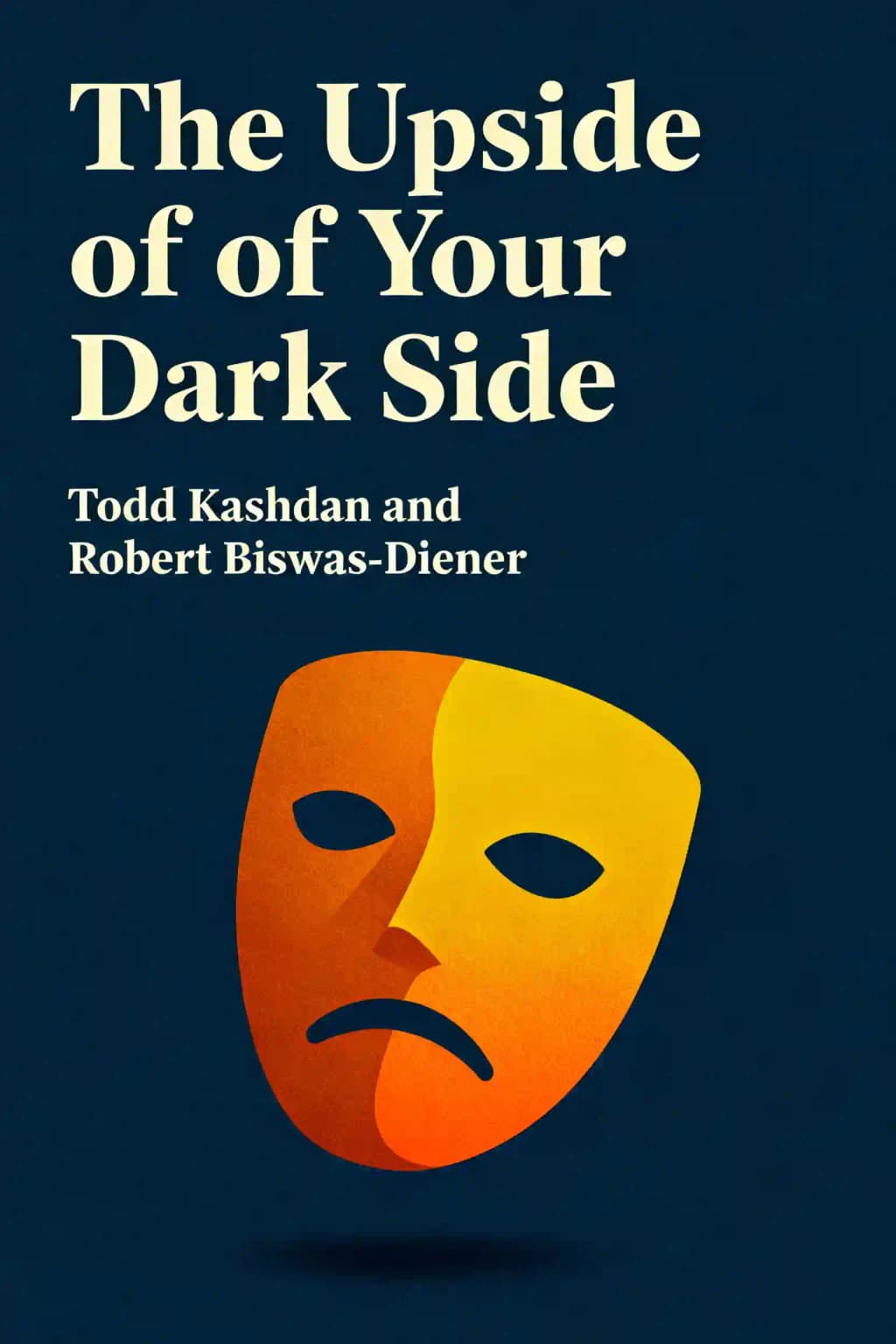
Embrace your anger, anxiety, and guilt - Todd Kashdan's counterintuitive bestseller challenges America's happiness obsession. Featured on Amazon's top business books list, it reveals why negative emotions drive success when properly harnessed. What if your "dark side" holds the key to fulfillment?
Todd B. Kashdan and Robert Biswas-Diener are the authors of The Upside of Your Dark Side: Why Being Your Whole Self—Not Just Your “Good” Self—Drives Success and Fulfillment. They are pioneering positive psychologists challenging conventional self-help paradigms.
Kashdan is a professor of psychology at George Mason University, and Biswas-Diener has been dubbed the “Indiana Jones of positive psychology” for his cross-cultural research. Together, they combine decades of expertise in emotional agility and well-being. Their book—spanning self-improvement, psychology, and business genres—argues for harnessing “negative” emotions like guilt and anger as tools for creativity and resilience.
Kashdan’s earlier work, Curious?, explores mindfulness and novelty-seeking, while Biswas-Diener’s studies on happiness span unconventional groups like the Amish and Maasai. Both authors frequently contribute to NPR, TEDx talks, and major outlets like Scientific American.
Translated into multiple languages, their contrarian approach has influenced corporate training programs and therapeutic practices, solidifying its status as a modern behavioral science classic.
The Upside of Your Dark Side challenges the cultural obsession with positivity, arguing that "negative" emotions like anger, anxiety, and guilt are essential for success and fulfillment. Authors Todd Kashdan and Robert Biswas-Diener use neuroscience and psychology to show how discomfort builds resilience, mindfulness can hinder instinctual decisions, and traits like narcissism (in moderation) enhance leadership. The book reframes emotional complexity as a strength rather than a flaw.
This book is ideal for psychology enthusiasts, self-help skeptics, and professionals in high-stress roles (e.g., CEOs, therapists, athletes). It appeals to readers seeking evidence-based alternatives to toxic positivity or those navigating career transitions, relationship conflicts, or creative blocks. Kashdan’s humor and storytelling make complex research accessible to general audiences.
Yes—it combines 200+ peer-reviewed studies with actionable advice, offering a fresh perspective on emotional intelligence. Unlike generic positivity guides, it provides tools to harness anxiety for problem-solving, leverage guilt for moral growth, and use anger constructively. Critical acclaim highlights its balance of scientific rigor and relatable examples.
Key ideas include:
Psychological flexibility involves mindfully embracing discomfort to align actions with core values. For example, acknowledging anger during a conflict without suppression allows clearer communication of needs. Kashdan contrasts this with rigid positivity, which often escalates distress by invalidating authentic emotions.
Kashdan argues that mindfulness can reduce creativity by over-focusing attention, and that guilt—often seen as harmful—is critical for repairing relationships and ethical growth. He also defends strategic selfishness, showing how prioritizing self-interest in moderation strengthens leadership and boundaries.
The book teaches harnessing anxiety to prepare for presentations, using guilt to address team conflicts, and channeling anger to negotiate raises. It also advises leaders to balance empathy with controlled narcissism to project confidence during crises.
Unlike Atomic Habits (focused on routines) or The Power of Now (prioritizing mindfulness), Kashdan’s work emphasizes emotional nuance. It aligns with Susan Cain’s Bittersweet but adds behavioral strategies for applying “negative” emotions proactively.
Some reviewers argue its defense of dark triad traits risks normalizing harmful behaviors if taken out of context. Others note that recommending intermittent stress may overwhelm readers already facing chronic anxiety. Kashdan counters by emphasizing moderation and value-aligned action.
Kashdan—a George Mason University psychology professor with 250+ peer-reviewed studies—integrates clinical research, including his work on curiosity and resilience. His awards from the American Psychological Association and collaborations with organizations like the World Bank bolster credibility.
Yes: The book shows how guilt motivates apologies, anxiety fosters empathy, and constructive conflict (fueled by anger) deepens intimacy. It advises against suppressing emotions to maintain “harmony,” which often breeds resentment.
Amid rising mental health crises and workplace burnout, the book’s rejection of toxic positivity resonates. Its strategies align with trends like “quiet quitting” and “radical acceptance,” offering a science-backed path to sustainable resilience.
Почувствуйте книгу через голос автора
Превратите знания в увлекательные, богатые примерами идеи
Захватите ключевые идеи мгновенно для быстрого обучения
Наслаждайтесь книгой в весёлой и увлекательной форме
Every emotion serves a purpose.
Our modern approach to happiness is fundamentally flawed.
The very pursuit of happiness often backfires spectacularly.
Anger increases optimism, creativity, and effective performance.
Happy people consistently demonstrate less persuasive abilities.
Разбейте ключевые идеи Spite на понятные тезисы, чтобы понять, как инновационные команды создают, сотрудничают и растут.
Выделите из Spite быстрые подсказки для запоминания, подчёркивающие ключевые принципы открытости, командной работы и творческой устойчивости.

Погрузитесь в Spite через яркие истории, превращающие уроки инноваций в запоминающиеся и применимые моменты.
Задавайте любые вопросы, выбирайте голос и совместно создавайте идеи, которые действительно находят у вас отклик.

Создано выпускниками Колумбийского университета в Сан-Франциско
"Instead of endless scrolling, I just hit play on BeFreed. It saves me so much time."
"I never knew where to start with nonfiction—BeFreed’s book lists turned into podcasts gave me a clear path."
"Perfect balance between learning and entertainment. Finished ‘Thinking, Fast and Slow’ on my commute this week."
"Crazy how much I learned while walking the dog. BeFreed = small habits → big gains."
"Reading used to feel like a chore. Now it’s just part of my lifestyle."
"Feels effortless compared to reading. I’ve finished 6 books this month already."
"BeFreed turned my guilty doomscrolling into something that feels productive and inspiring."
"BeFreed turned my commute into learning time. 20-min podcasts are perfect for finishing books I never had time for."
"BeFreed replaced my podcast queue. Imagine Spotify for books — that’s it. 🙌"
"It is great for me to learn something from the book without reading it."
"The themed book list podcasts help me connect ideas across authors—like a guided audio journey."
"Makes me feel smarter every time before going to work"
Создано выпускниками Колумбийского университета в Сан-Франциско

Получите резюме книги «Spite» в формате PDF или EPUB бесплатно. Распечатайте или читайте офлайн в любое время.
Imagine a Navy SEAL candidate jogging along the beach with no idea when the run will end. This isn't a test of physical fitness but of psychological uncertainty tolerance-a quality that predicts success not just in elite military training but in marriages, business, and parenting. While our culture obsessively pursues happiness, groundbreaking research reveals that our darker emotions-anger, guilt, anxiety-contain hidden superpowers essential for living a full life. Every emotion serves a purpose, and those who can access their full emotional range are actually healthier, more successful, and ultimately happier in a deeper, more resilient way. Despite thousands of years of philosophical wisdom and a multi-billion dollar happiness industry, only 17 percent of Americans are psychologically flourishing. We've become increasingly uncomfortable with discomfort itself, creating a society where even mild psychological pain is pathologized and avoided at all costs. This "comfort addiction" makes us less resilient and more fragile, stunting our emotional growth and ability to find meaning in life's challenges.