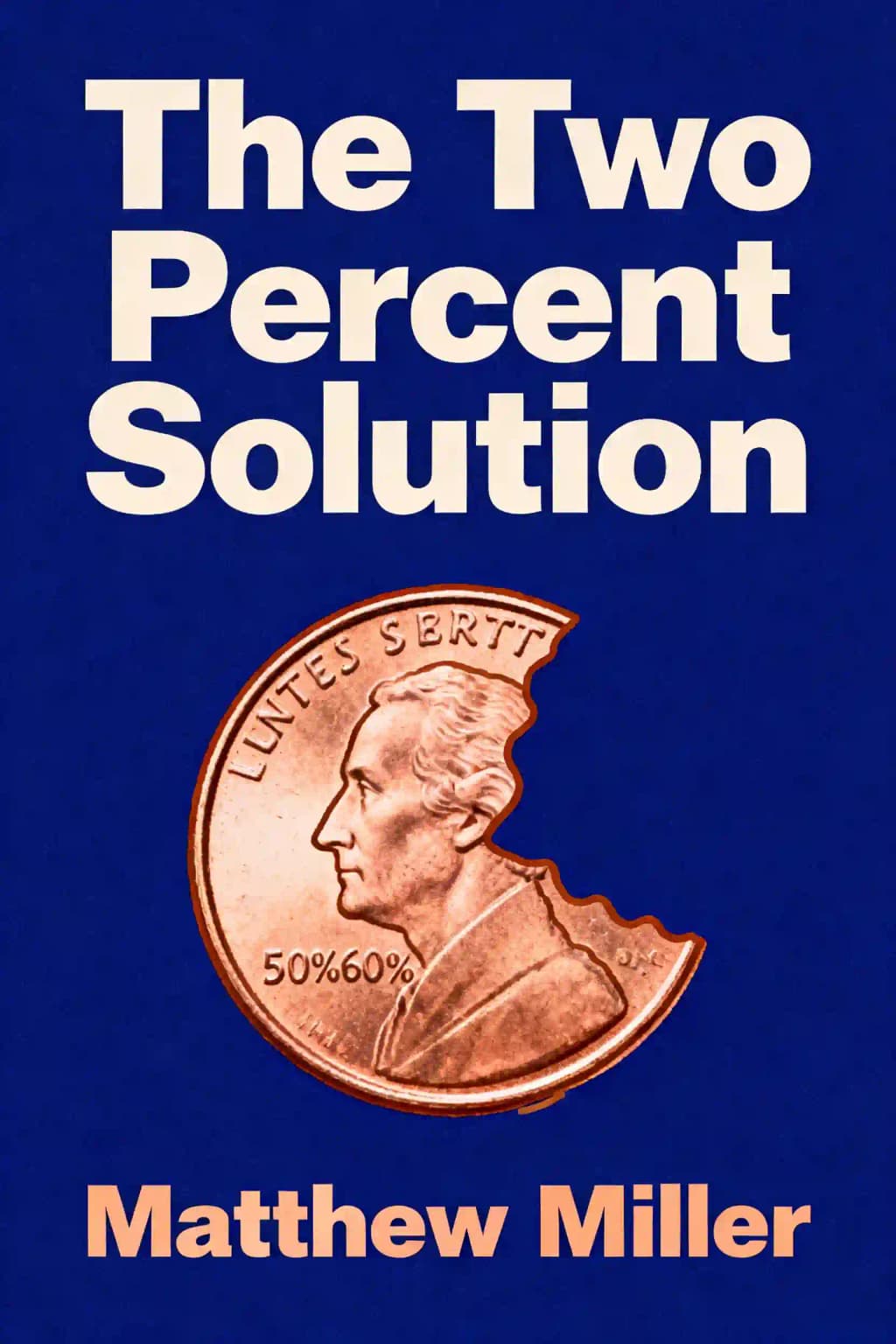
Two Percent Solution
Fixing America's Problems in Ways Liberals and Conservatives Can Love
Обзор книги Two Percent Solution
Could a mere 2% of GDP solve America's biggest problems? Matthew Miller's groundbreaking bipartisan blueprint challenges Washington gridlock with practical solutions that both sides can embrace. Even John McCain's adviser admitted: "This could actually work."

Ключевые темы в Two Percent Solution
- bipartisan policy reform
- market-based social safety
- equal opportunity funding
- political gridlock solutions
- universal healthcare access
Цитаты из Two Percent Solution
The time for bipartisan solutions has arrived.
Money continues to dominate politics.
We tend to be guided by what public officials are debating.
Capitalism naturally improves everyone's lot eventually.
The nation faces $25 trillion in unfunded liabilities.
Персонажи в Two Percent Solution
- Matthew MillerAuthor and policy strategist
- Bill BradleyFormer presidential candidate with healthcare plan
- George H.W. BushFormer President who proposed private tax credits
- Lawrence SummersEconomist who analyzed Democratic strategy
- Walter IsaacsonMedia figure discussing political journalism
Об авторе
Об авторе книги Two Percent Solution
Matthew Miller, author of The Two Percent Solution, is an acclaimed journalist and policy expert known for his incisive analysis of socioeconomic issues.
A senior fellow at the Center for American Progress and monthly columnist for Fortune, Miller’s work bridges political theory and practical policymaking, drawing from his experience as a Clinton administration advisor and McKinsey & Company consultant. His writing regularly appears in The New York Times Magazine and The Atlantic Monthly, and he has contributed to CNN as a political commentator.
Miller’s insights stem from his multidisciplinary background—he holds a law degree from Columbia and a BA from Brown University—and his candidacy for California’s 33rd congressional district in 2014. A co-host of the public radio program Left, Right & Center for two decades, Miller’s nuanced perspectives on governance and equity have solidified his reputation as a pragmatic voice in public discourse.
The Two Percent Solution reflects his career-long focus on innovative policy frameworks, blending data-driven rigor with accessible storytelling. The book has been cited in academic and political circles for its actionable proposals to address systemic inequality.
Скачать резюме книги «Two Percent Solution»
Получите резюме книги «Two Percent Solution» в формате PDF или EPUB бесплатно. Распечатайте или читайте офлайн в любое время.
Часто задаваемые вопросы об этой книге
The Two Percent Solution argues that redirecting 2% of America’s GDP (about $220 billion annually) could solve critical issues like universal healthcare, education reform, living wages, and campaign finance. Matthew Miller proposes bipartisan, market-friendly policies to achieve these goals while keeping government smaller than during the Reagan era.
This book is ideal for policymakers, political enthusiasts, and voters seeking pragmatic solutions bridging liberal and conservative ideologies. It appeals to readers interested in healthcare, education, wage reform, and campaign finance overhaul through fiscally responsible frameworks.
Yes, for its bold yet practical roadmap to address systemic issues without expanding government bureaucracy. Miller’s blend of data-driven analysis and bipartisan appeal makes it a standout for those tired of partisan gridlock.
Miller suggests reallocating 2% of GDP ($220 billion/year) from existing spending to fund universal healthcare, education improvements, living wages, and campaign finance reform. This “conservative means for liberal ends” approach aims to prove systemic change is achievable without drastic tax hikes.
The plan uses tax credits to help individuals buy private insurance, coupled with community rating laws to prevent discrimination. It combines universal coverage with market competition, avoiding a single-payer system while ensuring affordability.
Miller prioritizes attracting top teachers to low-income schools via competitive salaries and student loan forgiveness. The plan also funds infrastructure upgrades in underserved districts, aiming to close the education gap through targeted investment.
It proposes expanding the Earned Income Tax Credit (EITC) to guarantee full-time workers a living wage. This market-compatible approach supplements incomes without mandating higher employer wages.
The book advocates replacing corporate donations with citizen vouchers, allowing every voter to allocate public funds to candidates. This system aims to reduce special interest influence while encouraging civic participation.
Liberals gain progressive outcomes (universal healthcare, living wages), while conservatives get market-based mechanisms and smaller government than Reagan’s era. Miller frames this as a “grand bargain” transcending ideological divides.
Critics argue redirecting 2% of GDP oversimplifies budget reallocation, underestimating political resistance to cutting existing programs. Some progressives oppose reliance on private markets, while conservatives dismiss expanded tax credits as government overreach.
Unlike single-issue focuses, Miller integrates healthcare, education, wages, and governance into a unified fiscal framework. It contrasts with works like The Audacity of Hope by emphasizing bipartisan viability over ideological purity.
Matthew Miller is a columnist, NPR commentator, and former McKinsey consultant. His government experience includes advising the White House Office of Management and Budget, informing his pragmatic approach to systemic reform.
Yes, as debates over healthcare costs, wage stagnation, and political corruption persist. Miller’s $220 billion reallocation framework remains a viable benchmark for evaluating modern policy proposals.
Key lines include:
- “2% of GDP is more than $200 billion a year—way beyond what politicians think possible”
- “Transforms campaign finance into an occasion for civic responsibility”
These emphasize the gap between public intuition and political feasibility.