Глава 1
Into the Heart of Darkness: A Journey Through the Sheltering Sky
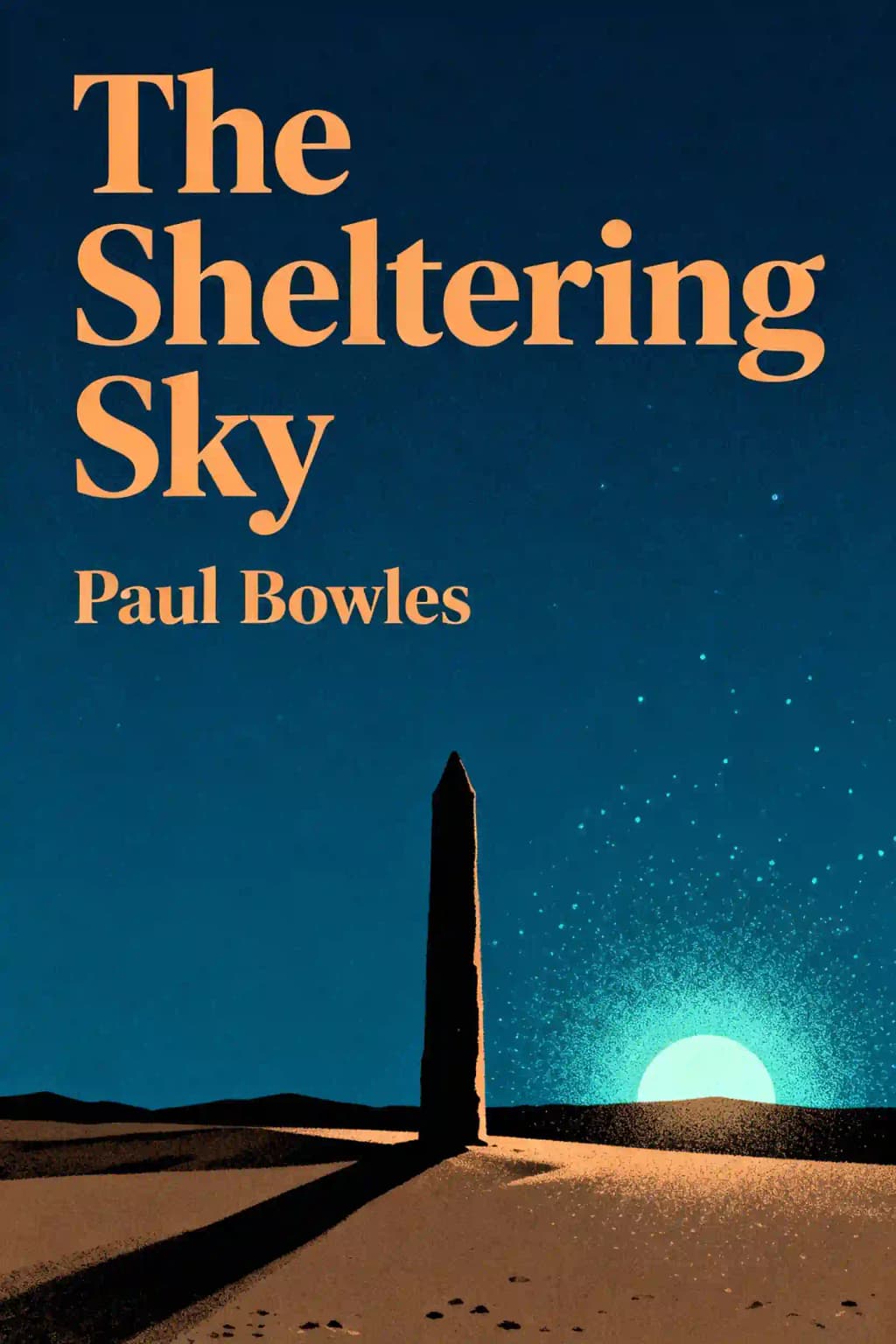
The Sheltering Sky isn't just a novel-it's an experience that has captivated readers since its publication in 1949. Paul Bowles' masterpiece has influenced generations of travelers, writers, and filmmakers with its unflinching exploration of existential isolation. The book gained renewed attention when Bernardo Bertolucci adapted it into a haunting film starring Debra Winger and John Malkovich in 1990. David Bowie was famously obsessed with the novel, citing it as a major influence on his Berlin trilogy albums. Even today, the book remains a staple on literary travelers' reading lists, with its stark warnings about the dangers of cultural displacement resonating powerfully in our globalized world. What makes this novel so enduring is its brutal honesty about what happens when we strip away the comforts of civilization and confront the vast emptiness that lies beneath our sheltering sky.
Глава 2
The Thin Veneer of Civilization
Port Moresby awakens in a foreign room, disoriented and immersed in what he calls "nonbeing" - a state of profound displacement that sets the tone for the entire narrative. This opening scene establishes the novel's central preoccupation: the fragility of human identity when removed from familiar surroundings. The stark hotel room, with its unfamiliar shadows and sounds, becomes a metaphor for the psychological displacement that will deepen throughout the story. Port, his wife Kit, and their friend Tunner are Americans traveling through North Africa after World War II, each carrying their own psychological baggage from a continent still reeling from global conflict.
Port considers himself not a tourist but a traveler - someone who moves slowly through the world, belonging nowhere specifically. This distinction is crucial to understanding his character; he prides himself on seeking authentic experiences beyond the superficial encounters of tourism. His self-imposed exile from conventional tourism reflects a deeper alienation from Western society, yet paradoxically reinforces his inherently Western perspective. He keeps detailed journals, sketches local architecture, and learns phrases in multiple dialects, all while maintaining a careful emotional distance from genuine cultural immersion.
The trio's dynamics reveal immediate tensions that simmer beneath their civilized exterior. Port and Kit's twelve-year marriage shows signs of strain, manifested in their stilted conversations and careful avoidance of certain topics. Tunner's presence - with his bland contentment, good looks, and effortless charm - creates an undercurrent of sexual tension that threatens to destabilize their already precarious relationships. When Port insists on sharing a disturbing dream about breaking his teeth, Kit becomes visibly upset and leaves the table crying. The dream sequence, with its violent imagery of decay and destruction, foreshadows the psychological deterioration to come.
Kit's subsequent discomfort about Port sharing this intimate dream with Tunner reveals complex layers of trust and betrayal. Her cryptic remark that Tunner is "much more your business than mine" hints at deeper complications in their three-way relationship - suggesting both sexual jealousy and a fundamental disconnection between husband and wife. Their interactions are marked by unspoken accusations and subtle power plays, all conducted with impeccable manners that mask deeper hostilities.
As they navigate the crowded streets of their first North African stop, Port contemplates the locals who stare at him openly. He obsessively questions whether they would help him if something happened - a reflection of his own isolation and vulnerability. His internal dialogue reveals a simultaneous fascination with and alienation from the culture he's visiting - a colonial mindset masked as intellectual curiosity. Port's nervous habit of tracing figure-eights with his finger physically manifests his inner disquiet, becoming a ritualistic gesture that attempts to impose order on chaos. This compulsive behavior, along with his detailed observations of local customs, shows how thin the veneer of civilization truly is when we're placed in unfamiliar territory, where our carefully constructed identities begin to unravel.
Глава 3
Sexual Transgressions and Cultural Collision
Sexual encounters in the novel serve as metaphors for cultural collision and the characters' attempts to find meaning in their increasingly unmoored lives. Port follows a local man named Smail to the nomad tents where he meets Marhnia, a beautiful young woman with tattooed designs on her forehead. Their encounter ends disastrously when Port catches her attempting to steal his wallet, forcing him to flee through a Moslem graveyard. This failed connection foreshadows the more profound cultural misunderstandings to come.
Meanwhile, Kit's anxiety manifests in her obsessive interpretation of omens. On days when doom hangs over her "like a low rain cloud," her usual system of interpreting signs becomes unreliable. What might normally be a clear warning could actually be bait luring her toward danger. This superstitious framework reveals her desperate attempt to impose order on a world that increasingly defies her understanding.
The sexual tension between Kit and Tunner culminates during their train journey together. As they drink champagne, Kit's anxiety about potential accidents transforms into giddy intoxication. After wandering into the fourth-class carriage filled with locals, where she experiences profound cultural disconnect, Kit returns to find a worried Tunner waiting. Despite her weak protests, she surrenders to his embrace, aware only of "the softness of the woolen bathrobe next to her skin" and "the nearness and warmth of a being that did not frighten her." This infidelity becomes a pivotal moment that Port will later discover, driving his desire to separate from Tunner.
The Lyles, an English mother and son duo, introduce another layer of sexual impropriety. Their bitter arguments and Mrs. Lyle's paranoid beliefs about Arabs spying on foreigners reveal the ugliness of colonial attitudes. Later, Port learns that Eric Lyle has been intimate with an Arab woman under the pretense that she was his mother, suggesting a disturbing pattern of exploitation that mirrors the larger colonial dynamic at play in North Africa.
Глава 4
The Desert as Character: Landscape of Transformation
The Sahara Desert emerges as perhaps the most powerful character in the novel, transforming from backdrop to active force as the travelers venture deeper into its heart. Port and Kit's bicycle ride outside Boussif takes them to a mountain ridge where they watch the sunset over the desert. Their conversation turns philosophical as Port remarks how the sky seems like a solid thing protecting them from what lies beyond. "Because, if you're really alone in the desert," he explains, "the sky is a solid thing up there, protecting you from what's behind."
This image of the sheltering sky becomes the novel's central metaphor-the thin barrier between human consciousness and the void of non-existence. Kit admits this talk frightens her, and Port suggests they share the same fundamental fear: that they've never fully engaged with life, instead "hanging on to the outside." This moment of connection is rare between them, yet it's tinged with Kit's unspoken guilt over her encounter with Tunner.
As they travel deeper into the desert by night bus, Port reflects on his desire to strengthen his bond with Kit, which requires them to be alone together. He finds pleasure in the pioneering aspect of their journey, feeling connected to his great-grandparents while traveling through the desert. The night passes hypnotically as Port savors each moment of moving deeper into the Sahara, revealing how the landscape begins to work on his consciousness.
The desert's transformation from scenic backdrop to existential arena accelerates when Port and Kit reach Ain Krorfa. While exploring the town's awakening streets, they reach the riverbed where a solitary flutist plays among resting camels. When Port asks if she can be happy here, Kit responds with irritation that she can't possibly answer such a question. Her resistance to the place contrasts with Port's growing fascination, creating another wedge between them as the desert begins its work of stripping away their pretenses.
Глава 5
Flight from Self: The Impossibility of Escape
The characters' physical journeys through the Sahara serve as potent metaphors for their internal flights from uncomfortable truths, with each geographical movement corresponding to a deeper psychological escape. When Port discovers that Tunner is coming to Bou Noura with his recovered passport, he experiences a profound internal panic that manifests physically - his hands trembling slightly, his breathing becoming shallow - even as he maintains an outward facade of composure. His subsequent actions, bribing a ticket seller with an elaborate story about his wife's illness to secure bus seats to El Ga'a, reveal both his desperation and his talent for self-deception. This frantic departure from Tunner represents Port's deeper attempt to escape confronting the devastating truth about Kit's infidelity with Tunner during their train journey.
Kit's pattern of flight is even more complex and multilayered. After Port's death, she enters the room to find him in an unsettling position - his legs twisted in bedcovers, his body already beginning to stiffen. The sight of his "meaningless eyes," once so expressive and now vacant, triggers in her a profound dissociative response. Her initial flight is psychological: she stands completely motionless for what seems like hours, her mind creating a protective void where neither emotion nor thought can penetrate. This mental escape precedes her physical flight from Sba, where she takes only the barest necessities in a small overnight bag, leaving behind not just her possessions but symbolically attempting to shed her identity as Port's widow.
Her most dramatic act of escape occurs when she joins the desert caravan, a decision that represents both physical and psychological flight. Among the Bedouin travelers, she creates an elaborate mental barrier between herself and her recent past, deliberately avoiding any thoughts that might connect her to her former life. As dawn breaks over the desert, she experiences the landscape with an almost hallucinatory intensity - the sand, the sky, and the horizon seem to merge into a new reality where her past cannot touch her. This day feels "new and wholly separate" because she has willfully severed herself from her history, representing the ultimate form of escape - a complete rejection of her previous identity and the trauma she carries.
However, the novel repeatedly emphasizes the futility of such attempts at escape. When French authorities finally locate Kit, her refusal to open her eyes becomes a powerful symbol of her desperate resistance to reality. "She knew that the constant references to her closed eyes were being made only in order to trap her into protesting... Then they would say: 'Ah, your eyes are open, are they? Then - look!' and there she would be, defenseless before the awful image of herself." This moment crystallizes the novel's central insight about the impossibility of permanent escape from one's true self. The harder the characters try to run from their essential natures and their past actions, the more inexorably these truths pursue them across the desert landscape.
Глава 6
Illness as Metaphor: The Body's Betrayal
Port's illness serves as a powerful metaphor for Western civilization's vulnerability when stripped of its technological and cultural protections. His symptoms begin subtly - an inexplicable coldness "like a piece of metal inside him" - but rapidly progress to violent chills, cramps, and nausea that leave him completely incapacitated. The diagnosis of typhoid fever represents not just a physical ailment but the body's fundamental betrayal, much as the characters' psychological defenses begin to crumble in the harsh desert environment. This deterioration mirrors the broader theme of Western impotence in the face of ancient, implacable forces.
As Port lies delirious in the truck to Sba, he reflects on how his friends have always envied his seemingly simple, straight-line life - a life that now appears as an illusion of control. The fever rages within him like a separate entity, making him feel like "a baseball being wound up and flung into space." This vivid image captures his complete loss of control - both physically and existentially - as the illness progresses. His body, once a reliable instrument of his will, becomes an alien landscape of pain and confusion, reflecting the vast, indifferent Sahara surrounding him.
In his fevered dreams, Port experiences a series of increasingly disturbing hallucinations that mirror his psychological disintegration. He sees himself on a crowded street as a car careens down a hill - a scene from his familiar Western world that transforms into something nightmarish. His desperate attempt to seek shelter in a pastry shop doorway, only to be pinned against the wall as glass shatters in the sunlight, represents his futile attempt to find refuge in the trappings of civilization. These visions morph into desert imagery: mud wells in the vast emptiness, his entrails exposed to the merciless sky. The progression of these hallucinations traces his journey from the ordered world he knew to the chaotic realm of primitive fears and base mortality.
Kit's response to Port's illness reveals her own psychological fragility and foreshadows her imminent breakdown. Overwhelmed by the profound silence of the Sahara - a silence that seems to mock human attempts at meaning - she attempts to compose herself through familiar rituals, applying makeup in the doorway while death hovers nearby. This futile gesture of civilization in the face of nature's indifference emphasizes the ultimate powerlessness of human constructs against primal forces. Through the long night, she maintains a desperate vigil, giving Port medicine every two hours while a violent sandstorm rages outside. The storm becomes a physical manifestation of the psychological tempest that will soon engulf her own life, stripping away her civilized veneer and exposing her to raw existence.
The progression of Port's illness thus becomes a microcosm of the novel's larger themes: the dissolution of Western certainties, the futility of human control, and the ultimate surrender to forces beyond comprehension or resistance.
Глава 7
Cultural Appropriation and Sexual Exploitation
Kit's tumultuous journey with Belqassim's caravan represents the novel's most explicit and complex exploration of cultural appropriation and sexual exploitation. After initially resisting, Kit surrenders to Belqassim's advances, discovering what she perceives as "a perfect balance between gentleness and violence that gave her particular delight." However, this seemingly consensual dynamic quickly deteriorates when the older man of the caravan demands his rights, establishing a disturbing pattern of sexual use that mirrors broader colonial exploitation patterns in North Africa.
The power dynamics become increasingly complicated when Kit arrives at Belqassim's family compound. She's strategically hidden away and dressed as a boy - a deception designed to conceal her presence from his wives. This masquerade emphasizes the cultural transgression of her presence while highlighting the complex intersections of gender, power, and cultural norms in traditional Islamic households. The deception creates a powder keg of tension that eventually explodes when the wives discover her true gender. The ensuing chaos - filled with screaming, physical confrontation, and torn clothing - represents the violent collision of cultural worlds.
Belqassim's attempt to legitimize Kit's presence through what appears to be a wedding ceremony serves as a pivotal moment. Though adorned in gold and officially elevated in status, Kit remains acutely aware of her precarious position. The hatred emanating from the surrounding women pierces through the ceremonial facade, causing her to break down in tears - a recognition of her role in disrupting the established social order.
Kit's subsequent imprisonment in a windowless room becomes a powerful metaphor for colonial subjugation. The massive bed dominates the space, emphasizing her sexual captivity, while the presence of a guard - a fat woman who never leaves - underscores her complete loss of freedom. Her growing dependency on Belqassim's increasingly sporadic visits mirrors the psychological dynamics of colonization, where the colonized become emotionally dependent on their colonizers. The "drug-like addiction to their sexual encounters" represents the ultimate form of colonization - the complete possession of body and spirit.
The power structure shifts dramatically when Kit finally escapes, convinced that the nightly potions she's given are poison. The ironic assistance of Belqassim's wives in her escape suggests a complex moment of female solidarity that transcends cultural boundaries. However, this brief alliance doesn't lead to true liberation. Kit's subsequent relationships with Amar and other men continue the cycle of exploitation, as she trades sexual compliance for protection while maintaining emotional detachment - a survival strategy that leaves her perpetually trapped between worlds.
Throughout this section, the novel masterfully interweaves themes of sexual power, cultural transgression, and colonial dynamics, creating a nuanced exploration of how personal and political forms of exploitation often mirror and reinforce each other.
Глава 8
The Void Beyond: Existential Horror and Meaning
Throughout the novel, characters struggle to find meaning in a universe that increasingly appears indifferent to human concerns. Port's observation that "the sky is a solid thing up there, protecting you from what's behind" captures the existential horror at the heart of the novel - the fear that beyond our constructed meanings lies only emptiness. This metaphor of the sky as a protective barrier recurs throughout the narrative, suggesting humanity's desperate need to shield itself from cosmic insignificance.
The characters' attempts to find authentic experience in North Africa reveal their underlying fear of meaninglessness. Their journey becomes increasingly nightmarish as the familiar structures of Western civilization fall away. The desert landscape serves as both literal setting and metaphorical void, its vast emptiness reflecting the characters' internal spiritual wasteland. Even their encounters with local cultures fail to provide the profound connection they seek, instead highlighting their fundamental alienation.
In one of their rare moments of connection, Port tells Kit it's his birthday and that he's been "living for her all these years without knowing it." As Kit weeps in his arms, mourning wasted years, Port slips back into delirium. This belated recognition of love's importance comes too late to save either of them from the void that awaits. The scene underscores how their pursuit of exotic experiences has blinded them to the genuine meaning available in human connection.
Port's final vision is of blood merging with excrement - "the supreme moment" - as he sees a black point of darkness in the night sky. This image suggests that what lies beyond the sheltering sky is not transcendence but nothingness - the ultimate horror for characters who have defined themselves through external experiences rather than internal substance. His death scene becomes a grotesque parody of spiritual enlightenment, where revelation brings not wisdom but terror.
Kit's desperate telegram attempt reading "CANNOT GET BACK" speaks to this existential trap. When facing the telegraph clerk, she believes she's "established contact with the other side" and flees in terror, convinced they'll "force her to look at what she had buried." Her subsequent refusal to open her eyes when found by French authorities represents her final resistance against confronting the meaninglessness she fears. This physical blindness mirrors her spiritual blindness, as she chooses oblivion over facing the void she's discovered beneath civilization's thin veneer.
The novel suggests that the characters' sophisticated Western consciousness, rather than providing protection against existential dread, actually makes them more vulnerable to it. Their education and cultural refinement prove useless against the fundamental questions of existence that the desert forces them to confront. In the end, their journey reveals not the profound meaning they sought but the terrifying possibility that meaning itself might be merely another human construct, as insubstantial as a mirage in the desert.
Глава 9
The Impossibility of Return: No Way Back to Innocence
The novel's final movements powerfully illustrate the irreversible nature of profound transformation, emphasizing that there can be no return to innocence once one has ventured beyond the sheltering sky. Tunner's actions in Bou Noura exemplify this futile pursuit of the past - he establishes a monotonous daily routine while searching for Kit, spending his mornings playing chess with Abdelkader and his afternoons methodically walking through nearby towns. His mechanical persistence represents not just a search for Kit but a desperate attempt to reconstruct the familiar world that has been irretrievably lost.
The physical and psychological transformation of Kit becomes starkly apparent when she is finally discovered and brought to Oran. Miss Ferry, an American consulate employee, observes Kit's profound deterioration with clinical detail. Kit appears in "a formless blue and white checked dress" - a far cry from her former elegant attire - with the defeated demeanor of someone who has "hit bottom." Her appearance reflects not just physical neglect but a fundamental shift in her being. Kit's devastating declaration that "Everything's lost" serves as both confession and epitaph for her former self.
The depth of Kit's transformation becomes even more apparent in her visceral reaction to news of Tunner. When Miss Ferry casually mentions that Tunner has been searching for her and might be at the hotel, Kit's face contorts with such primal terror that Miss Ferry is forced to conclude, "My God, the woman's nuts!" This moment reveals that Kit's changes run far deeper than mere physical appearance or social disposition - she has been fundamentally rewired by her experiences in the desert.
The novel's final scene employs masterful symbolism: a crowded streetcar winding through the city toward the edge of the Arab quarter, carrying Kit toward her chosen exile. This carefully constructed ending suggests multiple layers of meaning - Kit has not only escaped from Western civilization but has chosen to inhabit the liminal space between worlds. She exists now in a state of permanent displacement, neither fully Western nor fully "other," having rejected both the false security of her former life and complete absorption into the desert culture that transformed her.
Kafka's haunting epigraph to the final section - "From a certain point onward there is no longer any turning back. That is the point that must be reached" - serves as both warning and philosophical framework for understanding the novel's central theme. The Sheltering Sky ultimately suggests that this point of no return exists in all human lives - a threshold beyond which our former selves become not just distant but fundamentally inaccessible. Once crossed, we must forge new identities in the vast desert of existence, carrying the knowledge that our previous life, like the sheltering sky itself, was merely an illusion of protection against the infinite void.