Глава 1
The Science of Success: How Mental Energy Drives Intelligent Achievement
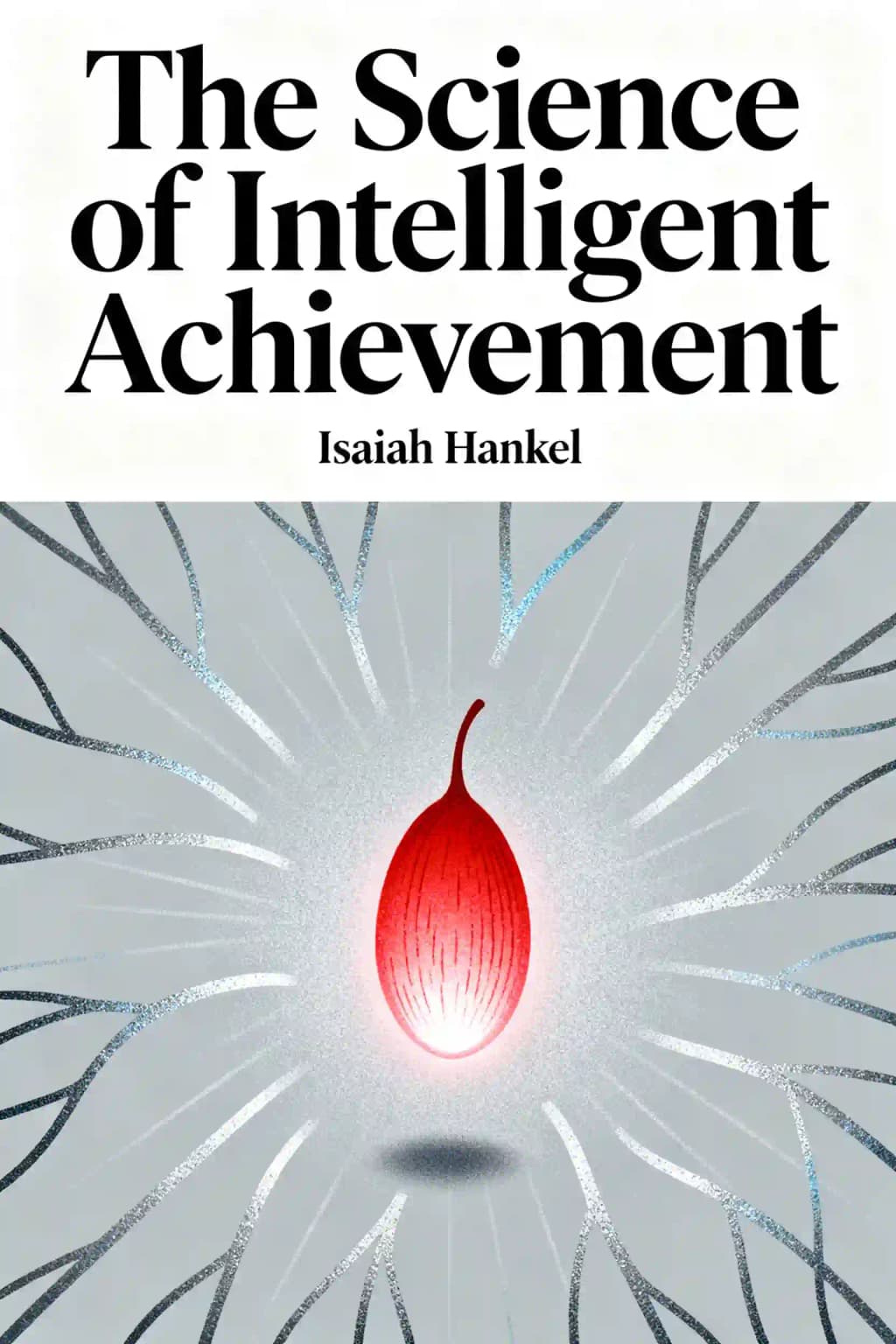
Have you ever wondered why some people achieve extraordinary success while others struggle despite similar talents and opportunities? Isaiah Hankel's "The Science of Intelligent Achievement" might hold the answer. This groundbreaking book, beloved by entrepreneurs like Tim Ferriss and executives at Fortune 500 companies, has become required reading at institutions like Harvard Business School. What makes it so compelling is Hankel's unique perspective - combining his scientific background (he holds a PhD in Cell Biology) with his experience recovering from a life-threatening cancer diagnosis that forced him to completely reimagine his approach to success.
Глава 2
Protecting Your Most Valuable Asset: Mental Energy
The foundation of intelligent achievement isn't time management or financial resources-it's mental energy management. Hankel argues that mental energy, not time or money, is our most precious resource. Scientific research shows we only get 90-120 minutes of peak mental energy and about five hours of near-peak energy daily. This optimal mental performance window typically occurs in the morning hours for most people, though individual patterns may vary. Despite this limited resource, most people carelessly spend their peak mental hours on low-value activities like checking emails or attending unnecessary meetings.
Our mental energy faces constant assault from both external forces and our own psychological immune system. External distractions have multiplied exponentially in the digital age - from endless social media notifications and email alerts to Slack messages and smartphone apps competing for attention. Studies show that each interruption requires approximately 23 minutes to fully regain focus. Meanwhile, our internal psychological immune system-formed by past obligations and conditioning-resists meaningful change and prefers comfortable distractions. This system developed as a survival mechanism but now often works against our best interests in the modern world.
Taking back control requires deliberate reprogramming through selective attention and strategic boundaries. Start by making "no" your default response rather than automatically saying "yes" to everything. For example, before accepting any new commitment, wait 24 hours and evaluate whether it truly aligns with your priorities. View saying "no" as success rather than failure - each decline preserves mental energy for what matters most. Eliminate gossip and drama, which rapidly deplete mental energy through emotional investment in others' problems. Most importantly, distance yourself from energy-draining people who feed on attention through victimhood and drama. These "energy vampires" often present themselves as friends in need but consistently leave you feeling exhausted and depleted.
After creating this protective boundary, intentionally surround yourself with people and activities that increase your mental energy and align with your goals. This might include joining masterminds with ambitious peers, reading books that challenge your thinking, or engaging in deep work on meaningful projects. These positive influences help reprogram your psychological immune system to defend against distraction rather than embracing it. Consider implementing energy-protecting routines like morning meditation, regular exercise, and designated "deep work" blocks where you're completely unreachable.
"Mental energy is the world's hottest commodity," Hankel writes. "Everyone is trying to steal it, yet few are protecting it." This scarcity makes mental energy management the ultimate competitive advantage in today's attention economy. Those who master the art of protecting and directing their mental energy will consistently outperform those who simply manage their time.
Глава 3
The Busyness Trap: Why Activity Isn't Achievement
Many people confuse busyness with productivity, wearing their packed schedules as badges of honor in today's always-on culture. They proudly declare "I'm so busy!" while rushing between meetings, answering endless emails, and maintaining packed calendars. However, extensive research across multiple fields reveals that elite performers practice deliberately in short bursts (averaging just 3.5 hours daily) while average performers work longer but less effectively by spreading work throughout the day. Top violinists, chess grandmasters, and Olympic athletes all follow this pattern of focused work rather than marathon sessions.
Busyness leads to mediocrity because it prevents mastery and deep learning. Without dedicated time to reflect, analyze, and strategically plan, busy people become reactive rather than proactive - things happen to them rather than them making things happen. A manager constantly putting out fires never develops better systems. A writer interrupted by constant meetings never produces their best work. Despite the temporary dopamine rush from completing tasks and clearing inboxes, busyness ultimately functions as an addictive drug that keeps you from focusing on meaningful results and creative breakthroughs.
More dangerously, busyness makes you easily manipulated and controlled by others. When overwhelmed with tasks and commitments, it becomes simple for others to limit your perceived choices, make you feel dependent on them, or obligate you to care for their needs. Colleagues exploit your busyness through emotional blackmail ("We're counting on you!"), playing the victim ("I have no one else to ask"), or creating artificial drama and urgency ("This needs to be done right now!"), knowing you'd rather give in than deal with guilt or conflict. Your packed schedule becomes a weapon others use against you.
The solution is to obsess over results and impact rather than activities and motion. This means ruthlessly evaluating how you spend your time and learning to say no to anything that doesn't bring you meaningfully closer to your goals. A helpful framework is to ask "Will this matter in a year?" before taking on new commitments. Highly successful people aren't necessarily less busy, but they're busy with the right things - those that align with their priorities and create lasting value. Selectivity, not constant activity, is the gateway to both peak productivity and personal fulfillment. This requires regular periods of strategic thinking and careful choice-making about where to direct your limited time and energy.
Глава 4
The Infection of Other People's Opinions
Other people's opinions function like viruses, infecting your thoughts and behaviors regardless of your perceived strength against them. Scientific research shows that while positive people increase your chances of positivity by only 11 percent, negative people double your chances of becoming negative. This asymmetric impact demonstrates how negativity carries more weight in shaping our mindset and behavior patterns than positivity does.
You're biologically wired to copy others through mirror neurons and powerful psychological factors like groupthink, negativity bias, and the chameleon effect. These mirror neurons activate both when we perform an action and when we observe others performing the same action, creating an automatic tendency to mimic and internalize behaviors around us. The chameleon effect causes us to unconsciously adopt the mannerisms, attitudes, and behavioral patterns of those we spend time with, making social influence nearly impossible to resist completely.
Research demonstrates this herd mentality's profound impact across multiple domains: people exposed to liars are more likely to lie themselves, having obese friends increases obesity risk by 171%, and having a smoker in your family raises smoking chances by 61%. Even more striking, studies show that divorce can spread through social networks, increasing the likelihood of separation among friends of divorced couples by up to 75%.
Stanford University research reveals that just 30+ minutes of negativity destroys neurons in your hippocampus, literally rotting your brain and impairing problem-solving abilities. This neurological damage affects memory formation, emotional regulation, and cognitive flexibility. The stress hormones released during negative interactions can persist in your system for hours, affecting decision-making and creative thinking long after the interaction ends.
Engaging with negative people reduces mental energy and performance through multiple mechanisms: constant complaining forces your brain to process and respond to problems that aren't yours, emotional vampirism drains your psychological resources, and toxic relationships create ongoing stress that impairs cognitive function. Feeling obligated to make others happy leads to burnout, reckless behavior, and even suicide, as the constant pressure to please others depletes your emotional reserves and disconnects you from your own needs and aspirations.
To achieve your biggest goals, you must defy your herd mentality and be highly selective about whose advice you accept. This means consciously curating your social circle, limiting exposure to negative influences, and creating boundaries that protect your mental space. When it comes to your goals and life, trust yourself first and put your interests ahead of others to maintain the mental energy needed for your biggest goals. This isn't selfishness; it's self-preservation and the foundation for sustainable success.
Глава 5
Half Your Friendships Are Fake: The Science of Relationships
Research from Tel Aviv University and MIT reveals a startling truth about human relationships: for every genuine friend we have, we likely have one fake friend. While an overwhelming 95% of people believe their friendships are reciprocal, only 50% actually qualify as bidirectional relationships. This disparity creates a significant "friendship paradox" where people consistently overestimate the mutual nature of their social connections.
Fake friendships fundamentally violate basic causality by expecting unearned benefits and reversing natural relationship progression. These relationships distort the natural order in several ways: seeking unearned respect as if respect (effect) could generate personal value (cause), demanding unearned admiration as if admiration (effect) could create virtue (cause), and expecting loyalty without first demonstrating trustworthiness. This reversed causality often manifests in social media connections, where people mistake shallow interactions for meaningful relationships.
Three distinct warning signs help identify fake friendships. First, when someone weaponizes their care for you as leverage to control your behavior, using phrases like "after all I've done for you" to manipulate outcomes. Second, when someone expects you to consider their feelings in every decision about your own life, essentially making your autonomy conditional on their approval. Third, when someone consistently asks for favors or handouts while expecting you to maintain the pretense that they earned it, creating an unsustainable dynamic of entitlement.
The importance of cultivating genuine friendships cannot be overstated. Research demonstrates that people with healthy friendships are five times more likely to be healthy themselves, with benefits ranging from lower stress levels to increased longevity. In the workplace, having a good friend makes you seven times more likely to be engaged in your job and significantly improves job satisfaction. These authentic relationships create positive feedback loops, where mutual support and genuine care generate compound benefits over time.
Being selective with friendships requires conscious effort but yields tremendous returns. True friends celebrate your successes without envy, offer honest feedback without manipulation, and provide support without keeping score. They understand that genuine friendship is built on mutual growth, shared values, and reciprocal investment in each other's well-being. By carefully curating our social circles to include only authentic relationships, we create an environment that nurtures personal growth and emotional well-being while eliminating the emotional drain of maintaining fake friendships.
Глава 6
Creative Ownership: The New Path to Security
Traditional employment no longer provides the security it once promised-try getting sick for a few months and see how loyal your employer remains. The 2008 recession eliminated 7.9 million jobs in the U.S. and drove U.K. unemployment to 2.5 million by 2010, demonstrating how expendable employees are when companies face difficulties. Even seemingly stable industries like banking, retail, and manufacturing saw massive layoffs, proving no sector is truly safe from economic turbulence.
The alternative to this precarious temp-employment is "entre-employment"-the new path to the upper class. Self-employed individuals make up nearly three-quarters of all millionaires globally-74% in the U.S. and 43% in the U.K. Most entrepreneurs started as employees who developed their business models while still working day jobs. Examples include Sara Blakely working as a fax machine saleswoman while developing Spanx, or Jeff Bezos maintaining his hedge fund job while building Amazon in his garage. This hybrid approach minimizes risk while building foundations for independence.
Creative ownership liberates you from dependence on any single employer or market condition. While everything else can be taken from you-your job, savings, or material possessions-your knowledge, network, and ability remain. Today's equity takes only these three forms-the only assets that can't be taken from you. This explains how successful people can go bankrupt yet quickly rebound. Donald Trump, Walt Disney, and Henry Ford all faced bankruptcy before rebuilding their empires using their retained knowledge and connections.
Ownership also creates demonstrably higher levels of happiness and fulfillment-97% of entrepreneurs report feeling daily purpose compared to just 25% of temp-employees. With over 70% of employees disengaged from their jobs according to Gallup polls, ownership becomes crucial for engagement in work and life. This ownership mindset extends beyond just business ownership-it includes intellectual property, personal brands, and specialized expertise that creates value independently of any employer.
The security of creative ownership comes from diversification of income streams, direct connection with customers, and the ability to pivot quickly as markets change. Unlike traditional employees who depend on a single paycheck, creative owners can generate income through multiple channels-consulting, products, content creation, and investments. This portfolio approach to career building provides both higher income potential and greater stability than conventional employment.
Глава 7
Content Marketing: The Modern Path to Ownership
Content marketing provides entre-employees a way to generate second income streams while maintaining their current positions. It's a strategic approach focused on creating valuable, relevant content to attract and retain an audience, ultimately converting them into buyers by building trust. This method has become increasingly vital in the digital age, where traditional advertising often falls flat against the authenticity of genuine, value-driven content. Successful content marketers focus on solving specific problems, whether through blog posts, podcasts, videos, or social media content.
Finding your voice in content marketing means aligning your message with your audience's needs. It's not about waiting for divine inspiration but the deliberate process of discovering what resonates. This involves consistent experimentation, gathering feedback, and refining your approach. Market research, competitor analysis, and direct audience engagement through surveys and comments help identify gaps you can fill. You must be passionate about your content while ensuring it fulfills a market need; having only one without the other limits you to a hobby rather than a business. The sweet spot lies at the intersection of your expertise, your audience's problems, and your authentic expression.
Storytelling differentiates you from everyone else in your market. Your unique story is what you alone own, making it the key to capturing audience attention. Position yourself as the humble warrior-not perfect, but deeply flawed and relatable. Audiences don't want stories about perfection; they want to hear about your problems, failures, and how you overcame them. Share your journey, including the setbacks and victories, using specific examples and emotional touchpoints that resonate with your audience. This vulnerability creates trust and builds stronger connections with your followers.
Your email subscription list becomes your most valuable asset in content marketing. While algorithms can change and platforms can limit your reach, no one can take away your connections as long as you have their contact information. Studies show email marketing conversion rates average 7% compared to just 1% for other online marketing methods. Building this list requires strategic lead magnets, compelling opt-in offers, and consistent value delivery. Segment your email list based on subscriber interests and behaviors to deliver more targeted content. Regular engagement through newsletters, exclusive content, and personal updates maintains relationship strength and increases the likelihood of converting subscribers into customers.
Content marketing success requires consistency and patience. Create an editorial calendar to maintain regular posting schedules, and focus on quality over quantity. Track metrics like engagement rates, time on page, and conversion rates to optimize your strategy. Remember that building authority in your niche takes time - most successful content marketers spend 12-18 months consistently creating before seeing significant results.
Глава 8
Pragmatic Growth: The Power of Small Changes
Pragmatic growth allows you to seize the right opportunities at the right time while maintaining personal responsibility. While you can't transform your life overnight, daily opportunities exist to achieve Intelligent Achievement. This approach emphasizes making calculated, realistic decisions rather than pursuing dramatic but unsustainable changes. Success comes from consistently identifying and acting on small, manageable improvements that compound over time.
Trauma and tragedy are painful, but they can be transformed through pragmatic thinking. The solution is developing a pragmatic mindset that keeps you grounded in reality while maintaining personal responsibility. Studies show pragmatic people are more resilient and measurably happier when facing stress. Research from the University of California found that individuals with pragmatic coping strategies recovered from setbacks 60% faster than those who remained in emotional reaction modes. This resilience stems from focusing on what can be controlled rather than dwelling on circumstances beyond our influence.
Your brain has a negativity bias, quickly routing negative information to long-term memory while positive information needs at least 12 seconds of awareness to be stored. This evolutionary adaptation, while useful for survival, can sabotage modern success if left unchecked. Instead of complaining about negative events, channel that mental energy into productive action. When something goes wrong, take immediate positive steps. This transforms life's pain into forward momentum. For example, if you lose a client, immediately begin prospecting new ones while analyzing the loss for improvement opportunities.
Action items are rarely actionable because more options lead to fewer decisions - a phenomenon psychologists call "choice paralysis." To-do lists fail for three scientific reasons: heterogeneous complexity (mixing ten-second tasks with ten-hour projects), heterogeneous priority (lacking context and hierarchy), and too many options. Research shows that when faced with more than seven choices, decision-making effectiveness drops by 30%. The solution is non-negotiables - things you'll never compromise on. Bookending your days with non-negotiables creates structure and urgency, like never skipping your 7 a.m. gym session and never staying online past 9:30 p.m. These fixed points act as anchors for your day, creating a framework for consistent progress.
Successful pragmatic growth requires establishing clear boundaries and systems. This might include implementing the "two-minute rule" (immediately completing any task that takes less than two minutes), creating decision-making frameworks for common challenges, and regularly auditing your commitments to ensure they align with your core priorities. By breaking down larger goals into smaller, manageable steps and maintaining unwavering commitment to your non-negotiables, you create a sustainable path to long-term success.
Глава 9
Hacking Habits for Lasting Change
Motivation fluctuates like the wind, but habits function like freight train wheels-powerful, persistent, and moving relentlessly forward. While motivation might get you started, it's the establishment of solid habits that creates lasting change. By implementing mini-habits rather than attempting massive life overhauls, you can transform your life completely within months, creating sustainable changes that stick.
MIT researchers studying habit formation discovered that as mice repeatedly navigated mazes, their brain activity actually decreased. The maze-running sequence had been offloaded from the cerebral cortex to the basal ganglia (the brain's habit center). This is how habits conserve mental energy-by automating behaviors. Similar patterns have been observed in human subjects performing routine tasks, from driving to brushing teeth. Once a behavior becomes habitual, it requires significantly less cognitive effort, freeing up mental resources for more complex tasks.
A complete habit consists of three essential components: a trigger (the cue that initiates the behavior), a routine (the actual behavior itself), and a reward (the positive reinforcement that follows). Mini-habits are smaller versions of full habits-flossing just one tooth instead of all teeth, or doing one exercise set instead of thirty. These mini-habits are easier to establish and can gradually scale into full habits. For example, starting with a single push-up every morning can evolve into a complete workout routine, or reading one page daily can develop into a robust reading habit.
Mini-habits can be stacked by using one routine as a trigger for the next, creating a chain of automatic behaviors that preserve mental energy and willpower. This habit stacking technique works because it leverages existing habits as reliable triggers. For instance, you might stack "drink water" after "brush teeth," then "take vitamins" after "drink water." By stacking healthy habits, you free yourself from unimportant decisions, preserving energy and time for adventures and meaningful projects. Research shows that people who successfully stack habits can automate up to 40% of their daily activities, significantly reducing decision fatigue.
The key to successful habit formation lies in starting small and being consistent. Rather than attempting dramatic changes, focus on tiny improvements that compound over time. For example, improving by just 1% each day leads to a 37-fold improvement over a year. This approach aligns with the brain's preference for gradual, sustainable change over sudden disruptions to established patterns.
Глава 10
From Achievement to Adventure: The Ultimate Reward
After mastering selectivity, ownership, and pragmatism, reinvest your newfound freedom in adventure. Intelligent Achievement naturally leads to increased discovery, awe, and fun, which in turn makes you more creative and productive.
When you've eliminated energy-draining drama and put life's nagging parts on autopilot, you'll face a void. Initially pleasant, this emptiness can eventually weigh on you. But boredom itself isn't the enemy-it's actually a springboard for innovation. Studies show that people who experience boredom outperform others on creativity tests.
Don't waste your newfound mental space by manufacturing drama or mindless internet surfing. Instead, get creative about your future possibilities. Most adults have replaced childhood's boundless imagination with mundane aspirations like small promotions or good parking spots. Intelligent Achievement should fuel adventure and passion.
Mental energy connects directly to physical energy-without it, your mind suffers. The key is recognizing this connection and prioritizing mobility, which is fundamental to happiness and creativity. Motion creates emotion-start moving, exuding energy, and injecting enthusiasm into everything you do.
A legacy is something valuable handed down to future generations-whether it's a child, product, service, message, or your character. To leave a legacy, you must create something so inspiring that future generations will sustain it, which requires understanding the difference between significance and self-importance. With time constantly running out, you must choose between chasing fake success or pursuing Intelligent Achievement.