Глава 1
The Universe's Mathematical Blueprint
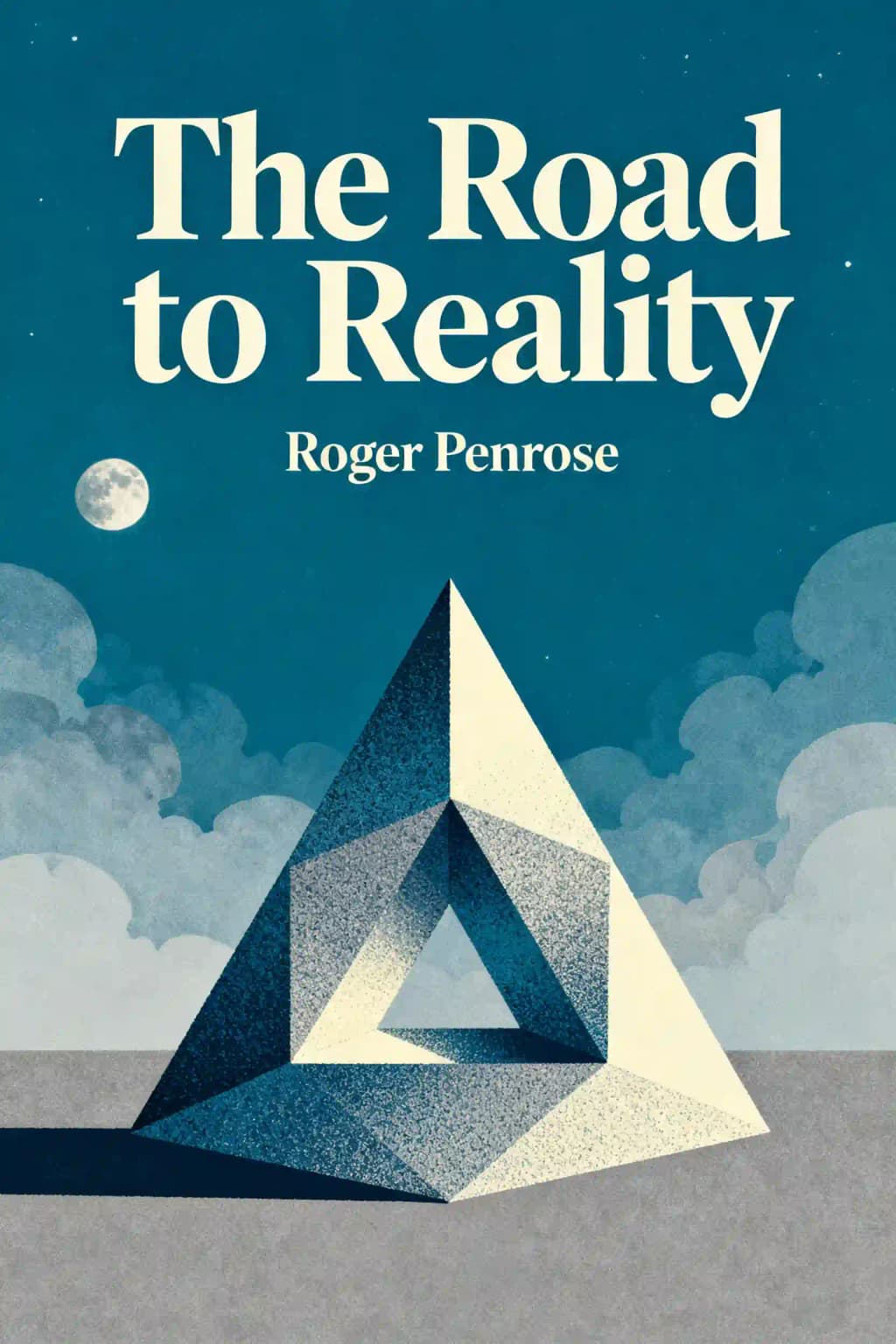
Have you ever wondered why the universe speaks the language of mathematics? When Roger Penrose released "The Road to Reality" in 2004, it represented his magnum opus-a sweeping 1100-page journey through the mathematical foundations of physical reality. The book quickly became a favorite among theoretical physicists, including the late Stephen Hawking who called it "a remarkable achievement." Penrose, who would later win the 2020 Nobel Prize in Physics for his work on black holes, crafted this monumental text not just as an explanation of physics, but as an intellectual odyssey that challenges readers to reconsider the very nature of reality itself. The book's cultural impact has been profound, inspiring a generation of scientists to pursue the deepest questions about our universe's mathematical underpinnings. As we explore this masterwork, prepare to have your understanding of reality fundamentally transformed.
Глава 2
Mathematics as the Hidden Architecture of the Universe
The ancient Greeks first recognized that mathematics might be the key to understanding the physical world. This revolutionary insight - that abstract mathematical concepts could precisely describe natural phenomena - remains the foundation of modern physics. Pythagoras discovered that musical harmonies corresponded to simple fractional ratios between string lengths, revealing a profound connection between mathematics and physical reality. His brotherhood established the concept of mathematical proof, developing a system of logical deduction that created unassailable truths. These truths, once proven, remain eternally valid regardless of how our scientific understanding evolves.
The Pythagoreans' work extended beyond music to geometry, number theory, and astronomy. They discovered irrational numbers through the diagonal of a square, a finding so disturbing to their worldview that they initially kept it secret. This discovery highlighted a crucial aspect of mathematical truth - it often reveals realities that transcend our intuitive understanding of the world.
Plato took this philosophical foundation further, distinguishing between physical approximations and perfect mathematical entities inhabiting a separate "world of forms." This extraordinary concept provided the blueprint for modern science. In Plato's view, the circle drawn in sand was merely a shadow of the perfect mathematical circle - an ideal form existing independent of physical manifestation. This distinction between mathematical perfection and physical approximation remains crucial in modern physics, where theoretical models describe an idealized reality that physical systems can only approximate.
Mathematical truth possesses an objectivity independent of human opinion or culture. Consider Fermat's Last Theorem, unproven for over 350 years until Andrew Wiles's 1995 proof. The theorem's truth existed before any human conceived it - it would be absurd to suggest its validity depended on when someone proved it. Similarly, the infinite decimal expansion of contains patterns and relationships that exist whether or not humans discover them.
The Mandelbrot set illustrates this objectivity perfectly. No one, not even Mandelbrot himself, initially comprehended its extraordinary richness and complexity. Its infinite intricacy emerges from a simple equation: z -> z2 + c. The set's existence cannot be contained within our minds (too complex to fully comprehend) or within computer printouts (mere approximations). Its robustness is undeniable - the same structure reveals itself to greater fineness regardless of who examines it, what computer generates it, or what mathematical approach investigates it.
This raises profound questions about reality's nature. Roger Penrose conceptualizes three separate "worlds" - the physical, the mental, and the Platonic mathematical - with mysterious connections between them. Why do mathematical laws apply to the physical world with such extraordinary precision? Einstein wondered how "mathematics, being after all a product of human thought which is independent of experience, is so admirably appropriate to the objects of reality." How does organized physical material produce conscious awareness? And how do we perceive mathematical truth beyond mere calculation? These mysteries point to a deeper relationship between mathematics and reality than we currently understand, suggesting that mathematics might not just describe the universe - it might be its fundamental essence.
Глава 3
The Quantum Revolution: Particles, Waves, and Probability
Quantum mechanics represents a far more revolutionary change to our picture of reality than even Einstein's curved spacetime. The theory so drastically departs from classical conceptions that many physicists abandon attempts at visualizing quantum-level "pictures" altogether, some even doubting the existence of true "reality" at quantum scales.
The quantum world reveals a fundamental duality between waves and particles. The Davisson-Germer experiment showed electrons deflecting from crystalline materials at specific angles, demonstrating that particles have wavelike properties with wavelength = h/p (the de Broglie wavelength). Conversely, light-previously thought purely wavelike-exhibits particle behavior in phenomena like the photoelectric effect, where Einstein showed light consists of photons with energy E = h.
This wave-particle duality is most dramatically demonstrated in the two-slit experiment. Individual particles create interference patterns as if they were waves, with particles unable to reach certain regions of the screen when both slits are open, despite reaching those areas when only one slit is open. This seemingly contradictory behavior is accommodated within quantum mechanics' mathematical formalism, where momentum becomes "differentiation with respect to position" and energy becomes "differentiation with respect to time."
Wavefunctions possess a fundamentally non-local character that distinguishes them from classical waves. In the two-slit setup, we can't interpret the wavefunction as independently providing probabilities at each separate location. The entire wavefunction describes just one particle-if it causes a spot to appear at one place, it cannot cause another elsewhere. This non-locality becomes even more striking in thought experiments with beam-splitters, where a single photon's wavefunction can be split into parts separated by light-years.
Perhaps most unsettling is the "quantum jump" that occurs during measurement. When we detect a particle, its wavefunction undergoes a discontinuous, non-local change-collapsing from a spread-out wave to a localized particle. This process doesn't follow the smooth Schrodinger evolution but represents something fundamentally different. Schrodinger himself was deeply troubled by these quantum jumps, once lamenting to Bohr that if "this damned quantum jumping were really here to stay," he'd regret his involvement with quantum theory.
Глава 4
Entanglement: The Quantum Web of Reality
In multi-particle quantum systems, we don't have separate wavefunctions for each particle but rather a single holistic state vector describing the entire system. This wavefunction is a function of all position coordinates of all particles-essentially a function on the configuration space of the system. The complexity grows exponentially with the number of particles. While n individual particles might require n separate wavefunctions (freedom of 2n3), a proper quantum description requires one complex function of 3n variables (freedom of 23n)-a stupendously larger space.
Entanglement, first made explicit by Schrodinger, represents the vast majority of information in a multi-particle wavefunction. These subtle quantum relationships between particles lead to the puzzling Einstein-Podolsky-Rosen (EPR) effects, which cannot be explained by treating particles as independent entities. John Bell's remarkable theorem proved this by deriving inequalities that quantum mechanics violates but which any model of independent particles must satisfy.
Bohm's EPR experiment uses two spin-12 particles in a combined spin-0 state traveling in opposite directions to widely separated detectors. The entangled state | = |^|v - |v|^ cannot be factored into independent states for each particle. When measuring spin in the same direction, the results are always opposite. For measurements in different directions with angle between them, the joint probabilities are: agreement (YY or NN): 12(1-cos ), disagreement (YN or NY): 12(1+cos ).
These quantum correlations exceed what's possible with classical-like independent particles. Many experiments have confirmed these quantum predictions, with recent tests showing Bell-inequality violations over distances exceeding 15 kilometers. This profound quantum feature underlies the potential power of quantum computing, which aims to exploit these hidden entanglement resources.
Quantum teleportation demonstrates how an unknown quantum state can be transmitted using classical communication channels plus pre-shared entanglement. The process requires sending just two bits of classical information (one of the numbers 0, 1, 2, 3) to convey what would classically require an infinite amount of information-the exact position on a Riemann sphere. What makes this possible is that the sender and receiver already share quantum entanglement-a resource established beforehand that provides the necessary quantum channel.
Глава 5
Spacetime: Einstein's Geometric Revolution
Einstein's general relativity fundamentally transformed our understanding of space and time by introducing Einsteinian spacetime, a sophisticated generalization of Minkowski space that parallels how Newton-Cartan spacetime built upon Galilean concepts. While Minkowski space features a uniform arrangement of null cones throughout spacetime, Einsteinian spacetime presents a more complex geometry where light cones can tilt, twist, and vary in ways that reflect the presence of matter and energy - much like a rubber sheet distorted by weighted objects.
The mathematical foundation of Einsteinian spacetime retains a Lorentzian metric with signature (+ - - -), which defines proper time for ideal clocks using the same fundamental formula as in Minkowski space. However, it abandons the rigid uniformity of Minkowski space in favor of a dynamic structure that can bend and warp. This metric determines the null-cone structure that governs causality throughout spacetime, establishing the fundamental limits of cause and effect relationships between events.
While local differences between Einsteinian and Minkowski spacetime appear subtle - following Einstein's equivalence principle that gravity is indistinguishable from acceleration in small enough regions - the global causality structures can become remarkably complex in more elaborate Einsteinian spacetimes. In extreme scenarios known as "causality violations," the mathematics allows for closed timelike curves - paths through spacetime that return to their starting point in both space and time, theoretically enabling time travel. These possibilities have sparked intense debate in the physics community, with some dismissing them as unphysical while others, including Kurt Godel, have taken them seriously as potential features of our universe.
The elegant power of Einstein's spacetime lies in how the metric alone determines a unique torsion-free connection where the covariant derivative of the metric vanishes. This represents a significant advancement over Cartan's Newtonian spacetime, where the connection required separate specification. In Einstein's framework, inertial motion follows timelike geodesics - paths through spacetime that locally maximize proper time, corresponding to the actual time measured by ideal clocks moving along these world lines. This unification of geometry and motion represents one of the theory's most profound achievements.
Einstein's field equation - perhaps the most famous equation in gravity after Newton's inverse square law - establishes the fundamental relationship between spacetime curvature and the energy-momentum tensor T. This relationship emerged from two essential requirements: that energy and momentum should serve as the local source of gravitational effects, and that the theory should reproduce Newtonian gravity's predictions in weak-field, slow-motion scenarios. The equation elegantly captures how mass and energy curve spacetime, while curved spacetime tells matter how to move.
The equation builds upon and geometrizes the Newtonian insight that neighboring geodesics accelerate relative to an observer's geodesic, producing a volume-reducing effect proportional to the enclosed mass. In Einstein's geometric framework, this phenomenon is quantified by the Ricci tensor - a mathematical object derived from the more general Riemann curvature tensor that measures the essential features of spacetime curvature. This geometric interpretation of gravity represents one of the most profound conceptual advances in the history of physics, replacing Newton's force-based theory with one based on the curvature of spacetime itself.
Глава 6
Black Holes: Where Physics Breaks Down
A black hole represents one of the most extreme phenomena in our universe - a region of spacetime where gravity becomes so intensely concentrated that the known laws of physics begin to break down. Unlike any other cosmic object, black holes demonstrate the profound consequences of Einstein's general relativity, marking a dramatic departure from Newtonian physics where light's speed wasn't considered absolute. In our modern understanding, the speed of light represents an unbreakable cosmic speed limit for all information and matter, making black holes particularly fascinating as regions where even this fundamental constraint becomes relevant.
The birth of a typical stellar black hole occurs through a dramatic process when massive stars - generally those exceeding 20-25 times the Sun's mass - reach the end of their lives. As these celestial giants exhaust their nuclear fuel, they can no longer generate the immense pressure needed to counteract their own gravitational pull. This triggers a catastrophic collapse where gravity overwhelms all other forces. The star's core implodes with such violence that even the strong nuclear force cannot prevent its matter from being crushed to unimaginable densities.
The event horizon - perhaps the most crucial feature of a black hole - marks a mathematical and physical boundary in spacetime that fundamentally alters our understanding of causality. This three-dimensional surface acts as a cosmic point of no return, where spacetime becomes so severely warped that all future-directed paths lead inexorably inward. The mathematics behind this phenomenon reveals how light cones - which represent all possible paths that light rays could take - progressively tilt inward near the horizon until they become tangent to it, making escape mathematically impossible.
While the event horizon represents a point of no return, it holds another surprising property - an observer falling through it would experience nothing particularly unusual at the moment of crossing. This "no drama" principle stands in stark contrast to the horizon's global significance. However, once past this boundary, the journey becomes one-way, with all paths leading to the central singularity - a point where spacetime curvature becomes infinite and known physics breaks down completely.
The mathematical elegance of black holes emerges through the "no-hair theorem," which shows that regardless of how chaotic or asymmetrical the collapse process might be, the resulting black hole settles into a remarkably simple state described by the Kerr metric. This final form requires only two parameters: the total mass (m) and the angular momentum per unit mass (a). This simplification represents one of the most beautiful results in theoretical physics - complex stellar deaths resulting in mathematically elegant structures.
The connection between black holes and thermodynamics reached a breakthrough with the Bekenstein-Hawking entropy formula: S_BH = kA/4G. This elegant equation relates a black hole's entropy directly to its horizon surface area (A), combining fundamental constants from both quantum mechanics () and gravity (G). This unexpected bridge between thermodynamics, quantum theory, and gravity hints at deeper connections in physics, potentially offering clues toward a unified theory of quantum gravity.
Recent observations, particularly from the Event Horizon Telescope collaboration, have provided the first direct images of black hole shadows, confirming many theoretical predictions and opening new avenues for testing Einstein's theory in the most extreme gravitational environments nature provides.
Глава 7
The Big Bang and the Arrow of Time
The Big Bang's extraordinarily low entropy represents one of the most profound mysteries in cosmology, evident from the mere existence of the Second Law of thermodynamics. This fundamental principle - that entropy increases over time - requires explanation for why the universe began in such an improbable, highly ordered state. The particular form this special initial state took presents an apparent paradox that demands careful examination.
Observational evidence indicates the very early universe was in a thermal state, which might misleadingly suggest high entropy. This thermal character manifests in two crucial ways. First, the cosmic microwave background radiation, measured precisely at 2.7 Kelvin, matches Planck's theoretical black-body curve with extraordinary accuracy - deviating by less than one part in 100,000. Second, the abundances of light elements produced during Big Bang nucleosynthesis show remarkable agreement between theoretical calculations and astronomical observations, confirming the thermal nature of the early universe's nuclear processes.
The resolution to this paradox emerges through a deeper understanding of gravitational entropy. While matter and electromagnetic degrees of freedom were indeed thermalized - meaning particles were in random thermal motion - the gravitational degrees of freedom remained completely untapped. In gravitational systems, clumping of material counter-intuitively represents much higher entropy than uniform distribution, especially when this clumping leads to the formation of black holes. For perspective, in a closed universe containing approximately 10^80 baryons, the entropy of a final "Big Crunch" scenario - where matter congeals into massive black holes - would reach approximately 10^123, astronomically higher than the 10^88 entropy value present in radiation and matter shortly after the Big Bang.
This vast entropy difference provides a quantitative measure of the Big Bang's exceptional nature. The phase-space volume containing all possible Big Bang states that could evolve into our observed universe occupies only one part in 10^10^123 of the total available phase-space volume - a number so large it defies comprehension. To illustrate this specialness: if a hypothetical Creator needed to "aim" for our universe's initial conditions, the required precision would far exceed that needed to hit a single proton if the target was the entire observable universe.
This extraordinary specialness manifests as a universe where matter achieved thermal equilibrium while gravity remained "aloof" - its degrees of freedom lying dormant, waiting to drive the Second Law as they gradually became utilized through gravitational clustering, galaxy formation, and the eventual creation of black holes.
The Weyl curvature hypothesis, proposed by Roger Penrose, offers a geometric understanding of what made the Big Bang so special. Gravitational degrees of freedom are described by the Weyl conformal tensor, which creates distorting or tidal effects rather than simple volume changes. The Friedmann-Lemaitre-Robertson-Walker (FLRW) models that successfully describe our early universe have zero Weyl curvature - suggesting a fundamental connection between the arrow of time and gravitational degrees of freedom. This geometric approach provides a mathematical framework for understanding the universe's initial conditions and their role in determining cosmic evolution.
Глава 8
Quantum Gravity: The Elusive Unification
Despite quantum theory's extraordinary success, no experiment has yet explored the quantum-gravity level where Penrose expects objective state-vector reduction to occur. Recent experiments with C60 "bucky balls" showing quantum interference are consistent with gravitational objective reduction, as such superpositions would last thousands of years before spontaneously reducing.
Penrose revisits the Schrodinger's cat thought experiment, replacing the cat with a simple lump of matter that can exist in superposition between two slightly different locations. According to standard quantum mechanics, if each position represents a stationary state with equal energy, then any superposition | = w| + z| would also be a stationary state, persisting indefinitely.
However, Penrose questions this by introducing general relativity considerations. In curved spacetime, we must reconsider the meaning of the time derivative operator /t in Schrodinger's equation. This operator should be thought of invariantly as a vector field on spacetime, where stationarity is expressed by being a timelike Killing field.
When we consider each lump's own gravitational field, we encounter a fundamental problem: each lump location state has its own associated Killing vector ( and ), satisfying separate Schrodinger equations. Since these Killing vectors exist in different spacetimes, we cannot simply identify them without violating Einstein's principle of general covariance.
This creates a profound difficulty: without a unique /t, we cannot properly write down the Schrodinger equation for superpositions. Penrose suggests we might estimate the error involved in illegally identifying these vectors by using Cartan's formulation of Newtonian gravity.
The gravitational self-energy EG equals the energy gained in assembling the difference between two mass distributions (one positive, one negative). For rigid displacements, this equals the energy cost of moving one lump away from the gravitational field of another fixed lump. This fundamental energy uncertainty EG leads directly to a lifetime TG ~ /EG for quantum superpositions, after which they would decay into one constituent state or the other.
Глава 9
The Road Ahead: Seeking a Deeper Reality
Despite extraordinary progress over two and a half millennia, Penrose doesn't believe we've yet found the true "road to reality." Some might argue that the unity of Nature with a mathematical scheme is merely a pipe dream, or that the notion of an objective physical reality is itself illusory. Modern scientists often evade the question "what is physical reality?" in favor of asking "how does it behave?" But this approach feels unsatisfying-knowing how things behave doesn't tell us what is doing the behaving.
The most profound insight from our 2,500-year quest is the deep unity between mathematics and the physical world-the "first mystery." If we ever reach the goal of a unified theory, it would require profound underlying simplicity not evident in current proposals.
Two mathematical aspects deserve special attention: complex numbers and symmetry. Complex numbers appear fundamental to quantum mechanics, raising the question whether this reflects reality's true nature or merely mathematical utility. From a purely mathematical perspective, complex numbers with their "magical" properties might be considered more "natural" than real numbers. Interestingly, quantum mechanics isn't entirely holomorphic-non-holomorphicity enters precisely where measurements convert quantum information into classical information. This boundary between quantum holomorphicity and classical measurement may hold important clues about reality's fundamental nature.
While many profound scientific questions remain unanswered, humanity can justifiably feel pride in our accumulated understanding by the end of the 20th century. Phenomena that terrified our ancestors have been explained, enabling us to develop technologies that have transformed our lives-from medical diagnostics and treatments to electricity, telecommunications, computing, and modern transportation.
The spacetime singularities at black hole cores remain among our universe's most profound mysteries, beyond the reach of current theories. For 21st-century physics to advance beyond these limits, we need powerful new ideas taking us in significantly different directions-perhaps requiring only some subtle change in perspective that we have all missed.