Глава 1
When Violence Becomes a Dance: Inside the Cage with an English Professor
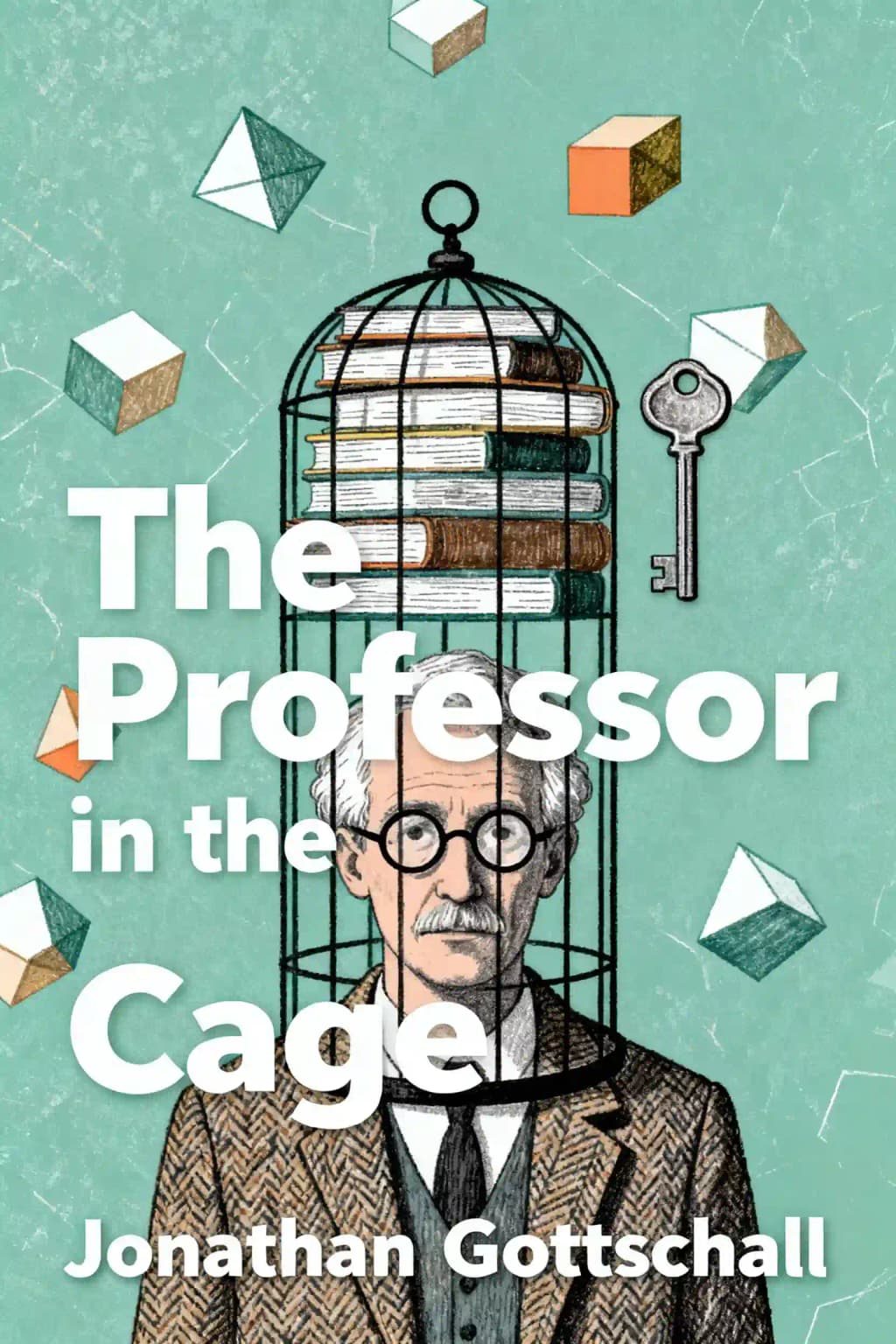
The bell rings. Two men charge at each other in a chain-link octagon. One is a 39-year-old English professor with no fighting experience. The other is a muscular young man trained in mixed martial arts. The crowd roars as they collide, civilization momentarily suspended while they attempt to incapacitate each other. This isn't some bizarre nightmare-it's Jonathan Gottschall's reality, meticulously documented in "The Professor in the Cage." This surprising bestseller became Joe Rogan's enthusiastically recommended "f*cking great book" and was hailed by the Boston Globe as one of 2015's best reads. What drives a mild-mannered literary scholar to step into the brutal world of cage fighting? The answer reveals profound truths about masculinity, violence, and the rituals that keep our primal instincts in check. Gottschall's journey began when, stuck in a dead-end academic position, he gazed out his office window at an MMA gym across the street and wondered: What if I crossed that threshold? What would I discover about violence, about men, and about myself?
Глава 2
The Riddle of Honor and Dueling
Why would intelligent men risk everything over mere words? This question haunted Gottschall as he studied the history of dueling, particularly its paradoxical nature where educated, rational men would stake their lives on matters that seem trivial to modern observers. In 1801, Philip Hamilton, just twenty years old, died in a duel after refusing to apologize for an insult at a theater. Just three years later, his father Alexander Hamilton-despite witnessing his son's agonizing death and understanding the devastating consequences-died in the infamous duel with Aaron Burr at Weehawken, the same fatal ground. Hamilton, a brilliant legal mind and founding father, knew the risks intimately but couldn't back down because in dueling culture, honor wasn't merely abstract-it represented a man's entire social worth, his creditworthiness, and his standing in society. When devalued, a man's professional prospects, social connections, and his family's future were irreparably ruined.
This muscular honor culture persists today, most extremely in modern prisons where inmates fight over perceived "respect" and seemingly minor infractions. As Jimmy Lerner's haunting prison memoir "You Got Nothing Coming" illustrates, failing to retaliate against even small slights marks one as weak prey, inviting increasingly aggressive challenges. The prison equation is ruthlessly simple: not fighting over trifles declares "I am food" to predatory inmates. Hamilton fought Burr not from bravery but from a deep-seated fear-dodging the duel would have destroyed his hard-won reputation, ended his political ambitions, ruined his lucrative legal practice, and tainted his entire family with the stain of cowardice for generations.
The formal duel, paradoxically, actually civilized violence through a complex system of clear rules, formal protocols, and crucial delays between challenge and combat, allowing hot rage to cool and often enabling peaceful resolution. Victory in these encounters came not from superior skill with pistols but from showing up and facing fear without flinching-the willingness to die for honor was more important than the ability to kill. For Gottschall, training for MMA meant enduring two years of mild background anxiety punctuated by moments of stark terror-not primarily fear of physical injury, but the deeper fear of showing cowardice in front of others. He nearly abandoned his fight when he realized other writers, including Sam Sheridan and Matthew Polly, had already documented similar journeys, but his gym mates accused him of "pussying out." Like Hamilton two centuries before, he ultimately fought because he was too much of a coward not to fight-and for all the times in his youth when he'd been too afraid to stand up to bullies, choosing instead to live with the quiet shame of backing down.
Глава 3
The Monkey Dance: Ritual Combat Across Species
Dueling isn't uniquely Western or even human-it's an elaboration of natural conflict resolution patterns found across species. Gottschall's observation of two male chimpanzees in conflict at the San Diego Zoo revealed three fundamental features that mirror human confrontations: physical confrontation is predominantly male, actual violence is relatively rare compared to threats and displays, and fights typically end before severe injury occurs. This "ritual combat" appears across diverse species from beetles to bears, allowing animals to resolve conflicts while minimizing risk of death or serious injury. Even among highly aggressive species like elephant seals, most confrontations end with displays rather than violence.
Self-defense expert Rory Miller's concept of the "monkey dance" describes human confrontations as a ritualized progression with specific, predictable steps: hard stare, verbal challenge, closing distance, chest bumping, and finally punching. These steps are remarkably consistent across cultures and contexts, from bar fights to schoolyard confrontations. Despite ritual combat's evolutionary purpose of reducing risk, it remains a leading cause of male mortality in both animals and humans, with studies showing that 50-70% of homicides begin as "altercations of relatively trivial origin," often over perceived insults or status challenges.
Presidential debates provide a fascinating window into primate dominance displays in modern political contexts. The first 2012 debate between Obama and Romney illustrates this perfectly. While transcripts might suggest a draw, Romney's commanding body language-sweeping gestures, direct eye contact, and upright posture-contrasted sharply with Obama's downcast gaze and constrained movements. Detailed analysis showed Obama looked down 500 times more than Romney, signaling submission in primate terms. The impact was so significant that Obama's team completely revamped his physical presence for the second debate, where he matched Romney's physicality on the open stage, demonstrating how deeply embedded primate dominance rituals remain in our highest political contests.
Human sensitivity to gaze and dominance cues runs remarkably deep. We can detect shifts in another person's gaze direction of just one centimeter, and typically limit direct eye contact to 1-2 seconds in normal conversation to avoid triggering confrontation responses. Research shows men constantly engage in mutual assessment, evaluating height, muscularity, and perceived toughness, even from facial cues alone. Brain imaging studies reveal that men's amygdalas activate more strongly than women's when processing dominant faces. Unlike women, who can maintain longer eye contact comfortably in social situations, men engage in "staring endurance" contests identical to those of other primates, where dominance is established by who can withstand the stress-hormone surge longest without looking away. These contests trigger measurable spikes in cortisol and testosterone, demonstrating the physiological reality of these ancient dominance rituals.
Глава 4
The Biology of Male Aggression
Male reproductive competition is deeply embedded in our DNA, with genetic studies revealing a striking pattern: we have twice as many different female ancestors as male ancestors. This disparity illuminates maleness as a high-stakes evolutionary game where historically, men faced a stark reality - roughly half died without passing on their genes, while successful competitors achieved extraordinary reproductive success. Genghis Khan represents perhaps the most extreme example, with genetic evidence suggesting he has approximately 16 million male descendants alive today. Unlike women, who rarely faced complete reproductive failure, men confronted intense pressure to compete or risk genetic extinction.
This evolutionary history manifests in profound physical differences between the sexes. Men developed substantially greater muscle mass - not just 20% heavier overall than women, but 40% heavier in fat-free mass, 60% more lean muscle, and 80% more arm muscle. The sex difference in upper-body strength is particularly dramatic: only one in a thousand women can outlift the average man - a level of sexual dimorphism comparable to gorillas, our most sexually differentiated primate relatives. These differences extend beyond just raw strength - men also have denser bones, faster reaction times, and greater cardiovascular capacity.
When Gottschall questioned his daughters about the meaning of "being a man," their responses revealed internalized cultural expectations: his eight-year-old answered "be tougher" while his five-year-old said "being strong." These perceptions aren't merely Western constructs - cross-cultural studies spanning thirty diverse societies, from hunter-gatherer groups to industrial nations, show remarkable consistency in gender perceptions. Men are universally seen as more active, adventurous, dominant, forceful, independent and strong. Both sexes consistently rate women more favorably than men in terms of likability and warmth (termed the "WAW Effect" - Women Are Wonderful), suggesting deep-rooted psychological biases.
These stereotypes persist because they reflect genuine personality differences that emerge before children even understand gender concepts, challenging pure socialization theories. Modern research shows these differences appear as early as nine months of age, well before conscious gender awareness. Schools actually tend to discourage traditionally "masculine" behaviors, while studies of parenting show surprisingly little difference in how parents treat sons versus daughters in most contexts. The fundamental behavioral distinction between girls and boys remains consistent across cultures: "girls play; boys play fight." This difference manifests in social organization - boys establish clear dominance hierarchies based primarily on strength and athletic ability, with social status at age six remarkably predictive of social standing in young adulthood. These hierarchies serve as training grounds for adult male competition, teaching crucial lessons about status, alliance-building, and conflict resolution.
Глава 5
The Martial Arts Myth
The author's journey through traditional martial arts revealed deep-seated problems with many classical fighting systems. His karate training became a source of growing skepticism when he realized it failed to address crucial aspects of real combat, particularly ground fighting. During one pivotal session, when he asked his sensei about defensive strategies if taken down in a fight, the sensei's dismissive response "Just don't get taken down" exemplified the rigid, unrealistic thinking prevalent in traditional dojos. This exchange highlighted how many traditional martial arts schools avoid addressing their systems' limitations, instead maintaining an illusion of completeness that leaves practitioners vulnerable in real-world situations.
Kyokushin karate, while physically demanding, operated more like a religious cult than a practical fighting system. At its center stood Mas Oyama, nicknamed "the Godhand," whose legendary status grew to mythical proportions. His followers claimed he possessed almost superhuman abilities, including killing a yakuza gangster with a single punch, defeating 270 fighters during an American tour, overwhelming 300 karate experts in a three-day marathon, and perhaps most famously, fighting and defeating bulls with his bare hands. However, when investigated, many of these stories crumbled under scrutiny. Former students and associates of Oyama have since revealed these tales as exaggerations or complete fabrications, crafted to build a mystique around the style's founder. This pattern of mythologizing founders remains common in traditional martial arts, where historical figures are elevated to nearly divine status.
The martial arts publishing industry further perpetuates these unrealistic expectations through what became known as the "how-to ninja" genre. Books like "Shadow Warrior" made outlandish claims about teaching supernatural abilities, including mind reading, invisibility, and psychic power development. "Ninja Mind Control" went even further, promising deadly techniques for ambush and assassination, feeding into popular ninja fantasies while having little basis in reality. These publications exemplify how Asian martial arts often transform into quasi-religious systems, complete with their own mythology, founding demigods, and mystical concepts like chi (internal energy). This religious-like devotion to tradition and supernatural elements actively prevents these systems from evolving through scientific testing and skeptical inquiry.
The effectiveness myth surrounding traditional martial arts faced its most significant challenge during the early Ultimate Fighting Championship (UFC) events. Royce Gracie, weighing only 170 pounds, revolutionized combat sports by consistently defeating larger opponents using Brazilian jiu-jitsu (BJJ). His success exposed the limitations of traditional striking arts when confronted with ground fighting. However, even Gracie's dominance proved temporary - once other fighters adapted by learning BJJ, American wrestlers emerged as the new dominant force in mixed martial arts (MMA). This evolution demonstrated how practical, tested fighting methods ultimately prevail over traditional systems that resist change and empirical validation. The rise of MMA has continued to challenge traditional martial arts' assumptions, forcing many practitioners to confront the reality that their training might not prepare them for actual combat situations.
Глава 6
Sports as Ritual Combat
Sport is another form of the monkey dance-a ritualized combat equivalent to animal contests. While comparing human sports to animal battles may seem absurd, biologists routinely make this comparison. Male gazelles don't sneak-attack each other but engage in contests of strength following fixed rules-more tournament than fight. The key difference is that animal sports are purely instinctive while human sports are culturally elaborated, yet beneath their diversity, all sports share the same purpose: providing safe, rule-bound ways to demonstrate physical prowess and mental toughness.
For men in particular, forming functional male groups was historically a matter of survival, but so was the ability to compete within those groups. Sports evolved as nature's solution to this problem-allowing men to compete intensely without destroying their social bonds. This explains why men transform harsh fighting words and physical roughhousing into expressions of affection. When Gottschall's brother tackled him at an airport, it was actually saying "I love you, but I hardly see you. That makes me sad. And that's why I'm so happy now."
The gym functions through a balance of trust and competition. Each man must protect his partners (releasing chokeholds when tapped) while simultaneously competing for dominance. Though they hope to win, they don't aim to harm. The competition remains civilized because their dominance hierarchy is clear-everyone knows who would win in a real fight. Subordinates give clear submission signals to dominants, as when the author humorously buried his head in Clark Young's chest before sparring, pleading "I've got a family."
Athletes enjoy greater sexual success because their status signals desirable traits. From high school jocks to ancient gladiators to wrestlers in traditional societies worldwide, athletic prowess correlates with sexual opportunity. Women are attracted to athletic physiques because the features that make men beautiful-broad shoulders, swollen muscles-signal formidability and capacity for protection. Unlike men who seek reproductive cues in women (fertility signals), women select mates based on production cues (ability to do work). As anthropologist David Puts argues, "men seek physical beauties, while women seek physical beasts."
Глава 7
War Games: The Tribal Psychology of Sports
Sports fandom is an ancient phenomenon, not just a modern quirk. Historian Allen Guttmann found evidence of passionate sports spectators across ancient civilizations, including Greek vase art showing screaming fans. Roman chariot racing inspired such devotion that some fans would examine horse dung to ensure proper feeding. These fans divided into color-coded factions (reds, whites, greens, blues) and engaged in violent riots despite having no meaningful demographic differences between groups.
As Jerry Seinfeld observed, this loyalty seems irrational-fans essentially root for clothes, not people. Team sports generate more passionate followings than individual sports because they activate tribal instincts. This explains why MMA crowds are tamer than football or soccer fans, why Roman gladiator audiences were better behaved than chariot race spectators, and why boxing declined when it stopped promoting tribal conflicts (Irish vs. Italian, black vs. white).
American football evolved from rugby over 140 years, beginning with dangerous "massed play" where offenses would arrange players in military-style wedge formations and target individual defenders repeatedly. Dangerous tactics included hurdling (throwing small ball carriers over the scrum), ramming, and defensive flying dropkicks. The game was not just violent but "dirty violent"-players were allowed two free fouls before ejection. In 1905, football caused 18 deaths and 159 severe injuries; by 1909, those numbers rose to 30 deaths and 216 injuries.
Though modern sports have evolved away from their warlike roots, football retains its essential character as a war game. Its vocabulary (bullets, bombs, trenches, blitzes) and metaphors (warriors, battles, field generals) reveal its true nature-a ritualized battle between tribal communities, just like the sham battles of ancient knights and tribal warriors worldwide.
Throughout history, nations depended on young men's physical strength and valor. The Duke of Wellington supposedly claimed "The battle of Waterloo was won on the playing fields of Eton," where rough games cultivated warlike qualities. Though possibly apocryphal, Wellington did write that boxing produced "national spirit of undaunted bravery" that enabled military victories.
Глава 8
Our Complicated Relationship with Violence
Men show a stronger preference for violent entertainment than women, starting from childhood. Despite decades of efforts to de-masculinize boy play through gender-neutral toys and educational approaches, numerous psychological studies consistently show boys strongly prefer potentially violent scenarios and characters over non-violent ones, while girls express opposite preferences. This pattern appears across cultures and socioeconomic backgrounds, suggesting deeper biological roots rather than purely social conditioning.
The author reflects on his own childhood of nonstop war play with neighborhood boys, despite his liberal parents' disapproval. They would spend hours creating elaborate battle scenarios, fashioning weapons from sticks and toys, and organizing themselves into armies - behavior that emerged spontaneously without adult encouragement. This mirrors anthropological observations of similar play patterns in societies worldwide, where young males naturally gravitate toward mock combat and competitive physical activities.
He explains that real warriors experience war as both hellish and heavenly-a confusing duality where combat feels simultaneously like the worst and best experience of their lives. Combat veterans describe the horror of seeing friends die and experiencing extreme fear, yet simultaneously report feeling more alive and purposeful than ever before. Quoting combat veteran William Broyles Jr., he describes how men often can't explain to loved ones that when war ended, they lost "perhaps the great-love of their lives." This paradox appears in countless war memoirs and veteran interviews, suggesting it's a fundamental aspect of male psychology rather than an aberration.
Men don't simply love or hate war-they love-hate it. From Robert E. Lee observing "It is well war is so terrible; we should grow too fond of it" to Vietnam veterans describing combat's ecstasy, soldiers frequently compare battle's intensity to sexual pleasure-not because combat is literally arousing, but because sex is the only comparable experience in intensity. This comparison appears repeatedly throughout military literature, from ancient Greek writings to modern war memoirs, suggesting a deep connection between violence and male psychology.
MMA fighters struggle to describe winning a fight, often comparing it to sex or drugs. The rush of adrenaline, the feeling of power, and the primitive satisfaction of physical dominance create a cocktail of sensations that many find addictive. Gottschall's coach bluntly admitted: "A fighter may be the nicest guy on the street, but once he's in a fight, he has to like it." The coach described his own mindset: "I wanna see your blood. I'm going to fuck you up!" while noting he'd buy his opponent a beer afterward. This duality - the ability to switch between controlled aggression and social harmony - appears to be a crucial aspect of male psychology.
This revelation troubles Gottschall, who joined MMA hoping to master violence without embracing its darker aspects. Yet as his training progresses, he discovers his own capacity for aggression, finding himself drawn into the primal satisfaction of combat. After landing a devastating front kick on a sparring partner, he feels both apologetic and secretly pleased. He admits that physically dominating another man is "intoxicating" and "deeply satisfying," understanding how fighters can develop a taste for it. This personal transformation forces him to confront uncomfortable truths about male nature and our species' complex relationship with violence.
Глава 9
The Final Fight: Lessons from Defeat
As Gottschall prepares for his fight, his daughters discover his plans. Six-year-old Annabel pleads, "Please don't, Daddy. I don't want you to die," while nine-year-old Abby predicts he'll "lose bad." He sheds twelve pounds through starvation and fluid loss, briefly achieving his ideal physique before immediately regaining half a pound per hour after weigh-in by gorging on food and liquids.
On fight night, his fear has largely dissipated-partly because there's nowhere to hide in a cage, but mostly because he no longer feels like "a lamb awaiting slaughter." For the first time, he feels tough and capable, having proven he can take a punch and keep fighting. Though not cocky, he believes he might be up to the challenge. When the bell rings, he has "zero desire to beat his opponent up" but is "desperate to beat him."
The fight ends quickly-trapped in his opponent's arm bar submission hold with his elbow about to break, he has no choice but tap out after just 47 seconds despite fifteen months of training. Driving home at midnight, nursing his aching arm and gorging on gas station food, he reflects on the humiliation of tapping out, which in "MMA sign language" means acknowledging total submission: "Please stop. I admit you are the better man. I acknowledge that you could end my life-right now-if you chose to."
After the fight, he meets his opponent Justin McCloskey in the stands. They share beers-a ritual of small-time MMA shows reminiscent of 17th-century Amsterdam duelists who would "drink away" their troubles after knife fights. They discuss their performances and motivations for fighting. Despite part of him wanting to fight again to prove himself, the author declares his retirement at age thirty-nine. In a final ironic twist, he learns that his opponent-the skilled fighter who defeated him-is studying to become a nurse.
The author reflects on how fights simultaneously display humanity's worst and best qualities. Fighting creates conditions of extreme adversity that call forth heroism, allowing men to demonstrate their courage. He challenges the notion that MMA fans are bloodthirsty troglodytes, describing the knowledgeable, civil atmosphere at events where communities gather to support fighters in controlled rites of passage. Despite the physical toll (chronic injuries to his wrists, toes, Achilles, groin, and neck), the author continues training because "fighting is a good drug" that makes life more intense and meaningful: "I'm not ready to slide down off the steeps of life-down, down to the long, dull flats."