Глава 1
The Sword of Submission: Unveiling Islam's Complex Relationship with Non-Believers
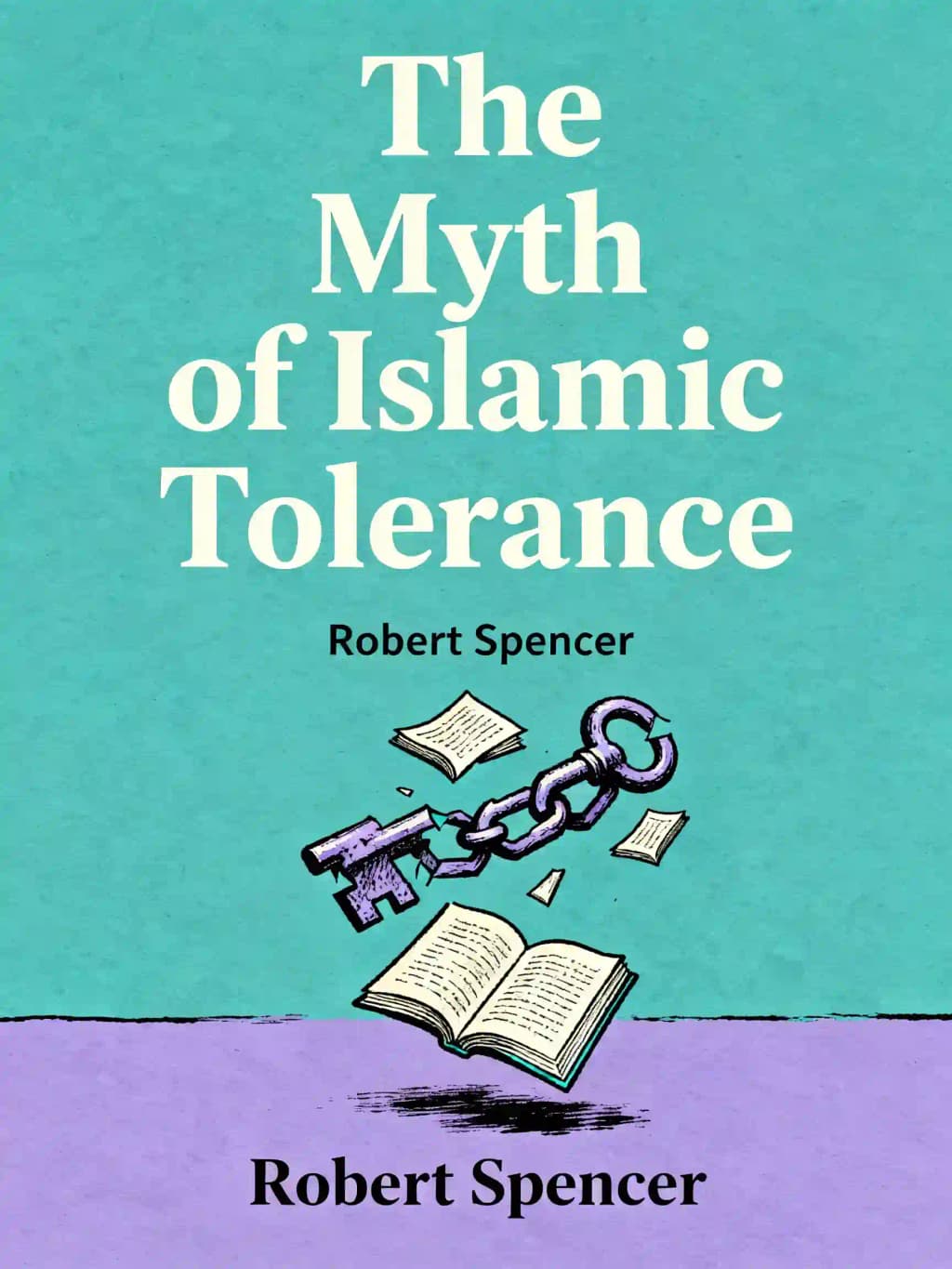
The Council on American-Islamic Relations recently launched a high-profile advertising campaign claiming Muslims and Christians share "universal values of love, peace, and forgiveness." This effort represents a broader strategy to present Islam as benign and closely aligned with Christianity and Judaism. This campaign has been remarkably successful in establishing what author Robert Spencer calls a "secular faith in Islam" among influential sectors of American society. At its core lies an unquestioned assumption: historically, Islam has been tolerant toward non-Muslims. When terrorist attacks occur in places like Madrid or Istanbul, commentators invariably remind us these locations were once beacons of Muslim tolerance where Jews and Christians supposedly lived in harmony with their Muslim rulers. This narrative of Islamic tolerance has become so deeply embedded that millions accept it without question, despite substantial historical evidence to the contrary.
Глава 2
The Myth's Origins: Political Expediency Over Historical Accuracy
The myth of Islamic tolerance emerged primarily as a political creation, gaining prominence through 19th-century European political machinations in the Balkans. European politicians, particularly British and French diplomats, actively promoted the narrative that Ottoman rule over Christians was just and lawful. This fabrication served two strategic purposes: maintaining the precarious balance of power in Europe and creating a buffer against Russian expansion toward the Mediterranean. The myth gained particular momentum during the Crimean War (1853-1856), when Britain and France allied with the Ottoman Empire against Russia.
The narrative achieved academic legitimacy and near-untouchable status through Edward Said's influential 1978 publication "Orientalism." Said's work, while groundbreaking in many respects, effectively made it academically taboo to question Islamic tolerance, labeling such inquiries as manifestations of Western prejudice. This intellectual framework has persisted in academia, despite mounting historical evidence to the contrary.
The historical reality documented in contemporary sources painted a markedly different picture. Non-Muslims in Ottoman territories faced systematic discrimination codified in Sharia law. These restrictions included prohibitions against building new churches, riding horses, bearing arms, and requirements to wear distinctive clothing marking their inferior status. The jizya tax, levied exclusively on non-Muslims, created additional economic hardship. In 1860, British Consul James Zohrab's detailed report from Sarajevo revealed that Christians' deep-seated hatred toward Bosniak Muslims stemmed from "nearly 300 years" of "oppression and cruelty" where "no other law but the caprice of their masters existed." Similar accounts from other European consuls across the Ottoman Empire consistently documented systematic discrimination.
This historical myth continues to shape contemporary political discourse and policy decisions. European nations with growing Muslim populations frequently invoke al-Andalus as a model of interfaith harmony, despite historical evidence of periodic persecution during this period. Law enforcement agencies are often discouraged from monitoring mosques and Islamic centers, even when credible security concerns exist. Terrorist actions are frequently framed as completely disconnected from religious ideology, despite perpetrators explicitly citing religious motivations.
When radical Muslim groups openly declare their intention to establish a global caliphate governed by sharia law, Western leaders often respond with calls for dialogue while downplaying legitimate security concerns. Canada's former Foreign Minister Bill Graham exemplified this approach, promoting "bridges of understanding" while dismissing evidence of radical elements within Muslim communities. This pattern of response, rooted in the myth of historical Islamic tolerance, has complicated efforts to address security challenges and integration issues in Western societies.
Глава 3
The Qur'anic Foundation: Theological Hostility Toward Non-Muslims
The Qur'an's portrayal of Jews and Christians is overwhelmingly negative, establishing a theological framework that profoundly influenced Islamic attitudes toward non-Muslims. While some verses suggest potential salvation for "People of the Book" (Ahl al-Kitab), particularly in early Meccan revelations, the dominant narrative condemns them as faithless corrupters who have rejected Allah's final revelation out of malice and stubbornness. Jews are repeatedly charged with serious transgressions: covenant-breaking (naqd al-mithaq), prophet-slaying (qatl al-anbiya), scripture-distorting (tahrif), and blasphemy (kufr), with Allah's curse (la'na) explicitly pronounced upon them in multiple verses.
Christians face similarly harsh criticism, particularly condemned for three major doctrinal points: their Trinity doctrine (which the Qur'an specifically mischaracterizes as worship of Jesus and Mary alongside Allah), belief in Jesus's divinity (calling him "Son of God"), and the crucifixion (which the Qur'an denies occurred). Verses like 5:73 explicitly declare that "They have certainly disbelieved who say Allah is the third of three."
Most significantly, Sura 9:29 establishes a clear hierarchical relationship, commanding Muslims to fight Jews and Christians "until they pay the jizya with willing submission and feel themselves subdued." This verse, revealed late in Muhammad's life, has historically been interpreted as the definitive statement on interfaith relations. The Qur'an further warns Muslims against taking Jews and Christians as awliya (friends/protectors/allies), stating in 5:51 that "he amongst you that turns to them is of them" - effectively declaring that such Muslims have left the faith.
The Hadith collections significantly amplify this negative portrayal with more explicit condemnations. These authenticated traditions describe Jesus's future return not as the Christian messiah but as a Muslim who will "break the Cross," "kill pigs," abolish the jizya tax, and effectively end Christianity by revealing its "corruption." Multiple hadiths in Sahih Muslim and Sahih Bukhari quote Muhammad declaring that any Jew or Christian who hears of his message but doesn't believe "shall be but one of the denizens of Hell-Fire."
Particularly influential is a hadith in Sahih Muslim outlining Muhammad's three-step approach to dealing with non-Muslims: first invite them to Islam (da'wa), if refused then demand jizya tax, and if that's refused, "seek Allah's help and fight them." This graduated response became a template for Islamic expansion and treatment of conquered peoples. Additional hadiths reinforce spatial segregation, commanding that Jews and Christians not be greeted first, be forced to use the narrower part of the road, and that "two religions shall not co-exist in the Arabian Peninsula."
This theological foundation of hostility makes the popular modern narrative of historical Islamic tolerance particularly difficult to reconcile with Islam's primary texts. The Qur'anic and hadith attitudes toward non-Muslims established a framework of religious supremacy that would significantly influence Islamic law and society.
Глава 4
The Legal Framework: Systematic Inequality Under Islamic Law
Islamic jurisprudence developed a remarkably consistent legal structure for the treatment of non-Muslims across all major schools of thought - Hanafi, Maliki, Shafi'i, and Hanbali. Contemporary Saudi sheikh Marzouq Salem al-Ghamdi's sermon outlines conditions nearly identical to those found in classical sources dating back to the earliest Islamic legal texts. These stipulations require that dhimmis must pay the jizya tax, cannot renovate existing churches or monasteries or build new ones, must feed and lodge Muslims who pass by their homes for up to three days, must rise when Muslims wish to sit, and cannot imitate Muslims in dress, speech, or manner of riding animals.
The restrictions extend further: dhimmis cannot ride horses or bear arms (though they may ride donkeys), cannot sell wine or pork, cannot display crosses or religious symbols, must shave their forelocks to be identifiable, and cannot strike a Muslim even in self-defense. These rules were codified in the "Pact of Umar," traditionally attributed to the second caliph, which became the template for dhimmi treatment throughout Islamic history.
The 14th-century manual 'Umdat al-Salik, which continues to be endorsed by Cairo's Al-Azhar University as conforming to "orthodox Sunni" practice, elaborates on these restrictions in detail. It mandates that dhimmis must be distinguished by specific dress codes (including wearing distinctive belts called zunnar), must keep to the side of streets when Muslims pass, must build their houses lower than those of Muslims, and are forbidden from displaying religious symbols or ringing church bells. The manual also specifies that dhimmis cannot testify in Islamic courts against Muslims and their oath is not considered valid in legal proceedings.
As Islamic legal scholar Joseph Schacht summarized, "The basis of the Islamic attitude towards unbelievers is the law of war; they must be either converted or subjugated or killed." This principle derives from various Quranic verses and hadiths, particularly Surah 9:29, which commands fighting against People of the Book until they pay the jizya with willing submission.
While these laws aren't strictly enforced in most modern Islamic states (with notable exceptions like Saudi Arabia, which bans all non-Muslim religious practice entirely), centuries of enforcement have produced deeply ingrained cultural attitudes that contribute to ongoing discrimination against non-Muslims throughout the Islamic world. This historical legacy manifests in contemporary cases like that of Robert Hussein Qambar Ali, a Kuwaiti convert to Christianity who faced apostasy charges in 1996 despite Kuwait's constitutional guarantee of religious freedom. When his home was burglarized and vandalized, Hussein knew reporting it to authorities was pointless, stating: "It is not a crime to steal or vandalize the property of an apostate."
Similar cases continue to emerge across the Muslim world, from Egypt's restrictions on church building to Pakistan's blasphemy laws, demonstrating how classical Islamic legal frameworks continue to influence modern treatment of religious minorities, even in nominally secular states.
Глава 5
Modern Radical Theorists: Reviving Traditional Intolerance
Modern radical Muslim theorists have fueled intolerance toward non-Muslims through their influential writings, establishing intellectual frameworks that continue to shape extremist thought today. Sayyid Qutb, the Egyptian Muslim Brotherhood theorist executed in 1966, stands as perhaps the most influential of these modern thinkers. In his extensive Qur'anic commentary "Fi Zilal al-Qur'an" (In the Shade of the Qur'an), he writes venomously of Jews and Christians, developing elaborate conspiracy theories about their supposed eternal enmity toward Islam. He claims Jews have "been behind every calamity that has befallen the Muslim communities everywhere" while Christians have been "no less hostile," citing everything from the Crusades to modern colonialism as evidence.
For Qutb, this hostility isn't circumstantial but represents permanent attitudes described in the Qur'an as established facts. His interpretation of verses like "Never will the Jews nor yet the Christians be pleased with you unless you follow their faith" (2:120) goes beyond traditional readings to argue these are "definitive statements describing permanent attitudes" that make meaningful coexistence impossible. This represents a significant hardening compared to classical interpretations that often viewed such verses in their specific historical context.
Qutb develops this into a comprehensive political theory, arguing Islam must "remove all physical and material obstacles" to "liberate mankind from submission to anyone other than God." This liberation, in his view, requires smashing the power of non-Muslim authorities until they "declare their submission" through paying the jizya tax. His writings particularly emphasize confrontation with secular governments and Western influences.
Similarly, Indian theorist Sayyid Abdul Ala Maududi (1903-1979) developed parallel theories through his influential organization Jamaat-e-Islami. Maududi asserts Muslims must fight non-believers to "put an end to the sovereignty and supremacy of the unbelievers" because "authority to rule should only be vested in those who follow the true faith." His works explicitly reject democracy as "spiritual evil," arguing that human-made laws and institutions represent a form of idolatry that usurps divine authority.
These deeply traditionalist views explicitly reject not only democracy but also socialism, nationalism, and other modern ideologies as un-Islamic alternatives. Their influence extends far beyond their original contexts - Qutb's writings have inspired movements from al-Qaeda to ISIS, while Maududi's theories have shaped Islamist politics across South Asia. Both thinkers developed sophisticated theoretical frameworks that continue to provide intellectual ammunition for radical movements seeking to justify intolerance and violence against both non-Muslims and Muslims deemed insufficiently orthodox.
Глава 6
Historical Reality: The Dhimmi Experience Under Islamic Rule
The historical record reveals that Jews and Christians had lived throughout the Orient, Egypt, and North Africa for centuries before being overrun by Islamic invaders from Arabia in the seventh century. While initial administrative tolerance was dictated by expediency, as Arab colonization took root, conditions for local populations worsened. Surviving Jewish and Christian communities were relegated to an inferior status of subjection and humiliation as ahl al-dhimma-protected peoples tolerated in Muslim lands but subjected to disabilities and humiliations under the Covenant of Umar.
European travelers consistently reported the degraded position of Jews in Muslim countries. Romanian Jew "Benjamin II" compared the plight of Jews under "oriental barbarism and fanaticism" to their European brethren living under liberal regimes. Jacob Saphir, who fled Safed after the 1836 pogroms, described the suffering of Yemeni Jews as "baffling all description."
In Morocco, General Domingo Badia y Leblich observed Jews living "in the most abject state of slavery" in the early nineteenth century. They were forced to wear distinctive black clothing, remove their footwear when passing mosques or houses of Muslim officials, and in Fez were required to walk barefoot throughout the city. When asked why they didn't leave, Jewish servants replied they couldn't because they were "slaves of the sultan."
William Shaler, U.S. consul in Algiers (1816-1828), described the ten thousand Jews there as "a most oppressed people" who couldn't resist any violence from Muslims. They were forced to wear dark clothing, forbidden from riding horses or carrying weapons (not even canes), and permitted to leave the city gates only on Saturdays and Wednesdays without special permission. During seditions, Jews were "indiscriminately plundered" and even in normal times were "pelted in the streets even by children."
Глава 7
The Dhimmi System: Institutionalized Oppression
After the Arab conquest, "dhimmi" designated indigenous non-Arab, non-Muslim peoples whose territories fell under Arab-Muslim domination. These peoples were theoretically "protected" through specific conditions in a covenant between victors and vanquished, but in return had to submit to numerous restrictions under the Covenant of Umar.
The dhimmi system imposed comprehensive economic exploitation and political discrimination. Economically, dhimmis paid the kharaj (land tax) symbolizing Arabization of their land, and each male paid the jizya (poll tax) symbolizing subjection. They paid double the taxes of Muslims and faced frequent extortion of ransoms under threat of collective punishment.
Political discrimination was severe. Dhimmis were forbidden on pain of death to carry weapons, raise a hand against Muslims, criticize Islam, convert to any religion except Islam, or hold authority over Muslims. They were forced to live separately from Muslims, have shorter houses, practice religion secretly, wear distinctive clothing, and maintain a humiliated demeanor-walking with lowered eyes, accepting insults without reply, and yielding to Muslims in public spaces.
In legal matters, dhimmi testimony against Muslims was inadmissible. Punishments for crimes were unequal, with murder of a dhimmi carrying lighter penalties. In North Africa and Yemen, Jews were forced to perform repugnant duties like cleaning public latrines, even on holy days.
The economic exploitation of dhimmis was central to the conqueror's system. Having dispossessed the conquered populations, the conquerors strengthened their hold by weakening indigenous populations through economic exploitation and inequitable laws. The empire's expansion relied on a Bedouin army maintained through dhimmi exploitation. Dhimmis became merely "an exploitable human mass" providing corvee labor at will, tolerated with either condescension or animosity depending on the empire's economic and strategic needs.
Глава 8
Contemporary Manifestations: Dhimmitude in the Modern World
In the modern age, rather than seeing reform of the dhimmi system of intolerance, we've witnessed retrenchment. Though partially set aside during the Ottoman Empire's decline and Western colonialism in Islamic regions, the legal superstructure of dhimmitude was never repudiated in theory. Today, radical Muslims have revived it as part of their traditionalist emphasis on Islamic sources.
The behavior of Christian dhimmis varies by country, social category, and association with ruling classes. Because Christian dhimmi populations are typically highly skilled and better educated, they often suffer from jealousy coupled with traditional anti-Christian prejudices. Christian attitudes can be classified in three categories: active resistance, passive resistance, and collaboration.
Active resistance examples include Christian rebellion against Sharia in Sudan (causing over 2 million deaths), Lebanese Christians fighting Islamization during the 1975 civil war, and Armenian/Assyrian Christians who faced genocide for independence attempts. Christians actively resisting Islamization in Indonesia, Nigeria and other African countries face massacres and village burnings, while Westerners often blame them for their own misfortunes.
Passive resistance occurs in Egypt, Pakistan, and Iran, where Christians denounce violence against them and strive to protect dignity, reduce discrimination, and secure basic rights like church building permissions. The West largely ignores their situation.
Around 40 million Christians live as minorities in Muslim-majority countries today, ranging from 15 million in Indonesia to just dozens in countries like the Maldives. In Saudi Arabia, national Christians must keep their faith secret or face execution. Christians in Muslim countries are generally treated as second-class citizens, facing discrimination in education, employment, and from authorities. They're often suspected of giving primary loyalty to the "Christian" West rather than their homeland, based on traditional Islamic teaching that Christians and Jews should be subjugated and made to pay jizya tax.
Глава 9
The International Arena: Islamism at the United Nations
Representatives of Muslim states have demanded and often received special treatment at the UN Commission on Human Rights. Non-diplomatic terms like "blasphemy" and "defamation of Islam" have entered the UN system, leading non-Muslim governments to accept rules conforming to Islamic law and maintain silence on Islam-related topics.
In 1990, the Islamic Conference of Foreign Ministers adopted the Cairo Declaration on Human Rights in Islam (CDHRI), which explicitly states that all rights and freedoms are subject to Islamic Sharia law, which is "the only source of reference" for explaining any articles of the declaration. This gives Sharia supremacy over the Universal Declaration of Human Rights. Despite this contradiction, the UN Office of the High Commissioner for Human Rights published the CDHRI in 1997, giving it authority within the UN system.
In 1999, OIC countries introduced a resolution condemning "defamation of Islam" at the UN Commission on Human Rights. Pakistan's ambassador compared criticism of Islam to antisemitism and cited the 1997 "blasphemy" decision as precedent. Western countries refused to accept a resolution focused exclusively on Islam, leading to a compromise titled "Defamation of Religions." Despite this neutral title, Islam remained the only religion specifically mentioned in the text, which expressed "deep concern that Islam is frequently and wrongly associated with human rights violations and with terrorism."
The new rules of conduct being imposed by the Organization of Islamic Conference and accepted by other states give those claiming to represent Islam an exceptional status at the United Nations with no legal basis or precedent. This raises serious concerns about whether prohibitions on discussing certain political aspects of Islam will become generally accepted at the UN, contradicting "the right to freedom of opinion and expression" guaranteed by Article 19 of the Universal Declaration of Human Rights.
Глава 10
Challenging the Myth: Toward Genuine Reform
The myth of Islamic tolerance has become so deeply entrenched that non-Muslims themselves now frequently lecture Muslims about the "true" nature of Islam. Former Archbishop of Canterbury George Carey claimed that Islamic extremism "does not reflect the true values of Islam," while American officials like Judge Robert Jones told convicted jihadists they were "an insult" to the Muslim faith. Similar statements have been echoed by political leaders, academics, and religious figures across the Western world, often presenting an idealized version of historical Islamic governance.
However, this approach fundamentally misunderstands the historical and theological realities of Islamic doctrine regarding non-Muslims. The complex legal framework of dhimmitude, developed over centuries through Islamic jurisprudence, created a comprehensive system of religious discrimination that cannot be dismissed as mere cultural practice. By perpetuating the myth of Islamic tolerance rather than confronting these problematic aspects of Islamic jurisprudence, Western leaders and academics inadvertently make genuine reform more difficult. Their well-intentioned but historically inaccurate narratives often prevent honest dialogue about necessary changes in Islamic law and practice.
If Muslims wish Christians and others to view an Islamic political order as attractive, their scholars must engage in substantial ijtihad (independent reasoning) to revise elements of Islamic jurisprudence particularly offensive to non-Muslims. This would require not only abandoning the dhimmi archetype but also developing new theological frameworks that recognize full religious equality and the Jewish people's right to national sovereignty. Such reforms would need to address specific aspects of traditional Islamic law, including restrictions on religious practice, discriminatory taxation, and limitations on political participation.
President Sadat's historic 1977 visit to Jerusalem represented a profound break with thirteen centuries of tradition. By meeting with Menachem Begin, shaking his hand, and engaging in direct communication, Sadat rejected the dehumanizing "dhimmi Jew stereotype" that had been transposed onto Zionists in Arab consciousness. This simple human interaction-treating Israelis as equals worthy of conversation-challenged the traditional view that had isolated Israelis as objects of "derision, hate, and aversion." The visit demonstrated how personal engagement could transcend centuries of ingrained prejudice and legal discrimination.
True peace requires "a total revision of the values" that assured Arab expansion and domination, moving beyond tactical toleration to genuine recognition of equal rights between Arabs and formerly dhimmi nations. This revision must include reexamining traditional interpretations of religious texts, challenging established legal precedents, and developing new theological approaches that embrace religious pluralism. Only by acknowledging the historical record and current Islamic jurisprudence regarding jihad and dhimmitude can genuine Islamic reform and tolerance become possible. This process requires both Muslim scholars willing to engage in critical analysis of traditional teachings and non-Muslim partners who understand the complexity of Islamic reform without minimizing historical realities.
The path forward demands honest dialogue about historical injustices while working toward new interpretations that align with modern human rights standards. This includes addressing specific legal reforms, educational changes, and social transformations necessary to build truly pluralistic societies.