Глава 1
Unlocking the Enigma: Dan Brown's Masonic Masterpiece
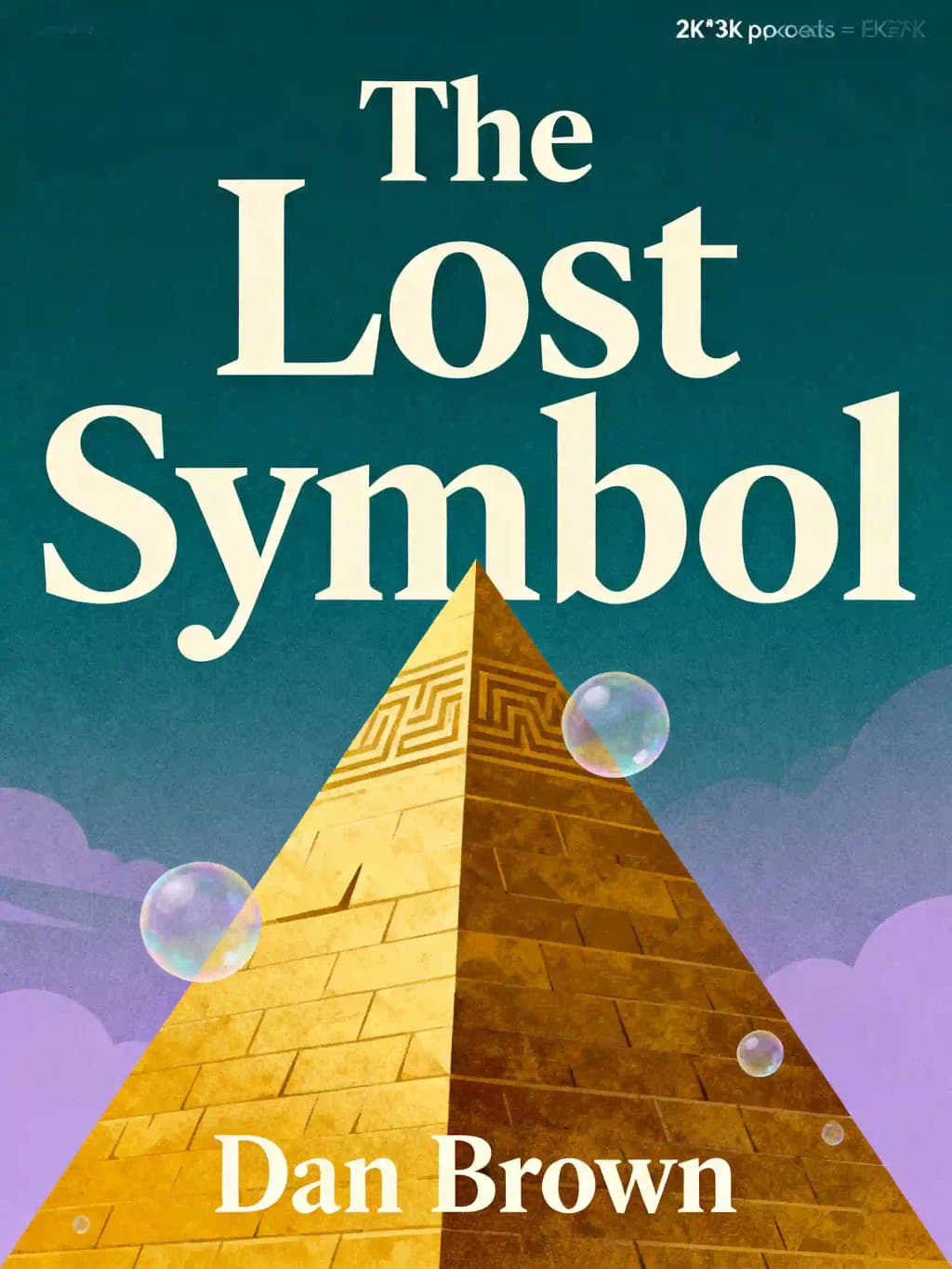
Dan Brown's "The Lost Symbol" rocketed to the top of bestseller lists when it debuted in 2009, selling over one million copies in its first day-a publishing phenomenon that cemented Brown's status as a literary force. Following the global success of "The Da Vinci Code," this thriller continues Robert Langdon's adventures, this time plunging readers into the secretive world of Freemasonry in Washington D.C. The novel became an instant cultural touchstone, with readers worldwide suddenly fascinated by Masonic symbols hidden in plain sight throughout America's capital. Brown's meticulous research into Masonic traditions and Washington's architectural secrets sparked renewed interest in these topics, with tourism companies even creating "Lost Symbol" tours of D.C. landmarks featured in the book. What makes this work particularly compelling is how it blends historical fact with fiction, leaving readers questioning where one ends and the other begins-a signature Brown technique that transforms an entertaining thriller into an intellectual treasure hunt.
Глава 2
A Desperate Race Against Time
Harvard symbologist Robert Langdon awakens disoriented aboard a private Falcon 2000EX jet approaching Washington D.C., his tweed jacket wrinkled from unexpected sleep. He's been urgently summoned by his longtime mentor Peter Solomon-a prominent philanthropist, Smithsonian Institution Secretary, and thirty-third-degree Freemason-to deliver a last-minute lecture at the U.S. Capitol Building. The weather is unseasonably cold, and the capital's monuments glitter under a light dusting of snow as the plane descends.
Upon arrival at the Capitol, Langdon discovers the lecture was a ruse. Instead, he encounters a horrifying sight in the center of the Capitol Rotunda: a severed human hand, expertly preserved and positioned on a wooden stand to point upward toward the dome. The hand has been tattooed with ancient symbols: an all-seeing eye, a crown, and other mystical markings on each finger. Langdon recognizes it as the Hand of the Mysteries, a sacred invitation used by ancient mystics to extend knowledge to worthy initiates. With mounting dread, he realizes the hand belongs to Peter Solomon, identified by a distinctive family ring.
The situation intensifies when Langdon receives a call from the perpetrator, a muscular, completely tattooed man who identifies himself as Mal'akh. Speaking with an educated accent and unsettling serenity, he reveals that Peter Solomon is being held in "the Araf"-a reference to Dante's conception of purgatory as a realm between heaven and hell. Mal'akh demands Langdon decode the legendary Masonic Pyramid, which supposedly contains directions to a vault of ancient wisdom, by nightfall. Despite Langdon's protests that he knows nothing about such a pyramid, Mal'akh remains convinced the professor is lying.
The crisis deepens with the arrival of CIA Director Inoue Sato, a petite Japanese-American woman whose authoritative presence is amplified by her gravelly voice-the result of throat cancer surgery. She declares the situation a matter of urgent national security, though she refuses to explain why. The mystery compounds when an X-ray scan reveals Langdon is carrying a small package entrusted to him years ago by Peter Solomon-a package he'd completely forgotten about. Sato's suspicion of Langdon grows, but before she can take him into custody, Warren Bellamy-the distinguished Architect of the Capitol and a high-ranking Mason-stages a diversion. He temporarily incapacitates Sato's team, allowing Langdon to escape with both the package and a curious stone pyramid discovered in a hidden chamber beneath the Capitol's subbasement.
As Langdon and Bellamy navigate the labyrinthine tunnels beneath the Capitol complex, dodging security forces, Langdon realizes he's been unwittingly drawn into an elaborate scheme. Someone with extensive knowledge of both Masonic history and his personal connection to Peter Solomon has orchestrated these events with clockwork precision. With Peter's life hanging in the balance and national security supposedly at risk, Langdon knows the night's deadly game of cat and mouse has only just begun.
Глава 3
The Power of Noetic Science
Katherine Solomon, Peter's younger sister, works in a classified laboratory at the Smithsonian Museum Support Center, where she conducts groundbreaking research in Noetic Science-the study of how human consciousness can physically affect the material world. Her experiments have produced remarkable results: proving that thoughts have mass, that intention can alter physical reality, and that human consciousness extends beyond the body.
One experiment particularly stands out-Katherine's attempt to weigh the human soul. Using a hermetically sealed chamber with an ultra-precise scale, she documented a dying patient's final moments and discovered that immediately after death, the body became measurably lighter. This suggested something with physical mass had departed, offering scientific evidence for what religions had claimed for millennia.
Katherine's research represents a bridge between ancient wisdom and modern science. As Peter once showed her, ancient texts like the Zohar described concepts remarkably similar to modern superstring theory's ten-dimensional universe. This revelation led Katherine to dedicate her life to using cutting-edge technology to rediscover lost ancient wisdom.
When Katherine receives a call from Dr. Christopher Abaddon claiming to be Peter's psychiatrist and expressing concern about missed appointments, she agrees to meet him. During their encounter, Abaddon reveals that Peter has been consulting him about the psychological impact Katherine's research might have when made public. More disturbingly, he suggests Peter may be experiencing delusions, claiming Peter had revealed a "great truth" about their mother's murder ten years ago and mentioned a hidden treasure of ancient wisdom in Washington.
Later that evening, Katherine is horrified to discover that "Dr. Abaddon" is actually Mal'akh-the same tattooed giant who kidnapped her brother and has now infiltrated her lab. After a terrifying chase through the darkened facility, Katherine narrowly escapes, but not before learning a shocking truth: Mal'akh claims to be the same man who murdered her mother a decade ago, a man the Solomons believed dead.
Глава 4
Secrets Written in Symbols
The Masonic Pyramid becomes the central focus of the night's frantic chase. Found in a hidden chamber beneath the Capitol, this small stone pyramid with a flat top is said to be a map to the location of ancient wisdom. Its surface contains sixteen precisely engraved symbols-a Masonic cipher that Langdon quickly decodes. However, the deciphered text appears meaningless: a seemingly random grid of letters.
The pyramid requires its missing capstone to be complete. This turns out to be the small package Peter entrusted to Langdon years ago-a cube-shaped stone box containing a solid gold pyramid tip. When Katherine impulsively opens the box against Bellamy's warnings, they find a simple inscription: "The secret hides within The Order."
Through a series of brilliant deductions, Langdon and Katherine discover that the pyramid must be decoded using a magic square created by Benjamin Franklin. When properly arranged according to this mathematical pattern, the letters form the Latin phrase "Jeova Sanctus Unus"-One True God. Still, this revelation seems too simple to be the profound secret they're seeking.
Later, Katherine notices the marking "1514 A.D." on the stone box. Langdon realizes this isn't a date but a reference to Albrecht Durer, the Renaissance artist whose 1514 engraving "Melencolia I" contains a mathematical magic square. Using this square to rearrange the letters from the pyramid yields the same Latin phrase, confirming they're on the right track.
The final breakthrough comes when they heat the gold capstone in boiling water-exactly thirty-three degrees on Isaac Newton's temperature scale. This reveals three glowing words: "The secret hides within The Order Eight Franklin Square." This cryptic message leads them on a wild chase through Washington as they attempt to locate the final piece of the puzzle while staying one step ahead of both the CIA and Mal'akh.
Глава 5
The Temple of Transformation
Mal'akh, the novel's antagonist, embodies the darkest extremes of occult obsession. His massive, bodybuilder-like physique serves as a living canvas, covered in intricate tattoos that form a complex tapestry of ancient mystical symbols - Egyptian hieroglyphs, alchemical signs, and Kabbalistic imagery. Only a small circle of unblemished flesh remains at the crown of his head, which he views as sacred space awaiting the ultimate inscription. He believes that by obtaining and inscribing the Lost Word-a powerful ancient secret said to grant divine knowledge-onto this final spot, he will complete his metamorphosis into a godlike being.
His mansion, a sprawling estate in the outskirts of Washington D.C., conceals a carefully constructed sanctum beneath its foundations. This hidden chamber combines elements of various mystical traditions - black marble floors inscribed with ceremonial circles, walls covered in mirrors to multiply spiritual energy, and an altar made of human bone. Here, he performs elaborate rituals, including the creation of a special ink using Peter Solomon's blood mixed with rare herbs and metals, believing this mixture will serve as the medium for inscribing the final transformative symbol.
Mal'akh's dedication to his transformation extends beyond mere physical alterations. Following the path of ancient ascetic traditions, he has undergone voluntary castration, emulating the practices of mystical eunuch monks from various cultures who believed that sacrificing physical procreation opened channels to spiritual power. His tattoos, rather than simple decoration, represent a complex magical system - each symbol carefully chosen and positioned to channel specific energies and mark stages in his transformation.
His methodical nature reveals itself in years of careful preparation. He infiltrated the Solomons' inner circle through multiple personas, including a stint as Peter's psychiatrist Dr. Christopher Abaddon, gathering intimate knowledge of family secrets and vulnerabilities. His technical expertise allows him to hack security systems, manipulate surveillance footage, and create elaborate technological deceptions. He's assembled damaging evidence against numerous powerful figures, including video documentation of secret Masonic initiation rites involving Supreme Court justices and prominent government officials - footage he threatens to release for maximum social disruption.
The truth of Mal'akh's identity adds layers of tragic complexity to his obsession. Born as Zachary Solomon, Peter's son, he chose a path of rebellion and self-destruction, squandering his inheritance on drugs and hedonistic pursuits. After being imprisoned in Turkey for drug trafficking, he orchestrated an elaborate deception to fake his death. Through years of systematic physical transformation - including steroid treatments, extensive plastic surgery, and the elaborate tattoo work - he recreated himself as Mal'akh, unrecognizable even to his own father. This transformation was driven not just by a desire for revenge against his father's perceived rejection, but by a warped spiritual quest to transcend his human origins through ancient mystical secrets, even if that transcendence required destruction and sacrifice.
Глава 6
Washington's Hidden Mysteries
Dan Brown transforms Washington D.C. into a character itself-a city designed as a vast symbolic tableau by its Masonic founders. Through Robert Langdon's expert eyes, we discover how the city's layout and architecture contain hidden meanings and esoteric symbols, creating a complex tapestry of sacred geometry and ancient wisdom that extends far beyond mere architectural beauty.
The Capitol Building stands as a neoclassical temple, its massive dome topped by the 19.5-foot Statue of Freedom. This architectural marvel wasn't merely designed for governance-its proportions and design elements mirror those of classical temples, particularly the Pantheon in Rome. Inside, the Rotunda features Constantino Brumidi's masterpiece "The Apotheosis of Washington"-a 4,664-square-foot fresco depicting America's first president ascending to godhood. The fresco shows Washington seated among the clouds, flanked by Liberty and Victory/Fame, while classical deities representing various aspects of American progress surround him. Minerva teaches science to Benjamin Franklin, Neptune offers maritime dominance, and Vulcan presents weapons of war. This representation of apotheosis-the transformation of man into god-reflects the core belief of the Ancient Mysteries that humans possess untapped divine potential.
The Washington Monument, a 555-foot Egyptian obelisk, serves as America's symbolic connection to ancient wisdom traditions. Its precise measurements incorporate significant numerical symbolism: the height-to-base ratio exactly matches that of the Great Pyramid of Giza. Its cornerstone was laid in a Masonic ceremony on July 4, 1848, and contains not only a Bible but also significant Masonic artifacts and historical documents. The monument's aluminum capstone, bearing the inscription "Laus Deo" (Praise God), is visible only from the sky, creating a symbolic connection between earth and heaven that the founders believed essential to their vision.
Brown reveals intricate details about the city's cornerstone ceremonies, which were meticulously timed according to astrological conditions. The Capitol, White House, and Washington Monument were all laid under the same celestial alignment, specifically when Caput Draconis (the dragon's head) was in Virgo. The city contains more astrological symbols in its architecture than any other capital, including zodiacal references in building decorations, alignments with celestial events, and sacred geometric proportions that reflect the founders' deep belief in cosmic harmonies.
Perhaps most fascinating is Brown's revelation about the National Mall's sacred geometry. The entire mall forms a giant circumpunct-the universal symbol for God and perfection in numerous ancient traditions-with the Capitol dome at the center of the circle and the Washington Monument serving as the dot. This massive symbolic layout transforms the city into an architectural prayer, expressing humanity's connection to the divine through geometric precision. The distance ratios between major monuments, the angular relationships between buildings, and even the placement of trees and gardens all contribute to this grand design, creating what Brown calls "America's greatest architectural mystery."
Глава 7
The Ancient Mysteries Revealed
Throughout the novel, characters engage in deep philosophical debates about the Ancient Mysteries-powerful wisdom allegedly preserved and transmitted through generations via secret societies that could unlock humanity's dormant potential. Robert Langdon, with his academic skepticism, initially dismisses these as mere mythological constructs, but his mentor Peter Solomon, a 33rd-degree Mason, persistently argues that beneath the symbolic language lie profound truths about human consciousness and our place in the universe.
The climactic revelation unfolds at the Washington Monument, where Peter Solomon explains that the legendary Lost Word isn't a singular utterance but rather represents the collective wisdom contained within sacred texts across diverse cultures and epochs. The Bible, Koran, Torah, Vedas, and other ancient manuscripts, while differing in their specific teachings and cultural contexts, all fundamentally convey the same essential truth: humans possess an inherent divine potential within themselves, waiting to be awakened and realized.
Peter meticulously demonstrates how America's founding fathers, many of whom were active Freemasons, deliberately embedded this esoteric understanding into the nation's architecture and symbolic framework. The provocative phrase "Know ye not that ye are gods?" appears across multiple religious and philosophical traditions, from ancient Greek mysteries to Hindu scriptures, suggesting humanity's forgotten divine nature. This theme resonates in America's national motto, E PLURIBUS UNUM (Out of many, one), which reflects not just political unity but a deeper understanding of collective consciousness and shared divine heritage.
Katherine Solomon's groundbreaking scientific research in Noetic Science provides contemporary validation for these ancient teachings. Her carefully controlled experiments reveal several startling discoveries: human thought possesses measurable physical mass and can directly influence material reality; consciousness exists as quantifiable energy that persists outside the physical body; and perhaps most significantly, collective human intention amplifies these effects exponentially. Through rigorous scientific methodology, she demonstrates how the ancient understanding that thoughts create reality isn't merely metaphorical but represents a measurable phenomenon supported by quantum physics and advanced neuroscience.
The novel reaches its symbolic crescendo in a final scene where Langdon and Katherine stand atop the Capitol dome at sunrise. They watch in contemplative silence as dawn's first light illuminates the Washington Monument's aluminum peak, inscribed with the words "Laus Deo" (Praise be to God). This daily solar journey, marking the connection between heaven and earth, serves as a powerful metaphor for mankind's universal connection through the Creator. For Langdon, this moment marks a profound shift in perspective. The skeptical professor finds himself experiencing a deep sense of hope and possibility, having witnessed firsthand how the seemingly disparate paths of scientific inquiry and spiritual wisdom might ultimately converge on the same fundamental truth about human consciousness and our collective potential.
Глава 8
National Security and Sacred Secrets
Director Inoue Sato's urgent concern throughout the novel initially appears excessive and perhaps even paranoid, but her motivations become starkly clear when Langdon views the video Mal'akh has created. This explosive footage reveals numerous powerful government officials-including Supreme Court justices, prominent senators, the secretary of defense, and even the CIA director himself-participating in ancient Masonic rituals that, when stripped of their proper context and ceremonial significance, appear deeply sinister and potentially threatening to national security.
The video captures several particularly dramatic ceremonies. One ritual shows an initiate kneeling before Masonic leaders, solemnly vowing to protect the brotherhood's secrets under penalty of having his "chest cavity ripped open" and his heart torn out-language that, while purely symbolic, could easily shock the uninitiated. Another powerful scene depicts an elaborate simulated death ritual where the initiate is symbolically "murdered" and carefully placed in a ceremonial coffin, representing the death of his old self and rebirth into Masonic wisdom. Perhaps most striking is the Fifth Libation ceremony, where Peter Solomon presents a human skull filled with wine, from which the trembling initiate must drink while swearing sacred oaths of secrecy and brotherhood.
Though these ceremonies are actually profound symbolic experiences celebrating the cycle of life, death, and spiritual transformation through controlled confrontation with mortality, Sato recognizes the powder keg such footage represents. In an era of viral videos and conspiracy theories, the release of these ceremonies would trigger widespread panic and outrage, severely undermining public trust in government institutions and potentially destabilizing the nation's political foundations. The Masonic tradition's noble goal of using universal symbols to transcend religious and cultural differences would be twisted into something dark and malevolent in the public imagination.
This subplot masterfully highlights the dangerous gap between symbolism's intended meaning and its potential misinterpretation when stripped of context. The Masons' sophisticated use of ritual drama to teach moral lessons through allegory becomes deeply sinister when viewed through a contemporary lens of cynicism and suspicion. Brown suggests that in our modern world of instant information sharing and knee-jerk reactions, ancient wisdom traditions face unprecedented challenges in preserving and protecting their sacred teachings from misunderstanding and manipulation. The ceremonies that have bound brotherhood together for centuries could, in seconds, be transformed into weapons of social destruction through strategic misrepresentation.
The section also underscores how symbols that seem shocking to outsiders often carry profound meaning for initiates who understand their true context and purpose. This tension between surface appearance and deeper truth runs throughout the novel, challenging readers to look beyond their initial reactions and consider multiple layers of meaning in both ancient rites and modern interpretations.
Глава 9
The Power of Perspective
"The Lost Symbol" ultimately reveals that the greatest mysteries often hide in plain sight, visible only when viewed from the right perspective. This theme manifests repeatedly throughout the novel, serving as both a literal plot device and a profound metaphor for spiritual enlightenment.
When examining the grid of symbols on the pyramid's base, Langdon initially sees only chaos - a jumble of seemingly random characters that defy interpretation. It's only by applying Benjamin Franklin's magic square principle - rearranging the symbols according to a specific numerical pattern that dates back to ancient Chinese mathematics - that coherent meaning emerges. Similarly, the capstone's inscription becomes visible only when heated to precisely thirty-three degrees, a number with deep significance in Masonic tradition. Peter's ring, too, must be turned exactly thirty-three degrees to transform the stone box into a cross, demonstrating how slight shifts in perspective can reveal entirely new meanings.
The Washington Monument serves as perhaps the most dramatic example of this principle. Viewed from street level, it appears to be merely an impressive obelisk, a towering tribute to America's first president. However, when observed from above, it forms the precise center point - the dot in the middle of the circular National Mall - completing the ancient circumpunct symbol visible only from a higher vantage point. This revelation extends to Pierre L'Enfant's entire city plan, where streets, circles, and squares form elaborate geometric patterns that reveal their deeper symbolic meaning only when viewed from above.
Katherine's cutting-edge scientific research in her Cube facility demonstrates that particles behave differently based on observation - the very act of looking changes what is seen. This quantum principle becomes a powerful metaphor for spiritual insight: reality itself is not fixed but shifts depending on our perspective and level of consciousness. Her experiments with thought affecting matter further reinforce how perception shapes reality at both microscopic and macroscopic levels.
In the novel's pivotal epilogue, Langdon and Katherine stand at the pinnacle of the Capitol dome watching sunrise illuminate the Washington Monument. From this elevated perspective, they can finally see the grand design that remains invisible to the thousands of tourists and locals below. This physical elevation mirrors their spiritual and intellectual journey throughout the novel - rising above limited understanding to glimpse a more comprehensive truth about the interconnection between science, spirituality, and human potential.
The novel's final message suggests that true wisdom isn't about acquiring new information but about developing the capacity to see what's already there with new eyes. The ancient mysteries aren't hidden in some secret underground vault or encrypted in indecipherable codes, but rather encoded in plain sight - in architecture, symbols, and natural patterns - waiting for those who have developed the perspective to recognize them. This revelation transforms not just how the characters see Washington D.C., but how they understand the nature of reality itself.