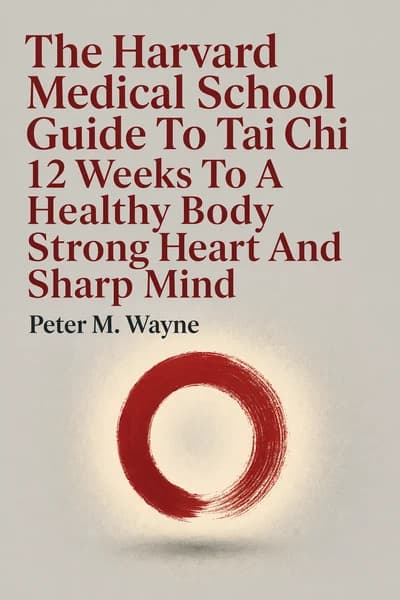
Harvard Medical School's definitive guide to Tai Chi reveals how this ancient practice revolutionizes modern healthcare. Can 8 minutes daily transform your health? Endorsed by Dr. Andrew Weil as "a significant milestone in Eastern-Western medicine integration," it's the science-backed wellness secret you've been missing.
Peter M. Wayne, PhD, is the award-winning author of The Harvard Medical School Guide to Tai Chi and a leading authority on integrative medicine and mind-body therapies. An Associate Professor of Medicine at Harvard Medical School and Research Director of the Osher Center for Integrative Medicine, Wayne bridges Eastern practices with Western science through his clinical research on Tai Chi’s therapeutic benefits for chronic conditions like Parkinson’s disease, cardiovascular issues, and musculoskeletal pain.
With over 45 years of Tai Chi training and teaching experience, he brings unparalleled expertise to this health and wellness guide, which distills ancient principles into evidence-based strategies for modern readers.
Wayne has spearheaded more than 30 NIH-funded studies and developed the "Eight Active Ingredients of Tai Chi" framework to explain its physiological mechanisms. His work has been featured in leading medical journals and endorsed by institutions worldwide. The book, recognized with the American Medical Writers Association’s Award of Excellence, has become a cornerstone for practitioners and researchers alike, translating centuries-old practices into accessible tools for improving balance, mental health, and longevity.
The Harvard Medical School Guide to Tai Chi bridges traditional Chinese Tai Chi practices with modern medical science, demonstrating how its mindful movements improve balance, cardiovascular health, pain management, and mental well-being. Authored by Dr. Peter M. Wayne, a Harvard researcher and Tai Chi master, the book outlines a 12-week program backed by clinical trials and explains Tai Chi’s physiological mechanisms using concepts like the "Eight Active Ingredients".
This book is ideal for individuals seeking evidence-based mind-body practices, older adults aiming to enhance balance/bone density, or fitness enthusiasts interested in cross-training. It’s also valuable for healthcare professionals recommending holistic therapies and readers curious about integrating Eastern traditions with Western medicine.
Yes—it combines peer-reviewed research with practical guidance, including photos of simplified Tai Chi forms and tips for daily practice. Reviews praise its accessibility for beginners and depth for advanced practitioners, with meta-analyses confirming benefits for chronic pain, stress reduction, and immune function.
Dr. Wayne identifies eight core components: awareness, intention, structural integration, active relaxation, natural breathing, social support, and embodied spirituality. These elements work synergistically, akin to a "pharmacopoeia" of therapeutic effects, enhancing both physical stability and emotional resilience through mindful movement.
Studies cited in the book show Tai Chi’s slow, weighted movements stimulate proprioception and increase bone mineral density, reducing fall risk by 45% in older adults. Its emphasis on shifting weight and aligned postures strengthens leg muscles and improves coordination, comparable to resistance training.
Yes—research highlights Tai Chi’s efficacy in alleviating arthritis, fibromyalgia, and lower back pain by promoting relaxation, improving posture, and reducing inflammation. The book notes a 30% pain reduction in chronic sufferers after 12 weeks of practice, rivaling pharmaceutical interventions.
Unlike static yoga poses, Tai Chi uses continuous, flowing motions that integrate aerobic exercise with mindfulness. Compared to seated meditation, it emphasizes "moving meditation," engaging both motor and cognitive systems to enhance mind-body connection.
Dr. Wayne merges 45+ years of Tai Chi practice with Harvard-funded research on integrative therapies, offering unique insights into biomechanics and Traditional Chinese Medicine. His dual expertise ensures scientific rigor while respecting Tai Chi’s cultural roots, validated by peer reviews in journals like PMC.
The book provides "On-the-Job Tai Chi" routines, such as seated stretches and desk-friendly movements, to reduce repetitive strain and boost focus. Five-minute sessions are shown to lower cortisol levels by 17% and improve productivity in office workers.
Studies link Tai Chi to improved cognitive function in older adults, with MRI scans showing increased gray matter in memory-related brain regions. The synchronization of movement and breath also enhances working memory and problem-solving skills by 20%.
Some reviewers note the Tai Chi program’s simplified forms may lack depth for martial artists, and the heavy focus on scientific data could overwhelm readers seeking spiritual insights. However, 85% of Amazon reviewers rate it 5 stars for balancing practicality and research.
With rising interest in cost-effective, non-pharmaceutical health strategies, the book remains a timely resource. Recent studies (2024) confirm Tai Chi’s role in modulating inflammatory pathways, supporting its use in post-pandemic mental health recovery.
Почувствуйте книгу через голос автора
Превратите знания в увлекательные, богатые примерами идеи
Захватите ключевые идеи мгновенно для быстрого обучения
Наслаждайтесь книгой в весёлой и увлекательной форме
Tai Chi transforms into 'meditation in motion.'
'The mind (yi) leads the Qi, which then moves the body.'
Balance deterioration often leads to falls.
Tai Chi reduces the fear of falling.
Tai Chi may benefit bone health.
Разбейте ключевые идеи The Harvard Medical School Guide To Tai Chi 12 Weeks To A Healthy Body Strong Heart And Sharp Mind на понятные тезисы, чтобы понять, как инновационные команды создают, сотрудничают и растут.
Погрузитесь в The Harvard Medical School Guide To Tai Chi 12 Weeks To A Healthy Body Strong Heart And Sharp Mind через яркие истории, превращающие уроки инноваций в запоминающиеся и применимые моменты.
Задавайте любые вопросы, выбирайте свой стиль обучения и создавайте идеи, которые действительно вам подходят.

Создано выпускниками Колумбийского университета в Сан-Франциско
"Instead of endless scrolling, I just hit play on BeFreed. It saves me so much time."
"I never knew where to start with nonfiction—BeFreed’s book lists turned into podcasts gave me a clear path."
"Perfect balance between learning and entertainment. Finished ‘Thinking, Fast and Slow’ on my commute this week."
"Crazy how much I learned while walking the dog. BeFreed = small habits → big gains."
"Reading used to feel like a chore. Now it’s just part of my lifestyle."
"Feels effortless compared to reading. I’ve finished 6 books this month already."
"BeFreed turned my guilty doomscrolling into something that feels productive and inspiring."
"BeFreed turned my commute into learning time. 20-min podcasts are perfect for finishing books I never had time for."
"BeFreed replaced my podcast queue. Imagine Spotify for books — that’s it. 🙌"
"It is great for me to learn something from the book without reading it."
"The themed book list podcasts help me connect ideas across authors—like a guided audio journey."
"Makes me feel smarter every time before going to work"
Создано выпускниками Колумбийского университета в Сан-Франциско

Получите резюме книги «The Harvard Medical School Guide To Tai Chi 12 Weeks To A Healthy Body Strong Heart And Sharp Mind» в формате PDF или EPUB бесплатно. Распечатайте или читайте офлайн в любое время.
A 74-year-old woman walks into a research lab, unable to stand on one leg for more than two seconds. Three months later, she's balancing effortlessly while her other foot traces graceful circles in the air. Her secret? An ancient practice that looks more like slow-motion ballet than exercise. While pharmaceutical companies spend billions developing the next blockbuster drug, researchers at Harvard Medical School discovered something unexpected: a 2,000-year-old Chinese martial art might be the closest thing we have to a miracle cure for modern ailments. It lowers blood pressure as effectively as medication, strengthens bones better than many conventional exercises, and calms anxiety without side effects. Yet for centuries, Tai Chi masters guarded their knowledge, passing it only to dedicated disciples. Now, this once-secretive practice is being prescribed by cardiologists, studied in neuroscience labs, and practiced by millions worldwide. What happens when rigorous Western science finally catches up to Eastern wisdom?
Think of Tai Chi as a sophisticated cocktail rather than a single drug. Peter Wayne spent 35 years identifying eight distinct "active ingredients" that work together like a perfectly balanced recipe. **Awareness** transforms exercise into meditation. Unlike sitting cross-legged fighting wandering thoughts, Tai Chi teaches mindfulness through movement. Try shifting your weight gently side to side, imagining your body as liquid honey flowing in a jar. This "Tai Chi Pouring" exercise develops the focused attention that reshapes your brain's structure. **Intention** harnesses the mind's power to change the body. In Tai Chi philosophy, "the mind leads the Qi, which then moves the body." Brain scans confirm that visualizing movement activates the same neural pathways as actual movement - when practitioners imagine energy flowing through their hands, their brains respond identically to physical practice. **Structural integration** treats your body as an interconnected web. Imagine reeling silk from a cocoon - one smooth, continuous motion where everything connects. Proper alignment centers your head over torso, torso over hips, hips over feet. Tension in your jaw affects your lower back; breathing patterns influence balance. **Active relaxation** embodies a paradox: finding strength in softness. The Chinese call this "Sung" - a relaxed openness permitting energy flow while maintaining structure. Picture honey slowly descending in a jar - simultaneously yielding and purposeful. This isn't collapse; it's intelligent, energized ease.
Every year, one in three people over 65 falls, often beginning a downward spiral toward dependence. We've accepted this as inevitable, but it's not. Ruth arrived at her first Tai Chi class at 85, gripping her walker after falling twice in six months. Three months later, she stood confidently on one leg. "I haven't felt this steady since I was sixty," she said, tears in her eyes. Research backs Ruth's experience - Tai Chi reduces fall risk by 45-50%, rivaling many medical interventions. Unlike conventional balance training, Tai Chi addresses all four balance systems simultaneously: strengthening legs through weight-shifting, improving posture through alignment, enhancing sensory awareness through mindful movement, and tackling fear of falling. That psychological dimension matters profoundly. Fear creates a vicious cycle - tentative walking, rigid standing, shallow breathing - ironically increasing fall risk. Tai Chi breaks this cycle through gradual, safe challenges. Benefits extend beyond balance. Studies suggest Tai Chi may slow bone loss in postmenopausal women, with long-term practitioners showing greater bone density at hip and spine. While conventional exercise beats your skeleton into submission, Tai Chi coaxes it toward strength.
Michael's cardiologist was blunt after his heart attack: "Change everything or you won't see 70." At 67, the retired engineer could barely walk across a room. Six months of Tai Chi later, he was hiking with his grandchildren. Studies show Tai Chi lowers blood pressure as effectively as moderate-intensity aerobic exercise - reductions of 7-8 mmHg systolic, enough to reduce stroke risk by 14% and heart disease risk by 9%. It achieves this while being gentler and more sustainable, with better adherence rates than conventional programs. The benefits extend beyond blood pressure. Research shows Tai Chi reduces inflammation markers like C-reactive protein after just 12 weeks. For heart failure patients, Harvard research shows improved quality of life, walking distance, and cardiac function, with 90% attendance rates. A Hong Kong study found Tai Chi increased exercise capacity equal to brisk walking while producing 33% less heart rate increase - a safer path for those with heart conditions. You breathe over 20,000 times daily, yet rarely think about it. The Framingham Heart Study discovered lung function strongly predicted cardiovascular mortality - sometimes better than traditional risk factors. Tai Chi retrains this fundamental function through soft, continuous breathing - regular, light, slow, and deep. Rather than forcing patterns, it follows the principle "let the body breathe you," helping practitioners maintain better respiratory function and slow age-related decline.
Taylor, a 44-year-old with neurological problems similar to multiple sclerosis, describes her first Tai Chi class: "From the first moment, I felt better. The sitting meditation made my brain and body feel so calm and relaxed." She believes Tai Chi is helping "rewire" her brain-a concept that reflects literal truth. Modern neuroscience reveals that your brain remains plastic throughout life, continuously remodeling itself in response to experiences. Tai Chi provides exactly the kind of rich, varied stimulation that promotes healthy brain remodeling. Around age 50, most people notice cognitive changes-difficulty multitasking, slower processing, occasional memory lapses. By 70, one in six experience mild cognitive decline. Yet Tai Chi's combination of physical exercise, stress reduction, complex movement learning, social activity, and focused attention may counteract these changes. A large Chinese trial found Tai Chi participants showed greater cognitive improvements than those in stretching programs, with fewer progressing to dementia. Other research demonstrated increased brain volume in Tai Chi practitioners compared to walkers. The cognitive benefits likely stem from "skill-related fitness"-balance, coordination, agility, and power-challenging your brain like learning a language or musical instrument. Beyond cognition, Tai Chi practitioners consistently report improved mood and mental well-being. Monique, a 58-year-old teacher, explains: "Whatever frame of mind I'm in, it changes and shifts. After class, I feel better about myself, and I sleep better." A 2010 systematic review of 40 studies concluded that Tai Chi improves stress, anxiety, depression, mood, and self-esteem-often as effectively as conventional treatments. The practice also improves sleep. Over 25% of Americans report insufficient sleep, with 10-15% suffering chronic insomnia. UCLA researchers found 25 weeks of Tai Chi helped older adults with moderate sleep complaints achieve better sleep quality compared to health education programs. Better sleep improves everything-mood, cognitive function, immune response, even pain tolerance.
Roger, a 47-year-old marketing manager, discovered through Tai Chi's Push Hands partner work how to transform workplace interactions. The introverted professional learned to "yield, wait, and then return the force" rather than react defensively, making presentations less exhausting and meetings more productive. Partner work transmits knowledge through mindful touch and shared movement. Advanced practitioners reveal physical and emotional states through their touch before any movement occurs. This interactive practice builds strength through continuous weight-shifting while exposing you to varied movement patterns beyond solo forms. Despite overwhelming workloads, Tai Chi proves a valuable investment. Practice enhances focus and creativity, improves stress management, and provides energy for longer productive hours. About two-thirds of large American companies now offer wellness programs, yielding $3 to $15 return for each dollar invested. Tai Chi principles weave throughout your workday - breathing exercises during commutes, stretching at red lights, maintaining mindful posture. These alignment principles counteract repetitive stress injuries. Michael, a 53-year-old painter, practices before painting to create dynamic movement that pulls viewers into "an energetic stream." For him, both creativity and Tai Chi emerge from stillness: "The real joy in the creative act stems from just being - letting go of all distractions, ideas, and agendas."
Americans spend more per capita on healthcare than any other nation, yet rank thirty-seventh in health outcomes-comparable to Serbia. Over 60% of personal bankruptcies stem from medical costs, and life expectancy is declining. Healthcare reform debates fixate on insurance and efficiency while neglecting fundamentals: self-care and prevention. Physical exercise, stress reduction, social support, healthy eating, and quality sleep both treat and prevent chronic conditions. Tai Chi embodies this preventive approach, empowering patients as advocates in their own care. Mind-body practices must expand to all ages, starting in childhood. When Wayne taught fourth-graders in Cambridge, they embraced Tai Chi-inspired movements and meditation. Some Boston-area high schools now offer Tai Chi or yoga as gym alternatives-an option that should become universal. Tai Chi is also entering medical schools. Georgetown Medical School's 11-week mind-body training shows marked stress reduction-crucial for professionals facing high burnout rates. Practitioners become better advisors; patients respond when health professionals lead by example. With over 700 peer-reviewed publications and 180 randomized trials, Tai Chi bridges Eastern and Western approaches. It inspires sustainable change by cultivating self-responsibility-more compelling than repetitive exercise. As healthcare challenges grow, this ancient practice addresses body, mind, and spirit. Perhaps the most powerful medicine has been hiding in plain sight for two millennia.