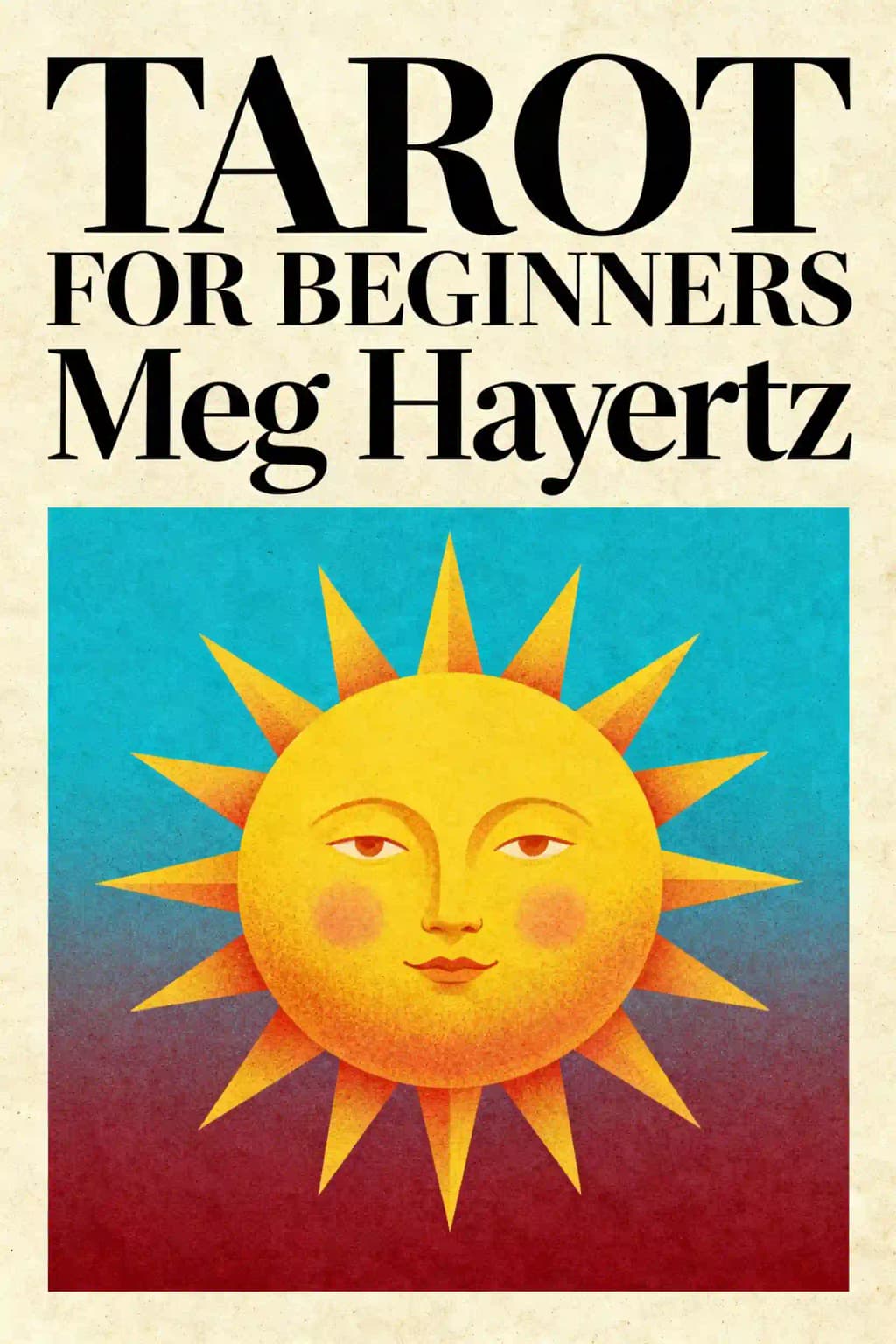
Unlock the ancient wisdom of tarot with Meg Hayertz's essential 2018 guide. Endorsed by clairvoyant Alia Curtis as "a must read" for creative blocks, this 206-page journey transforms self-discovery. What hidden truths might your cards reveal about your untapped potential?
Meg Hayertz, author of Tarot for Beginners: A Holistic Guide to Using the Tarot for Personal Growth and Self Development, is a seasoned tarot practitioner, educator, and founder of Creative Momentum, a San Francisco Bay Area organization dedicated to fostering creativity and self-discovery through tarot.
With an MFA in writing and consciousness from the California Institute of Integral Studies, Hayertz blends storytelling, spiritual insight, and practical guidance to demystify tarot, emphasizing its use as a tool for introspection and empowerment rather than mere fortune-telling. Her work addresses historical biases in traditional tarot imagery, offering inclusive interpretations that resonate with modern audiences.
Beyond her book, Hayertz leads workshops and offers personalized tarot sessions to help writers and artists overcome creative blocks, as highlighted in her collaborations with literary platforms like Door Is A Jar Magazine.
Tarot for Beginners has gained recognition for its accessible approach, combining card symbolism with actionable steps to help readers align daily choices with deeper self-awareness. The book’s focus on bridging abstract archetypes with real-life challenges has made it a trusted resource for newcomers and seasoned practitioners alike.
Tarot for Beginners by Meg Hayertz is a beginner-friendly guide that reimagines tarot as a tool for self-reflection and personal growth rather than fortune-telling. It combines historical context, clear card interpretations, and practical exercises to help readers connect tarot’s symbolism to daily life. The book emphasizes intuition, inclusivity, and actionable techniques like spreads and journaling prompts.
This book is ideal for newcomers seeking a modern, introspective approach to tarot. It’s also valuable for creatives (writers, artists) looking to use tarot for brainstorming, and anyone interested in inclusive spirituality. Hayertz’s accessible style makes it suitable for readers unfamiliar with esoteric traditions.
Yes—readers praise its clarity, inclusivity, and focus on self-discovery. Hayertz addresses outdated symbolism (e.g., sexist or racist imagery) and provides fresh interpretations, making tarot relevant to diverse audiences. The structured exercises and real-life applications add practical value.
Hayertz avoids predictive readings, instead framing tarot as a mirror for introspection. Her method ties card meanings to daily experiences (e.g., interpreting The Fool as embracing uncertainty in career choices) and encourages creative problem-solving. She also contextualizes tarot’s history while advocating for modern, inclusive adaptations.
The book critiques traditional tarot’s Eurocentric and gendered imagery, offering alternative interpretations for cards like The Hierophant (redefining authority) or The Lovers (emphasizing consent). Hayertz provides prompts to adapt readings to individual values, making tarot accessible across cultural and gender identities.
Absolutely. Hayertz, a novelist, shares techniques like using the Three-Card Spread to explore character motivations or plot dilemmas. For example, The Magician card might symbolize leveraging existing resources in a project. Testimonials highlight how her readings help writers unlock stalled stories.
Unlike formulaic guides, Tarot for Beginners prioritizes personal connection over memorization. It stands out by linking cards to contemporary issues (e.g., The Tower as disruptive life events like job loss) and offering journaling exercises. Reviews note its balance of depth and approachability.
Hayertz breaks down symbols layer by layer. For example, The High Priestess isn’t just intuition—she represents balancing logic and mystery in decision-making. The book includes diagrams linking card elements (water, moons) to emotions and cyclical change.
Some traditionalists may dislike its departure from predictive readings or mystical jargon. However, most praise its practicality—one review notes it’s “less about predicting tomorrow, more about understanding today”.
The book links cards to growth areas:
Case studies show readers using the Celtic Cross Spread to analyze habits or set mindful goals.
As mindfulness and personalized spirituality grow, Hayertz’s focus on self-guided insight over dogma resonates. The book’s inclusive updates to classic imagery align with contemporary values, making it a timely resource for modern seekers.
Почувствуйте книгу через голос автора
Превратите знания в увлекательные, богатые примерами идеи
Захватите ключевые идеи мгновенно для быстрого обучения
Наслаждайтесь книгой в весёлой и увлекательной форме
Tarot bridges the mundane and spiritual aspects of our lives.
The future isn't predetermined.
Effective questions explore dynamics.
Intuition flows more freely through it.
The Fool embodies our sense of adventure.
Разбейте ключевые идеи Tarot for Beginners на понятные тезисы, чтобы понять, как инновационные команды создают, сотрудничают и растут.
Погрузитесь в Tarot for Beginners через яркие истории, превращающие уроки инноваций в запоминающиеся и применимые моменты.
Задавайте любые вопросы, выбирайте свой стиль обучения и создавайте идеи, которые действительно вам подходят.

Создано выпускниками Колумбийского университета в Сан-Франциско
"Instead of endless scrolling, I just hit play on BeFreed. It saves me so much time."
"I never knew where to start with nonfiction—BeFreed’s book lists turned into podcasts gave me a clear path."
"Perfect balance between learning and entertainment. Finished ‘Thinking, Fast and Slow’ on my commute this week."
"Crazy how much I learned while walking the dog. BeFreed = small habits → big gains."
"Reading used to feel like a chore. Now it’s just part of my lifestyle."
"Feels effortless compared to reading. I’ve finished 6 books this month already."
"BeFreed turned my guilty doomscrolling into something that feels productive and inspiring."
"BeFreed turned my commute into learning time. 20-min podcasts are perfect for finishing books I never had time for."
"BeFreed replaced my podcast queue. Imagine Spotify for books — that’s it. 🙌"
"It is great for me to learn something from the book without reading it."
"The themed book list podcasts help me connect ideas across authors—like a guided audio journey."
"Makes me feel smarter every time before going to work"
Создано выпускниками Колумбийского университета в Сан-Франциско

Получите резюме книги «Tarot for Beginners» в формате PDF или EPUB бесплатно. Распечатайте или читайте офлайн в любое время.
You're standing at a crossroads. The job offer sits on your desk, the relationship feels uncertain, the dream you've been nurturing whispers both promise and doubt. Where do you turn when logic fails and your mind spins in circles? For centuries, people have found answers not in algorithms or advice columns, but in 78 illustrated cards that speak the language of the soul. Tarot has exploded in popularity-searches for card meanings have tripled since 2016-not because we've become more superstitious, but because we're starving for meaning in a world that reduces everything to data points. These cards don't predict your fate like some cosmic fortune cookie. Instead, they mirror your inner wisdom back to you, helping you see what you already know but haven't yet acknowledged. The 22 Major Arcana cards represent life's big themes-transformation, love, loss, triumph-while the 56 Minor Arcana cards illuminate daily experiences through four elemental suits. Together, they form a visual language that bypasses your overthinking mind and speaks directly to your intuition.
Tarot began as entertainment. Playing cards traveled from Persia through Egypt to 14th century Europe, where nobles enjoyed them at parties. The oldest surviving deck, the 15th century Visconti-Sforza, combined regular playing cards with 22 additional "trionfi"-carnival float images, not spiritual symbols. Napoleon's Egyptian campaign sparked Europe's mysticism obsession. Occultists fabricated origin stories linking tarot to ancient Egypt. The breakthrough came in 1910 when A.E. Waite partnered with artist Pamela Colman Smith to create history's most influential deck. Smith deserves greater recognition. This synesthetic artist-who saw sounds as colors-designed theater sets for W.B. Yeats, illustrated for Bram Stoker, and created suffrage art. Her genius was adding narrative scenes to the Minor Arcana, previously just abstract symbols, making cards intuitively readable. The Rider-Waite-Smith deck remains today's gold standard. This evolution reflects our collective reclaiming of wisdom beyond pure rationality-integrating conscious and unconscious knowing, reconnecting with understanding that honors body, emotions, and spirit alongside logical thought.
Reading tarot requires intention, presence, and respect. Treat your deck as a portal to your deeper self. While this guide references the Rider-Waite-Smith system, select whichever deck resonates with you. Before your first reading, create a ritual of connection. Place your deck under moonlight, cleanse it with sage smoke, or shuffle with focused intention. Spend time getting acquainted - gaze at each card, feel its texture, absorb its imagery. Store your deck wrapped in silk or cotton as a tangible expression of respect. Creating sacred space means both physical and mental preparation. Choose a quiet corner, light a candle, play soft music, turn off your phone. Before reading, quiet your mind through five to ten minutes of focused breathing. Imagine light entering through your crown, filling your body, extending down through your feet like roots into the earth. Here's what beginners get wrong: asking yes-or-no questions. Tarot doesn't work like a Magic 8-Ball - it illuminates dynamics, reveals hidden factors, and shows likely outcomes if you continue your current path. The future isn't fixed; it's shaped by your awareness and choices. Better questions explore dynamics ("What influences are affecting my career path?") or blind spots ("What am I not seeing about this relationship?"). As you shuffle, let your non-dominant hand lead - intuition flows more freely through it. Cards that jump out carry special significance. Balance intellectual understanding with intuitive response. The first image or feeling that arises often matters most. Sometimes insights arrive days later, sparked by something you experience after your reading.
The 22 Major Arcana cards represent fundamental forces shaping human existence, appearing during significant transitions. Together they form the Fool's Journey, with The Fool (card 0) as our adventurous spirit encountering life's essential lessons. The early cards establish foundations: The Magician (I) transforms ideas into reality, The High Priestess (II) guards intuition, The Empress (III) embodies creativity, The Emperor (IV) provides structure, and The Hierophant (V) interprets deeper meanings. The middle cards explore challenges: The Lovers (VI) represent connection, The Chariot (VII) balances opposites, Strength (VIII) depicts compassionate taming, The Hermit (IX) seeks inner truth, The Wheel of Fortune (X) shows life's cycles, Justice (XI) restores balance, and The Hanged Man (XII) gains perspective through surrender. The final cards signal transformation: Death (XIII) represents rebirth through release, The Tower (XVI) shows false foundations collapsing, The Star (XVII) represents your guiding vision, The Moon (XVIII) illuminates the subconscious, The Sun (XIX) brings joy, Judgement (XX) signals awakening, and The World (XXI) represents wholeness-the satisfying conclusion of a major life chapter.
While Major Arcana cards represent spiritual lessons, the 56 Minor Arcana cards illuminate everyday experiences through four elemental suits-the difference between "Should I change careers?" and "How do I handle tomorrow's meeting?" **Cups (water)** govern emotions, relationships, and creative flow. The Ace overflows with new love; the Ten shows family happiness; the Queen embodies nurturing energy. **Pentacles (earth)** govern material concerns-money, resources, security, work. The Ace signals new prosperity; the Ten shows generational wealth; the King expertly manages resources. **Swords (air)** govern the mind-thoughts, intellect, communication, conflict. The Ace brings intellectual breakthrough; the Ten shows betrayal; the Queen transforms pain into wisdom. **Wands (fire)** govern spirit in action-creativity, passion, how you show up. The Ace offers creative drive; the Ten shows overwhelm; the Knight embodies unstoppable enthusiasm. Each suit contains ten numbered cards (Ace through Ten) and four court cards (Page, Knight, Queen, King). Numbers carry consistent meanings: Aces signal beginnings, Twos indicate choices, Threes show growth. Court cards represent people and personality traits. These patterns help you read intuitively.
Reading tarot develops through consistent practice and reflection. Begin by centering yourself with deep breaths, then pull one card mindfully. Absorb every detail-figures, poses, symbols, landscape, emotional atmosphere, colors, numbers, and the card's name. What catches your attention first? What reveals itself upon deeper observation? Try embodying the card physically. Stand as the figure stands, imagine their emotional state, or visualize stepping into the scene. Notice what memories, emotions, or sensations arise. If insights don't surface immediately, describe the card aloud or in writing. These first associations bridge conscious thought and intuitive wisdom. After establishing this connection, compare your response with traditional meanings from various sources. This naming process crystallizes insights, creating synthesis between conscious and unconscious understanding. When lived experience aligns with established meanings, you generate moments of profound psychological freedom. Deepen insights through creative expression: write stories incorporating the card's symbols, journal about illuminated aspects of your situation, or create dialogue between card figures. This active meaning-making guides you into unknown territory where intuition leads. Finally, consider specific actions the cards suggest-persevering through difficulties, changing direction, establishing boundaries, or extending compassion. Every card contains constructive qualities: the Ten of Swords represents profound release; the Five of Swords offers growth through conflict transformation. Create a concrete list of ways to embody these positive qualities, then implement one or two actions immediately.
Tarot deepens through consistent practice. Start with daily one-card pulls, journaling your questions, cards, and interpretations. Over time, patterns emerge as you develop your personal relationship with the meanings. As comfort grows, explore different spreads. Past/Present/Future creates narrative structure. The Celtic Cross examines situations through ten positions. Design custom spreads from familiar frameworks - a novelist might use Hero's Journey plot points, a chef might mirror recipe stages. Tarot refines intuition by reflecting barely acknowledged hunches. Cards often confirm premonitions about your situation. Stay relaxed when reading - moments when memory falters create openings for intuition. As practice deepens, explore connected traditions: astrology, Kabbalah, numerology. The Empress connects to Venus, suggesting beauty and pleasure. The Hermit links to Virgo, sharing gentle attunement to wonder. Beyond divination, tarot offers transformation. The Major Arcana maps psychological development - each card represents a stage toward wholeness. Challenging cards like Death or The Tower build resilience for real transitions. Most importantly, tarot emphasizes your agency. Challenging cards don't doom you - they invite examination and choice. The Devil asks where you feel trapped and reminds you that chains are often loose enough to escape. In a world of metrics and algorithms, tarot offers irreplaceable visual language speaking to your whole self. These cards witness your growth, reflect your challenges, and celebrate your victories. So shuffle the deck, ask your question, and trust what emerges. Your inner wisdom has been waiting.