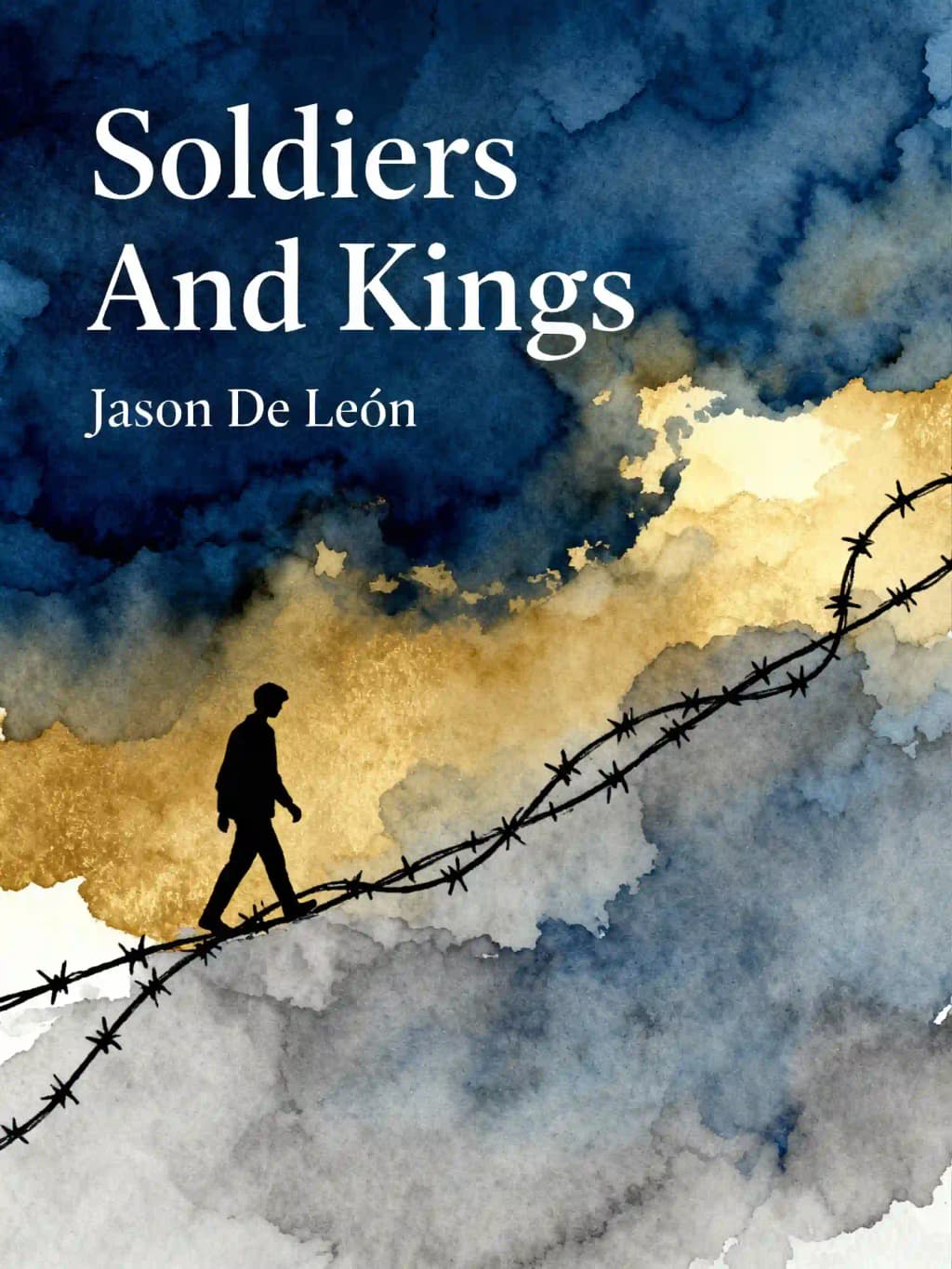
Soldiers and Kings
Survival and Hope in the World of Human Smuggling
Обзор книги Soldiers and Kings
Inside the shadowy world of human smuggling, Jason De Leon's National Book Award-winning expose reveals coyotes as complex humans, not villains. What drives someone to risk everything? As Matthew Desmond notes, this "extraordinary reportage" will leave you forever changed.

Ключевые темы в Soldiers and Kings
- human smuggling industry
- clandestine migration economy
- border enforcement consequences
- central american migration
- prevention through deterrence
Цитаты из Soldiers and Kings
Many migrants have told me they would prefer to die en el camino than stay home.
Everyone says that we are all bad, but that's not true.
Payaso has eyes everywhere.
A story yet to be written.
A wish.
Персонажи в Soldiers and Kings
- Jason De LeónAnthropologist and author who conducted fieldwork
- ChinoA smuggler and member of the migrant crew
- RobertoA young Honduran guide who died on the trail
- EscobarA low-level smuggler and friend of the author
- SantosA member of the migrant group in Pakal-Na
Об авторе
Об авторе книги Soldiers and Kings
Jason De León, author of Soldiers and Kings, is an anthropologist, 2017 MacArthur Fellow, and National Geographic Explorer.
As Executive Director of the Undocumented Migration Project and Professor at UCLA, his research blends ethnography, archaeology, and forensics to document migration from Latin America to the U.S.
Soldiers and Kings examines the human smuggling industry along the U.S.-Mexico border, exposing the violent realities shaped by immigration policies. His prior award-winning book, The Land of Open Graves: Living and Dying on the Migrant Trail, established his authority on borderland violence.
Soldiers and Kings won the 2024 National Book Award for Nonfiction, solidifying his impact on migration discourse.
Скачать резюме книги «Soldiers and Kings»
Получите резюме книги «Soldiers and Kings» в формате PDF или EPUB бесплатно. Распечатайте или читайте офлайн в любое время.
Часто задаваемые вопросы об этой книге
Soldiers and Kings by Jason De León is an intimate exploration of human smuggling networks along Central American migration routes. The book centers on "coyotes"—guides who navigate migrants through Mexico—revealing their moral conflicts, economic desperation, and humanity beyond villainous stereotypes. Through seven years of embedded research, De León traces the journey of a smuggler named Roberto, whose attempt to leave the trade ends tragically, exposing the brutal realities of the migrant trail.
This book is essential for readers interested in migration studies, anthropology, or socio-political narratives about borders. It suits those seeking nuanced perspectives beyond immigration headlines, particularly educators, policymakers, and advocates. De León's narrative depth makes it valuable for understanding systemic drivers like poverty and violence.
Absolutely. Winner of the National Book Award for Nonfiction, it combines rigorous ethnography with gripping storytelling. De León's unprecedented access to smugglers offers groundbreaking insights into a shadow economy, challenging reductive media portrayals. Its balance of personal narratives and systemic analysis makes it a landmark work.
Jason De León is an anthropologist, MacArthur "genius" grant recipient, and UCLA professor specializing in migration. His previous work, The Land of Open Graves, examined border-crossing fatalities. For Soldiers and Kings, he spent seven years embedded with smugglers, blending academic expertise with immersive journalism.
Unlike 宏观 analyses, it foregrounds smuggler perspectives through character-driven storytelling. De León’s exclusive access reveals hierarchical networks—from low-level "foot soldiers" to conflicted kingpins—and dissects their moral ambiguities. This humanizing approach reframes smuggling as a symptom of global inequality, not mere criminality.
De León frames the trail as a perilous web of interdependencies: guides, informants, gang leaders, and migrants create a fragile economy. He documents extreme violence, exploitation, and survival tactics, highlighting how U.S. border policies inadvertently strengthen smuggling cartels. This ecosystem thrives on desperation and collapsed alternatives.
Roberto, a Honduran smuggler seeking redemption, is the narrative anchor. His desire to leave the trade—and eventual death—illustrates the impossibility of escape in a system trapping both migrants and guides. His arc embodies the book’s core theme: smuggling isn’t a choice but a last resort against "cruel hardships and early death".
The book links smuggling demand to intersecting crises: Central American gang violence, poverty, climate displacement, and Western labor markets. De León argues smuggling networks are parasitic outgrowths of these root causes, implicating global policy failures rather than individual "criminal" actors.
The award recognized its methodological innovation—blending anthropology with vivid narrative—and humanitarian impact. Jurors praised its "ground-breaking" access to clandestine worlds and "heart-wrenching" portrayal of resilience. The book reframes polarizing debates through empathetic storytelling.
De León employs literary nonfiction techniques: immersive scenes, character depth, and lyrical prose. Chapters shift between Roberto’s journey and wider analysis, merging academic rigor with novelistic pacing. This approach makes complex socio-politics accessible without sacrificing nuance.
De León embedded intermittently with smuggling networks for seven years across Mexico and Honduras. This prolonged engagement built trust with subjects like Roberto, enabling rare disclosures about operational hierarchies, ethical dilemmas, and personal traumas.
It demonstrates that punitive border enforcement fuels smuggling’s brutality and profitability. Solutions, De León implies, must address source-country instability and create legal migration pathways. The book urges policies acknowledging smuggling’s economic logic rather than vilifying its actors.