Глава 1
When Freud Fled: The Race Against Nazi Terror
In March 1938, as Nazi troops marched into Vienna, a dramatic scene unfolded at Berggasse 19. While Hitler addressed cheering crowds from the imperial palace, Nazi thugs invaded Sigmund Freud's apartment. Martha Freud, displaying remarkable composure, cleverly played hostess and offered money to distract the intruders while her daughter Anna emptied their safe. When the 81-year-old Freud himself appeared in the doorway, the intimidated Nazis retreated with their loot, though promising to return. This terrifying encounter marked the beginning of what would become known as "Operation Freud" - a remarkable rescue mission orchestrated by an unlikely coalition of disciples, diplomats, and even a Nazi bureaucrat who risked everything to save the father of psychoanalysis from certain death.
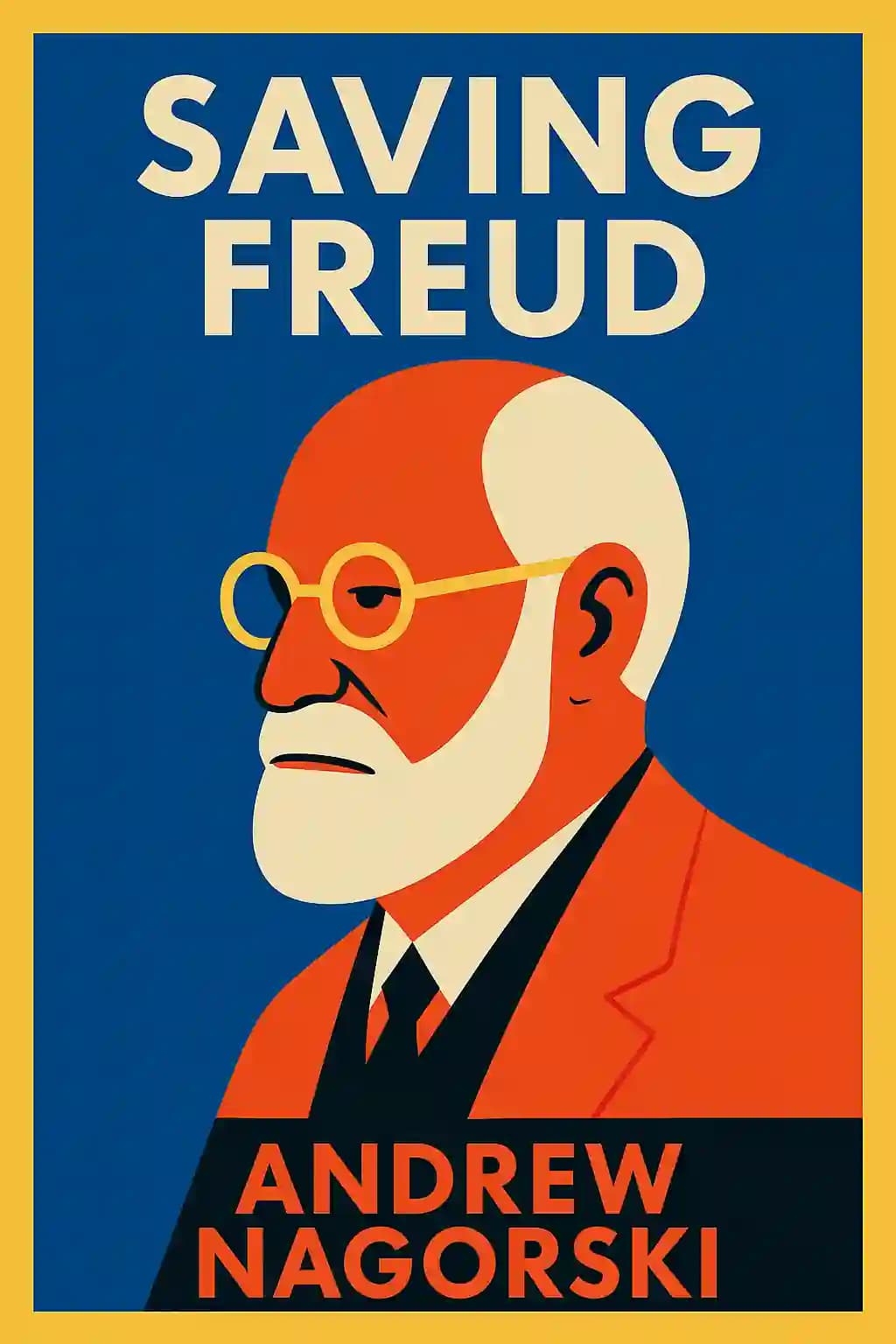
The book that chronicled this rescue mission became an international sensation upon its release, earning praise from publications like The New York Times and The Wall Street Journal. It captured readers' imagination not just for its historical significance but for its cinematic qualities - a race-against-time thriller featuring one of the 20th century's most influential minds. The story resonated particularly strongly during our current era of rising authoritarianism and refugee crises, reminding us how quickly civilization can crumble and how crucial individual acts of courage become in such moments.
Глава 2
Vienna: A Laboratory of Genius and Darkness
The Vienna of Freud's era embodied striking contradictions - a glittering imperial capital showcasing dazzling cultural and scientific achievements while simultaneously harboring sordid poverty, prostitution, and political unrest. This schizophrenic quality defined what could be called "Freud's Vienna" versus "Hitler's Vienna" - two radically different experiences of the same city that would eventually collide with catastrophic consequences.
As the capital of the sprawling Austro-Hungarian Empire, Vienna brought together fifty million people across at least nine major nationalities. The city's cosmopolitan character required tolerance of inherent ambiguities - precisely the environment where Freud's revolutionary ideas about the human psyche could flourish. Here, he developed his groundbreaking theories about the unconscious mind, shocking contemporaries with his portrait of humans as "insatiable animals" driven by repressed desires. His concepts of the id, ego, and superego sought to lead people out of their psychological labyrinths through what he initially called "the talking cure" and later renamed "psychoanalysis."
Though Freud spent most of his life in Vienna, he wasn't born there but in Freiberg, Moravia (now Pribor, Czech Republic) in 1856. His father Jacob, a struggling wool merchant, moved the family to Vienna's Jewish quarter when Sigmund was nearly four. Despite frequently expressing discomfort with Vienna in private correspondence, calling it "disgusting" in letters, Freud paradoxically flourished there as Vienna's Jews gained full citizenship and became leaders in arts, science, and medicine. This ambivalence toward his adopted city would later contribute to his reluctance to flee, even as danger mounted.
Freud's daily life followed a strict routine: rising at seven, seeing patients from eight until one, followed by lunch, afternoon patients or writing, walks, late supper, and more reading or writing until retiring at one in the morning. He maintained this disciplined schedule for decades, dressed impeccably with not "a hair out of place," and cherished his summer vacations in Alpine settings where he hunted mushrooms, hiked, and swam breaststroke to keep his beard dry.
Глава 3
The Rescue Squad: An Unlikely Alliance
The group that would eventually save Freud from Nazi persecution comprised an improbable mix of colorful personalities with divergent backgrounds, united by their devotion to Freud and his theories. They faced three critical tasks: overcoming Freud's reluctance to leave Vienna, convincing Nazi authorities to release him, and securing British acceptance for Freud and his entourage of sixteen people.
Ernest Jones, a Welsh physician who became Freud's fervent disciple in the English-speaking world, played a pivotal role. Born in 1879, Jones was gifted, ambitious, and self-confident despite his small stature. At sixteen, he enrolled at University College of South Wales to study medicine, later completing clinical training in London where he won scholarships and gold medals. Despite academic prowess, his early medical career was tumultuous - he was fired from one position after unauthorized absences and later embroiled in a scandal when two mentally challenged girls accused him of indecent behavior, though the case was dismissed.
After meeting Freud in 1908, Jones became his de facto emissary to North America, carefully navigating cultural sensitivities by "diluting" sexual content in his papers to make psychoanalysis more palatable to American audiences. Despite personal complications - including another scandal when a "severe hysteric" patient accused him of having sex with her - Jones established the London Psychoanalytical Society in 1913 and assumed a prominent role in the international movement. His relationship with Freud would endure until Freud's death and beyond, with Jones eventually authoring his mentor's first major biography.
Anna Freud, Sigmund's youngest daughter, developed the closest personal and professional relationship with him. As the youngest child, Anna especially delighted her father, who called her "Annerl" (little Anna) and described her as "a nice, complete little woman." She competed fiercely for her father's attention, writing to him daily whenever he was away. After Sophie, another daughter, died in the Spanish flu epidemic of 1920, Anna became even closer to her father as his other children had all moved out to start their own families.
Anna decided early to become a schoolteacher while simultaneously learning from her father. She would listen to discussions at the Wednesday evening meetings of the Vienna Psychoanalytic Society from a small library ladder. Most significantly, Freud became Anna's analyst in 1918 for three years - an arrangement now considered unethical but common in psychoanalysis's earliest days. By 1922, she wrote her first paper, delivered it to the Vienna Psychanalytic Society, and became a full member. She began seeing patients herself, launching her career as a child psychoanalyst.
By early 1923, father and daughter were drawn even closer by Freud's deteriorating health. He consulted physician Marcus Hajek about a growth on his right jaw and palate - a direct result of his cigar habit. Following multiple operations, Freud had to wear an uncomfortable prosthesis that only Anna mastered inserting, removing and cleaning. Anna assumed two key roles she would maintain for the rest of his life - closest companion and personal nurse.
Глава 4
Diplomats and Royalty: Unexpected Allies
William Bullitt, the U.S. ambassador to France who had been Freud's patient, brought diplomatic weight to the rescue effort. Born in 1891 to wealthy Philadelphia society, Bullitt enjoyed all the trappings of privilege. His father made his fortune in railroads and coal, while his mother ensured he received a proper upbringing with fluency in French and German. At Yale, Bullitt displayed boundless energy as captain of the debating team, newspaper editor, and president of the Yale Dramatic Association.
After a brief journalism career, Bullitt entered diplomacy, serving on the American Commission to Negotiate Peace in 1918. Disillusioned with the Treaty of Versailles, which he predicted would lead to "eleven wars," Bullitt resigned in May 1919, declaring to President Wilson that the treaty would deliver "suffering peoples of the world to new oppression." After his diplomatic career collapsed, Bullitt moved to New York to edit silent film scripts for Paramount.
In 1925, struggling with marital problems, Bullitt sought Freud's help in Vienna. Though he claimed he wanted treatment for his wife Louise Bryant (John Reed's widow), it was Bullitt himself who became Freud's patient. Their relationship evolved beyond therapy when in 1930, Bullitt mentioned his work on a book about the Treaty of Versailles. To his surprise, a depressed Freud brightened and proposed they collaborate on the Wilson chapter. Despite having previously refused to use psychoanalysis as "a weapon in literary and political polemics," Freud eagerly agreed.
This unlikely partnership would prove crucial for Freud's future safety when Bullitt became Franklin D. Roosevelt's ambassador to France during Hitler's early conquests, including the Anschluss. From this position, he would leverage his diplomatic influence to help secure Freud's escape.
Marie Bonaparte, Napoleon's great-grandniece who became an analyst herself, embodied remarkable contradictions: royal status and inherited wealth combined with serious intellectual pursuits. Born in 1882 to wealth and tragedy (her mother died shortly after her birth), Marie grew up isolated from peers despite her family's riches. Her childhood was marked by emotional neglect from her emotionally distant father Roland and strict grandmother.
In 1907, Marie married Prince George of Greece and Denmark after a brief courtship. Despite his impressive appearance - "a handsome giant" who seemed kind - their marriage proved sexually unfulfilling. Marie concluded her husband was "adverse to female bodies" and likely attracted to men. Feeling emotionally abandoned, Marie soon began seeking affection elsewhere, embarking on a series of mostly unsatisfying affairs.
In 1925, Marie met Rene Laforgue, a psychoanalyst who had been corresponding with Freud. After Marie expressed interest in psychoanalysis, Laforgue arranged for her to see Freud in Vienna. From their first meeting on September 30, 1925, they formed an extraordinary connection. Though her hope to find "penis and orgiastic normality" remained unfulfilled, Marie was awed by "my great master Freud."
Marie's relationship with Freud evolved from patient to trainee and eventually serious practitioner of psychoanalysis. Martin Freud called her the "best and dearest friend of father's last years." They shared interests beyond psychoanalysis, including a fascination with antiquities and a love of chow dogs. Marie became increasingly involved in Freud's inner circle, helping establish the Paris Psychoanalytic Society in 1926 and providing crucial financial support to Freud's publishing company when it nearly collapsed in 1929.
Глава 5
The Nazi Shadow Falls
As the 1930s began, the Great Depression reinvigorated radical political movements. In Germany, Hitler's Nazi Party grew from winning just 2.6% of votes in 1928 to becoming the largest party by 1932, setting the stage for Hitler's rise to power in January 1933. Despite being keenly aware of rising anti-Semitism, Freud initially downplayed the dangers to both Germany and Austria, advising a young German Jewish patriot in 1923 to avoid wasting energy fighting political movements: "Mass psychoses are proof against arguments."
Though Freud claimed to be "politically just nothing," his views revealed a man deeply skeptical of revolutionary movements and political crusades. When American editor Max Eastman visited in 1926 defending the Bolshevik Revolution as a transitional phase toward greater liberty, Freud dismissed this: "People who are going to produce liberty some time in the future are just the same to me as people who are going to have it ready for you in a celestial paradise. I live in this real world right here."
The Nazi regime quickly targeted psychoanalysis and its Jewish practitioners. By April 1933, Ernest Jones described to American colleagues how "some seventy thousand got away from Germany" with persecution that "quite lived up to the Middle Ages in reputation." Nazi propaganda directly attacked Freud's work, with one magazine declaring that "even if he gave us 5% that was novel and apparently good, 95% of his doctrine is destructive and annihilating for us."
On May 10, 1933, Nazi students and supporters burned books by authors they despised, including Freud's works. When his books were thrown into the flames, the announcer declared: "Against the soul-destroying overestimation of the sex life - and on behalf of the nobility of the human soul - I offer to the flames the writings of one Sigmund Freud!" Freud's initial response was darkly witty: "What progress we are making. In the Middle Ages, they would have burnt me; nowadays they are content with burning my books."
Despite urging from friends and colleagues to leave Vienna, Freud remained adamantly opposed to emigration. To Marie Bonaparte, who offered her home in Paris, he insisted there was no danger in Vienna, dismissing such advice as "nonsense." To Ferenczi, he wrote, "I am not mobile enough, and am too dependent on my treatment, on various ameliorations and comforts; furthermore, I do not want to leave my possessions here." He maintained "flight would only be justified by direct danger to life."
Глава 6
The Austrian Cell: A Precarious Haven
Freud's stubborn belief that he could remain in Vienna rested on the assumption that Austria would maintain independence from Nazi Germany. In April 1933, he wrote confidently to Jones: "Despite all the newspaper reports of mobs, demonstrations, etc., Vienna is calm, life undisturbed." While acknowledging the Hitler movement would spread to Austria, he insisted it was "very unlikely that it will present a similar danger as in Germany."
The "Austrian cell," as Freud called it, was merely a remnant of the sprawling Austro-Hungarian Empire, reduced from 50 million inhabitants to just 6.5 million. Like Germany, Austria suffered hyperinflation, social unrest, and political instability in the interwar period. Vienna, known as "Red Vienna," was the Socialist stronghold where most of the city's 175,000 Jews (10% of the population) found political support. The countryside favored conservative Catholics. Both sides maintained paramilitary forces that occasionally clashed violently.
In May 1932, Engelbert Dollfuss, a diminutive figure at four feet eleven inches, became chancellor. Despite his unimposing stature, he proved determined to resist Hitler, who had declared in Mein Kampf that "Germanism could be safeguarded only by the destruction of Austria." When Nazis launched a terror campaign of bombings and violence, Dollfuss banned the Nazi Party and allied with Mussolini, who wanted Austria as a buffer state between Italy and Germany.
After defeating the Socialists in February 1934, Dollfuss faced increased Nazi terror. On July 25, 144 Nazis stormed the federal chancellery, and their leader Otto Planetta shot Dollfuss twice. The chancellor bled to death over agonizing hours while his assassins refused to call a doctor or priest. Kurt von Schuschnigg, appointed as Dollfuss's successor, continued resistance to Nazi takeover while hoping for accommodation with Hitler.
For Freud and other Austrian Jews, the situation remained unpredictable but not necessarily alarming. Freud wrote to his son Ernst: "native fascism we are willing to take in stride up to a certain point; it can hardly treat us as badly as its German cousin." Despite the disturbing political developments of the 1930s, Freud maintained his daily routine of seeing patients and meticulously responding to correspondence.
As Freud's eightieth birthday approached in May 1936, tributes poured in, most notably a document signed by 197 writers and artists including Thomas Mann, Virginia Woolf, H.G. Wells, and Stefan Zweig. This tribute praised him as a "courageous seer and healer" whose work had left "a deep mark" across numerous fields. Though Freud frequently noted his strength was hardly "undiminished," his intellectual resolve remained powerful, even as he acknowledged to Mann that he considered it "a good thing when merciful fate puts a timely end to our life span."
Глава 7
Operation Freud: The Race to Escape
On March 10, 1938, Freud received an anonymous phone call with the terse message: "Tell the Herr Professor that Hitler is coming tomorrow!" His only response was, "That will be bad, Paula." The warning came after Austria's independence had already begun collapsing a month earlier when Chancellor Schuschnigg met Hitler at Berchtesgaden. There, Hitler had launched into a furious tirade, threatening military action: "I have only to give an order, and in one single night all your ridiculous defense mechanisms will be blown to bits."
On March 12, German troops poured across the Austrian border unopposed. By that afternoon, Freud penned his famous diary entry: "Finis Austriae." The streets of Vienna erupted with Nazi supporters, and journalist William Shirer witnessed "fanatical eyes, gaping mouths, hysteria" and young thugs smashing Jewish shop windows to the crowd's delight.
While Hitler made his triumphant journey to Vienna on March 14, Ernest Jones engaged in frantic phone calls from London to mobilize help. He contacted Dorothy Burlingham, the American Tiffany heiress who lived two floors above the Freuds and was Anna Freud's partner. On March 15, Jones rushed to Vienna, flying first to Prague and then hiring a small monoplane to reach the Nazi-occupied city. His mission: to make a final effort to persuade Freud to leave Vienna.
Despite his reluctance to emigrate, Freud was finally convinced by Jones's story about Charles Lightoller, the Titanic's second officer who explained his survival by saying "I never left the ship, Sir; she left me." The same day, John Wiley sent an urgent cable to Bullitt in Paris: "Fear Freud, despite age and illness, in danger." Bullitt immediately called President Roosevelt, resulting in Secretary of State Hull instructing Ambassador Wilson in Berlin to intervene with German authorities.
The Nazi campaign of intimidation intensified when Anna Freud was summoned to Gestapo headquarters on March 22. Fearing torture, she and Martin had secretly obtained barbiturates from Dr. Schur as a last resort. While Anna was driven away by armed S.S. men, Freud paced anxiously, smoking incessantly - "the worst day," according to Schur. Anna was interrogated about her role in the International Psychoanalytical Association and only released late that evening. Freud's emotional reaction to her return marked the moment he abandoned any remaining doubts about emigrating.
Anton Sauerwald, appointed trustee for the Freud family's assets, revealed surprising complexity in his role. While working within the Nazi system and espousing their racial doctrines, he increasingly respected Freud after reading his works. He discovered documents about Freud's foreign holdings and funds in Switzerland but kept them "safely locked up." He even helped preserve Freud's books by arranging with the Austrian National Library to store rather than destroy them.
As the Freuds prepared to leave Austria, they faced a bureaucratic nightmare. Anna took the lead in navigating Nazi requirements while Marie Bonaparte smuggled important documents out through the Greek embassy. The family had to pay a substantial "flight tax" of 31,329 Reichsmarks (about 25% of Freud's assets), with Bonaparte covering most costs. Family members departed gradually - Minna first on May 4, followed by Martin and his family on May 14, and Mathilde with her husband on May 24. Freud's four elderly sisters remained behind, tragically unable to escape.
On June 2, Freud finally received his "declaration of no impediment" after being forced to sign a statement claiming good treatment by the Nazis. When asked to sign, he couldn't resist adding sarcastically: "I can heartily recommend the Gestapo to anyone."
Глава 8
This England: Final Days in Freedom
On June 4, 1938, the Freuds departed Vienna on the Orient Express. The party included Sigmund, Martha, Anna, their chow dog Lun, housekeeper Paula Fichtl (who had sewn silver and gold coins into her coat), and Dr. Josefine Stross. When they crossed into France at 3:30 in the morning, the feared customs inspection never materialized. As they crossed the Rhine, a visibly relieved Freud declared: "Now we are free."
When the Orient Express arrived at Paris's Gare de l'Est early on June 5, 1938, Marie Bonaparte, William Bullitt, and Ernst Freud waited on the platform. At Bonaparte's villa, the Freuds spent the day resting and greeting visitors in the garden. Bonaparte surpassed herself in care and attention, returning part of Freud's money she had smuggled out and presenting him with his beloved bronze Athena statue from his Vienna desk.
That evening, the Freuds boarded the night ferry across the Channel. At Dover, Freud had to part with his chow Lun for the mandatory six-month quarantine. At London's Victoria Station, diplomatic privileges arranged by Lord De La Warr meant they bypassed customs. The Freuds settled into a temporary furnished house at 39 Elsworthy Road near Primrose Hill. Despite needing to be carried up and down stairs daily, Freud's spirits improved dramatically.
Britain welcomed Freud with extraordinary enthusiasm. Medical journals like The Lancet celebrated his arrival, and he received avalanches of flowers and letters from admirers. Though declining most invitations to leave home, Freud made regular visits to Lun at the quarantine kennels. The Royal Society of Medicine brought their charter book to his home - an honor usually reserved for the King - where he signed alongside Darwin and Newton, remarking "Good company!" Visitors included H.G. Wells, Stefan Zweig (who brought Salvador Dali to sketch Freud), and Virginia and Leonard Woolf.
On July 28, 1938, the family purchased a house at 20 Maresfield Gardens in Hampstead for 6,500. Ernst Freud, the architect son, transformed the Queen Anne Revival brick structure to replicate key features of Berggasse 19, adding an elevator for his father and aunt Minna. Despite Ernst's meticulous recreation of his Vienna environment - with Paula Fichtl arranging his antiquities exactly as they had been in Berggasse 19 - Freud remarked upon seeing his new study, "Everything is here again, except me."
Despite his deteriorating health, Freud continued seeing up to four patients daily when able, receiving visitors, and reading avidly. He completed "Moses and Monotheism," his controversial work arguing Moses was Egyptian, despite pleas from Jewish scholars not to publish it during such perilous times for Jews. He also began "An Outline of Psycho-Analysis" to summarize his life's work, though he couldn't complete it before his health failed.
By August 1938, new cancerous lesions appeared, requiring surgery in September - "the worst since 1923." In February 1939, doctors discovered an inoperable oral lesion requiring radiation. By April, Freud confided to Marie Bonaparte his wish for "some kind of intervention that would cut short this cruel process."
On September 21, Freud took his doctor Max Schur's hand and reminded him of their earlier conversation: "You promised me then not to forsake me when my time comes. Now it's nothing but torture and makes no sense anymore." With Anna's agreement, Schur administered two centigrams of morphine the next morning, followed by a second dose twelve hours later that put Freud into a coma. He died at 3 a.m. on September 23, 1939. On September 26, Freud was cremated at Golders Green, his ashes placed in a Greek vase gifted by Marie Bonaparte. Ernest Jones delivered the eulogy, declaring that Freud's "creative spirit was so strong that he infused himself into others."
Глава 9
Legacy of the Rescue
After Freud's death, W.H. Auden captured his enduring influence in a poem stating that "to us he is no more a person now but a whole climate of opinion." This was especially true for members of Freud's rescue squad, whose lives continued to be shaped by his ideas and who were motivated to carry on his legacy.
Anna Freud remained at 20 Maresfield Gardens for the rest of her life, initially with her mother Martha and aunt Minna. Her partner Dorothy Burlingham returned from New York in 1940 and moved in after Minna's death in 1941. Together they opened the Hampstead War Nurseries in 1941 to care for children displaced by the war. After the war, they established the Hampstead Child Therapy Course and Clinic (later renamed the Anna Freud National Centre for Children and Families). Anna became a revered figure in psychoanalysis, with students describing sessions with her as "like sitting at the foot of the Buddha." She died in 1982 at age 86, her ashes placed beside her parents' in the "Freud Corner" at Golders Green Crematorium.
Ernest Jones remained president of the International Psychoanalytical Association until 1949, but his main postwar ambition was writing Freud's definitive biography. Beginning at age seventy, Jones interviewed Martha extensively before her 1951 death and collected all available correspondence. Anna was impressed by his "objective, factual and scientific approach" and provided crucial assistance, including her parents' personal courtship letters. Jones dedicated his three-volume opus to "Anna Freud, True Daughter Of An Immortal Sire."
Marie Bonaparte worked vigorously to rescue other Jews from Nazi rule, financially supporting Jewish organizations and lobbying French politicians for transit visas. Her biographer estimated she helped save nearly two hundred Jews, though she never publicized these efforts. After the war, she continued her dual life as psychoanalyst and princess, attending Queen Elizabeth II's coronation in 1953 - the same year her book "Female Sexuality" was published in English.
The story of Freud's rescue reminds us how quickly the veneer of civilization can crack and how crucial individual courage becomes in such moments. The unlikely coalition that saved him - a Welsh doctor, an American diplomat, a French princess, a Nazi bureaucrat, and a devoted daughter - demonstrated how disparate people can unite against barbarism. Their success ensured that one of history's most influential thinkers could, in Ernest Jones's words, "die in freedom" rather than perish in the Holocaust like so many others, including Freud's own sisters. In saving Freud, they preserved not just a man but an intellectual legacy that continues to shape our understanding of the human mind.