Глава 1
The Timeless Constants of Human Nature
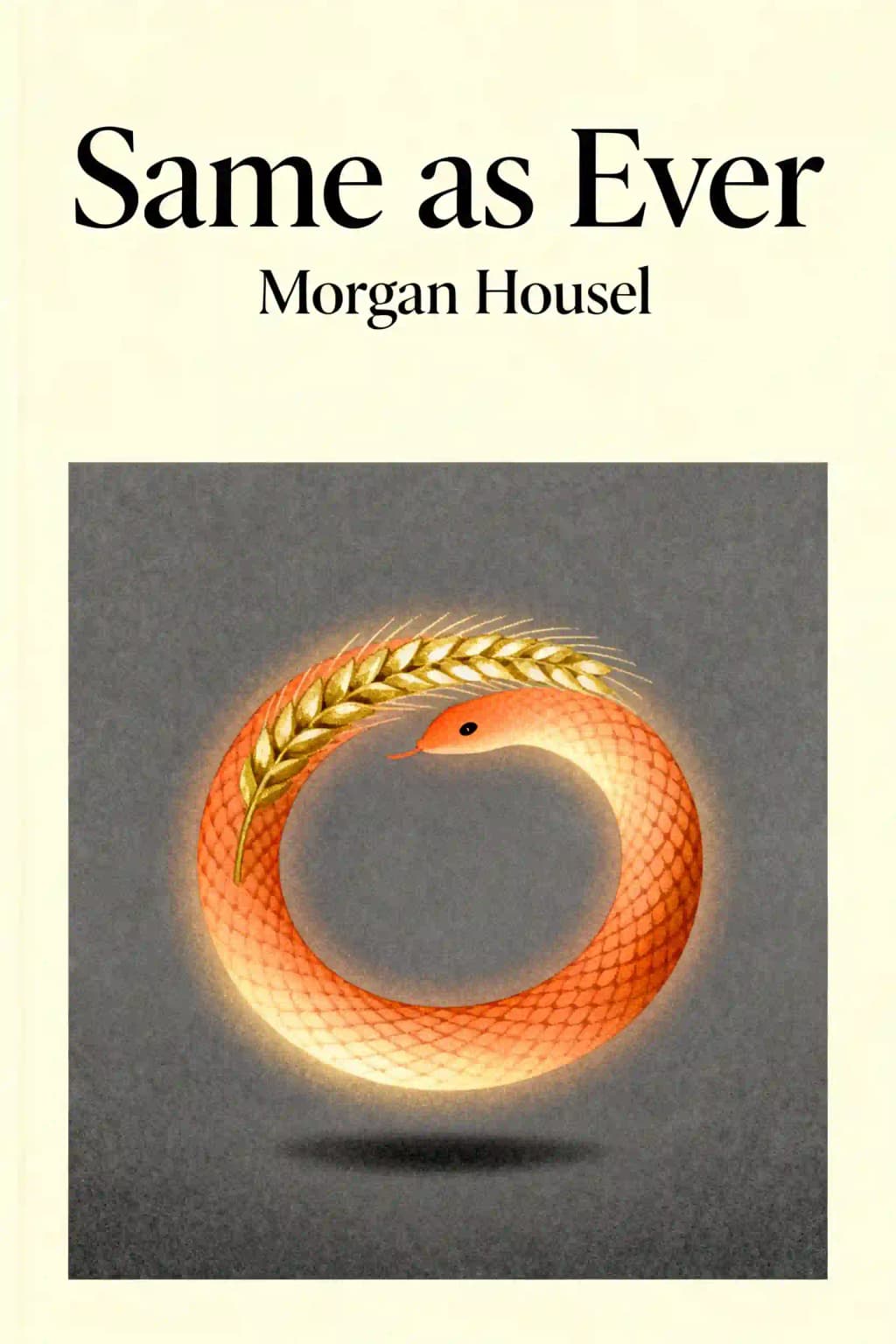
Warren Buffett, sitting in his Omaha office during the darkest days of the 2009 financial crisis, was asked how the economy would recover. Instead of complex forecasts, he simply noted that Snickers was the bestselling candy bar in both 1962 and today. His point? While markets crash and technologies evolve, certain fundamentals never change. Morgan Housel's "Same as Ever" has become a sensation among business leaders and cultural icons alike, with Bill Gates calling it "the book I've recommended more than any other." The work has climbed bestseller lists not just for its investment insights, but for its profound understanding of human psychology. In a world obsessed with predicting the next disruption, Housel offers something more valuable: a map of what remains constant across time-the stubborn patterns of human behavior that have persisted through centuries of technological and social upheaval.
Глава 2
The Fragility of History's Turning Points
History often hangs by the thinnest of threads, determined by random, unforeseeable decisions. Housel opens with a haunting personal story: on February 21, 2001, he inexplicably decided not to join his friends Brendan and Bryan for a second ski run in a dangerous area of Squaw Valley. Minutes later, they were caught and killed in a massive avalanche. This split-second, unexplainable decision saved his life. The randomness of this moment haunted him for years, illustrating how life's most significant outcomes can pivot on seemingly inconsequential choices.
This pattern extends beyond personal tragedies to history's pivotal moments. The American Revolution might have failed if winds had blown differently during a crucial battle at Brooklyn Heights, where fog allowed Washington's army to escape certain defeat. The U.S. might never have entered World War I if the Lusitania had adjusted its schedule by a day, avoiding its fatal encounter with a German U-boat. FDR nearly died from an assassin's bullet before becoming president-the bullet missed his brain by less than an inch because he happened to turn his head at the exact moment of firing to acknowledge a crowd in Miami.
Other examples abound: Hitler survived multiple assassination attempts by mere minutes or inches, including the July 20 plot where a briefcase bomb was inadvertently moved behind a thick table leg. The Cuban Missile Crisis could have ended differently if a single Soviet submarine captain hadn't refused to fire nuclear torpedoes. The course of the Cold War itself might have changed if a Soviet lieutenant colonel hadn't decided to ignore a false missile alert in 1983.
These examples reveal a profound truth: history's most consequential events often hinge on tiny, random variables that could easily have gone another way. The butterfly effect in action shows how minimal changes in initial conditions can lead to drastically different outcomes. While we can't predict specific outcomes, we can understand the patterns of human behavior that remain consistent throughout history. The lesson isn't to try forecasting exact events but to maintain a wider imagination about possibilities and prepare for multiple scenarios.
Money, like history, compounds in ways we can't anticipate. Small beginnings can grow into massive outcomes through the power of compounding-both positive and negative. A single wise investment decision in youth might lead to generational wealth, while a momentary lapse in judgment could trigger a cascade of financial troubles. This understanding helps us navigate an unpredictable world by focusing on what remains constant: human nature itself. Rather than trying to predict precise events, successful investors and leaders focus on understanding these enduring patterns and preparing for a range of possible outcomes.
Глава 3
The Blindspots in Our Risk Assessment
The most dangerous risks are those we don't see coming. Consider astronaut Victor Prather, who successfully tested a NASA space suit at 110,000 feet in 1961. After completing this groundbreaking high-altitude test, he drowned during a seemingly routine helicopter rescue when water entered through his opened faceplate-a tiny, unforeseen detail that proved fatal despite NASA's meticulous planning involving hundreds of engineers and multiple safety checks. This exemplifies Carl Richards' definition: "Risk is what's left over after you think you've thought of everything."
History's most consequential events-COVID-19, 9/11, Pearl Harbor, the Great Depression-share a common trait: they were surprises that almost no one anticipated. Even the Great Depression wasn't predicted by economists at the time. Nobel Prize winner Robert Shiller confirmed that "zero" people forecasted it, despite the presence of warning signs like market speculation and banking instability. The 2008 financial crisis followed a similar pattern - while some economists raised concerns about the housing market, very few predicted the systematic collapse that followed. The risks that matter most are, by definition, those outside our imagination and conventional risk models.
Our risk perception is further compromised by our limited view of both past and present. We can only see a fraction of what's happening around us, making us vulnerable to threats we can't envision. Historical records show this pattern repeatedly - the invention of the internet, the fall of the Soviet Union, and the rise of mobile technology all had profound impacts that experts failed to anticipate. Even today, with advanced technology and vast information networks, we regularly miss significant risks until they materialize.
The solution isn't better prediction but better preparation. California doesn't know when earthquakes will strike, but it prepares buildings to withstand them through strict building codes, emergency response systems, and public education. Japan similarly adapted after the 2011 tsunami, improving sea walls and warning systems. In finance, the most effective strategy isn't predicting market movements but building resilience through savings, diversification, and maintaining emergency reserves.
The wisest approach combines two fundamental principles: invest in preparedness rather than prediction, and save more than feels comfortable because the biggest risks are those you don't see coming. This means maintaining larger emergency funds, diversifying investments across multiple asset classes, and building redundancy into important systems. Organizations should stress-test their operations against extreme scenarios, even those that seem unlikely. This isn't pessimism-it's acknowledging that our risk perception has inherent blindspots that can only be addressed through systematic preparation and building robust safety margins into our plans.
Recent examples like supply chain disruptions during COVID-19 demonstrate how interconnected systems can fail in unexpected ways. Companies that survived best weren't those who predicted the pandemic, but those who had built in flexibility and maintained strong cash reserves. This reinforces the principle that preparation, not prediction, is the key to managing unknown risks.
Глава 4
The Gap Between Expectations and Reality
Happiness depends less on absolute circumstances than on the gap between expectations and reality. In a world that generally improves over time, the greatest challenge becomes keeping your expectations from rising in tandem with conditions. This explains one of history's great paradoxes: the 1950s are often romanticized as America's golden age despite today's objectively higher living standards.
What made the 1950s special wasn't prosperity itself but economic equality. The gap between you and your neighbors was smaller, making it easier to feel content. Post-war wage policies had flattened income distribution, creating a rare period when social pressure didn't push expectations beyond incomes. Despite modern Americans earning twice as much in real terms as 1950s families, living in larger homes, and spending less on necessities, many still yearn for that era because the comparison problem was less acute.
Today's economy excels at three things: generating wealth, showcasing it, and fostering envy. Social media amplifies this by presenting curated highlight reels of others' lives, constantly resetting our baseline expectations. Will Smith captured this perfectly, noting that becoming famous feels amazing, being famous is mixed, and losing fame is miserable-regardless of fame's actual magnitude. Tennis star Naomi Osaka similarly found tournament victories brought only relief, not joy, because expectations had risen to match her success.
Conversely, Harry Truman, initially dismissed as inadequate, became highly regarded partly because expectations for him were so low that any success seemed remarkable. We carefully guard possessions with clear price tags while neglecting the management of expectations, despite their enormous impact on our happiness. Learning to keep your goalposts from constantly moving might be our most underrated life skill.
Глава 5
The Inseparable Nature of Genius and Quirks
People with extraordinary abilities often possess equally extraordinary flaws that cannot be separated from their genius. Their unique perspectives enable breakthrough thinking but also make them indifferent to social norms and expectations-a double-edged sword that defines many of history's most brilliant minds. This pattern appears consistently throughout history, suggesting it's not coincidental but rather a fundamental aspect of exceptional talent.
John Boyd, perhaps history's greatest fighter pilot, revolutionized aerial combat with mathematical precision. His "Aerial Attack Study" became the official tactics guide still used today, introducing the OODA (Observe, Orient, Decide, Act) loop that transformed military strategy. Yet despite his brilliance, Boyd was socially abrasive-rude, erratic, and sometimes destructive. His superiors simultaneously praised his contributions while blocking promotions. In meetings, he would chain-smoke cigarettes while berating generals, earning him the nickname "Forty Second Boyd" for his claim that he could defeat any pilot in forty seconds. Boyd's unique thinking made him exceptional at his craft but also naturally resistant to established customs and authority.
Isaac Newton, likely history's smartest human, devoted years to alchemy and sorcery alongside his scientific work. He spent countless hours attempting to decode biblical prophecies and searching for the philosopher's stone, believing these pursuits were as legitimate as his work on calculus and gravity. This paradox suggests that the same mindset enabling scientific breakthroughs might also lead to pursuing seemingly irrational ideas. Newton's obsessive personality drove both his greatest discoveries and his strangest pursuits.
Modern examples abound. Elon Musk's relentless drive leads to both revolutionary companies and controversial public statements. Steve Jobs' perfectionism produced iconic products but made him notoriously difficult to work with. Walt Disney's unwavering creative vision built an entertainment empire while repeatedly bringing his company near bankruptcy. These leaders demonstrate that abnormal excellence in one area often comes with abnormal deficiencies elsewhere.
The same traits that push people to greatness-determination, optimism, and relentless confidence-also increase their likelihood of overreaching and failing spectacularly. Thomas Edison's stubborn persistence led to the light bulb but also caused him to waste years defending DC current against clearly superior AC power. Howard Hughes' attention to detail helped him build innovative aircraft but later manifested as debilitating obsessive-compulsive disorder.
We must accept that people we admire for certain traits come as complete packages-their brilliance inseparable from their flaws. As Naval Ravikant noted, you can't cherry-pick aspects of someone's life; you must consider whether you'd accept their entire existence. This insight extends beyond famous figures to anyone pursuing excellence-the very qualities enabling exceptional achievement often create significant personal challenges.
This understanding helps explain why revolutionary thinkers often face resistance-their minds operate differently not just in their area of expertise but across all domains of life. Their philosophy to "challenge all assumptions" creates both their greatest contributions and their most difficult personal qualities. The price of genius, it seems, is often paid in social currency and conventional stability.
Глава 6
Our Struggle with Probability in a Complex World
Humans crave certainty in a probabilistic world. We struggle with understanding risk and uncertainty, often ignoring nuanced probabilities in favor of black-and-white outcomes. With eight billion people on Earth, even one-in-a-million events happen to thousands daily. The modern media landscape amplifies this by connecting us globally, ensuring we hear about every disaster worldwide rather than just local events. This creates a perception that the world is increasingly chaotic when we're simply seeing more of the chaos that always existed.
Predictions are often less about providing accurate probabilities and more about relieving the pain of uncertainty. Charlie Munger called this the "Doubt-Avoidance Tendency"-our brains are programmed to quickly eliminate doubt by reaching decisions. Despite experts' poor forecasting track records, we continue seeking their certainty because, as Philip Tetlock noted, "We need to believe we live in a predictable, controllable world."
Even experienced economists with 50-year careers have only witnessed about seven recessions-too small a sample to truly validate forecasting abilities. Without dozens or hundreds of predictions to measure against outcomes, it's impossible to verify if someone claiming "80 percent chance of recession" is accurate, leaving us all guessing or preferring those who speak with unwarranted certainty.
When negative outcomes occur, we tend to attribute them to recklessness rather than probability. A hotel valet service that damages one car in 10,000 has an excellent record statistically, but management sees only the monthly accidents. Similarly, investors react emotionally to market crashes despite knowing they occur regularly. The pain of consequences makes us forget probability, causing us to treat inevitable statistical outcomes as preventable failures. This psychological tendency explains why we consistently underestimate the likelihood of rare events while overreacting when they occur.
Глава 7
The Persuasive Power of Storytelling
The best story wins-not the best idea, the right idea, or the most rational one. People who tell compelling stories that capture attention and generate nodding heads tend to be rewarded. Great ideas explained poorly go nowhere, while mediocre ideas told compellingly can spark revolutions. With too much information in the world for people to carefully analyze, emotional storytelling consistently trumps cold statistics.
Martin Luther King Jr.'s famous "I Have a Dream" speech wasn't planned-he improvised the most memorable part after gospel singer Mahalia Jackson called out "Tell 'em about the dream, Martin!" King set aside his prepared text, paused for six seconds, and delivered the historic words that changed history through their emotional power. This demonstrates how the best stories can inspire and bring attention to topics in ways that facts alone cannot.
Stories function as leverage, squeezing full potential from ideas with less effort. They help explain complex concepts simply, as physicist Richard Feynman did when describing physics through everyday scenarios. Even Einstein used imagination and simple scenes to process complex information. As Ken Burns said, "good stories are about one plus one equals three"-they create understanding beyond the sum of their parts.
The most compelling narratives confirm what we want to believe or connect to our personal experiences. As poet Ralph Hodgson noted, "Some things have to be believed to be seen," meaning poor evidence can be persuasive if it addresses a desired belief. Steven Spielberg observed that despite everyone bringing unique experiences to a movie, good storytelling gets everyone "to clap at the same time, to laugh at the same time, and to be afraid at the same time." Mark Twain similarly noted his books were like "water" that everyone drinks, finding universal emotions that resonate across all backgrounds.
Many great ideas have been discovered but could grow exponentially if explained better. Products often reach only a fraction of their potential market because companies communicate them poorly. As Visa founder Dee Hock said, "New ways of looking at things create much greater innovation than new ways of doing them." There's tremendous opportunity in better presentation of existing ideas rather than inventing entirely new ones.
Глава 8
The Unmeasurable Forces That Drive Our World
The world operates through forces that defy measurement and rational explanation. Despite our desire for logical frameworks, human decisions are rarely made on spreadsheets-they're driven by emotions, hormones, and psychological factors that can't be quantified. This fundamental disconnect between our expectations of rationality and the messy reality of human behavior creates endless frustration and surprise.
Many decisions don't make numerical sense yet continue happening because human elements-hard to quantify and explain-carry more influence than anything else. As historian Will Durant noted, "Logic is an invention of man and may be ignored by the universe." Attempting to reduce emotional humans to mathematical equations creates endless frustration.
Robert McNamara brought his Ford Motors statistical approach to managing the Vietnam War, demanding everything be quantified in charts. But as Pentagon special operations head Edward Lansdale pointed out, this approach couldn't measure "the feelings of the Vietnamese people." While Americans tracked kill ratios of ten-to-one, Ho Chi Minh understood the psychological reality: "You will kill ten of us, and we will kill one of you, but it is you who will tire first." Some immeasurably important factors make all the difference precisely because their lack of quantification causes people to discount their relevance.
Physiologist Archibald Hill discovered that athletic performance couldn't be predicted solely through measurable physical metrics. While his early Nobel Prize-winning work suggested maximum performance was tied to heart strength and oxygen transport, race outcomes rarely matched these calculations. He eventually realized that performance isn't just what you're physically capable of-it's what your brain will allow based on the risk-reward assessment of each moment. Your brain acts as a governor, permitting different physical limits when being tested in a lab versus competing in the Olympics versus fleeing an ax murderer.
Every market valuation combines measurable numbers with stories reflecting people's hopes, dreams, and fears. Jim Grant captured this perfectly: valuing stocks purely on earnings and interest rates "is to forget that people have burned witches, gone to war on a whim..." Lehman Brothers had strong capital ratios days before bankruptcy-only investor faith changed. Conversely, struggling GameStop became worth billions through Reddit enthusiasm. The most powerful force in business and investing is precisely what can't be measured or modeled in spreadsheets.
Глава 9
The Cyclical Nature of Stability and Chaos
The world operates in a perpetual cycle of greed and fear, where stability inevitably leads to instability. This pattern repeats endlessly as we swing from assuming good news is permanent to believing bad news will never end. Economist Hyman Minsky's financial instability hypothesis explains that stability itself creates instability. When an economy remains stable, people grow optimistic, take on more debt, and eventually destabilize the system.
This applies universally: imagine a stock market that never declined-everyone would rationally buy as much as possible, driving valuations to unsustainable heights until the slightest surprise triggered collapse. Stability creates the conditions for its own destruction.
Modern life has become remarkably safe compared to previous eras, with infectious disease deaths declining 94% since 1900. This improvement, while unquestionably good, created an anomaly where pandemics became inconceivable to many. Previous generations who routinely faced mumps, measles, and polio considered disease an "unavoidable gauntlet." Our complacency and skepticism toward warnings-a direct result of decades without major pandemics-left us psychologically unprepared when COVID-19 arrived, demonstrating how calm plants the seeds of future crises.
California's experience with drought and fire exemplifies Jung's concept of enantiodromia-when excess creates its opposite. Record rainfall in 2017 ended a six-year drought but triggered a "superbloom" of vegetation. When this abundant growth dried out in 2018, it became perfect kindling for some of California's worst wildfires. This counterintuitive pattern, where record rain directly led to record fires, demonstrates how calm conditions create the materials for future chaos, making us fundamentally underestimate both the odds and consequences of things going wrong.
Markets inevitably swing between extremes because the only way to discover limits is to exceed them. Just as tire companies test new tires by running them until they blow up, markets push boundaries to find what other investors will endure. People's desire to get rich far exceeds the number of obvious opportunities, so if there might be potential in something, someone will test it. This is why markets don't stay within sanity's limits and always overdose on both pessimism and optimism-they have to. The only way to identify the top is to push past where numbers make sense and beyond the stories people believe.
Глава 10
The Power of Experience in Shaping Beliefs
Nothing shapes our beliefs more powerfully than firsthand experience. As Harry Truman observed, "The next generation never learns anything from the previous one until it's brought home with a hammer." Throughout history, people's preferences and convictions have proven remarkably malleable when confronted with dramatic personal circumstances.
The Great Depression demonstrates this perfectly. Americans elected Herbert Hoover with a landslide in 1928, then rejected him just as decisively in 1932. This economic catastrophe transformed American politics and policy almost overnight: the gold standard disappeared, public works surged, and Social Security-previously a fringe idea whose supporters were arrested protesting on the Capitol lawn-suddenly passed with overwhelming bipartisan support (372-33 in the House, 77-6 in the Senate).
Such radical shifts don't happen when people have full stomachs and stable jobs. Only when lives are upended and hopes dashed do people become willing to embrace previously unthinkable ideas. Trevor Noah captured this perfectly: "If you find the right balance between desperation and fear, you can make people do anything." This dynamic played out catastrophically in 1930s Germany, where hyperinflation followed by depression created conditions where, as one civilian later explained, "When someone helps you get out of an emergency situation and into a better life, then you're going to give them your support."
Even our personal views fall into this trap. We imagine how we'd respond to market crashes while picturing everything else remaining stable, but downturns never happen in isolation-they occur because systems are breaking, which affects our confidence in recovery. This explains why far more people agree with Warren Buffett's advice to "be greedy when others are fearful" than actually follow it when the moment arrives.
The most important questions we can ask are: "What have you experienced that I haven't that makes you believe what you do? And would I think about the world like you do if I experienced what you have?" These questions acknowledge that people with different experiences will inevitably think differently. Hard-core stress leaves permanent scars that reshape our worldviews. After traumatic events like the Great Depression, World War II, or the dot-com crash, people's behaviors and expectations permanently change.
Two things happen after experiencing something big and unexpected: you assume it will keep happening with greater force, and you forecast with great conviction despite the original event being improbable. Disagreement isn't about information but experience-which is why people will always disagree, same as ever.