Глава 1
When Fear Trumps Facts: The Psychology Behind Our Risk Perceptions
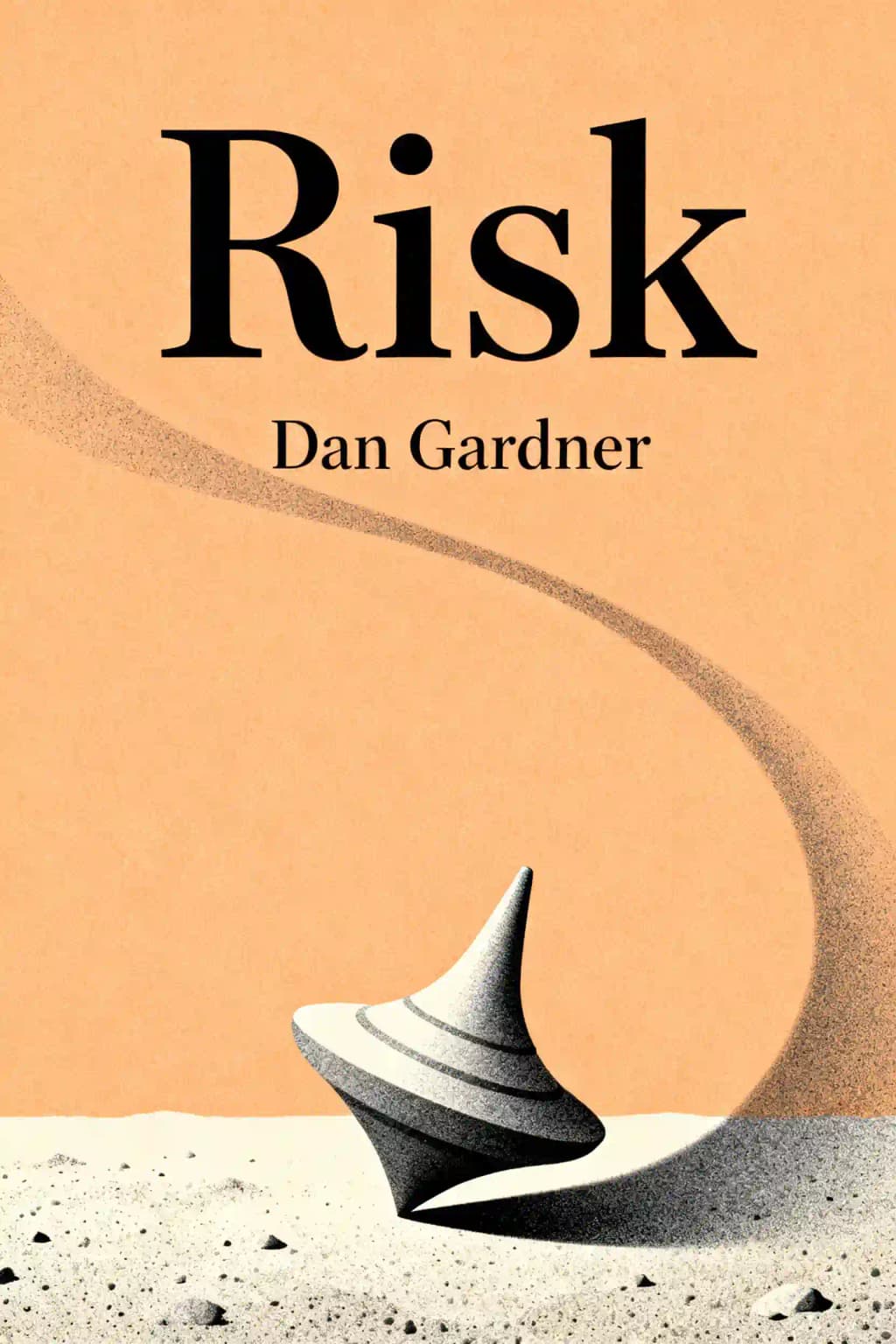
Imagine yourself in a world where the most terrifying dangers receive the least attention, while minor threats dominate headlines and policy decisions. This isn't some dystopian fiction-it's our reality, brilliantly dissected in Dan Gardner's "Risk." The book has become required reading in psychology departments worldwide since its 2008 publication, with Bill Gates citing it as instrumental to his approach to public health communication. Through compelling examples and cutting-edge research, Gardner reveals how our Stone Age brains consistently misinterpret modern risks, leading to costly misallocations of resources and unnecessary anxiety. As Nobel laureate Daniel Kahneman noted, "Gardner's work fundamentally changed how we understand the gap between statistical reality and human perception"-a gap that explains everything from terrorism policies to vaccine hesitancy.
Глава 2
Two Minds at War: How We Process Risk
We possess two distinct systems for assessing danger. System One-our "Gut"-operates unconsciously, making lightning-fast judgments based on emotions and intuition. System Two-our "Head"-works deliberately, examining evidence and calculating probabilities. This dual-processing system served our ancestors well, but creates profound problems in our modern information environment.
Head is our conscious, rational mind that can analyze statistics and weigh evidence. But it's slow, requires effort, and often takes a back seat to Gut's immediate reactions. Gut evolved to make snap judgments when something rustled in the tall grass-potentially saving our ancestors' lives. The problem is that Gut can't access how it forms these judgments, which is why focus groups often yield misleading insights. People rationalize their gut reactions with plausible but incorrect explanations.
These two systems interact constantly. Knowledge first used consciously by Head can sink into Gut through practice-like when golfers or doctors move from conscious checklists to intuitive expertise. Art historians who instantly identify fraudulent antiquities through "intuitive repulsion" demonstrate this expertise-based intuition.
The conflict between these systems explains why students resist eating fudge shaped like dog feces or sugar labeled "cyanide" despite knowing better. Our ancient wiring includes the Law of Similarity-the assumption that causes resemble their effects. At its most basic level, this principle means "appearance equals reality"-if it looks like a lion, it is a lion. This wiring worked well for millions of years until modern inventions like photography created images that look like things but aren't those things.
Head's monitoring becomes particularly loose when we're rushed, tired, distracted, stressed, or intoxicated-like "a bright but lazy teenager" who should keep a hand on the wheel but would rather listen to an iPod. Under stress or exhaustion, Gut takes control while Head sleeps, explaining many of our most irrational decisions about risk.
Глава 3
The Emotional Foundations of Risk Perception
Our emotional responses fundamentally shape how we perceive danger. Paul Slovic, a psychology professor and pioneer in risk perception research, discovered that while experts define risk as probability multiplied by consequence (essentially the body count), ordinary people incorporate many other factors.
The most dramatic example is nuclear power. Both experts and laypeople correctly identified it as having the fewest fatalities among surveyed risks, yet experts ranked it 20th in riskiness while the public ranked it first. This disparity occurs because people's risk perception is influenced by numerous qualitative factors beyond mere statistics.
Slovic identified key factors that heighten perceived risk: catastrophic potential (many deaths at once versus spread out), unfamiliarity, poor understanding, lack of personal control, involuntary exposure, threats to children or future generations, identifiable victims rather than statistics, institutional distrust, media attention, past accidents, inequitable distribution of benefits and risks, unclear benefits, and man-made origin.
Among these findings, familiarity stands out as particularly significant. Our brains constantly sort sensory input, prioritizing novel or unfamiliar stimuli while filtering out the routine. The complementary mechanism, habituation, causes repeatedly experienced stimuli without consequences to gradually fade from attention. Like cologne that becomes imperceptible to its wearer over time, we become desensitized to familiar risks regardless of their actual danger.
This explains why we fear terrorism more than heart disease, despite the latter killing far more people. Terrorism feels novel and frightening, while heart disease feels like background noise-even though it kills approximately 650,000 Americans annually. The problem is that habituation can't account for scientific knowledge-a smoker feels no threat from each cigarette despite statistical evidence, just as someone might feel comfortable driving drunk after years without incident.
Глава 4
The Good-Bad Rule and How Feelings Drive Judgment
Slovic discovered two crucial clues about how we judge risk. First, "dread" strongly correlated with qualities like catastrophic, involuntary, and inequitable risks, forming what he called "the dread factor." Second, people's ratings of risks and benefits were inversely correlated-if something seemed risky, they judged its benefits as low, and vice versa. This illogical connection suggested emotional responses were driving judgments.
Building on Robert Zajonc's work on affect (emotion), Slovic developed the "affect heuristic" or what Gardner calls the "Good-Bad Rule": Gut instantly categorizes things as Good or Bad, and this feeling guides subsequent judgments. Experiments confirmed this-under time pressure (limiting Head's intervention), the risk-benefit seesaw effect strengthened. Even more telling, when people read positive information about a technology, they not only raised their benefit estimates but also lowered their risk estimates, despite receiving no information about risks.
The Good-Bad Rule explains many risk perception puzzles. We overestimate cancer's lethality partly because the word itself evokes negative feelings. Our contradictory attitudes toward radiation make sense through this lens-nuclear power feels Bad (regardless of actual risk), while X-rays and sunbathing feel Good (despite real radiation exposure). Studies show people pay more to insure attractive cars and against specifically named threats like "terrorist acts" rather than broader "all possible causes," even though the latter logically includes the former.
Christmas presents a fascinating case study in risk perception. Despite causing roughly 1,000 hospital visits from tree accidents, another 1,000 from decorating injuries, and 350 from Christmas lights in Britain alone-plus 500 deaths and $500 million in damage from holiday house fires in America-these substantial risks generate little public concern. Why? Because Christmas carries powerful positive emotional associations. It's not just Good, it's Wonderful-and Gut instinctively knows Wonderful Things don't kill.
Глава 5
The Example Rule: Why Vivid Stories Trump Statistics
Our brains assess likelihood based on how easily examples come to mind-what psychologists call the "availability heuristic" or what Gardner terms the "Example Rule." This explains why earthquake insurance sales peak immediately after earthquakes and decline over time, despite the actual risk pattern being exactly opposite.
The breast implant crisis of the 1990s demonstrates how humans respond differently to stories versus statistics. When the FDA banned silicone implants in 1992, it wasn't because they were proven unsafe but because manufacturers couldn't prove they were safe. A massive class-action settlement of $4.25 billion followed, with Dow Corning eventually filing for bankruptcy. Public perception transformed completely-surveys showed people rated implants nearly as dangerous as cigarettes, despite no scientific evidence connecting them to disease.
The controversy revealed a fundamental tension: stories feel true but aren't necessarily accurate. With 1% of American women having implants and 1% having connective-tissue disease, coincidence alone would produce 10,000 women with both. The activists' rallying cry "we are the evidence!" ignored the need for epidemiological studies comparing disease rates between women with and without implants.
Journalists know that while numbers like "35 killed in a bus crash" barely register emotionally, personal stories grip us deeply. Anna Nicole Smith's death commands more attention than floods killing thousands in Indonesia. Even with 9/11, the statistic "3,000 killed" means little compared to individual stories like Diana O'Connor's-the Brooklyn woman who worked three jobs to attend college before perishing in the towers.
Our Stone Age brains now operate in a world utterly transformed from the one they evolved in. We've gone from the first crude writing 5,000 years ago to a world where execution videos spread globally within minutes via smuggled cell phones. Our brains-designed for a world where images were reality-now navigate a tsunami of instantaneous global information while still believing that easily recalled examples indicate common threats.
Глава 6
Anchoring and the Power of Irrelevant Numbers
Our minds are powerfully influenced by irrelevant numbers through the Anchoring Rule. When uncertain, our intuitive system (Gut) grabs the nearest available number as an anchor and adjusts insufficiently from there. This effect has profound implications for manipulation.
The claim that "50,000 pedophiles are prowling the Internet at any one time" has spread widely from news reports to government officials, despite having no credible source. This suspiciously round number changes in each telling-sometimes they're "on-line," sometimes "looking for children," sometimes specifically on "MySpace." When sources are cited at all, they point to the FBI, which denies creating or endorsing this statistic. Curiously, the number 50,000 has appeared in previous moral panics as the alleged number of children kidnapped by strangers and later as victims of Satanic cults-both claims later debunked.
Retailers exploit anchoring with signs like "Limit 12 per customer"-in supermarket experiments, shoppers exposed to such limits bought significantly more items than those who weren't. The rule extends beyond shopping: German judges who heard a hypothetical three-year sentence suggestion gave average sentences of 33 months, while those who heard one year suggested gave only 25 months.
Public opinion surveys can be similarly skewed-when asked how much the average person would pay to clean up a lake, respondents anchored to $200 guessed $36, while those anchored to $25 guessed only $14. This makes the Anchoring Rule invaluable for marketing fear-like software companies using the "50,000 pedophiles online" statistic. Even skeptical parents who reject the number will unconsciously use it as an anchor, perhaps adjusting down to 10,000-still a frightening figure that drives purchases, despite being derived from meaningless data.
Глава 7
The Rule of Typical Things: Why We Love Stories Over Statistics
The "representativeness heuristic" or Rule of Typical Things makes us favor outcomes that make good stories or good hypotheses, even when they defy statistical probability. This cognitive bias is deeply ingrained in human psychology, leading us to make judgments based on how well something matches our mental prototypes rather than actual statistical likelihood. Kahneman and Tversky's famous "Linda problem" demonstrates how powerfully this rule influences judgment. When presented with a profile of Linda-a philosophy major concerned with social justice who participated in anti-nuclear demonstrations-85-89% of people judge it more likely that she's "a bank teller active in the feminist movement" than simply "a bank teller," despite this being logically impossible. This conjunction fallacy persists even among sophisticated respondents and statistics students who should know better.
We're suckers for a good narrative, which explains why expert predictions so often fail. Pundits making elaborate scenarios score worse than simple coin flips or even Chippy the chimpanzee (58% accuracy). Political commentators who craft detailed stories about election outcomes, market analysts who construct complex scenarios about economic trends, and sports experts who predict game results all fall victim to this bias. Logically, each link in a complex prediction chain decreases overall probability - if each step has an 80% chance of occurring, a five-step sequence has only a 33% chance of completion. Yet our gut latches onto plausible details and judges the whole scenario as likely.
Terrorism scenarios particularly demonstrate how the Rule of Typical Things distorts risk assessment. When security experts describe chains of events-like terrorists acquiring uranium, building a bomb, and detonating it without detection-we focus on the plausibility of individual elements rather than the improbability of the entire sequence succeeding. The more detailed and vivid the scenario, the more convincing it becomes, despite each additional detail mathematically reducing its probability. Media coverage amplifies this effect by focusing on dramatic narratives rather than statistical realities.
These scenarios routinely include elements contradicted by historical experience-massive anti-Muslim backlashes that never materialized after 9/11, Madrid, or London; or catastrophic economic consequences that didn't follow 9/11. The 2008 financial crisis provides another example: experts crafted compelling narratives about bank failures leading to complete economic collapse, yet the actual recovery, while painful, didn't match these dramatic predictions. Yet such scenarios persist because they feel right to our intuitive minds, which evolved to learn from stories rather than statistics. This preference for narrative over numbers affects everything from personal financial decisions to public policy, often leading to misallocation of resources and attention to vivid but unlikely threats while ignoring more mundane but serious risks.
Глава 8
Fear Inc.: The Business of Selling Anxiety
Fear has become a thriving industry. At Security Essen, Germany's massive trade show, over 1,000 exhibitors showcase security products across 75,000 square meters-from electrified fences to surveillance cameras, home alarms to bulletproof luxury cars. The private security sector has expanded enormously over 25 years, with companies like Group 4 Securicor employing 400,000 people across 110 countries.
Security companies market fear rather than rational risk assessment. Their advertisements target affluent neighborhoods despite lower crime rates because they're more lucrative markets. These ads exploit how our unconscious mind processes information-Gut can't distinguish between commercials and reality, experiencing negative emotions that trigger the Good-Bad Rule to conclude the portrayed threats are highly likely.
Germs represent a perfect marketing opportunity-invisible, frightening, and seemingly everywhere. Companies like Pfizer with its Purell hand sanitizer capitalize on this fear, listing "99 Places Where Germs Are Likely To Lurk" from subway poles to library books. While reasonable sanitizer use in settings like daycares is beneficial, corporations portray virtually any human-touched object as threatening.
Pharmaceutical companies employ subtle fear marketing, like Bristol-Myers Squibb's poster "One Hundred Ways to Live to One Hundred" in doctors' waiting rooms. While appearing as general health advice, the visually emphasized items promote medication use and cholesterol reduction-Bristol-Myers happens to make Pravachol, a cholesterol drug that earned $1.3 billion in 2005.
Pharmaceutical companies engage in "disease mongering"-expanding markets by shifting the line between healthy and diseased. When professional associations changed diagnostic thresholds for conditions like high blood pressure and diabetes, 87.5 million otherwise healthy Americans suddenly qualified as having chronic conditions. Companies medicalize normal conditions through language (renaming "impotence" as "erectile dysfunction") and inflated statistics, transforming risk factors like cholesterol into diseases requiring medication.
Fear marketing isn't accidental but scientifically developed. Tobacco companies were 20 years ahead of cognitive psychologists in understanding the importance of affect and System One (Gut) thinking. Today's major industries integrate cutting-edge psychological research with marketing strategies, using techniques like "neuromarketing" with MRIs and biometric monitoring to access both Head and Gut responses.
Глава 9
The Politics of Fear: How Terrorism Distorts Policy
The September 11, 2001 attacks plunged America into a state of profound shock and dread. For most Westerners, the events were as incomprehensible as "the appearance of a second moon in the night sky." Our nearly total ignorance about bin Laden and his motives magnified our fear.
The terrorist attacks carried extraordinary "signal value"-suggesting grave future dangers-while televised images burned into our memories with unprecedented immediacy and horror. For our gut instincts, these vivid memories became permanent reference points, triggering the Example Rule: this will probably happen again. Even those without personal connections experienced intense emotions that unconsciously amplified their perception of the threat.
By mid-October 2001, Gallup polling revealed 85% of Americans believed more terrorism was likely "over the next several weeks," with 40% considering it "very likely." The fear was deeply personal-60% worried they or family members would become terrorism victims, with a quarter "very worried."
This fear didn't fade as expected. Despite no further attacks, by 2006 (the fifth anniversary of 9/11), 50% still believed terrorism was likely "over the next several weeks," and 44% worried about personal danger-actually higher than in 2002. This defied both logic and statistics. The 9/11 attacks represented a 1 in 93,000 chance of death for any American. Even if similar attacks had occurred monthly for a year (36,000 deaths), the risk would be about 1 in 7,750-still less than the 1 in 6,498 annual risk of dying in a vehicle accident.
Terrorism's actual toll is remarkably small. Between 1968 and 2007, international terrorism killed just 14,790 people worldwide-an average of 379 deaths annually. In North America during that period, terrorism claimed 3,765 lives (including 9/11), slightly more than motorcycle fatalities in America for 2003 alone. Western Europe saw only 1,233 terrorism deaths over those decades-just 6% of annual European deaths from radon gas.
Unlike FDR who declared "the only thing we have to fear is fear itself," the Bush administration found political advantage in stoking fears. The 9/11 attacks transformed Bush from a weak president with mediocre approval ratings into a wartime leader with a Churchill-like image. By framing terrorism as an ongoing world war, this transformation became permanent rather than temporary.
Terror alerts consistently boosted presidential approval ratings, as psychological research confirmed that reminders of death or 9/11 increased support for the president. Republicans recognized this pattern and campaigned heavily on themes of terrorism and security in 2002, crushing Democrats who focused on domestic issues.
Глава 10
Media, Crime, and Distorted Risk Perception
News media consistently reverse reality in covering crime. The pyramid of crime shows property crimes (88% of all offenses) vastly outnumber violent crimes (12%), with murder representing just 0.14% of all recorded crimes. Yet media coverage flips this reality upside-down-the rarest crimes receive the most attention while the most common are ignored.
Americans worry about murder despite only 0.0056% being murdered annually (three times less likely than dying in a car crash). Even within murder coverage, statistical outliers dominate-a poor young black man killing another receives minimal coverage, while the same perpetrator killing a rich white woman makes front pages.
With media consistently misrepresenting crime, public misconceptions flourish. Most people believe violent crime accounts for about half of all crime-drastically overestimating its actual proportion. Research shows only one in five can accurately estimate violent crime rates, with a third overestimating by at least six times. People persistently believe crime is increasing despite significant declines-even during Britain's 44% crime reduction (1995-2005) and America's spectacular 1990s crime drop, most believed crime was rising.
Our obsession with crime stories stems from evolutionary adaptations. As social mammals with brains specialized for understanding others' intentions, humans are naturally drawn to stories about rule-breaking. For our ancestors, understanding violations of social norms was crucial for survival. Crime stories satisfy this instinct while reinforcing that rule-breakers face consequences.
When emotions clash with statistics in risk assessment, gut feelings typically prevail. In an Ohio State University experiment, participants managing a park budget confronted two problems: deer overpopulation and minor crimes. Though numerical ratings showed deer posed a greater threat, participants consistently allocated equal or greater funding to crime prevention due to its emotional impact. This demonstrates how our emotional response to crime overrides rational analysis.
Глава 11
Cultural Worldviews and Group Polarization
Culture profoundly shapes our risk perceptions beyond both rational calculation and social conformity. Cultural attitudes toward substances like alcohol (beloved and underestimated) versus illicit drugs (stigmatized and overestimated) dramatically skew risk perception. The Example Rule also gets filtered through culture, as we pay more attention to and better remember information that confirms our culturally-shaped beliefs.
Research shows white men consistently perceive risks as less serious than women and minorities do. This "white male effect" persists even after accounting for differences in power, education, and trust in authorities. Dan Kahan's 2005 survey revealed this effect comes from a subset of white men (about 30%) who tend to be wealthier, better-educated, and more politically conservative. The real driver isn't race or gender but cultural worldview-hierarchists and individualists (disproportionately white men) perceive certain risks differently than communitarians and egalitarians.
When like-minded people gather to discuss risks, their collective opinion doesn't moderate toward the average-it becomes more extreme. This "group polarization" phenomenon occurs through two mechanisms. First, people judge themselves by comparison with others in the group, discovering they aren't holding the most extreme (and therefore most "correct") position. Second, information pooling occurs, but with confirmation bias ensuring only supporting information gets shared and accepted.
This polarization doesn't require face-to-face interaction-it happens just as readily online through blogs and social media. As Cass Sunstein observed, this process can quickly spread until "hundreds, thousands or millions of people" become convinced of a new threat. Sometimes they're right (as with AIDS), but often they're wrong (as with silicone breast implants). These waves of worry follow social networks, explaining why the breast implant panic swept across North America but barely touched Europe.
Глава 12
The Paradox of Progress: Why We Fear More As We Become Safer
We're living in the safest, healthiest era in human history, yet we've never been more afraid. Life expectancy has increased from just 48 years in 1900 to modern levels approaching 80 years in developed nations. Maternal and child mortality have plummeted, and people develop chronic illnesses later in life with less severity than previous generations.
We're living better lives than ever before-taller, smarter (with steadily improving IQs), and less physically disabled. Nobel laureate Robert Fogel describes this as "a form of evolution unique among the 7,000 or so generations of humans." Political arrangements have improved too, with democracies increasing from 22 in 1950 to 120 by century's end. War between countries has become much less likely, and civil wars have declined since 1960.
Yet paradoxically, as we've become the healthiest, wealthiest, and longest-lived people in history, we've grown increasingly afraid. Our fear priorities are dangerously misaligned with actual threats. We obsess over handgun violence while dismissing car accidents as background noise, despite vehicles killing far more people. We've transformed childhood into a virtual prison sentence-barring school doors, forbidding unsupervised play, and keeping children indoors-all while ignoring the very real health threats of obesity and diabetes caused by sedentary lifestyles.
This misallocation of resources and attention has deadly consequences. We spend "gargantuan sums" combating terrorism while neglecting proven, cost-effective health strategies that could save countless lives. As Gardner puts it, terrorism is "a scuttling beetle next to the elephant of disease."
The fundamental problem is that our brains evolved for hunter-gatherer existence but must now navigate a world of microns, parts-per-million, and global information bombardment-like a Stone Age hunter suddenly waking in Times Square, confused and vulnerable to those who would exploit fear. Until we recognize how our ancient wiring distorts modern risk perception, we'll continue to fear the wrong things and neglect the threats that truly matter.