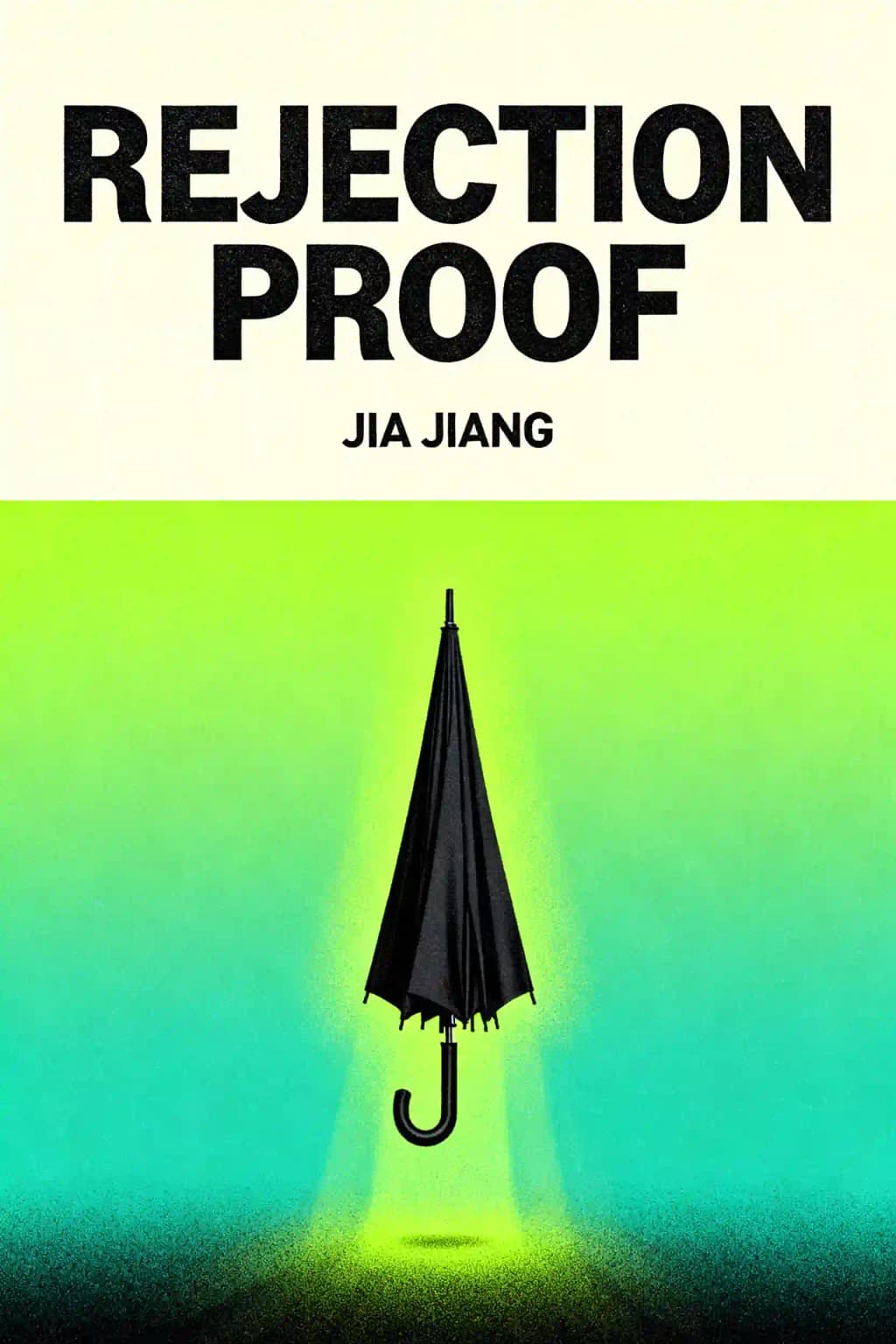
REJECTION PROOF
Обзор книги REJECTION PROOF
In "Rejection Proof," Jia Jiang transforms 100 deliberate rejections into a masterclass on resilience. His Olympic-logo donut request went viral, proving rejection isn't personal - it's just opinion. What outlandish request could transform your life?

Ключевые темы в REJECTION PROOF
- rejection therapy
- fear desensitization
- social courage
- asking for things
- resilience building
Цитаты из REJECTION PROOF
Rejection isn't an absolute truth but merely someone's opinion.
Failure feels tolerable because we can attribute it to external factors.
Rejection feels deeply personal.
Move on.
Don't take it personally
Персонажи в REJECTION PROOF
- Jia JiangThe author and subject of the rejection experiment
- TracyJia's wife who encouraged him to pursue his dream
- JackieKrispy Kreme shift leader who made Olympic donuts
Об авторе
Об авторе книги REJECTION PROOF
Jia Jiang, bestselling author of Rejection Proof: How I Beat Fear and Became Invincible Through 100 Days of Rejection, is a globally recognized expert on resilience and overcoming rejection. Born in Beijing and now based in the U.S., Jiang’s work blends personal experience with actionable strategies, rooted in his viral "100 Days of Rejection" experiment that captivated millions through a TED Talk and blog.
A Duke University MBA graduate and former corporate professional at Dell and LinkedIn, he transitioned to entrepreneurship, founding Rejection Therapy and Wuju Learning to help individuals and organizations build courage through rejection training.
The book, a self-help classic in the personal development genre, draws from Jiang’s journey of transforming fear into empowerment, offering tools to reframe rejection as opportunity. His insights have been featured in TIME, NPR, and Forbes, and his TED Talk has surpassed 10 million views. Jiang’s upcoming 2026 release, The Art of Achieving Ambitious Things, expands on his philosophy of fearless goal-setting. Rejection Proof remains a staple in sales training and career development programs worldwide, with Audible naming it among the "top 100 well-being books of all time."
Скачать резюме книги «REJECTION PROOF»
Получите резюме книги «REJECTION PROOF» в формате PDF или EPUB бесплатно. Распечатайте или читайте офлайн в любое время.
Часто задаваемые вопросы об этой книге
Rejection Proof chronicles Jia Jiang's transformative "100 Days of Rejection" experiment, where he deliberately sought rejection to conquer his fear of it. The book blends personal anecdotes (like asking for Olympic ring-shaped doughnuts or addressing a plane’s passengers) with actionable strategies to reframe rejection as a learning opportunity. Jiang reveals how persistence, curiosity, and redefining "no" can build resilience in personal and professional life.
This book is ideal for entrepreneurs, professionals facing client negotiations, creatives pitching ideas, or anyone struggling with social anxiety. It’s particularly valuable for those seeking to turn setbacks into growth opportunities. Jia Jiang’s humor and relatable stories make it accessible for readers interested in self-improvement, confidence-building, or overcoming fear of failure.
Yes—Rejection Proof offers a fresh, practical take on resilience. Unlike abstract self-help guides, Jiang’s approach is grounded in real-world experiments, providing tools to desensitize readers to rejection. Its mix of storytelling and actionable frameworks (like the "rejection math" concept) makes it a compelling read for personal or professional growth.
- Rejection is a numbers game: Persistence increases success odds.
- Ask “why” after a “no”: Digging deeper can uncover opportunities.
- Detach from outcomes: View rejection as feedback, not personal failure.
- Reframe requests: Creative asks (e.g., a "burger refill") reduce perceived stakes.
Jia Jiang’s self-designed experiment involved seeking one rejection daily for 100 days, from mundane (asking for a discounted hotel room) to outrageous (requesting Krispy Kreme doughnuts shaped like Olympic rings). These trials revealed that rejection often stems from external factors, not personal shortcomings, and that polite persistence can turn "no" into "yes."
The book teaches techniques like normalizing rejection (exposure reduces anxiety) and strategic questioning (e.g., “Could you explain why?”). By demonstrating that even bizarre requests sometimes succeed, Jiang helps readers reframe fear as curiosity, empowering them to take calculated risks in careers, relationships, or creative pursuits.
- “Rejection is nothing but a human interaction with two sides.”
- “The fear of rejection is often worse than rejection itself.”
- “Every ‘no’ is a step closer to ‘yes’.”
These quotes emphasize mindset shifts to reduce rejection’s emotional impact.
Jiang advocates the 5-second rule: act before fear escalates. He also recommends:
- Clarify intent: Ensure requests are specific and respectful.
- Embrace curiosity: Ask follow-up questions to understand rejections.
- Track outcomes: Logging attempts reveals patterns and progress.
“Wuju” (meaning “fearless” in Chinese) refers to Jiang’s philosophy of embracing vulnerability to build courage. Through his company Wuju Learning, he trains individuals and organizations to view rejection as a skill to master, not a threat to avoid—a theme central to the book.
Some readers note the book leans heavily on anecdotal evidence rather than scientific research. Others argue its focus on individual resilience may overlook systemic barriers to success. However, most praise its practical, engaging approach to a universal challenge.
While Brené Brown’s Daring Greatly explores vulnerability’s role in wholehearted living, Rejection Proof focuses on tactical strategies to normalize and overcome fear of “no.” Jiang’s book is more action-oriented, whereas Brown’s work delves deeper into emotional psychology. Both complement each other for readers seeking mindset and practical tools.
Absolutely. The book’s frameworks help professionals pitch ideas, negotiate salaries, or lead teams by reducing fear of criticism. For example, Jiang’s “sandwich method”—coupling bold requests with humility—is applicable in meetings, client interactions, and performance reviews.