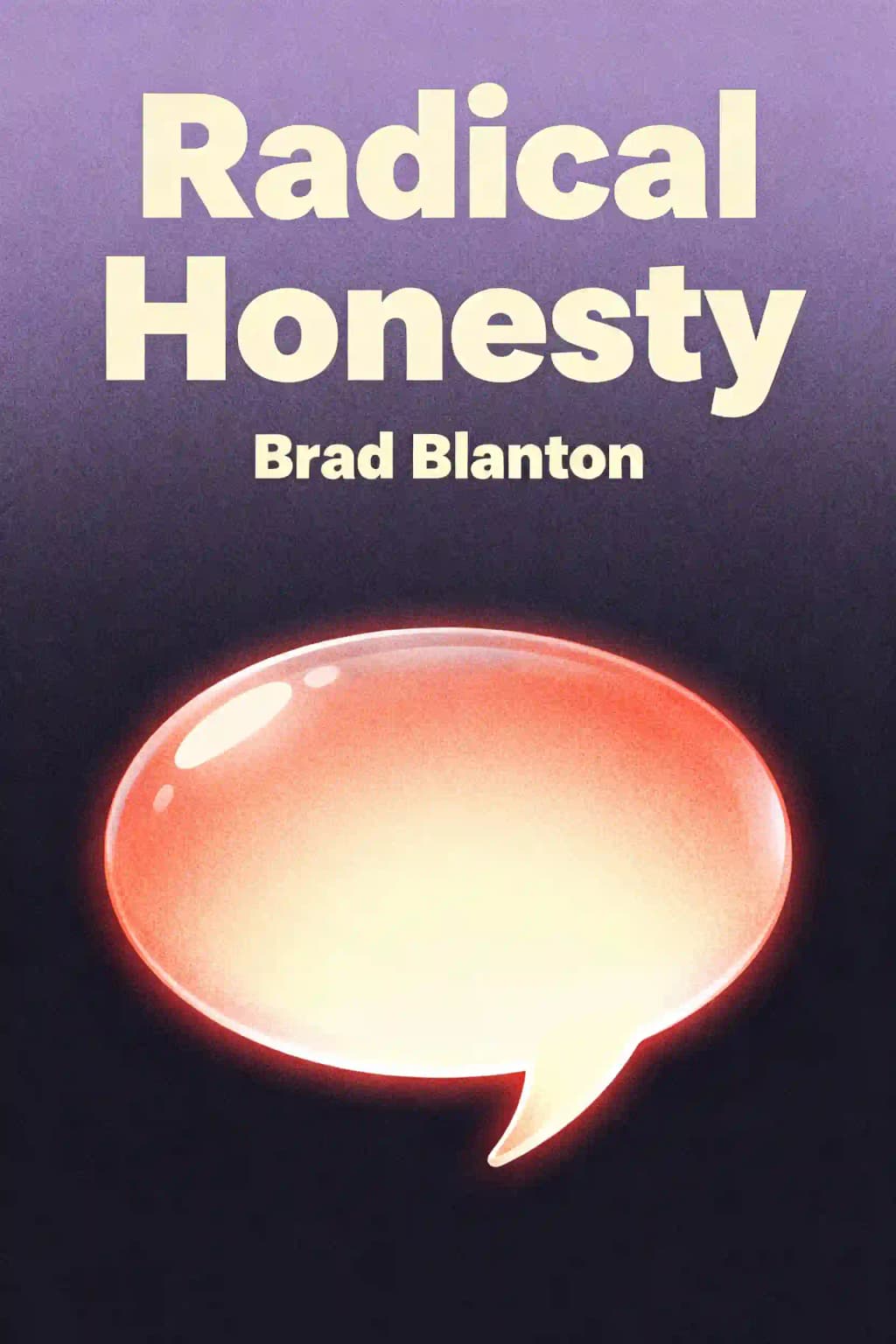
"Radical Honesty" challenges you to strip away deception in every interaction. Featured in "Silicon Valley" and "Bones," this controversial self-help phenomenon asks: what if lying - even small white lies - is what's truly making you miserable? A.J. Jacobs tried it. Could you?
W. Brad Blanton, author of the bestselling self-help classic Radical Honesty: How To Transform Your Life By Telling The Truth, is a pioneering psychotherapist and founder of the Radical Honesty movement. A clinical psychologist with decades of experience, Blanton specializes in interpersonal communication, stress reduction, and authentic living through radical truth-telling. His work bridges psychology and social philosophy, rooted in his civil rights activism and transformative group therapy sessions in 1970s Washington, D.C.
Blanton’s expertise extends to multiple bestselling books, including Practicing Radical Honesty, Honest to God (co-authored with Neale Donald Walsch), and Radical Parenting. His TEDx Talk in Romania and frequent podcast appearances amplify his contrarian approach to relationships and emotional freedom. A former U.S. congressional candidate, Blanton’s methods are taught globally through workshops and his Radical Honesty Online Course.
Radical Honesty has sold over one million copies worldwide and been translated into twelve languages, cementing its status as a landmark in personal development literature.
Radical Honesty advocates for complete truthfulness in all interactions to reduce stress, build authentic relationships, and overcome emotional burdens caused by lies. Brad Blanton, a psychotherapist, argues that honesty about feelings, thoughts, and past actions fosters clarity and connection. The book outlines practical steps to practice truth-telling, including confronting hidden emotions and dismantling societal norms of politeness.
This book suits individuals seeking deeper relationships, improved communication, or relief from anxiety caused by dishonesty. It’s valuable for those tired of superficial interactions, therapists exploring client communication tools, or anyone interested in personal growth through vulnerability. Critics note its confrontational approach may challenge readers uncomfortable with direct feedback.
Yes, for its provocative insights into how dishonesty harms mental health and relationships. Blanton’s methods, like expressing anger directly and admitting past lies, offer tangible steps toward authenticity. However, some find its extreme stance impractical or socially risky, citing critiques of Blanton’s seminar tactics as overly abrasive.
Blanton views anger as natural and advocates direct expression to prevent resentment. Instead of suppressing it, he encourages phrases like “I’m angry because…” to foster resolution. Critics argue this risks harming relationships if not paired with empathy.
Critics call it socially irresponsible, arguing unchecked truth-telling can damage relationships or careers. Others label Blanton’s seminars cult-like, citing accounts of aggressive coaching. Despite this, supporters praise its mental health benefits and focus on accountability.
Unlike nonviolent communication (NVC), which prioritizes empathy, Blanton’s approach values unfiltered expression. While NVC avoids blame, Radical Honesty encourages admitting judgments openly. Both aim for authenticity but differ in balancing honesty with social harmony.
In an era of curated social media personas, the book’s call for vulnerability resonates. Its principles align with trends toward mental health transparency and workplace authenticity, though modern readers often adapt its extremes to softer, context-sensitive honesty.
He argues self-deception (e.g., “I’m fine”) perpetuates loneliness and stress. By contrast, admitting flaws or unmet desires fosters self-acceptance. Blanton shares personal examples, like confessing his vanity in writing the book.
Blanton acknowledges risks but suggests honesty builds trust long-term. For example, admitting errors upfront can prevent larger crises. However, he advises pairing truths with accountability (e.g., “I missed the deadline—here’s my plan to fix it”).
Почувствуйте книгу через голос автора
Превратите знания в увлекательные, богатые примерами идеи
Захватите ключевые идеи мгновенно для быстрого обучения
Наслаждайтесь книгой в весёлой и увлекательной форме
We all lie like hell.
Life transforms into a story with moral lessons to follow.
Lawyers exemplify this disease.
We are the experience itself happening.
Truth-telling is the path to freedom from the roles we hide behind.
Разбейте ключевые идеи Radical honesty на понятные тезисы, чтобы понять, как инновационные команды создают, сотрудничают и растут.
Погрузитесь в Radical honesty через яркие истории, превращающие уроки инноваций в запоминающиеся и применимые моменты.
Задавайте любые вопросы, выбирайте свой стиль обучения и создавайте идеи, которые действительно вам подходят.

Создано выпускниками Колумбийского университета в Сан-Франциско
"Instead of endless scrolling, I just hit play on BeFreed. It saves me so much time."
"I never knew where to start with nonfiction—BeFreed’s book lists turned into podcasts gave me a clear path."
"Perfect balance between learning and entertainment. Finished ‘Thinking, Fast and Slow’ on my commute this week."
"Crazy how much I learned while walking the dog. BeFreed = small habits → big gains."
"Reading used to feel like a chore. Now it’s just part of my lifestyle."
"Feels effortless compared to reading. I’ve finished 6 books this month already."
"BeFreed turned my guilty doomscrolling into something that feels productive and inspiring."
"BeFreed turned my commute into learning time. 20-min podcasts are perfect for finishing books I never had time for."
"BeFreed replaced my podcast queue. Imagine Spotify for books — that’s it. 🙌"
"It is great for me to learn something from the book without reading it."
"The themed book list podcasts help me connect ideas across authors—like a guided audio journey."
"Makes me feel smarter every time before going to work"
Создано выпускниками Колумбийского университета в Сан-Франциско

Получите резюме книги «Radical honesty» в формате PDF или EPUB бесплатно. Распечатайте или читайте офлайн в любое время.
What if the polite lies we tell every day - the "I'm fine" when we're falling apart, the withheld resentments, the careful omissions - are slowly killing us? Most of us navigate life wrapped in layers of acceptable deception, believing we're protecting ourselves and others. We've become experts at managing impressions, curating personas, and maintaining comfortable distances. But what's the actual cost? Stress-related illness. Relationships that feel more like performances than connections. A gnawing sense that we're living someone else's life. The premise here is both liberating and terrifying: complete, unfiltered honesty - about everything, to everyone - might be the only path to genuine freedom and authentic connection. Not selective honesty. Not "honest but kind." Radical, uncomfortable, sometimes socially catastrophic truth-telling. Let's explore why this extreme approach might be exactly what our carefully constructed lives need.
We enter the world as pure experience. Watch a toddler-they feel what they feel, want what they want, express everything without filter. Then something shifts. We learn to evaluate, predict, control. Life becomes less about direct experience and more about following rules, living up to standards, being "good." This isn't just growing up-it's catching a cultural disease called moralism. We teach children that certain feelings are acceptable and others aren't. Schools reinforce this, training us to orient through external rules rather than internal experience. We become "field dependent"-people who need external references to know what to think, feel, or believe. Lawyers exemplify this perfectly. After years of training to argue by rules and principles, they often become incapable of authentic relating. They work 70-80 hour weeks navigating life entirely through abstract principles rather than direct experience. The further we drift from direct experience, the angrier we become when reality refuses to conform to our neat categories.
Before personality and mental chatter, you existed as pure consciousness. In the womb, you experienced undifferentiated awareness - profound unity where time and separation didn't exist. You were the ocean, not a wave. All spiritual seeking attempts to remember this lost wholeness. Birth shattered this unity. Blinding light, first breath, overwhelming sensation - your unified experience fragmented into categories: mother's breast, your hand, your body's boundaries. This differentiation created the mind, which paradoxically obscures your original nature. You exist primarily as the experiencer of what's happening now, secondarily as the recorder of experience, and least significantly as the rememberer of past events. Yet most of us live almost entirely in that last, smallest aspect - lost in thoughts about experience rather than experiencing directly. Meditation dissolves these artificial boundaries. Rediscovering wholeness requires courage - you must allow your carefully constructed personality to dissolve, experiencing what feels like death before rebirth. With nuclear weapons and environmental catastrophe threatening existence, this isn't just personal growth - it's a survival imperative for our species.
Truth-telling unfolds in three progressively demanding levels. Level one involves revealing hidden facts - confessing affairs, money issues, or buried resentments. Most discover their feared catastrophes don't materialize. Parents barely remember the incidents; spouses respond with their own confessions. This frees energy previously spent maintaining secrets. Level two demands continuously revealing emotional truths as they occur - where most people flee. After her husband Mark left, Beth suffered until facing him directly: "I resent you for leaving when I needed you most. I appreciate how you always made me laugh." This honest exchange allowed genuine grieving, transforming resentments into appreciations and enabling forgiveness. Level three requires transcending even the ego of being a "truth-teller." You've developed humility but now feel proud of it - a new trap. At this level, you own that there's no virtue in owning up. What emerges resembles your original innocence before developing identity. When your authentic self speaks, it describes. When your mind speaks, it evaluates. Notice the difference: "My chest feels tight and my thoughts are racing" versus "You're making me anxious." One describes reality; the other judges and blames. The first barrier is politeness - modifying your experience out of "consideration" for others' feelings. But this consideration is really self-protection. We craft elaborate cover stories presenting us favorably, while honest people simply say what is so. Here's the paradox: honest people experience greater insecurity because they rely on fewer beliefs for protection. Beliefs don't provide actual security, but they insulate us against reality, creating a comforting illusion of control. Learning to make uncertainty pleasant resembles enjoying a rollercoaster - initially uncomfortable but eventually exciting.
Our cultural taboos against excitement run deep. Freud's psychoanalysis emerged from Victorian sexual repression. Though shame has decreased, we still engage in complex social dances to control excitement and avoid embarrassment. Repressed sexuality doesn't vanish-it resurfaces as socially acceptable addictions: overeating, overworking, shopping, smoking, drinking. These provide similar physiological arousal while avoiding taboo. After two world wars revealed our problem with anger, Fritz Perls developed theories on transforming aggression into growth. Rather than experiencing immediate anger, we engage in mental criticism, making ourselves sick through denial. This unacknowledged anger manifests as weight gain for protection or artificial niceness that increases isolation. When we allow ourselves to experience anger fully, it often transforms or disappears. Beneath anger lies grief, and beneath grief lies joy-perhaps our most primitively repressed emotion. Adults systematically suppress joy to protect themselves from potential hurt. Children express anger and move on. Adults hide it, letting it emerge indirectly-as forgetfulness, criticism, "accidents," hurtful "slips." Without bodily experience and acknowledgment, anger doesn't complete its cycle. Telling the truth about anger means making present-tense statements directly to the person involved. This isn't morality-it's pragmatic functionality. When willing to experience something without categorizing it as "good" or "bad," you gain choice in responding.
Powerful relationships reveal our nature through how we relate to each other. Martin Buber distinguished between I-You relationships involving our whole being and I-It relationships that objectify others-the difference between relating to a person experiencing PMS versus "PMS itself," or someone slightly inebriated versus "a goddamned drunk." For couples wanting genuine intimacy: Tell each other your entire life story. Share your complete sexual history in detail. Masturbate to orgasm in front of each other without assistance. Disclose any affairs, near-affairs, flirtations or daydreams. Take turns with 30-minute monologues expressing all resentments and appreciations. Relive these experiences while telling them so more detail emerges. Discuss attractions to other people and sexual fantasies about them. Whether monogamous or polygamous, the critical factor is truthfulness, not exclusivity. The blissful "in love" state connects us with our sense of being through another person. Problems arise when this feeling becomes a belief to preserve and defend, which paradoxically makes it disappear. We resent partners for "changing" when often we've changed. Arguments ensue when both expect the other to live up to previous expectations rather than meeting who they actually are right now.
Power resides in persons, not techniques. We are integrated beings producing exactly the results we choose. The dieter who can't stop snacking, the workaholic longing for family time-these aren't contradictions but smokescreens hiding true intent. Our unwillingness to acknowledge this power keeps us stuck. When we shift from moralistic thinking to experiential being, our shrill "shouldistic" warrior self moves to the background while our natural, present-moment experiencer comes forward. People discover their power when they reconnect with bodily experience rather than obeying the internal voice of shame-based moralism. Cherish the independent witness-the being that observes your mind's moralism, thoughts, and experiences. From this perspective, you gain freedom to use all your mental patterns creatively. A person operating from this expanded consciousness chooses relationships from freedom rather than security, values experience over protection, prioritizes discovery over carefulness. When you lie or withhold information, you're protecting something meaningless-usually a memory to preserve a constant state of being. The illusion of the self you're protecting blocks your view. When you destroy that illusion through truth-telling, you see clearly. Your power doesn't lie in perfect self-control or flawless presentation. It lives in the messy, uncomfortable, liberating act of simply telling the truth about what is-right now, to the person in front of you, regardless of consequences. That's the only path back to being fully alive.