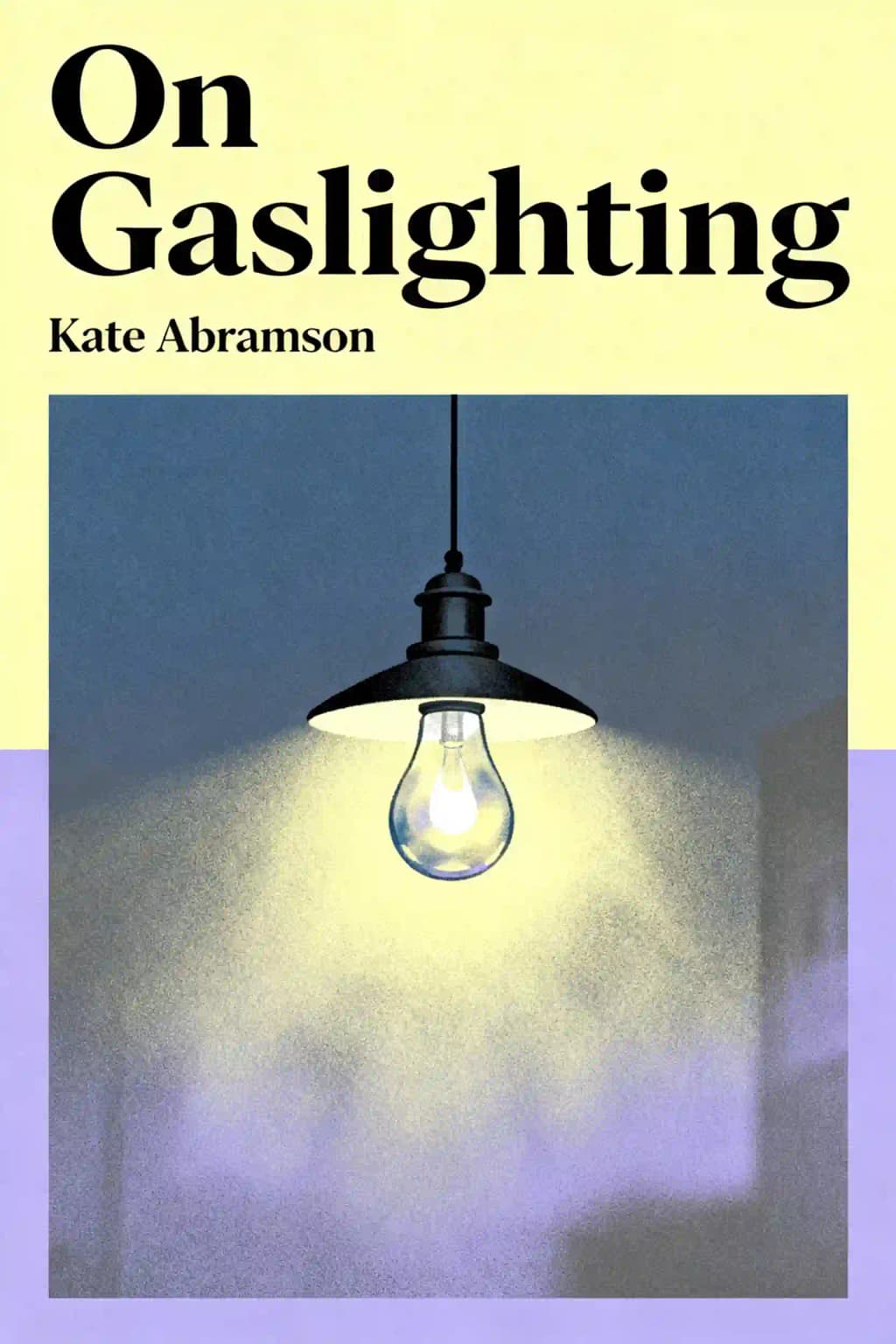
Philosopher Kate Abramson's "On Gaslighting" decodes the manipulative tactics that weaponize trust and exploit empathy. Hailed by The New York Times as "helpful and enlightening," this 2024 release arrived just when we needed it most - can you recognize when someone's making you doubt your own reality?
Kate Abramson, author of On Gaslighting, is a philosopher and acclaimed scholar specializing in 18th-century ethics, moral psychology, and philosophical feminism.
An associate professor at Indiana University and Director of Undergraduate Studies in Philosophy, her work bridges historical analysis with contemporary issues like systemic oppression and emotional manipulation.
Abramson’s expertise on gaslighting, detailed in her seminal article “Turning Up the Lights on Gaslighting,” established her as a leading voice on psychological manipulation and its societal ramifications. She has received fellowships from the American Council of Learned Societies and the American Philosophical Society, along with multiple teaching awards for her contributions to philosophy education.
Her forthcoming monograph, The Artifice of Nature, explores David Hume’s ethical theories. On Gaslighting, published by Princeton University Press, synthesizes decades of research into a groundbreaking examination of trust, power, and self-doubt in modern relationships.
On Gaslighting examines gaslighting as a distinct moral phenomenon where perpetrators systematically undermine victims’ self-trust and perception. Abramson analyzes its mechanisms, ties to systemic oppression like sexism and racism, and ethical implications through philosophical inquiry and examples, distinguishing it from mere manipulation.
Kate Abramson is an associate professor of philosophy at Indiana University Bloomington, specializing in ethics and feminist philosophy. Her work focuses on moral psychology and interpersonal dynamics, which underpins her rigorous analysis of gaslighting’s ethical dimensions.
This book suits readers interested in philosophical ethics, gender studies, or gaslighting’s societal implications. Academics, mental health professionals, and advocates addressing emotional abuse or systemic inequality will find its analytical depth valuable, though it requires engagement with philosophical concepts.
Yes, for those seeking an academic perspective on gaslighting’s moral foundations. While not a self-help guide, it offers critical insights into power dynamics and systemic oppression. Reviews praise its originality but note its density for casual readers.
Abramson defines gaslighting as intentional interpersonal harm where perpetrators destabilize victims’ confidence in their reasoning, emotions, or perceptions. It systematically erodes epistemic agency, often reinforcing oppressive structures by denying victims’ ability to interpret reality.
Key arguments include gaslighting’s role in maintaining systemic power imbalances, its distinction from manipulation via intent to destroy self-trust, and its immorality as a violation of epistemic reciprocity. Abramson emphasizes its use in dismissing marginalized voices.
Abramson posits gaslighting perpetuates sexist/racist systems by invalidating marginalized groups’ experiences. For example, dismissing women’s accounts of discrimination as “overreactions” reinforces patriarchal narratives denying their epistemic authority.
The 1944 film Gas Light serves as a foundational example, where a husband manipulates his wife’s reality. Modern cases include denying valid emotional responses or rewriting shared events to destabilize victims.
Unlike practical guides, Abramson’s philosophical approach dissects gaslighting’s ethical underpinnings rather than offering coping strategies. It contextualizes the behavior within broader moral frameworks, appealing to academic audiences.
Critics note its dense academic style may limit accessibility. Some suggest expanding on victim psychology and real-world applications, though most praise its theoretical rigor in redefining gaslighting.
The film exemplifies textbook gaslighting: the husband’s manipulation aims not just to deceive but to make his wife doubt her sanity. Abramson uses it to illustrate the perpetrator’s intent to destroy self-trust.
Abramson argues gaslighting corrodes mutual recognition in relationships—the foundational belief that others can accurately interpret reality. Healthy trust requires respecting each other’s epistemic agency, which gaslighters deliberately undermine.
Почувствуйте книгу через голос автора
Превратите знания в увлекательные, богатые примерами идеи
Захватите ключевые идеи мгновенно для быстрого обучения
Наслаждайтесь книгой в весёлой и увлекательной форме
Gaslighting is far more sinister than ordinary lying or dismissal.
Gaslighting...strikes at the very core of our ability to trust ourselves.
The gaslighter wants you to believe you're 'crazy.'
'You're too sensitive,' 'That's not how it happened,' 'You're imagining things.'
Gaslighting thrives in specific contexts where power dynamics create fertile ground.
Разбейте ключевые идеи On Gaslighting на понятные тезисы, чтобы понять, как инновационные команды создают, сотрудничают и растут.
Выделите из On Gaslighting быстрые подсказки для запоминания, подчёркивающие ключевые принципы открытости, командной работы и творческой устойчивости.

Погрузитесь в On Gaslighting через яркие истории, превращающие уроки инноваций в запоминающиеся и применимые моменты.
Задавайте любые вопросы, выбирайте голос и совместно создавайте идеи, которые действительно находят у вас отклик.

Создано выпускниками Колумбийского университета в Сан-Франциско
"Instead of endless scrolling, I just hit play on BeFreed. It saves me so much time."
"I never knew where to start with nonfiction—BeFreed’s book lists turned into podcasts gave me a clear path."
"Perfect balance between learning and entertainment. Finished ‘Thinking, Fast and Slow’ on my commute this week."
"Crazy how much I learned while walking the dog. BeFreed = small habits → big gains."
"Reading used to feel like a chore. Now it’s just part of my lifestyle."
"Feels effortless compared to reading. I’ve finished 6 books this month already."
"BeFreed turned my guilty doomscrolling into something that feels productive and inspiring."
"BeFreed turned my commute into learning time. 20-min podcasts are perfect for finishing books I never had time for."
"BeFreed replaced my podcast queue. Imagine Spotify for books — that’s it. 🙌"
"It is great for me to learn something from the book without reading it."
"The themed book list podcasts help me connect ideas across authors—like a guided audio journey."
"Makes me feel smarter every time before going to work"
Создано выпускниками Колумбийского университета в Сан-Франциско

Получите резюме книги «On Gaslighting» в формате PDF или EPUB бесплатно. Распечатайте или читайте офлайн в любое время.
Have you ever left a conversation feeling crazy, despite being certain of what you experienced? This psychological manipulation has a name: gaslighting. Far more sinister than ordinary lying, gaslighting aims to make you doubt not just specific perceptions, but your fundamental ability to perceive reality accurately. The term originated from the 1944 film "Gaslight," where a husband systematically manipulates his wife by hiding her belongings and denying the dimming gaslights she observes-all while expressing concern for her mental state. What makes gaslighting particularly destructive is its gradual nature. It typically begins with small distortions-"I never said that" or "You're misremembering"-before escalating to more significant reality-bending assertions that leave victims questioning their sanity.