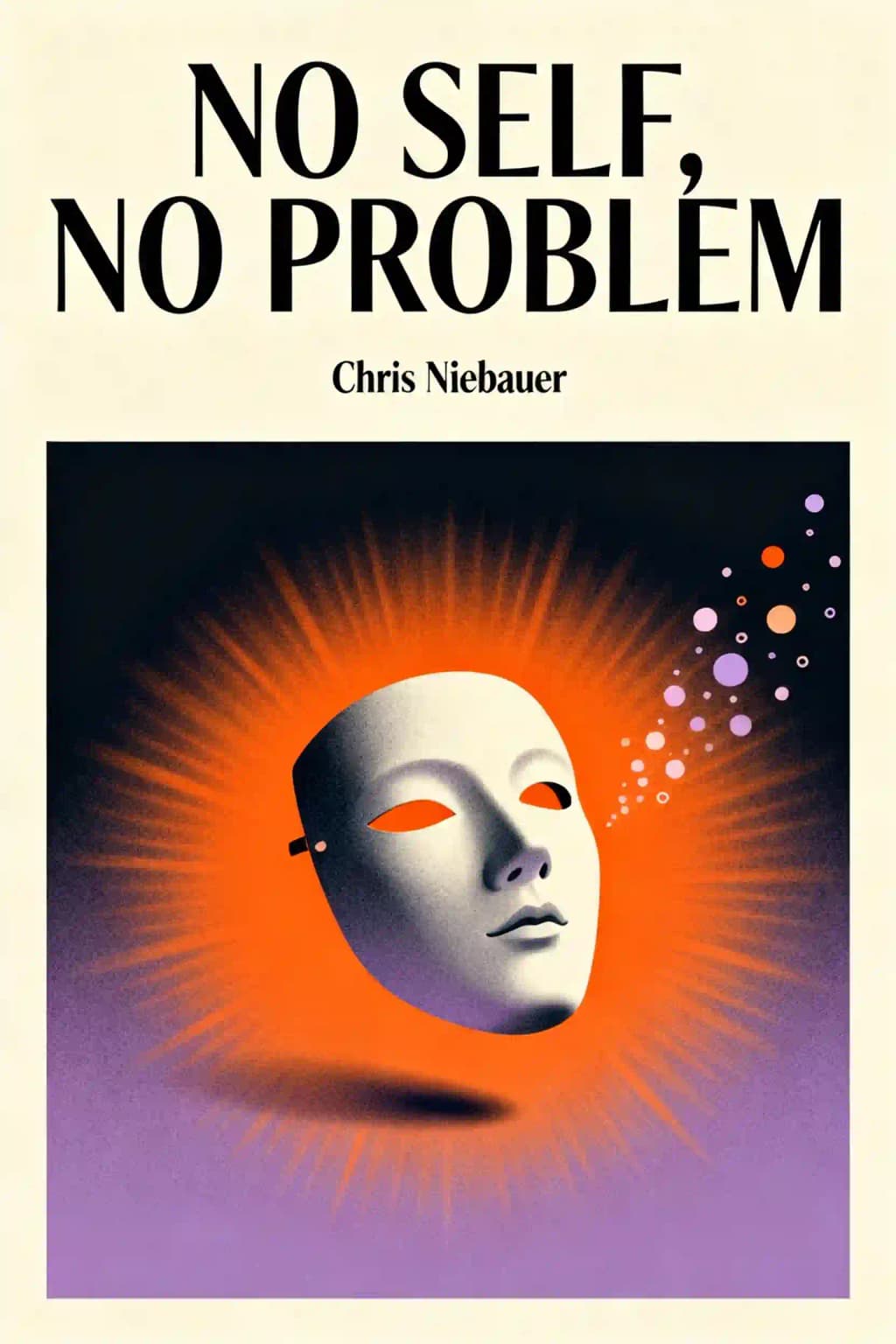
Discover why your "self" might be an illusion as neuroscience confirms what Buddhism taught centuries ago. This mind-bending exploration bridges Eastern wisdom with brain science, offering practical mindfulness techniques that challenge how we perceive identity. What if everything you think you are is just left-brain fiction?
Chris Niebauer, Ph.D., is a cognitive neuropsychologist and bestselling author of No Self, No Problem: How Neuropsychology Is Catching Up to Buddhism, a groundbreaking exploration bridging neuroscience and spirituality.
As a professor at Slippery Rock University for over two decades, he taught courses on consciousness, mindfulness, and brain lateralization, informed by his doctoral research on left- and right-brain differences. His work challenges conventional views of selfhood, arguing that anxiety and existential struggles stem from overidentifying with the "thinking mind" – a theme expanded in his companion No Self, No Problem Workbook.
A sought-after speaker, Niebauer has appeared on Deepak Chopra’s The Chopra Well and the top-rated podcast The One You Feed, reaching millions globally. His insights blend empirical rigor with Buddhist philosophy, offering practical frameworks to transcend ego-driven narratives.
The original No Self, No Problem became an Amazon top-10 bestseller across multiple categories, establishing Niebauer as a leading voice in mindfulness-based neuropsychology. He continues to advance this dialogue through his website (chrisneibauerphd.com) and academic collaborations.
No Self, No Problem explores how neuropsychology validates Buddhism’s claim that the “self” is an illusion. Chris Niebauer, a cognitive neuropsychologist, argues the left brain constructs a narrative self through language and categorization, while the right brain processes reality holistically. By recognizing this duality, readers can reduce mental suffering tied to ego-driven thoughts.
This book suits seekers of mindfulness, psychology enthusiasts, and anyone grappling with overthinking. It’s ideal for readers interested in bridging science (neuropsychology) and spirituality (Buddhism). Those seeking clarity on ego, identity, or left/right brain dynamics will find actionable insights.
Yes—it offers a fresh synthesis of neuroscience and Eastern philosophy, backed by Niebauer’s 22 years of academic research. The book provides practical exercises to detach from the “storytelling mind,” making abstract concepts like non-self accessible. Its Amazon bestseller status and companion workbook underscore its value.
Key ideas include:
Niebauer posits the left brain excels at logic, language, and constructing a coherent self-narrative. The right brain processes experiences holistically, without labels. Conflict arises when the left brain dominates, mistaking its stories for reality. Balancing both hemispheres reduces attachment to the illusory self.
Notable quotes include:
The book aligns with Buddhism’s anatta (no-self) doctrine, showing how modern neuroscience confirms ancient insights. Niebauer parallels the left brain’s “monkey mind” with Buddhist teachings on attachment, arguing both traditions aim to transcend egoic suffering.
Some neuroscientists argue Niebauer oversimplifies left/right brain dichotomies, as modern research emphasizes interconnectivity. Others note the book prioritizes conceptual understanding over meditation practices. However, most praise its ability to make complex ideas digestible.
By revealing anxiety as a product of the left brain’s storytelling, the book teaches readers to observe thoughts without identification. Exercises like mindful awareness weaken the ego’s grip, fostering inner calm. This aligns with therapies like ACT (Acceptance and Commitment Therapy).
Yes—the companion workbook offers practices like:
Niebauer describes consciousness as the substrate beneath thought—a silent awareness that observes the mind’s chatter. He contrasts this with the left brain’s “illusion of a thinker,” proposing true self is this observing presence.
Unlike typical self-help books that reinforce ego-driven goals, Niebauer’s work dismantles the notion of a fixed self. Its blend of neuropsychology and spirituality offers a scientifically grounded path to ego transcendence, distinguishing it from purely philosophical or religious approaches.
Почувствуйте книгу через голос автора
Превратите знания в увлекательные, богатые примерами идеи
Захватите ключевые идеи мгновенно для быстрого обучения
Наслаждайтесь книгой в весёлой и увлекательной форме
The self we identify with is an illusion generated by our left brain.
We live under the direction of an interpreter.
We mistake these maps for reality itself.
Categories group continuous things by common features.
People fight and die for beliefs they mistake for reality itself.
Разбейте ключевые идеи No Self, No Problem Workbook на понятные тезисы, чтобы понять, как инновационные команды создают, сотрудничают и растут.
Погрузитесь в No Self, No Problem Workbook через яркие истории, превращающие уроки инноваций в запоминающиеся и применимые моменты.
Задавайте любые вопросы, выбирайте свой стиль обучения и создавайте идеи, которые действительно вам подходят.

Создано выпускниками Колумбийского университета в Сан-Франциско
"Instead of endless scrolling, I just hit play on BeFreed. It saves me so much time."
"I never knew where to start with nonfiction—BeFreed’s book lists turned into podcasts gave me a clear path."
"Perfect balance between learning and entertainment. Finished ‘Thinking, Fast and Slow’ on my commute this week."
"Crazy how much I learned while walking the dog. BeFreed = small habits → big gains."
"Reading used to feel like a chore. Now it’s just part of my lifestyle."
"Feels effortless compared to reading. I’ve finished 6 books this month already."
"BeFreed turned my guilty doomscrolling into something that feels productive and inspiring."
"BeFreed turned my commute into learning time. 20-min podcasts are perfect for finishing books I never had time for."
"BeFreed replaced my podcast queue. Imagine Spotify for books — that’s it. 🙌"
"It is great for me to learn something from the book without reading it."
"The themed book list podcasts help me connect ideas across authors—like a guided audio journey."
"Makes me feel smarter every time before going to work"
Создано выпускниками Колумбийского университета в Сан-Франциско

Получите резюме книги «No Self, No Problem Workbook» в формате PDF или EPUB бесплатно. Распечатайте или читайте офлайн в любое время.
What if the voice in your head-the one narrating your life, defending your choices, explaining your feelings-is actually lying to you? Not maliciously, but constantly, creatively, and completely beyond your awareness. In the 1960s, neuroscientist Michael Gazzaniga stumbled upon something extraordinary while studying split-brain patients. When he showed the word "walk" only to a patient's right brain, they stood up and started walking. Asked why, their left brain-which never saw the command-instantly invented an explanation: "I'm going to get a Coke." The patient believed this completely. This wasn't confusion or memory loss. It was something far more unsettling: the left hemisphere functions as an interpreter that fabricates explanations for behaviors it doesn't understand, creating a seamless narrative that feels absolutely true. This mechanism doesn't just explain our actions-it constructs the very sense of "I" that seems to be living your life. What we call the self might be the brain's most elaborate fiction.
The left-brain interpreter builds reality using language and categories - but mistakes these mental constructs for reality itself. Philosopher Alfred Korzybski called this "confusing the map with the territory." Try the Stroop effect: look at the word "RED" printed in blue ink and try to name the color. That struggle reveals how literally your left brain takes language, explaining why verbal abuse wounds as deeply as physical harm. Categories work similarly. "Canada" or "Harvard University" exist only as thoughts - the land and buildings remain whether anyone thinks about them or not. Your self works the same way. The interpreter creates categories like "successful person" or "good parent," then judges whether you measure up. This creates an impossible conflict: one imaginary part judging another. You become the only species capable of hating yourself, lying to yourself, believing in yourself - all because the interpreter turned its machinery inward and created an "I" that seems separate from everything else. Recognition brings freedom: when you see judgments as "just my opinion" rather than "the way things are," you stop confusing the map with the territory.
Your left brain excels at pattern detection, effortlessly turning marks into meaning. But this gift becomes a curse when turned inward. In one study, rats outperformed humans at predicting random light sequences because rats simply responded to frequency while humans invented nonexistent patterns. We're pattern-seeking machines that see faces in clouds and conspiracies in coincidences. Dopamine, concentrated in the left hemisphere, amplifies this tendency. Increased dopamine makes skeptics suddenly "see" patterns in random noise. Under threat, pattern perception intensifies-skydivers spot more patterns in random images before jumping than calm subjects do. The self defends against dissolution by strengthening its pattern-making abilities. The left brain creates the self-illusion like certain images create illusory triangles-by inferring something that isn't actually there. We define ourselves relationally: parent, introvert, American. These categories depend entirely on contrast with others. Notice throughout your day how many different "selves" appear-work self, home self, versions depending on who you're with. Between these selves are moments of complete engagement where the self vanishes entirely. Where is the self when nobody's thinking about it?
When neuroanatomist Jill Bolte Taylor's stroke disabled her left brain, her inner voice silenced and boundaries dissolved-she felt "at one with the universe." This was right-brain consciousness emerging from beneath the interpreter's chatter. While your left brain categorizes and separates, your right brain processes holistically, perceiving continuums rather than divisions, staying anchored in the present rather than sequencing time. This explains "flow"-being "in the zone" during sports or music. Time vanishes, ego disappears, actions happen without deliberation. You're experiencing reality directly, not thinking about it. Eastern traditions valued this state because living in abstractions-language, concepts, beliefs-means living in a dream world. Our suffering comes from forgetting stories aren't reality. Try this: focus completely on one breath. Feel sensations as you inhale, hold, exhale. This brief moment wrests control from the chattering left brain. Or perform activities for no reason-not for self-improvement or productivity-to bypass the left brain's need for purpose. The right brain also acts as fact-checker, generating "aha moments" when the left brain's stories drift too far from reality.
Meaning emerges from your right hemisphere's holistic perception, not logical analysis. Viktor Frankl observed that concentration camp inmates with purpose survived longer. Research confirms this: chasing happiness makes people less happy, while meaningful activities bring fulfillment despite discomfort. Your right brain possesses prajnaparamita-"wisdom beyond wisdom." It's immediate knowing you can't explain: sensing tension upon entering a room, or having information on the tip of your tongue. Studies reveal intuition's validity: participants' palms sweated when reaching for disadvantageous card decks after just ten draws, while conscious understanding took fifty to eighty. Your right brain detects patterns and sends gut-feeling warnings before your interpreter articulates why. Emotions, gratitude, and compassion are innate right-brain functions. Dr. Taylor felt extreme compassion during her stroke when her left brain went offline. Complaining-objecting to reality-stems from the interpretive mind and breeds anxiety. Grateful people have more gray matter in right-brain regions. Compassion involves the right temporoparietal junction, helping us understand others' perspectives. This explains instinctively running into burning buildings to save strangers-illogical to the interpreter but natural to right-brain consciousness. Creativity flows from the right brain's extensive connections, enabling novel associations. Einstein connected space and time; Ray Bradbury advised writers to "get out of the way" of intuition.
If consciousness exists, where is it located? The rubber hand illusion reveals something startling: when a fake hand is tapped in sync with your hidden real hand, consciousness relocates so completely you react with genuine pain when the fake hand is harmed. Your brain radically revises reality based on sensory input, suggesting consciousness is more fluid than we believe. Perhaps consciousness is more verb than noun - individual brains tapping into a larger field rather than generating it independently. Eastern philosophies suggest consciousness gives rise to matter, not the reverse. Consider this: God, being all-knowing, created a game by forgetting himself, becoming lost in each of us to experience adventure. Like a casino owner who must forget he owns the casino to truly enjoy gambling, perhaps our existence is this divine game of forgetting. Three paths forward exist: continue believing the left brain is you, playing society's anxious game. Or pursue right-brain consciousness through meditation - the path of saints. Or walk a middle path - meditating in the morning, cursing traffic in the afternoon, maintaining an inner smile knowing every win depends on loss. Understanding the interpreter's mechanisms helps you take it less seriously, lessening suffering. To discover who you really are, turn inward to find the source of the "I" thought - not through labels, but as a feeling found in silence. By recognizing the interpreter's stories as just stories, you glimpse what Eastern traditions call your true nature: consciousness itself, unbounded by artificial boundaries. As the Zen axiom states: "No self, no problem."