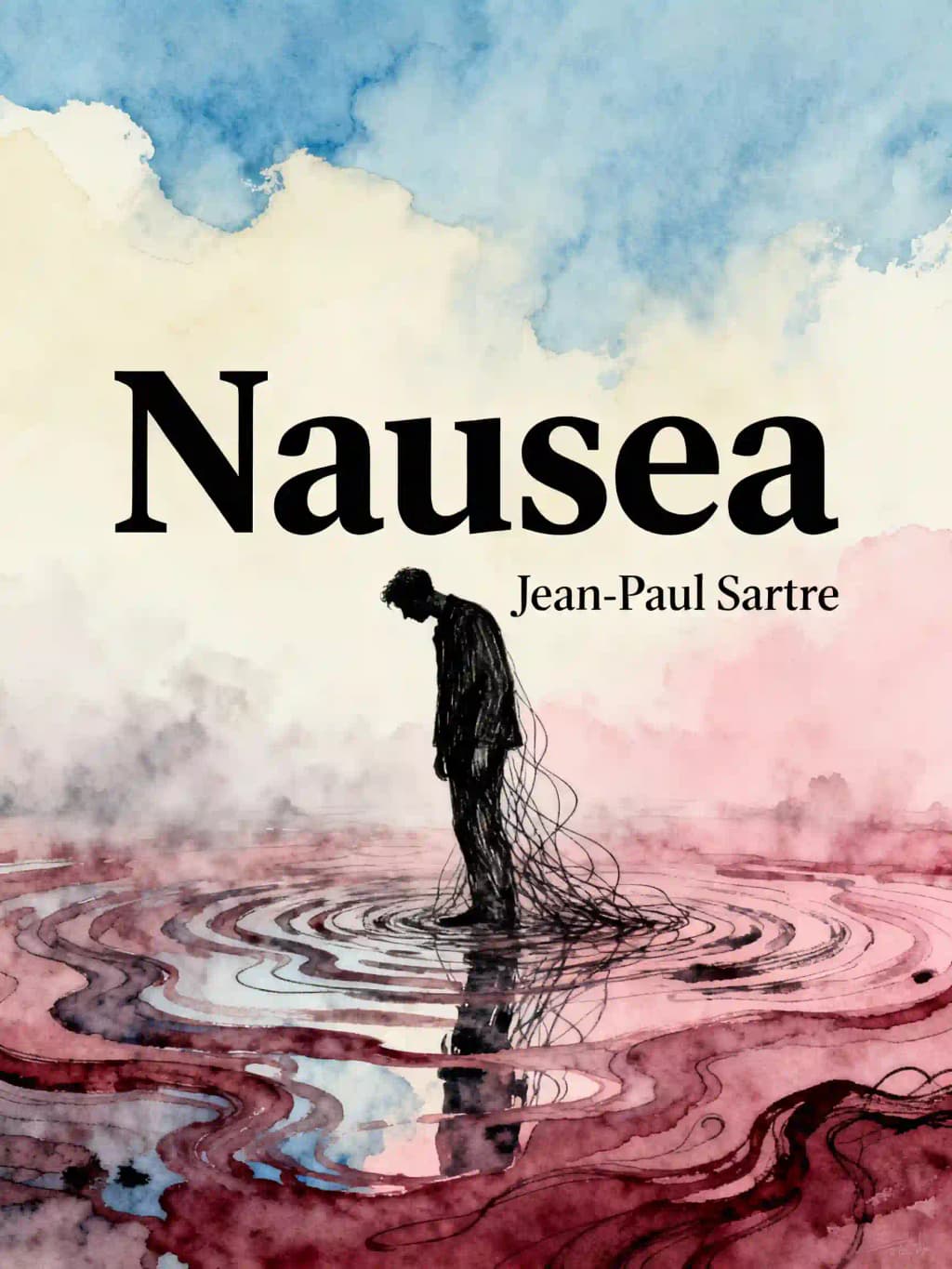
Nausea (Penguin Modern Classics)
Обзор книги Nausea (Penguin Modern Classics)
Sartre's "Nausea" - the 1938 existentialist masterpiece that plunges readers into profound alienation through Antoine Roquentin's crisis. What if meaninglessness itself became physical? This cornerstone of philosophy influenced generations, with Simone de Beauvoir calling it Sartre's first robust expression of contingency and existence.
Ключевые темы в Nausea (Penguin Modern Classics)
- existential dread
- radical freedom
- ontological contingency
- absurdity of existence
- subjective consciousness
Цитаты из Nausea (Penguin Modern Classics)
I am, I exist, I think, therefore I am; I am because I think, why do I think? I don't want to think any more, I am because I think that I don't want to think.
I wanted to leave, to go somewhere where I should be really in my place, where I should fit in… but my place was nowhere; I was unwanted.
I exist. It is sweet, so sweet, so slow. And heavy: it never stops.
Every existing thing is born without reason, prolongs itself out of weakness, and dies by chance.
Персонажи в Nausea (Penguin Modern Classics)
- Antoine RoquentinA historian and the protagonist facing nausea
- Marquis de RollebonAn obscure aristocrat and Roquentin's research subject
- AnnyRoquentin's former lover living in Paris
- The Self-Taught ManA lonely acquaintance of Roquentin in Bouville
Скачать резюме книги «Nausea (Penguin Modern Classics)»
Получите резюме книги «Nausea (Penguin Modern Classics)» в формате PDF или EPUB бесплатно. Распечатайте или читайте офлайн в любое время.
Часто задаваемые вопросы об этой книге
Nausea follows Antoine Roquentin, a historian grappling with existential angst as he confronts the absurdity of existence. Through his diary entries, Sartre explores themes of isolation, freedom, and the meaningless of life, symbolized by Roquentin’s overwhelming “nausea” when realizing reality’s lack of inherent purpose. The novel is a cornerstone of existentialist literature, blending philosophical inquiry with introspective narrative.
This book suits readers interested in existential philosophy, modernist literature, or psychological introspection. Philosophy students, admirers of Sartre’s works, and those exploring themes of human freedom and authenticity will find it compelling. Its dense, reflective style appeals to fans of Camus or Dostoevsky, though it may challenge those seeking plot-driven stories.
Yes, Nausea is a seminal existentialist work that profoundly examines the human condition. While its abstract style and lack of conventional plot may deter some, its exploration of freedom, identity, and existential dread offers enduring relevance. It’s ideal for readers seeking philosophical depth and literary innovation.
Sartre argues that existence precedes essence: humans define themselves through actions, not predetermined purpose. Roquentin’s “nausea” symbolizes the anguish of recognizing life’s arbitrariness, urging individuals to embrace freedom and create meaning despite inherent absurdity.
The titular nausea represents Roquentin’s visceral awareness of existence’s meaninglessness. It manifests as a physical revulsion toward objects and routines, reflecting his realization that reality lacks inherent structure or purpose. This metaphor encapsulates existentialism’s focus on confronting life’s absurdity.
The novel popularized existentialist ideas like radical freedom and the absurd. Sartre’s portrayal of Roquentin’s crisis illustrated existentialism’s core tenets, influencing thinkers like Simone de Beauvoir and Albert Camus. It also introduced literary techniques to convey philosophical concepts, bridging fiction and theory.
- “Existence is a fullness which man can never abandon.”
Highlights the inescapable burden of conscious existence. - “Everything is gratuitous, this garden, this city, and myself.”
Emphasizes life’s lack of inherent meaning. - “I am free: there is absolutely no more reason for living.”
Reflects the terror and liberation of absolute freedom.
Critics note its dense prose, minimal plot, and overly abstract themes, which can alienate casual readers. Some argue it prioritizes philosophical ideas over character development. However, its intellectual rigor and innovative style are widely praised.
Roquentin’s realization that life lacks predefined meaning forces him to confront his freedom to create purpose. Sartre suggests that embracing this freedom—despite its accompanying dread—is essential to authentic existence, a central thesis in his later work Being and Nothingness.
The novel introduces themes expanded in Sartre’s philosophical treatise Being and Nothingness, such as bad faith and consciousness. It also shares existential motifs with plays like No Exit and aligns with Simone de Beauvoir’s ethical explorations in The Ethics of Ambiguity.
Roquentin finds mundane objects—a chestnut tree, a tram seat—triggering existential dread. These moments reveal Sartre’s view that routine obscures life’s inherent absurdity, urging readers to question familiar realities.
Its themes resonate in modern contexts like anxiety, alienation, and searches for meaning in a chaotic world. The novel’s critique of complacency and emphasis on self-determination remain pertinent to discussions about mental health and societal conformity.
Unlike Camus’ The Stranger, which focuses on detached absurdity, Nausea delves into the emotional turmoil of existential awakening. It shares introspective depth with Dostoevsky’s Notes from Underground but uses modernist techniques to fragment narrative structure.
- Existence precedes essence: Humans define themselves through choices.
- Bad faith: Self-deception to avoid freedom’s burden.
- The absurd: Life’s lack of inherent meaning.
These ideas are explored through Roquentin’s psychological journey.