Глава 1
A Tale of Vengeance on Rails: The Masterpiece That Redefined Mystery
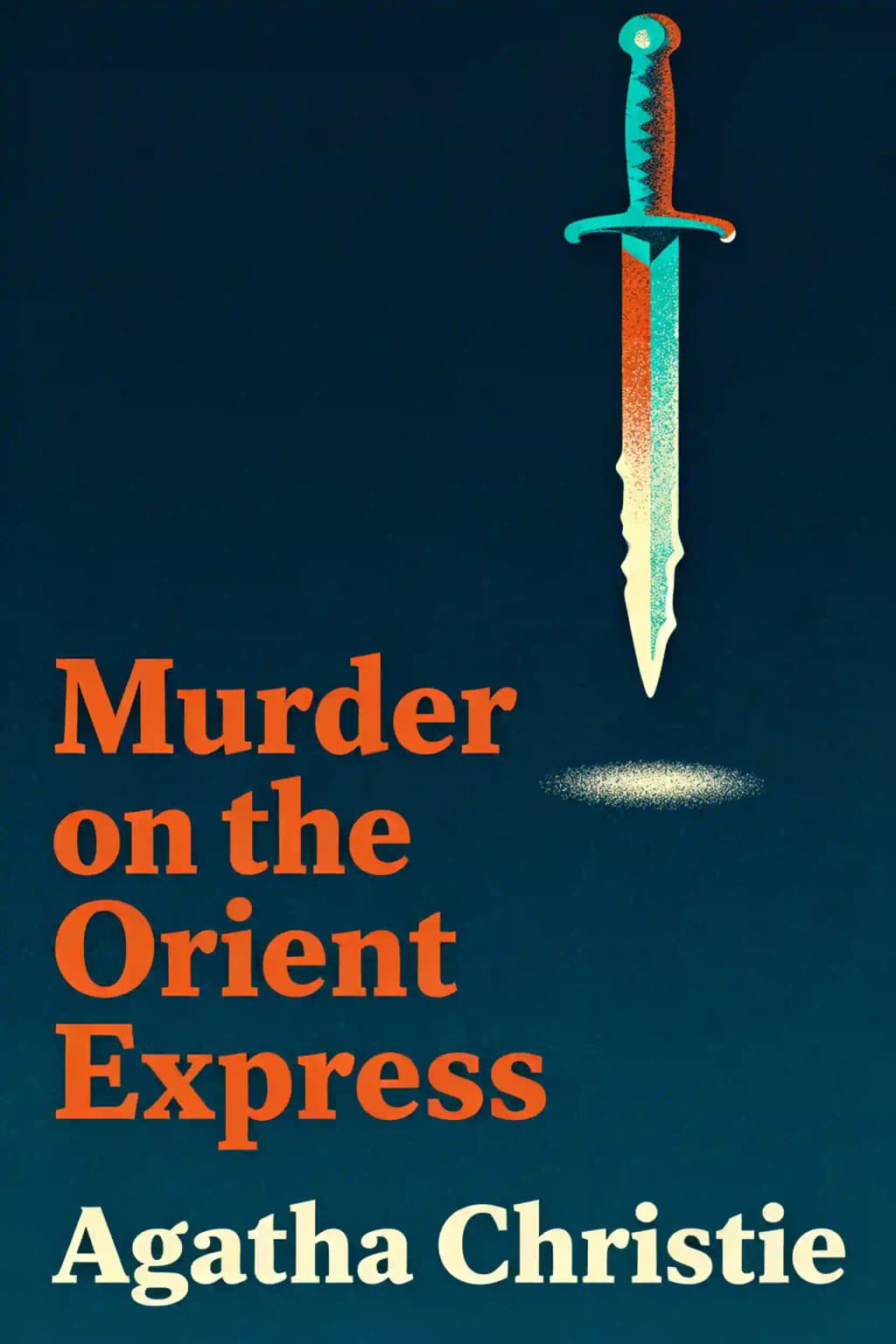
Agatha Christie's "Murder on the Orient Express" stands as one of the most ingenious murder mysteries ever written, a cultural touchstone that has captivated readers since its publication in 1934. The novel's brilliant twist ending has shocked generations of readers and inspired countless adaptations, including Sidney Lumet's acclaimed 1974 film starring Albert Finney and Kenneth Branagh's 2017 version. Christie herself considered it among her best works, having conceived the plot while stranded on the actual Orient Express during a snowstorm in 1931. The book's premise-a murder investigation confined to a luxury train-creates the perfect closed-room mystery, while its exploration of justice versus revenge continues to provoke moral debates nearly a century later. Even today, when someone mentions a plot twist, "Murder on the Orient Express" is often the gold standard against which all others are measured.
Глава 2
The Belgian Detective and the Mysterious Travelers
The story begins on a winter morning in Syria as Hercule Poirot, the fastidious Belgian detective with his distinctive egg-shaped head and magnificent mustache, boards the Taurus Express. Having just resolved a delicate military matter, he's eager to return to London. During this initial journey, Poirot's keen observational skills are already at work as he notices an unusual relationship between two English travelers-the composed governess Mary Debenham and Colonel Arbuthnot. He overhears a cryptic exchange between them: "Not now. When it's all over. When it's behind us-then-" words that will later take on profound significance.
After crossing the Bosphorus to Istanbul, Poirot checks into the Tokatlian Hotel where he encounters M. Bouc, an old friend who directs the Wagon Lit company. That evening, Poirot observes two curious figures in the dining room: a young American and an elderly man whose benevolent appearance masks something malevolent. When their gazes meet, Poirot senses a strange tension before the older man rises and instructs his companion, "Pay the bill, Hector," in an unnervingly soft voice.
Despite the Orient Express being unusually full for winter, M. Bouc secures Poirot a berth. Before boarding, the elderly man from dinner approaches Poirot, introducing himself as Ratchett, an American businessman who believes his life is in danger. He offers Poirot twenty thousand dollars for protection, displaying both wealth and a small automatic pistol. Poirot refuses with a cutting dismissal: "I do not like your face, M. Ratchett." This exchange establishes the central conflict-a man marked for death has just been denied protection by the one person who might have saved him.
The train departs Istanbul with its diverse array of passengers: the nervous, chatty Mrs. Hubbard; the aloof Princess Dragomiroff; the handsome Count and Countess Andrenyi; the Italian businessman Foscarelli; the Swedish missionary Greta Ohlsson; Ratchett's secretary MacQueen and his valet Masterman; the salesman Hardman; and the previously encountered Debenham and Arbuthnot. As the Orient Express cuts through the Balkan night, it's not just carrying passengers but a complex web of hidden connections and motives that will soon unravel in spectacular fashion.
Глава 3
A Murder Most Foul in the Dead of Night
The Orient Express becomes trapped in a snowdrift between Vincovci and Brod, creating the perfect isolated setting for murder. During that fateful night, Poirot is awakened by strange noises-a cry from Ratchett's compartment, the sound of something heavy falling against his door, and the vision of a woman in a scarlet kimono moving down the corridor. When Ratchett's compartment bell rings, the conductor receives a response in perfect French: "Ce n'est rien. Je me suis trompe" ("It's nothing. I made a mistake.").
The next morning brings the grim discovery-Ratchett has been murdered in his locked compartment, stabbed twelve times with savage and inconsistent force. Some wounds are deep and powerful, others merely glancing blows. Some appear to have been made by a right-handed person, others by someone left-handed. Even more puzzling, some wounds were inflicted after Ratchett was already dead. His window is open, but the unbroken snow outside proves no one escaped that way.
The crime scene yields curious evidence: a handkerchief with the initial "H," a pipe cleaner though Ratchett didn't smoke a pipe, a woman's button, and a charred paper fragment with the words "...member little Daisy Armstrong." This last clue allows Poirot to identify Ratchett's true identity-he was Cassetti, the notorious kidnapper who had abducted and murdered little Daisy Armstrong, daughter of a wealthy American family, years earlier.
The Armstrong case had been a sensational tragedy. After receiving the $200,000 ransom, Cassetti revealed that Daisy had been dead for weeks. The shock caused Mrs. Armstrong, who was pregnant, to give birth prematurely to a stillborn child before dying herself. Colonel Armstrong subsequently committed suicide, and their innocent nursemaid, falsely suspected by police, threw herself from a window. Though Cassetti was eventually arrested, he escaped justice through legal technicalities and his wealth, fleeing America to live as "Ratchett" abroad.
With this revelation, the murder takes on new dimensions. Was it revenge for the Armstrong tragedy? Was it connected to the threatening letters Ratchett had received? And most importantly-with the train snowbound and no outside access, the murderer must still be among them.
Глава 4
The Passengers' Testimonies: A Web of Contradictions
With M. Bouc and Dr. Constantine as his assistants, Poirot begins methodically interviewing each passenger. The testimonies create a complex puzzle of alibis and contradictions that challenge even Poirot's legendary "little gray cells."
Pierre Michel, the Wagon Lit conductor, claims he was mostly at his post except for brief absences to attend to passengers. MacQueen, Ratchett's secretary, spent the evening talking with Colonel Arbuthnot until nearly 2:00 AM. Masterman, Ratchett's valet, says he suffered from toothache and read until 4:00 AM. Mrs. Hubbard dramatically insists someone entered her compartment during the night, producing a Wagon Lit uniform button as evidence and later discovering the murder weapon hidden in her sponge bag.
Greta Ohlsson confirms she mistakenly entered Ratchett's compartment around 10:40 PM, seeing him alive. Princess Dragomiroff reveals she was awake with rheumatic pain and had her maid, Hildegarde Schmidt, read to her. Count Andrenyi insists both he and his wife took sleeping draughts and heard nothing. Colonel Arbuthnot describes smelling a woman's perfume in the corridor and noticing someone peering furtively through a compartment door.
Cyrus Hardman reveals himself as a detective hired by Ratchett to protect him from a "small, dark man with a womanish voice"-a description matching no one on the train. Antonio Foscarelli claims he shared a compartment with Masterman all night. Mary Debenham maintains her composed demeanor, revealing only that she saw someone in a scarlet kimono around 5:00 AM.
Most startlingly, Hildegarde Schmidt describes encountering a conductor in the corridor who doesn't match any of the actual train staff-"a small dark man with a little mustache" and "a weak voice, like a woman's." This suggests someone was impersonating a conductor, a theory supported by the later discovery of a hidden Wagon Lit uniform with a missing button in her luggage.
As the investigation proceeds, mysterious events continue. The scarlet kimono appears folded in Poirot's own suitcase-a clear challenge from the murderer. The murder weapon, a cheap Oriental dagger, is found hidden in Mrs. Hubbard's sponge bag. Each new discovery seems to deepen rather than solve the mystery.
Глава 5
The Impossible Crime: Twelve Wounds, Twelve Jurors
As Poirot sifts through the evidence, he notices critical inconsistencies. Ratchett spoke no French, yet someone replied in perfect French when the conductor knocked. The watch in Ratchett's pocket was deliberately set to 1:15, suggesting the murder occurred earlier. The stab wounds show wildly different force and technique, as if delivered by multiple people.
Most importantly, Poirot begins to uncover connections between the passengers and the Armstrong case. The Countess Andrenyi is revealed to be Helena Goldenberg, Mrs. Armstrong's younger sister. Mary Debenham was the family's governess. Antonio Foscarelli was their chauffeur who fondly remembered Daisy calling him "Tonio." Greta Ohlsson was Daisy's nurse who still describes her as "an angel-a little sweet trustful angel." Masterman was Colonel Armstrong's batman during the war and later his valet.
With these revelations, Poirot assembles everyone in the dining car to present two possible solutions. The first-a conventional explanation involving an outside killer who boarded the train at Vincovci and escaped-is clearly a fiction designed to satisfy the authorities.
The second solution is breathtaking in its audacity: all twelve passengers participated in Ratchett's murder, functioning as a jury delivering justice that the legal system had failed to provide. Each person had a connection to the Armstrong family and delivered one stab wound, explaining the inconsistent force and technique. The threatening letters, the mysterious "small dark man," the scarlet kimono-all were elaborate misdirections in a brilliantly orchestrated plan.
"I have, I think, made my case clear?" Poirot asks the stunned audience. Mrs. Hubbard then reveals herself as Linda Arden, the famous actress and Daisy Armstrong's grandmother, confirming Poirot's theory. "We were a court of justice-and we were considering all the evidence," she explains. "We decided on the penalty of death."
Глава 6
Justice Beyond the Law: The Moral Heart of Christie's Masterpiece
What elevates "Murder on the Orient Express" beyond a clever puzzle is its profound moral question: When the legal system fails, is vigilante justice ever justified? The twelve passengers-representing different nationalities, classes, and backgrounds-unite in a shared conviction that Cassetti deserved punishment for his heinous crime against an innocent child and the destruction of an entire family.
Poirot, typically a champion of law and order, faces his greatest ethical dilemma. "I am not concerned with judicial punishment," he admits. Having solved the case through his brilliant deduction, he must now decide whether to reveal the truth to the authorities. In the end, he chooses compassion over strict justice, presenting the fictional solution of an outside killer to M. Bouc and Dr. Constantine, who readily agree to support this version for the Yugoslavian police.
Christie's genius lies in making readers sympathize with the murderers rather than the victim. We understand their grief and outrage, their sense that conventional justice has failed them. The novel asks us to consider whether some crimes are so terrible that they justify extraordinary measures-a question that remains as relevant today as when Christie wrote it.
The setting itself reinforces this moral complexity. The Orient Express, traveling between East and West, becomes a liminal space where conventional rules are suspended. Isolated by snow, the train becomes its own closed society with its own conception of justice. The twelve passengers, like a jury, deliver their verdict not in a courtroom but in the narrow confines of a luxury train car.
Глава 7
The Brilliant Construction of Christie's Puzzle
Christie's technical mastery shines throughout the novel, demonstrating why she earned the title "Queen of Crime." The confined setting of the Calais-bound train, stopped by a snowdrift, creates both practical limitations for the investigation and intense psychological pressure. Like a classical drama, this unity of place forces characters into unavoidable confrontation while eliminating outside interference. The international cast of characters-including English, American, Russian, Swedish, and French passengers-allows Christie to play with national stereotypes while ultimately transcending them, showing how grief and moral outrage unite people across cultural boundaries.
The clues are meticulously placed with surgical precision. The handkerchief marked with an "H," the pipe cleaner found in an unlikely spot, the uniform button that doesn't quite match, the watch deliberately stopped at 1:15, and the mysterious voice speaking French in Ratchett's compartment-each piece of evidence seems to point in a different direction. These disparate clues appear contradictory until Poirot's brilliant insight reveals how they all fit together in the collective murder plot. Christie expertly plants each clue so it can be interpreted in multiple ways, supporting both the false narrative the passengers construct and the actual truth.
The novel's structure mirrors Poirot's investigative process in three distinct parts. We begin with "The Facts"-the observable events and physical evidence that establish the framework of the crime. We proceed through "The Evidence"-the testimonies that create an increasingly contradictory narrative, with each interview adding new layers of complexity and confusion. Finally, we reach "Hercule Poirot Sits Back and Thinks"-the analytical phase where the detective's famous "little gray cells" make sense of the seemingly impossible crime, transforming chaos into order.
Christie's misdirection operates on multiple levels. She presents us with what appears to be a conventional murder mystery, complete with suspicious characters and red herrings, only to reveal that the conventional framework itself is the illusion. The true mystery isn't "which one did it?" but "how did they all do it together?" This subversion of the traditional whodunit format challenges readers' expectations while delivering a solution that, in retrospect, feels both surprising and inevitable. The author uses readers' familiarity with mystery conventions against them, making them complicit in their own misdirection by assuming there must be a single killer.
The timing of revelations is particularly masterful, with Christie carefully controlling the flow of information to maintain suspense while gradually laying the groundwork for the final solution. Each interview adds another piece to the puzzle while simultaneously making the overall picture more complex, creating a narrative tension that builds steadily toward the dramatic revelation.
Глава 8
The Legacy of a Perfect Murder Mystery
"Murder on the Orient Express" remains Christie's most ingenious plot construction and one of the most influential mystery novels ever written. Its premise has been adapted and parodied countless times across various media, from television shows like "Doctor Who" and "Inside No. 9" to Japanese anime and contemporary thriller novels. Yet the original retains its power to surprise and provoke, demonstrating why Christie earned the title "Queen of Crime" through her masterful manipulation of both plot mechanics and reader psychology.
The book's enduring appeal lies in its combination of intellectual satisfaction and emotional resonance. We admire the clockwork precision of the murder plot, with its meticulously planned timing, carefully planted clues, and intricate web of alibis. Each piece of evidence, from a dropped handkerchief to a burned letter, serves multiple purposes - simultaneously misleading and revealing. The novel's structure mirrors its central crime, with twelve distinct chapters gradually unveiling twelve distinct perspectives, building to a revelation that transforms our understanding of everything that came before.
The emotional depth of the story elevates it beyond mere puzzle-solving. The tragic backstory of the Armstrong case - involving the kidnapping and murder of a young child, the suicide of a grieving mother, and the death of an unborn baby - provides moral weight to the conspirators' actions. Christie deftly handles themes of justice, revenge, and collective responsibility, asking readers to consider whether some crimes are beyond the reach of conventional law.
Poirot's moral struggle forms the heart of the novel's conclusion. His decision to present two solutions - the true one and a convenient fiction - represents a profound meditation on the nature of justice itself. This ethical dimension has helped the story resonate across cultures and generations, inspiring discussions about vigilante justice, moral relativism, and the limits of legal systems.
Nearly a century later, Christie's snowbound train continues its journey through our cultural imagination. The novel's influence can be seen in countless locked-room mysteries, ensemble cast thrillers, and stories about justice versus revenge. Modern adaptations, including Kenneth Branagh's 2017 film version, continue to explore its themes while finding new relevance in its examination of collective guilt and moral responsibility. The Orient Express remains a perfect vehicle for exploring how ordinary people might be driven to extraordinary acts, and how even the most rational minds must sometimes choose between truth and justice.
Глава 9
The Clockwork Precision of Christie's Plot
The brilliance of "Murder on the Orient Express" lies in its meticulous construction. Every element serves multiple purposes-establishing character, providing clues, and ultimately contributing to the final revelation. The pipe cleaner found at the crime scene initially suggests Colonel Arbuthnot's involvement but later proves part of the collective misdirection. The handkerchief with the initial "H" points toward Helena Andrenyi but is claimed by Princess Dragomiroff in an act of protective loyalty. The scarlet kimono appears and disappears like a phantom, deliberately drawing attention away from the true mechanics of the crime.
Christie's timing is impeccable. The snowstorm that traps the train isn't just a convenient plot device; it forces the conspirators to adapt their original plan (which likely involved the murderer escaping at Brod) and creates the closed environment necessary for Poirot's investigation. The various alibis are constructed with clockwork precision-each passenger accounted for through testimony from another conspirator, creating an impenetrable web of mutual protection.
Even the character types are carefully selected to create a microcosm of society: the aristocratic Princess Dragomiroff, the theatrical Linda Arden (as Mrs. Hubbard), the dutiful servants Masterman and Schmidt, the professional women Debenham and Ohlsson, the cosmopolitan Count and Countess, the bluff Colonel, the gregarious Italian, and the loud American. Each brings different skills and perspectives to both the murder plot and its investigation.
Глава 10
The Psychological Depth Beneath the Puzzle
While celebrated for its plot mechanics, "Murder on the Orient Express" also displays surprising psychological depth. Each character reveals something about how different personalities respond to grief and injustice. Princess Dragomiroff embodies aristocratic hauteur, believing herself above conventional morality. Linda Arden channels her theatrical talents into her performance as the annoying Mrs. Hubbard. Mary Debenham maintains her English reserve even under intense questioning. Greta Ohlsson's religious faith doesn't prevent her from participating in retribution she believes divinely justified.
Poirot himself undergoes a subtle transformation. Known for his insistence on order and method, he confronts a situation where conventional justice has failed and vigilante action has restored a moral balance. His decision to present the fictional solution represents a rare moment where his heart overrules his dedication to legal process. "The impossible could not have happened, therefore the impossible must be possible in spite of appearances," he reasons-a statement that applies not just to the murder's mechanics but to his own ethical flexibility.
The novel also explores how trauma creates unexpected bonds. Twelve strangers unite in common purpose because of shared grief and moral outrage. Their conspiracy transcends differences of nationality, class, and temperament. In this way, Christie suggests that our humanity ultimately matters more than our social categories-a surprisingly progressive message for a writer often characterized as conventional.
As the train remains trapped in the snow, isolated from the outside world, it becomes a space where conventional rules are suspended and justice can be reimagined. The Orient Express itself-luxurious, international, between destinations-serves as the perfect liminal space for this moral experiment to unfold.
Глава 11
A Mystery That Still Captivates
Despite countless adaptations and its famous solution becoming part of popular culture, "Murder on the Orient Express" continues to captivate new readers. Even knowing the outcome, we appreciate the intricate construction, the psychological insights, and the moral complexity Christie brings to what could have been a simple whodunit. From Sidney Lumet's star-studded 1974 film to Kenneth Branagh's lavish 2017 interpretation, each new adaptation finds fresh nuances in Christie's masterwork, proving its enduring relevance across generations.
The novel's central question remains provocative: When conventional justice fails, is collective action justified? The twelve conspirators believe so unequivocally, each carrying deep personal wounds from Cassetti's escape from American justice. Their carefully orchestrated plan - with each participant striking a symbolic blow - transforms them from mere passengers into a jury of peers, executioners of their own verdict. Poirot, despite his dedication to law and order, ultimately cannot bring himself to condemn them. His internal struggle reflects the broader tension between formal justice systems and moral justice, between the letter of the law and its spirit.
The confined setting of the Orient Express itself becomes a metaphor for moral confinement - a closed system where traditional rules of society are temporarily suspended. The train's luxury and refinement contrast sharply with the brutal nature of both Daisy Armstrong's murder and Cassetti's execution, creating a sophisticated backdrop for primitive justice. The international cast of characters further universalizes the moral dilemma, suggesting that certain ethical questions transcend cultural boundaries.
As readers, we find ourselves in the uncomfortable position of sympathizing with murderers - understanding their grief, admiring their ingenuity, and perhaps even approving their verdict. Christie masterfully leads us to this moral precipice, forcing us to question our own beliefs about justice and revenge. The novel's genius lies in making accomplices of its readers, drawing us into the conspiracy through our emotional investment in the characters' pain and their quest for closure.
In this snowbound train from another era, Christie created not just a perfect puzzle but a moral parable that continues to challenge our assumptions about justice, vengeance, and the human capacity for both terrible cruelty and profound solidarity. The novel's exploration of collective responsibility and vigilante justice resonates particularly strongly in our current era of social movements and grassroots justice initiatives. As long as we continue to wrestle with these questions, the Orient Express will continue its journey through our imagination, carrying its twelve jurors and their brilliant detective through the snowy night of ethical complexity, reminding us that sometimes the most difficult mysteries are not about discovering who committed a crime, but about deciding what justice truly means.