Глава 1
The Enigmatic Legacy of Freemasonry's Philosopher-King
In a dusty library in Washington D.C. sits one of the most mysterious and influential philosophical works ever penned by an American - Albert Pike's "Morals and Dogma." This 861-page tome has been called the "Bible of Freemasonry," though few have read it in its entirety. When Dan Brown was researching "The Lost Symbol," he reportedly spent weeks poring over Pike's dense prose. Even President Theodore Roosevelt, himself a Mason, described it as "a book of profound philosophical insight that changed my understanding of symbolism forever."
Pike, a Confederate general, lawyer, poet and philosopher, created this masterwork as an instruction manual for Scottish Rite Freemasons. Published in 1871, it was given to every initiate until 1974 - not as dogma to be believed, but as a philosophical guidebook to be contemplated. What makes this work so compelling is how it weaves together ancient wisdom from Egyptian, Greek, Persian, Hindu, Jewish, and Christian traditions into a unified philosophical system that still challenges readers today. Pike's genius lay in recognizing patterns across seemingly disparate religious and philosophical traditions, creating a universal framework for understanding humanity's spiritual journey.
Глава 2
The Architecture of Initiation: Freemasonry as Moral Development
Freemasonry's genius lies in its progressive system of degrees - a carefully architected spiritual and intellectual journey that transforms the initiate through symbolic death and rebirth. Pike reveals that this system has ancient roots, appearing in the Mysteries of Eleusis, Mithras, and Isis, where candidates underwent carefully orchestrated experiences designed to awaken higher consciousness. These mystery schools shared a common understanding that true wisdom requires both intellectual understanding and direct experiential knowledge.
The first three "Blue Lodge" degrees form the foundation of Masonic initiation. As an Apprentice, the candidate enters in darkness, symbolizing ignorance, and is brought to light, representing the beginning of wisdom. Pike explains this represents humanity's primordial state - blind, helpless, and dependent on others for guidance. The Apprentice learns to subdue passions and improve through intellectual labor. This initial degree emphasizes the cultivation of virtues like silence, discretion, and obedience to moral law. Through symbolic tools like the 24-inch gauge and common gavel, initiates learn time management and the discipline of controlling destructive impulses.
As a Fellow-Craft, the initiate undertakes an intensive study of the liberal arts and sciences, particularly geometry, which Pike reveals was considered divine knowledge in ancient times. This degree emphasizes that reason, while essential, has limitations. The Fellow-Craft learns that intellectual development without moral growth creates dangerous imbalance. Pike draws parallels to Pythagoras's school, where mathematics was seen as a bridge between the material and spiritual realms. The winding staircase of this degree represents the arduous path of learning, with each step bringing new insights and challenges.
In the Master Mason degree, the candidate symbolically dies and is raised to new life, reenacting the murder of Hiram Abiff, architect of Solomon's Temple. Pike unveils this as a profound allegory teaching that the soul must "die" to its lower nature before spiritual rebirth can occur. This ancient pattern appears across cultures - in Osiris's dismemberment, Christ's crucifixion, and the Hindu concept of spiritual awakening. The degree's five points of fellowship demonstrate the intimate connection between spiritual and practical wisdom, while the substitute word suggests the perpetual search for divine truth.
What distinguishes Pike's interpretation is his insistence that these degrees aren't mere ceremonies but transformative experiences that should permanently alter the initiate's consciousness. "Masonry," he writes, "is work, and to work the Mason is apprenticed." This work is nothing less than the complete reformation of character through contemplation of symbols and application of moral principles in daily life. Pike emphasizes that each symbol contains multiple layers of meaning - historical, moral, and spiritual - which the dedicated Mason must gradually uncover through study and reflection.
The genius of this system lies in its adaptability to each individual's capacity for understanding. While all experience the same rituals, each Mason derives meaning appropriate to their level of development. This progressive revelation ensures that the teachings remain relevant throughout a Mason's lifetime, offering deeper insights as consciousness evolves.
Глава 3
The Lost Word and the Quest for Divine Truth
Central to Pike's philosophy is the concept of the "Lost Word" - a profound symbol of divine truth that humanity once possessed but has since forgotten. This quest for recovering sacred knowledge forms the backbone of higher Masonic degrees, where the initiate embarks on a symbolic journey to rediscover this ineffable wisdom. The search represents both an individual and collective spiritual odyssey.
Pike explains that in ancient times, the true pronunciation of God's name (YHVH in Hebrew) was known only to select high priests who passed it down through an unbroken oral tradition. This sacred name was spoken just once annually in the Holy of Holies during Yom Kippur. Over time, following the destruction of the Second Temple and the dispersion of the Jewish people, this pronunciation was lost - a loss that symbolizes humanity's growing separation from direct knowledge of the divine. The Mason's quest to recover this Word represents the soul's journey back to its divine source through progressive spiritual illumination.
What makes Pike's interpretation revolutionary is his assertion that the Word transcends mere phonetics or linguistics. It represents the absolute truth about God's nature - a truth that exists beyond the limitations of human language and thought. "The True Word of a Mason," he writes, "is to be found in the concealed and profound meaning of the Ineffable Name... which meaning was long lost by the very precautions taken to conceal it." This paradox - that the truth becomes hidden precisely through efforts to preserve it - illustrates the delicate balance between revelation and concealment in esoteric traditions.
Pike masterfully draws parallels between this Masonic quest and similar concepts across world traditions: the Hindu search for Brahman (ultimate reality), the Gnostic pursuit of gnosis (direct spiritual knowledge), and the Kabbalistic exploration of Ein Sof (the infinite, unknowable divine essence). He demonstrates how each tradition recognizes that the seeker must move beyond literal interpretations and intellectual constructs to achieve direct experiential knowledge of ultimate reality. This comparative approach reveals universal patterns in humanity's spiritual quest.
For Pike, this search isn't merely intellectual but profoundly transformative. As the Mason progresses through higher degrees, contemplating increasingly complex symbols and rituals, his consciousness gradually expands. The symbols serve as keys unlocking deeper understanding - not through rational analysis alone, but through intuitive insight that transcends ordinary thought. Each degree presents new symbolic configurations that build upon previous insights, creating a comprehensive system of spiritual development.
This approach fundamentally challenges modern materialism and its empirical limitations. While science examines physical phenomena and measurable data, Pike argues that symbolic initiation explores realms beyond sensory perception - the metaphysical realities that underlie physical existence. "We have no proper cognizance of anything," he writes, "except as it affects us... we know nothing of the absolute." Therefore, symbols become necessary bridges between finite human understanding and infinite truth, serving as tools for transcending the limitations of rational thought and accessing higher realms of consciousness.
Pike's treatment of the Lost Word thus offers both a philosophical framework and a practical methodology for spiritual development, demonstrating how ancient wisdom traditions remain relevant to modern seekers of truth.
Глава 4
The Universal Religion Behind All Faiths
Perhaps Pike's most controversial contribution was his assertion that all religions contain fragments of a single universal truth. Drawing on comparative mythology, ancient texts, and esoteric traditions spanning continents and millennia, he identified recurring patterns across seemingly diverse traditions-patterns that suggested a common source of spiritual wisdom predating recorded history.
Pike reveals that ancient peoples worshipped the same cosmic forces under different names, developing sophisticated symbolic systems to represent universal principles. The Egyptian Osiris, Persian Mithras, Greek Dionysus, and Christian Christ all represented the dying and resurrected god-figure symbolizing the sun's annual journey through the zodiac. Each tradition encoded astronomical knowledge and spiritual teachings in myths that reflected their cultural context. This wasn't meant to diminish Christianity but to place it within a broader context of humanity's spiritual evolution, showing how universal truths adapt to different times and places.
"The universal religion," Pike writes, "is as old as the world. Men have had the TRUTH, and have lost it. All religions have some truths and none have the complete truth." This perspective was revolutionary in 19th-century America, where sectarian divisions ran deep and religious tolerance was often superficial. Pike's comparative approach suggested that seemingly contradictory faiths might be reconciled at a deeper level.
Pike's analysis of religious symbols reveals surprising connections that transcend geographical and cultural boundaries. The cross, far from being exclusively Christian, appears in ancient Egypt as the ankh (symbol of life), in India as the swastika (symbol of good fortune), and in pre-Columbian America as various forms of the crossed lines representing the four directions. The trinity concept exists not only in Christianity but in Hindu (Brahma-Vishnu-Shiva), Egyptian (Osiris-Isis-Horus), and Greek (Zeus-Poseidon-Hades) traditions. Similar patterns emerge in the use of sacred numbers, geometric forms, and creation myths across cultures.
Most controversially, Pike suggests that esoteric traditions preserved truths that organized religions often obscured through centuries of institutional development. He distinguishes between exoteric teachings for the masses-using stories, rituals, and moral codes to guide ordinary behavior-and esoteric wisdom for initiates who sought deeper understanding. The former provides necessary structure for society; the latter reveals philosophical principles behind these outer forms. This dual approach to spiritual teaching appears in virtually every major tradition, from Sufism in Islam to Kabbalah in Judaism.
This approach offers a powerful alternative to religious conflict and sectarian division. Rather than seeing faiths as competing truth claims, Pike presents them as different expressions of universal principles adapted to specific cultures and historical moments. The wise Mason respects all traditions while recognizing that each offers only partial glimpses of ultimate truth. This perspective promotes both religious tolerance and serious spiritual inquiry, encouraging seekers to look beyond surface differences to find common ground in humanity's perennial search for meaning and transcendence.
Глава 5
The Cosmic Dance of Duality and Equilibrium
At the heart of Pike's philosophy lies the concept of equilibrium between opposing forces. Drawing from ancient wisdom traditions, he presents the universe as a dynamic balance of contraries - light and darkness, activity and passivity, creation and destruction.
Pike traces this principle to the Kabbalah's doctrine of divine emanation, where God's attributes of Mercy (Chesed) and Judgment (Gevurah) must be perfectly balanced to sustain creation. Similarly, the ancient Persians recognized the cosmic struggle between Ormuzd (light) and Ahriman (darkness), while Chinese philosophy centered on the interplay of Yin and Yang.
"The single and absolute principle of the Universe," Pike writes, "is EQUILIBRIUM, symbolized by the joining of the Square and Compass." This equilibrium manifests at every level of existence - in physical forces like magnetism and gravity, in moral principles like justice and mercy, and in human psychology as the balance between intellect and emotion.
Pike applies this principle to politics, warning against both tyranny and anarchy. True liberty exists only within the constraints of just law. He critiques both absolute monarchy (where authority crushes freedom) and mob rule (where freedom destroys authority). The ideal government maintains equilibrium between central power and individual rights.
This principle extends to personal development. The initiate must balance intellectual growth with moral improvement, material concerns with spiritual aspirations. Pike warns against one-sided development: "To develop the intellectual only, makes at best a cold and heartless being... To develop the moral only, produces enthusiasts, fanatics, and superstitious devotees."
What makes Pike's approach unique is his insistence that opposites don't merely conflict but complement each other in a higher synthesis. Evil isn't an independent force but the absence or imbalance of good. Darkness doesn't fight against light but provides the necessary contrast for light to be perceived. This perspective transforms how we view life's challenges - not as meaningless suffering but as necessary resistance that strengthens the soul.
Глава 6
The Science of Symbols and Sacred Geometry
Pike reveals that Masonic symbols aren't arbitrary decorations but constitute a sophisticated language conveying truths that transcend ordinary expression. Drawing from ancient mystery schools, he explains how symbols operate on multiple levels simultaneously - speaking to intellect, imagination, and intuition. Each symbol serves as a gateway to deeper understanding, functioning like a key that unlocks successive layers of meaning as the initiate's consciousness evolves.
The fundamental symbols of Masonry carry profound metaphysical significance. The square represents moral rectitude and material reality, teaching the importance of ethical behavior and grounding in practical wisdom. The compass represents spiritual aspiration and divine wisdom, guiding the initiate toward higher understanding. Together, they symbolize the union of heaven and earth within the initiate - the perfect balance of spiritual insight and worldly responsibility. The letter G, prominently displayed in Masonic lodges, stands for both Geometry (divine science) and God (divine source), suggesting that mathematical principles reveal divine intelligence. The temple itself represents the perfected human being, with its proportions, orientations, and structures reflecting the ideal balance of human faculties.
Pike's analysis of sacred numbers reveals their universal symbolic significance across spiritual traditions. Three (triangle) represents divine perfection, manifesting in trinities like body-mind-spirit and past-present-future. Four (square) represents material stability and earthly completion, seen in the four elements and cardinal directions. Seven (three plus four) represents the union of divine and human principles, reflected in the seven classical planets and days of the week. The 47th problem of Euclid (the Pythagorean theorem) symbolizes how spiritual and material principles (represented by the vertical and horizontal) combine to create human existence (the hypotenuse) - a mathematical representation of humanity's dual nature.
What distinguishes Pike's approach is his integration of these symbols into a coherent philosophical system that bridges ancient wisdom and modern understanding. Unlike modern academics who might study symbols as mere cultural artifacts, Pike presents them as practical tools for psychological and spiritual transformation. By contemplating these forms through meditation and ritual, the initiate gradually attunes their mind to the cosmic patterns they represent, developing an intuitive grasp of universal principles.
This symbolic approach has profound implications for how we understand reality and acquire knowledge. While modern science analyzes phenomena by breaking them into components, symbolic thinking perceives patterns and relationships that connect seemingly disparate elements. Pike suggests that both approaches are necessary and complementary - analysis reveals how things work mechanically, while synthesis reveals their meaning and purpose within a larger cosmic order.
For Pike, geometry transcended its role as a mathematical discipline to become a sacred science revealing divine intelligence in creation. The proportions of ancient temples weren't arbitrary but reflected cosmic harmonies that could be experienced directly through contemplation. Similarly, music wasn't just pleasant sound but the audible expression of mathematical relationships that pervade the universe - the harmony of the spheres made manifest. This perspective helps restore the essential connection between science and spirituality that modern specialization has severed, offering a path to integrate rational understanding with spiritual insight.
Глава 7
The Royal Secret: Human Divinity and Cosmic Citizenship
The culmination of Pike's philosophical system appears in the 32nd degree, where he reveals the "Royal Secret" - the ultimate truth that the initiate has been preparing to receive through all previous degrees. This secret, carefully guarded and progressively unveiled, concerns humanity's true nature and cosmic destiny in a way that synthesizes both Western and Eastern wisdom traditions.
Pike reveals that humans possess a dual nature - partly material and partly divine. Our bodies connect us to the animal kingdom through biological processes and instinctual drives, while our souls link us to the divine source through consciousness, reason, and spiritual aspiration. The purpose of initiation is to awaken consciousness of our higher nature and live accordingly. "Man is not merely an animal," he writes, "but a spirit imprisoned in an animal machine." This imprisonment, however, is not permanent but rather a temporary condition for growth and development.
This concept of dual nature appears across numerous spiritual traditions. In Plato's allegory of the charioteer, reason (the divine element) must control the horses (representing physical passions and desires). Christianity teaches that humans are made in God's image, suggesting an inherent divine spark within each person. Hinduism speaks of atman (individual soul) as identical with Brahman (universal soul), while Sufism describes humans as mirrors reflecting divine attributes. Pike masterfully synthesizes these perspectives into a comprehensive view of human potential, suggesting that initiation progressively polishes the mirror of consciousness.
The Royal Secret also encompasses cosmic citizenship - the recognition that we belong to a universal brotherhood transcending national, religious, and racial boundaries. Pike writes: "Masonry teaches that around every human creature, as a center, extends a circle of influence... Each of us contributes to the others' happiness or adds to their misery." This circle of influence creates an interconnected web of responsibility and mutual support that extends far beyond immediate family or community.
This perspective fundamentally transforms how we view our responsibilities and place in the cosmos. Rather than limiting concern to family, tribe, or nation, the enlightened Mason recognizes obligations to all humanity. Pike challenges the tribalism and nationalism of his era, advocating a cosmopolitan ethic based on universal principles of justice and compassion. He saw this as particularly crucial during America's post-Civil War period, when healing and reconciliation were desperately needed.
What makes Pike's vision remarkable is how it balances individual development with social responsibility. Unlike certain Eastern philosophical systems that sometimes emphasize transcendence of worldly concerns, Pike insists that spiritual growth must express itself through practical service and civic engagement. The perfected Mason isn't an isolated sage but an engaged citizen working to improve society through education, charity, and moral leadership. This balance between contemplation and action, between individual enlightenment and social reform, forms the practical application of the Royal Secret.
Pike further elaborates that this cosmic citizenship carries specific duties: to seek and spread truth, to practice universal brotherhood, to fight against ignorance and superstition, and to work for the moral and intellectual elevation of humanity. These duties become more binding as one advances in understanding, creating what Pike calls a "hierarchy of obligation" that parallels the hierarchy of initiation.
Глава 8
The Enduring Legacy: Pike's Challenge to Modern Thought
Pike's masterwork continues to challenge contemporary thinking in profound ways. In an age of religious fundamentalism and militant atheism, his vision of a universal wisdom tradition offers a middle path that honors both faith and reason. Against modern materialism, he asserts the reality of spiritual dimensions accessible through symbol and intuition. Against moral relativism, he presents timeless ethical principles derived from natural law.
His insistence that true initiation requires both intellectual understanding and moral transformation challenges our tendency to separate knowledge from character. Modern education often focuses on information transfer without addressing the development of wisdom or virtue. Pike reminds us that genuine learning transforms the whole person.
Pike's emphasis on equilibrium between opposing forces offers a corrective to extremism in all forms. In politics, he warns against both unchecked authority and unbridled individualism. In religion, he cautions against both rigid dogmatism and shallow skepticism. In personal development, he advocates balance between intellect and emotion, activity and contemplation.
Perhaps most importantly, Pike's vision of human potential challenges the reductionism prevalent in modern thought. Against views that reduce consciousness to brain chemistry or humans to economic actors, he presents a multidimensional understanding of human nature that includes physical, intellectual, moral, and spiritual aspects.
The ultimate value of "Morals and Dogma" lies not in providing final answers but in asking essential questions that each generation must address anew: What is the purpose of human existence? How should we understand the diversity of religious traditions? What principles should guide individual and collective life? Pike doesn't dictate responses but provides tools for seeking our own answers through contemplation of ancient wisdom.
As Pike himself wrote: "He who would be an accomplished Mason must not be content merely to hear, or even to understand, the lectures; he must, aided by them, and they having, as it were, marked out the way for him, study, interpret, and develop these symbols for himself." This invitation to active engagement with perennial wisdom remains Pike's greatest gift to modern seekers.
Глава 9
The Symbolic Journey Through Degrees
Pike's genius shines in his explanation of how Masonic degrees systematically unfold spiritual truths through progressive symbolism. Each degree builds upon previous lessons, gradually preparing the initiate for deeper understanding. This structured approach reflects ancient mystery schools' recognition that wisdom cannot be received all at once but must be assimilated gradually.
The Lodge of Perfection (4th-14th degrees) introduces the initiate to the Temple's construction and destruction, symbolizing humanity's spiritual rise and fall. The Council of Princes of Jerusalem (15th-16th degrees) teaches lessons of leadership and justice. The Chapter of Rose Croix (17th-18th degrees) explores death and resurrection symbolism. The Council of Kadosh (19th-30th degrees) examines chivalric virtues and philosophical traditions. The Consistory (31st-32nd degrees) reveals the synthesis of all previous teachings.
What makes Pike's interpretation profound is his recognition that these degrees operate simultaneously on historical, moral, and metaphysical levels. The Temple's building represents both an actual historical event and the construction of the initiate's spiritual character. Hiram's murder symbolizes both political tyranny and the soul's subjugation to lower passions.
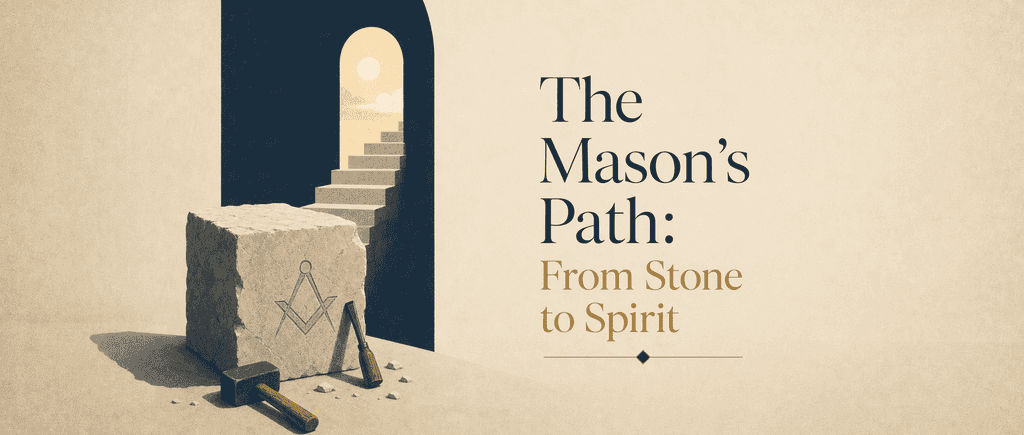
Pike reveals how symbols evolve across degrees. The rough ashlar (unworked stone) of early degrees becomes the perfect cube in higher ones, representing the transformation of character through discipline. The lost word sought in the third degree is progressively revealed through subsequent degrees, each offering partial insights until the final revelation.
This progressive structure reflects Pike's understanding of how consciousness develops. Just as children must master basic concepts before tackling complex ones, spiritual development requires sequential growth. Some truths cannot be understood until the mind has been prepared through preliminary lessons. The Mason who attempts to rush this process risks misunderstanding or misapplying the teachings.
Pike's approach offers a powerful alternative to both dogmatic religion (which demands belief without understanding) and academic study (which provides information without transformation). Masonic initiation engages the whole person - intellect, imagination, emotion, and will - in a journey that gradually unfolds the soul's potential through symbolic experience.