Глава 1
The Wounds That Make Us Visible
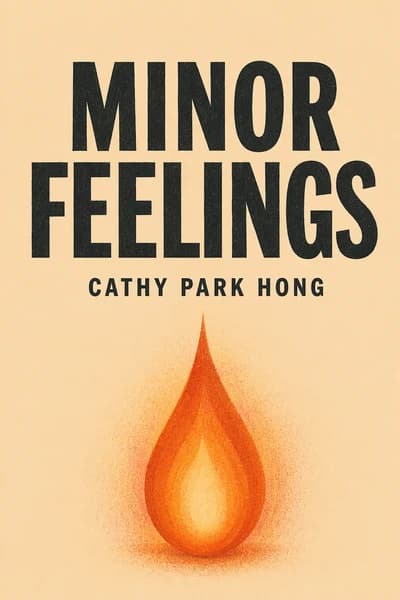
Minor Feelings by Cathy Park Hong has become a cultural touchstone since its 2020 publication, landing on bestseller lists and earning the National Book Critics Circle Award. Trevor Noah called it "the book that helped me understand myself," while Claudia Rankine praised it as "brilliantly crafted." This intimate exploration of racial consciousness and Asian American identity arrives at a critical moment in American culture-as anti-Asian hate crimes surge and conversations about race gain urgency. Hong's unflinching examination of what she calls "minor feelings"-the dissonance between American optimism and racialized reality-resonates deeply with readers seeking to understand the complex terrain of racial identity in America. Through personal narrative, cultural criticism, and historical analysis, Hong creates a work that's simultaneously memoir and manifesto, inviting us to witness the psychological toll of existing in a society that both erases and fetishizes Asian American experiences.
Глава 2
When Depression Becomes Political
My depression began with an imaginary facial tic that consumed me. Despite successful surgery years earlier for a real neuromuscular condition, I became convinced it had returned. I developed elaborate habits to hide this non-existent tic in public, my mind threatening mutiny against me. Even while living in a beautiful New York loft with my husband and having just finished a book, I felt "like a sloth that fell from its tree"-dull and depleted in private, flayed raw in public.
Seeking help, I found exactly one Korean American therapist in my insurance network, hoping she'd understand me without explanation. After an emotional consultation where I broke down sobbing about my childhood, she later rejected me as a patient. Despite increasingly desperate voicemails offering to handle paperwork for out-of-network reimbursement, she firmly refused, saying "We're not right for each other" without explanation. When pressed for reasons, she remained coldly professional, dismissing my distress as "depression talking" before ending our call.
This rejection tapped into something deeper-the struggle to prove myself into existence that had defined my life. Working five times harder than others, I still watched myself dissolve, my confidence impoverished from conditional love and a society treating me as interchangeable as lint. Asian Americans inhabit a vague purgatorial status: neither white enough nor black enough, distrusted by some, ignored by others. We're seen as carpenter ants of service industries, corporate apparatchiks who never get promoted because we lack the right "face" for leadership.
Have you ever felt yourself paddling frantically underwater while appearing impassive on the surface? This is the daily reality for many Asian Americans-overcompensating to hide a devouring sense of inadequacy. Racial self-hatred means seeing yourself through white eyes, becoming your own worst enemy. You hate your Asian features, resent other Asians in the room, feeling less than yourself when boundaries congeal into a horde rather than solidarity.
Our history in America is brutal but often forgotten. Chinese laborers built the transcontinental railroad with three dying for every two miles of track, yet were excluded from the Golden Spike celebration photo. The 1882 Chinese Exclusion Act banned an entire race from entering America after legislators characterized Chinese as "rats" and "machine-like" job stealers. By 1917, immigration bans expanded to all of Asia. America only welcomed Asians back in 1965 to improve its global image during the Cold War, promoting us as "model minorities" to undermine Black civil rights.
This "model minority" status remains precarious. Since 9/11, Indian Americans have been downgraded to or self-identify as "brown." Hate crimes against Asians have spiked, with white supremacists attacking Sikhs and Hindus, mistaking them for Muslims or "terrorists." Our racial status shifts with political winds, erasing complex histories between Asian nations.
When I hear "Asians are next in line to be white," I mentally replace "white" with "disappear." We're told our racial identity is beside the point, listed as "Other" in polls, hard to find in racial breakdowns. It's like being ghosted-I stop trusting what I see and hear. My ego free-falls while my superego becomes boundless, compelling me to do better, be better, blindly following America's gospel of self-interest until I vanish.
Глава 3
Finding Voice Through Comedic Truth
Snow blanketed New York into erasure as I lay depressed in our loft, barely eating or writing. The industrial heater roared so loudly my husband and I could barely hear each other. He suggested we watch Richard Pryor's Live in Concert, projecting it onto our wall. Pryor appeared seven feet tall, his red silk shirt gradually drenched with sweat as he performed, lancing our darkened room with light.
Pryor's comedy was revolutionary-his brilliance lay in embodying his monologues as an ensemble of one, his face revealing profound woundedness even while impersonating animals. His stark confessionals showed that innocence is a privilege Black people don't experience: "I was a kid until I was eight. Then I became a Negro." Pryor began his career trying to be Bill Cosby, telling clean jokes for white audiences until his epiphany at the Aladdin Hotel in Vegas when he realized his grandmother-who raised him in her brothel-wouldn't be welcome there. This marked the "B.C.-A.D. divide" in his career when he walked offstage saying, "What the fuck am I doing here?" and began finding his authentic voice.
Watching Pryor made me question who I was writing for. Poets claim to dismiss audience concerns, but it's a lie-we're obsessed with status and ingratiate ourselves to institutions. I realized I was still writing to please white people, a desire ingrained through education. Poetry initially freed me because my body was dematerialized, my identity shed. Keats said a poet "has no identity" and Barthes claimed literature is where "all identity is lost." But as a published Asian female poet, I couldn't suspend my identity-my spectral authorial presence limited how readers received my work. If Whitman's "I" contained multitudes, mine contained just 5.6 percent of this country.
I turned to stand-up comedy for its transparency. Unlike poets, comedians can't pretend they don't have identities-they're exposed onstage with nowhere to hide. Comedy is harder to fake since audiences cannot be convinced into laughter. At poetry readings, I performed for mostly white audiences, pretending I wasn't the only Asian woman in the room while feeling the whiteness like a traffic-cone orange background everywhere. Poetry readings felt vestigial with their canned rituals-the scripted banter, breathy "poet's voice," mechanical titters. I began doing stand-up instead of reciting poems, initially using other comedians' material before developing my own autobiographical jokes-something I never did in poetry.
I never felt comfortable writing about personal racial trauma because conventional forms didn't fit. The confessional lyric made my pain seem exceptional when my life was more banal. Traditional realist fiction risked becoming anthropological: "The life of Koreans is so heartbreaking!" Publishers treated ethnic stories as "single stories"-allowing only one Chinese American writer and forcing writers to replicate market-tested narratives. For decades, Jhumpa Lahiri's stories were the template for ethnic fiction supporting the fantasy of Asian Americans as compliant strivers. Her characters, written in flat, restrained prose with minimal interiority, became a literary affect signaling "Asianness" to readers.
In Pryor, I saw someone channel what I call "minor feelings": racialized emotions that are negative, dysphoric, and untelegenic, built from everyday racial experiences and having one's perception constantly questioned. They arise when hearing a slight, knowing it's racial, but being told "that's all in your head." After reality is belittled repeatedly, you doubt your own senses, generating paranoia, shame, irritation, and melancholy. These emotions rarely feature in American literature because they don't conform to narratives of survival and self-determination. Unlike bildungsromans, minor feelings come not from major change but from lack of change-structural racial and economic stasis.
Глава 4
The Myth of Childhood Innocence
Much of my youth was spent observing white children's lives with fascination-their harmonious homes with reasonable parents and pets, so unlike my tense household with its "witchy stenches" and grandmother who fertilized our garden with her own urine. At school, I felt recessed while everyone else seemed in relief. My only fond childhood memories come from summers in Seoul with extended family.
As a mother to a four-year-old daughter, I experience strange memory gaps when performing rituals my parents never did, like bedtime reading. There's an uncanny weightlessness when my mind searches for nostalgic memories and finds none. I'm not passing down happy memories so much as staging them for my daughter. My parents' idea of providing was more fundamental-food, shelter, school-as immigrants who traveled not just spatially but temporally, three generations into the future.
Rather than looking back on childhood with nostalgia, I "looked sideways" with envy at white families in commercials and TV shows. Scholar Kathryn Bond Stockton writes about how queer children and children of color "grow sideways" outside the model of the enshrined white child. This sideways gaze also implies suspicion and contempt-feelings I had toward coming-of-age novels like "Catcher in the Rye" that I was expected to identify with. Holden Caulfield was just "some rich prep school kid" whose fixation with childhood innocence seemed alien to me, as I wanted my childhood over with as quickly as possible.
The alignment of childhood with innocence is an Anglo-American invention popularized in the nineteenth century. Before that, Western children were treated like little adults, potentially damned to hell under Calvinism. William Wordsworth helped architect our modern sentimental view of childhood, depicting children as full of wonder and closer to God. By writing from the adult perspective, he established childhood as a vessel for adult nostalgia and failed reveries. This legacy continues through American culture, from Holden Caulfield to Wes Anderson films, where artists retreat to childhood innocence as a form of escape, often through a sanitized, whitewashed lens that erases racial complexity.
Wes Anderson's film Moonrise Kingdom exemplifies how white nostalgia manufactures a "screen memory" covering historical inequalities. Set in 1965-a pivotal year for civil rights with the Selma marches, Malcolm X's assassination, and the Watts riots-Anderson's film presents a hermetically sealed white world untouched by racial turmoil. The film coincidentally takes place the same year the Hart-Celler Act ended racist immigration quotas that had kept America predominantly white. Anderson's stylized nostalgia for this pre-diverse America represents Hollywood's broader tendency to remain "stuck in a time loop," refusing to acknowledge America's changing racial demographics.
Black children were historically "defined out of childhood," as scholar Robin Bernstein notes. Using Uncle Tom's Cabin as example, she contrasts Little Eva (the icon of white innocence) with Topsy (the "pickaninny" depicted as feral and impervious to pain). This perception persists today-white boys remain "boys" while black boys are ten times more likely to be tried as adults. Innocence itself isn't merely absence of knowledge but "an active state of repelling knowledge," a privileged unknowingness that, extended into adulthood, hardens into entitlement, leaving whites "unable to understand the world they themselves have made."
Глава 5
Language as Weapon and Wound
I have a deep, almost erotic relationship with stationery. As a child, I collected pencils and erasers with the same passion others reserve for toys. My Hello Kitty mechanical pencils and scented Sanrio erasers were objects of desire-I'd admire them before using them, delaying gratification to prolong the pleasure of anticipation.
My relationship with English has always been complicated. Born in LA but not fluent until six or seven, I grew up surrounded by Korean and broken English. Profanity was my first real introduction to the language-I taught my cousins curses to prepare them for school, while my uncle learned to begin and end sentences with "motherfucker" from his Black customers.
English in my community was borrowed from hip-hop, Spanglish, and pop culture. My father, learning that Americans are emotionally demonstrative, says "I love you" indiscriminately to everyone from family to airline personnel, his quiet delivery making these confessions uncomfortably intimate.
Bad English is my heritage, and I now say it proudly. I share a lineage with writers who "other" English-who queer, twerk, hack and warp it into a fugitive tongue, revealing the imperial power sewn into the language. On good writing days, I am the octopus devouring English before it devours me.
My grandmother watched the dating show "Love Connection" religiously despite not understanding English. She'd laugh along with the laugh track, turning to me to see if I was laughing too. This hollow cave of sound only heightened the cheerless tension in our household, where I sat vigilant, ears pricked, waiting for my mother's inevitable outbursts that would prompt me to slam windows shut so our inside sounds wouldn't leak outside.
As a poet, I've always wielded English as a weapon against those more powerful than me, yet I falter when using it to express love. The love I was raised with was so intertwined with pain that I fear airing it would become betrayal, as if I'm turning English against my family.
I question how far I can travel harvesting bad English before being called a trespasser. While I've borrowed from various dialects, today's identity politics often demands artists speak only from personal ethnic experiences. This "stay in your lane" approach assumes racial purity while reducing identity to intellectual property.
Though we must correct the unequal distribution that has favored white authorship, we shouldn't hoard culture like a depreciating product. Rather than "speaking about" other cultures, filmmaker Trinh T. Minh-ha suggests "speaking nearby"-acknowledging gaps while leaving space for others to fill. This approach frees both sides from hierarchical knowledge claims.
I've settled on bad English because it bypasses social media algorithms and consumer demographics, bringing together groups who wouldn't normally share space. Unlike the Internet's demand for clear, succinct poems that stop mid-scroll, bad English requires slowing down to listen with your full body. It's interactive, best shared offline or performed live.
Глава 6
The Crucible of Artistic Friendship
I first met Erin at a high school art camp in Maine, my first time away from my family in Los Angeles. Despite my combat boots, Marlboro Lights, and alternative music, I felt outclassed by the nihilistically hip New York kids. Erin, a tall Taiwanese goth girl with an asymmetrical bob and full-length vintage negligee, intimidated me most.
We formed a hesitant friendship in drawing class because she liked my art. We kept our easels next to each other, exchanged art supplies, but once class ended, she paired off with cooler friends while I retreated to my basement dorm room.
When Erin invited me to paint with her one Saturday night in an empty room, I immediately accepted. Making art had always been a private escape for me, so painting alongside someone else felt uncomfortably intimate. Self-conscious about performing the role of artist for Erin, I paradoxically found my identity as an artist becoming real for the first time. As we worked, Erin's intimidating aura evaporated. She wasn't from New York but Long Island suburbs, with strict immigrant parents like mine. We painted in comfortable silence until late, when the muffled dorm noises faded and only cricket songs remained, making our room feel like it was floating into a forest.
Years later in 2013, Erin and I attended Jim Shaw's Chelsea exhibition featuring amateur paintings collected from thrift stores. Among the salon-style display of kitsch paintings, we discovered Erin's unfinished surrealist painting from our art camp days. Shaw had found it at a Long Island thrift store where Erin's mother had dumped her high school portfolio. Despite my urging to claim ownership, Erin refused, embarrassed by what she considered juvenile work.
Erin and I reconnected at Oberlin during our second year, where we met Helen, a classical violinist turned religion and fine arts student who had lived in six countries. Helen approached everything with intense passion before abandoning it completely-languages, disciplines, friends, lovers. Only God, art, and her body issues remained constant. She once drove around campus on Easter, pelting friends with marshmallow Peeps and enemies with her discarded lithium pills.
Erin, Helen, and I frequented J.R. Valentine's, a diner miles from campus where we'd stay for hours drinking bad coffee. These conversations were more life-changing than conventional milestones. While Freud believed "creativity was most powerfully released in heated male colloquy," our heated exchanges became the foundation of our friendship and were absorbed into our art and poetry.
By sophomore year, Erin was the art department star. Helen initially imitated everything Erin did-using soil after Erin used soil, making artist books after Erin made them-which Erin found flattering. Eventually, both became formidable presences in art critiques, fearlessly challenging classmates and even famous guest artists. Professors adored them while classmates feared and resented them, passive-aggressively mixing them up despite their different appearances. They were nicknamed "the Twins."
I understood the Persian student who identified herself as "the other Persian"-I always knew when there were "too many" Asians in a space, which could be as few as three. With Erin and Helen, I felt my selfhood being slurred into them, but they didn't care. They dressed to be aggressively present with big clomping shoes, unapologetically ambitious in an art department previously dominated by underachieving white boys.
Poetry professor Myung Mi Kim transformed my understanding of writing by teaching me that "illegibility was a political act." She was the first mentor who told me I didn't need to sound like a white poet or translate my experiences for white audiences. When she asked why I was imitating others' speech patterns, she directed me to my earliest language memories. She taught me to use my "ineloquence"-my bilingualism and childhood struggles with English-as strengths, to "knock at English" until it became my own lexicon reflecting my conflicted consciousness.
I kept my poetry private, fearing Helen's judgment would destroy my confidence. When she insisted on reading my work, I reluctantly shared my carefully wrapped chapbook. Then she disappeared for a week, avoiding me despite living together. I was consumed with anxiety, convinced she hated my poems and by extension, me. When we finally reconnected, she praised my work with tears in her eyes, saying I'd captured something essential. Her validation made me feel real again, reinforcing our intense bond despite its complexities.
Глава 7
Remembering Theresa Hak Kyung Cha
On November 5, 1982, thirty-one-year-old artist and poet Theresa Hak Kyung Cha left her job at the Metropolitan Museum's textiles department wearing a white angora sweater, red leather coat, and maroon beret. She traveled downtown to Artists Space gallery to deliver photographs for an upcoming exhibition before heading northeast. Though already tired of New York's art scene, which she found "disgusting" with its "dregs of morals, money, parasitic existence," Cha's career was gaining momentum with her newly published book Dictee and upcoming exhibition. Before meeting friends for a film, she planned to meet her husband Richard at the Puck Building where he worked as a photographer. Walking into the back entrance on Mulberry Street, she encountered security guard Joseph Sanza.
I first encountered Cha's Dictee as a sophomore at Oberlin in 1996, in Myung Mi Kim's poetry workshop. Though classified as autobiography, Dictee is a bricolage of memoir, poetry, essay, diagrams, and photography. Published in 1982 by Tanam Press, it documents Korean history through personal stories of Cha's mother and the seventeen-year-old martyr Yu Guan Soon, who died after being tortured by Japanese soldiers. Unlike other Asian American literature that felt inauthentic to me, Dictee spoke my language by acknowledging English as an imposition on consciousness rather than a true expression of it.
I first heard that Cha was raped and murdered by a security guard in Kim's class, but for years never investigated further despite teaching and writing about Dictee. When I finally researched her death, I was disturbed to find that scholars rarely mentioned it, or when they did, omitted the rape entirely. This silence parallels how Asian cultures often handle trauma-stories of women who disappeared or went mad circulate without explanation, as speaking of pain is seen not as healing but as spreading trauma. While Sylvia Plath's death has generated endless analysis, Cha's personal life remains largely sealed, even as scholars extensively analyze how her work recovers silenced Korean women's histories.
Born March 4, 1951, in Busan during the Korean War, Theresa Hak Kyung Cha was the middle child of five in a family "always on the run"-from Japanese occupation to Soviet invasion to North Korean forces, finally emigrating to the United States to escape South Korean dictatorship. At Berkeley, she earned degrees in comparative literature and visual arts, studying French theory, film, and multimedia art, creating work that professor Bertrand Augst described as "totally different, original, and new."
After Cha's death, Dictee quickly went out of print. After a decade of silence, critical attention began to emerge, first from avant-garde film critics and later from Asian American scholars who had initially dismissed the book as too formally inaccessible. Now reprinted by the University of California Press, Dictee is considered a seminal work in Asian American literature, widely taught in universities, while her visual art is preserved in the Berkeley Art Museum and Pacific Film Archive and exhibited in major museums worldwide.
Joseph Sanza, a 29-year-old serial rapist working as security at the Puck Building, knew Cha and her husband. Unlike his other victims, Cha could identify him, likely motivating her murder. After raping her in the building's sub-basement, he beat her with a nightstick, strangled her, and dumped her body near her home. Despite police efforts, it was Cha's brothers and husband who found the crime scene. After three trials-the first conviction overturned on appeal and the second ending in mistrial-Sanza was finally convicted of first-degree rape and second-degree murder in December 1987 when his ex-girlfriend testified he had confessed to killing someone.
The most widely circulated image of Theresa Hak Kyung Cha is actually a film still of her sister Bernadette from Cha's video "Permutations." This misidentification troubles me, as Asians are always mistaken for other Asians, but the least we can do to honor the dead is to ensure they're never mistaken for anyone else again. In Cha's film "Permutations," after nine minutes of Bernadette's headshots, Cha briefly includes a single frame of herself-"Blink and you'll miss the portrait of the artist." This fleeting self-portrait shows Cha with "eyes present, alert, not haunted at all."
Глава 8
Beyond the Politics of Indebtedness
I open this reflection on motherhood and the limitations it places on my freedom, finding temporary escape at the Red Hook municipal pool. I contemplate the complex racial history of public pools in America, noting how they became battlegrounds for desegregation, with white communities often preferring to fill pools with concrete rather than share them with Black people. This leads me to recall a childhood incident of discrimination at my aunt's apartment complex pool in Orange County, where I was told to leave despite being there legitimately, hearing someone mutter "They're everywhere now" as I departed.
I critique the narrative in "Crazy Rich Asians" that presents economic success as revenge against racism: "if you discriminate against us, we'll make more money than you and buy your fancy hotel that wouldn't let us in." I question this approach, asking "who are we when we become better than them in a system that destroyed us?" and suggesting this is how whiteness recruits minorities into its power structures.
I admit I began writing this book "as a dare to myself," confronting my own prejudice that writing about racial identity was "minor and non-urgent." I struggle with using the collective "we," wishing I "had the confidence to bludgeon the public with we like a thousand trumpets against them" but hesitating because my specific experiences as "East Asian, professional class, cis female, atheist, contrarian" might not represent a racial group that "remains so nonspecific" I question whether there's any shared language between us.
I recall my father's story about American soldiers during the war who, after nearly shooting my grandfather, gave my father a tin of Charms Sour Balls. The candy's explosive flavors astonished him. I observe how American forces strategically distributed candy throughout war zones-sometimes as goodwill gestures, sometimes as cruel tricks. Yet in South Korea, hearts "were won" through these sweet offerings, as capitalism and Christianity rose "from its wrappers" in lands devastated by war.
I describe living with perpetual indebtedness-born a daughter instead of a replacement son for my parents' dead child, making life choices that disappointed them. The indebted speak in "clipped compressed bursts," grateful just to be heard. I position the Asian American immigrant as "the ideal neoliberal subject," accepting the burden of history and working without complaint to earn reparations for parental suffering. Unlike gratitude, which exists in the present moment's light, indebtedness fixates anxiously on the future, treating good fortune as a loan requiring repayment through inevitable misfortune.
In 1968, UC Berkeley students created the term "Asian American" as a radical political identity, inspired by Black Power and anti-colonial movements. Groups like I Wor Kuen and the Red Guard Party emulated Black Panthers' style while establishing community programs. They fought both domestic racism and U.S. imperialism, particularly concerned with Southeast Asian casualties. I lament discovering this radical history late, having absorbed mainstream dismissals of these movements as "failures" or "fringe." I worry about "this nation's inborn capacity to forget" while suggesting we look back to activists like Yuri Kochiyama who "offered an alternate model of mutual aid and alliance."
I reject notions of immigrant gratitude by pointing to America's violent interventions in Korea. I describe how two uninformed American officers arbitrarily divided Korea using a National Geographic map, separating millions of families including my grandmother's. I note how the U.S. dropped more bombs on Korea than during the entire Pacific campaign against Japan, and how an American surgeon invented double-eyelid surgery on Korean sex workers to make them more appealing to GIs-now the most popular cosmetic procedure in South Korea.
I acknowledge my indebtedness to activists, writer Theresa Hak Kyung Cha, and my parents, but refuse to repay them through silence or pursuing "that privatized dream of taking what's mine." I warn that "whiteness has already recruited us to become their junior partners in genocidal wars" and that Asian Americans live under a "softer panopticon" where belonging remains conditional even after generations. I conclude by noting Japanese internment camp survivors protesting the detention of Latin American children, declaring "We were always here."