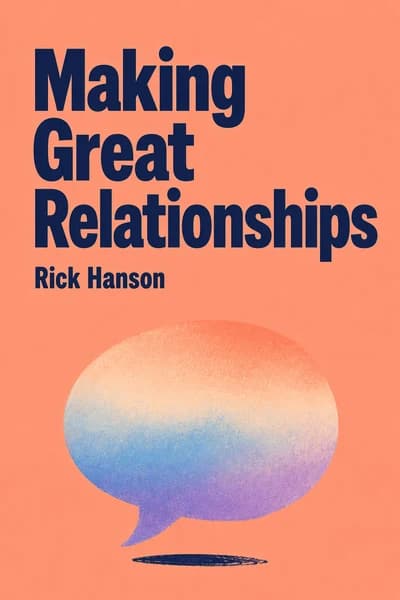
Making Great Relationships
Simple Practices for Solving Conflicts, Building Cooperation and Fostering Love
Обзор книги Making Great Relationships
Discover 50 brain-science-backed skills for transforming every relationship in your life. New York Times bestselling psychologist Rick Hanson's guide - praised by Lori Gottlieb - reveals counterintuitive communication techniques that make people feel truly seen, even during conflict.
Ключевые темы в Making Great Relationships
- neuroscience of connection
- emotional self-regulation
- negativity bias management
- internal family systems
- secure attachment building
Цитаты из Making Great Relationships
This self-loyalty isn't selfishness-it's the pilot light that makes everything else possible.
Most relationship mistakes happen when we're stressed and rattled.
We're born whole, like a mansion with all doors open to all rooms.
Many feel ashamed of their needs, but needs are universal and normal.
Everyone messes up.
Персонажи в Making Great Relationships
- Rick HansonAuthor and neuropsychologist
- NormanThe author's friend and rock climbing partner
Об авторе
Об авторе книги Making Great Relationships
Rick Hanson, Ph.D., New York Times bestselling author of Making Great Relationships: Simple Practices for Solving Conflicts, Building Connection, and Fostering Love, is a psychologist and leading expert in positive neuroplasticity and contemplative neuroscience. A Senior Fellow at UC Berkeley’s Greater Good Science Center, Hanson integrates decades of clinical psychology practice with cutting-edge brain science to explore how mindfulness and compassion can transform interpersonal dynamics.
His work, including acclaimed titles like Buddha’s Brain, Hardwiring Happiness, and Resilient, has been translated into 33 languages and distills complex neuroscience into accessible strategies for emotional well-being.
Hanson co-hosts the Being Well Podcast (15+ million downloads) and founded the Wellspring Institute for Neuroscience and Contemplative Wisdom. His free newsletters reach 260,000 subscribers, and his research-backed frameworks have been featured on CBS, NPR, and BBC, while his lectures at institutions like NASA and Google bridge science and practical wisdom. Making Great Relationships reflects his 50-year meditation practice and clinical insights, offering tools to resolve conflicts and deepen bonds. With over a million copies sold in English alone, Hanson’s works remain essential guides for cultivating resilience and meaningful connections.
Скачать резюме книги «Making Great Relationships»
Получите резюме книги «Making Great Relationships» в формате PDF или EPUB бесплатно. Распечатайте или читайте офлайн в любое время.
Часто задаваемые вопросы об этой книге
Making Great Relationships by Rick Hanson offers 50 practical skills grounded in neuroscience, psychology, and contemplative wisdom to improve personal and professional relationships. It teaches communication strategies, boundary-setting, conflict resolution, and empathy-building to foster deeper connections. Key themes include self-awareness, emotional resilience, and transforming interactions even with challenging individuals.
This book is ideal for couples, parents, professionals, or anyone seeking healthier relationships. It benefits those navigating conflicts, improving communication, or setting boundaries. Rick Hanson’s actionable advice appeals to self-help readers, therapists, and individuals prioritizing emotional intelligence and interpersonal growth.
Yes, Making Great Relationships provides research-backed, actionable tools for relationship challenges. Hanson’s blend of clinical expertise and mindfulness practices helps readers shift ingrained patterns. With over a million copies sold globally, it’s praised for transforming strained interactions into opportunities for connection.
Core concepts include:
- Self-awareness as the foundation for understanding others.
- Effective communication through active listening and clear expression.
- Boundary-setting to protect emotional well-being.
- Conflict resolution by staying calm and seeking mutual solutions.
The book teaches nonverbal cue awareness, “I” statements, and compassionate dialogue. For example, Hanson outlines how to express needs without blame and listen without defensiveness. These skills apply to romantic partnerships, workplace dynamics, and family interactions.
Absolutely. Strategies include pausing during tension, reframing perspectives, and focusing on shared goals. Hanson emphasizes resolving disagreements constructively rather than “winning,” fostering emotional resilience and mutual understanding.
Boundaries are framed as self-respect tools, not punishments. Steps include identifying non-negotiable needs, assertively saying “no,” and reshaping relationships when values clash. Practical examples show how to maintain kindness while prioritizing well-being.
Hanson advocates “seeing the good” in others through empathy exercises and nonjudgmental curiosity. Techniques like imagining others’ motivations or past struggles help build compassion, even in difficult relationships.
It stresses that self-awareness drives relational success. Introspective exercises help readers identify unconscious patterns (e.g., people-pleasing) and align actions with core values. This fosters authentic connections rooted in mutual respect.
Rick Hanson, Ph.D., is a psychologist, NY Times bestselling author, and UC Berkeley Senior Fellow. His expertise in “positive neuroplasticity” merges brain science with mindfulness. With 40+ years of clinical and teaching experience, he’s a trusted voice in relationship psychology.
Unlike generic advice, Hanson combines neuroscience with actionable steps, like specific phrases for tough conversations. It’s more structured than memoir-driven books, offering a holistic approach to relational health.
Some note it requires consistent practice to see results, as skills build gradually. However, Hanson’s exercises are designed for incremental progress, making it accessible for readers committed to long-term growth.
Yes. The book’s principles apply to team collaboration, leadership, and client interactions. For example, staying calm under pressure and giving constructive feedback align with professional settings, enhancing trust and productivity.