Глава 1
When Life Throws Its Hardest Punches
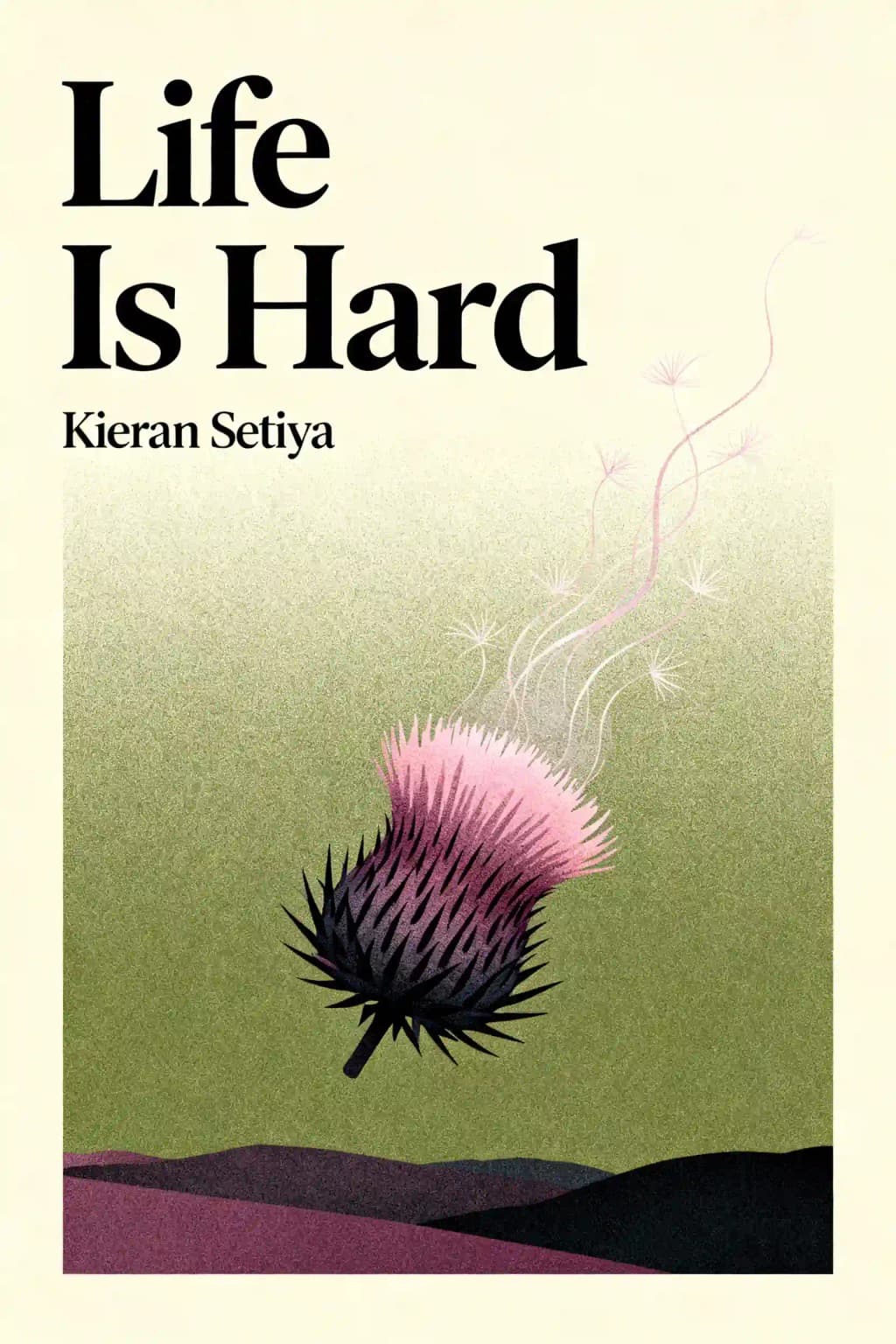
In a world obsessed with happiness and success, Kieran Setiya's "Life Is Hard" offers a refreshingly honest counterpoint. The book has garnered praise from luminaries like Atul Gawande and Rebecca Solnit, who call it "essential reading for difficult times." Written during the pandemic but conceived before, this philosophical exploration of suffering has struck a chord with readers seeking meaning amid hardship. What makes this book particularly compelling is Setiya's approach-blending rigorous philosophical inquiry with deeply personal reflections. As a professor at MIT, Setiya brings academic weight to universal human struggles, yet writes with such clarity and compassion that his ideas feel like a conversation with a wise friend. The book has become something of a sleeper hit, particularly among those grappling with chronic pain, loss, or existential questions-a philosophical lifeline for those swimming against life's strongest currents.
Глава 2
The Fragility of Our Physical Existence
The journey begins with Setiya's own experience of chronic pain that started suddenly at age twenty-seven. For thirteen years, he endured an undiagnosed condition while doctors eventually gave up on him, advising him to simply "ignore the pain if possible." This personal struggle unfolds alongside his family's medical challenges-his mother-in-law battling ovarian cancer, his wife undergoing surgery, his father-in-law surviving open-heart surgery, and his mother being diagnosed with early-onset Alzheimer's. These trials aren't presented as extraordinary but as emblematic of the universal human condition.
What's remarkable is how Setiya uses these experiences to explore deeper philosophical questions about disability and suffering. Drawing on disability theory, he challenges traditional notions that physical limitations necessarily make life worse. Disability theorists like Elizabeth Barnes have shifted the conversation from medicine to civil rights, arguing that disability represents not defective bodies but minority bodies. Research confirms this perspective-people with disabilities don't rate their well-being significantly lower than others.
This raises a fascinating puzzle: how can disabilities that remove access to valuable experiences not necessarily make life worse? The answer lies in rejecting Aristotle's notion that the good life must be "lacking in nothing"-an impossible standard for anyone. Good lives are inherently selective and limited; no one engages with everything valuable. Most disabilities leave enough value intact for lives that are no worse than average.
Setiya illustrates this through compelling examples like Bill Veeck, who lost his right foot in WWII yet thrived as a baseball executive who integrated the American League and led teams to championships. Similarly, Harriet McBryde Johnson, born with muscular dystrophy, became a successful lawyer and disability activist who challenged philosopher Peter Singer's views on euthanasia by asking: "Are we 'worse off'? I don't think so. Not in any meaningful sense."
Yet Setiya doesn't minimize suffering. He acknowledges that chronic pain transforms our experience of time itself-erasing memory of painlessness and preventing us from imagining relief. As Emily Dickinson wrote, pain traps us in an "infinite contain," cut off from past comfort and future hope. The best approach becomes focusing on the present rather than future suffering, treating persistent pain as isolated episodes to diminish its power.
Глава 3
The Paradox of Human Connection
Loneliness represents a universal hardship with devastating physical and emotional consequences, producing effects comparable to smoking fifteen cigarettes a day or having high blood pressure. Research consistently shows that individuals with fewer social connections face mortality rates two to three times higher than their more socially connected peers. Modern neuroscience has revealed fascinating insights: brain scans demonstrate that social rejection activates the same neural regions as physical pain, highlighting how deeply our need for connection is wired into our biology. This reflects our evolutionary heritage as social animals who survived through mutual dependence and collective action.
Yet Setiya challenges prevailing narratives about modern loneliness and its causes. While many blame capitalism and market economies for social atomization, he argues that these systems actually created unprecedented space for authentic friendships based on genuine affection rather than mere utility. Oxford historian Keith Thomas's research into early modern England reveals that friendships were predominantly practical arrangements - "One did not necessarily have to like them." The market economy's separation of economic and personal spheres enabled the emergence of private friendships founded on pleasure and genuine connection rather than social necessity or economic advantage.
Setiya presents a compelling critique of Aristotle's meritocratic conception of friendship, which suggested that true friendship requires virtue and that we should abandon friends who become morally compromised. This perspective fundamentally misunderstands the nature of deep friendship. When a friend faces moral struggles or becomes difficult, their redemption becomes more important to us than that of a stranger precisely because of our connection. True friendship means being loved for who you are fundamentally, not for your achievements or qualities - a radical departure from traditional virtue-based theories.
This understanding aligns with Enlightenment philosophy's revolutionary insight about human dignity existing independently of merit. Kant's crucial distinction between "price" (replaceable value) and "dignity" (irreplaceable worth) illuminates how friendship intertwines with moral philosophy - not through mutual appreciation of virtue but through reciprocal recognition of fundamental human worth. This shift transforms our understanding of friendship from a relationship based on exchange to one grounded in unconditional acceptance.
The solution to loneliness, paradoxically, lies not in direct pursuit of connection but in transcending self-focus to attend to others' needs. Contemporary research demonstrates that even brief positive interactions with strangers significantly boost happiness levels, while developing strong listening skills forms the foundation of lasting relationships. Friendship often begins not with grand gestures or shared interests but with simple acts of attention and presence. The journey from casual acquaintance to deep friendship requires courage to risk rejection and resilience to maintain connection. Practical paths include community engagement through volunteer work, participation in evening classes, joining amateur sports teams, and extending social invitations that make us vulnerable. These activities create structured opportunities for meaningful connection while building the social skills and confidence necessary for deeper relationships.
Глава 4
The Emotional Landscape of Loss
Grief manifests not as a simple feeling but as a complex, fluid emotional state encompassing anger, guilt, fear, and even moments of lightness. These emotions may be irrational or misdirected-anger without object, guilt without reason, or fear paradoxically directed at the past rather than the future. Grief isn't static but something we do, like the body forming a scar after injury.
Ancient philosophical schools-Academic, Epicurean, Skeptical, Stoic-despite their differences, agreed that grief was harmful. Epictetus, a Roman Stoic born into slavery, advised preparing for loss by reminding ourselves of the impermanence of what we love: "If you kiss your child or your wife, say to yourself that it is a human being that you're kissing; and then, if one of them should die, you won't be upset."
The Stoic approach to adversity involves changing our desires to match unchangeable reality rather than futilely trying to change what we cannot control. But Setiya finds this approach fundamentally perverse-akin to sour grapes, it distances us from what truly matters in life, resembling how prisoners or abuse victims accommodate oppression.
When grief subsides, it creates a profound paradox: if someone's death remains a permanent reason to grieve, why does our grief diminish? We don't want to stop loving the dead or registering their loss, yet grief naturally wanes. This isn't because the reasons for grief change-the dead remain just as dead-but because grief is an emotional process, not merely a state responding to reasons.
Like love, which grows and deepens without the beloved becoming more lovable, grief evolves in ways that seem unintelligible from within. This explains why mourning rituals are so essential-they provide structure when reasons alone cannot guide us. Each culture maps the terrain of grief differently, from Jewish shiva to the celebratory traditions of the Dahomey in Western Africa.
Western culture has increasingly privatized death, moving it from communal ritual to medical management. Without established practices, we must construct our own frameworks for mourning. Ultimately, grief has no permanent solution or narrative closure. We cannot "succeed" at mourning once and for all. The conventions of mourning don't provide a tidy beginning, middle and end, but rather an atlas for navigating the hardest stretches of grief that lead into uncharted but habitable terrain.
Глава 5
Redefining Success and Failure
Failure manifests in work, love, and obligations. But sports offer a special arena where failure is well-defined and irrefutable. Baseball history brims with legendary failures-Merkle's Boner, the Snodgrass Muff, Bill Buckner's error. How does one live with conclusive failure? This question concerns everyone, though it cuts deeper for some. Our lives are filled with frustrated projects and abandoned plans-as poet James Richardson notes, "if we remembered even a fraction of our million tiny plans, our whole lives would be regret at their failure."
The notion that we narrate our lives to ourselves is so commonplace that philosopher Galen Strawson calls it "a fallacy of our age." Many prominent thinkers-from Oliver Sacks to Daniel Dennett-argue that constructing autobiographical narratives is essential to making sense of ourselves. Yet Strawson himself claims to have "absolutely no sense of my life as a narrative," challenging this assumption.
Many exemplary lives-Iris Murdoch, Montaigne, Bill Veeck-demonstrate that one can live well without seeing one's life as a unified narrative arc. Their lives contained valuable achievements alongside miscues and swerves, without requiring an overarching storyline.
Setiya distinguishes between two kinds of activities: "telic" activities (like building a house) that aim at terminal states where they're finished, and "atelic" activities (like walking or thinking) that have no final endpoint. With telic activities, satisfaction lies always in the future or past, while atelic activities are realized in the present. Living well is fundamentally atelic-we can insure ourselves against failure by valuing the process, not just the outcome.
The film Groundhog Day illustrates this philosophy, as Phil Connors is trapped repeating the same day. His predicament shows how one might live better by being less focused on success and failure, more attuned to process than project. The author acknowledges his own struggle to reorient toward atelic values, noting meditation as helpful but insufficient against powerful cultural forces that reduce human worth to wealth.
The concept of being a "failure" emerged in mid-1800s America as entrepreneurship and credit reports began defining individual worth. Ralph Waldo Emerson noted the prevailing belief that character determined financial success, while Frederick Douglass proclaimed that success came through hard work, not luck. This individualist ethos led to people measuring self-worth by prosperity, with economic crashes causing not just poverty but spiritual collapse. Today's "deaths of despair" among non-college-educated whites reflect this same internalization of failure, while Black Americans more readily recognize systemic injustice.
Глава 6
The Weight of Structural Injustice
Faced with endless streams of horrific news about inequality, political gridlock, police violence, and climate disaster, many experience the modern phenomenon of "doomscrolling"-an addiction to consuming awful news that leaves one feeling powerless. This raises an ancient philosophical question: why concern oneself with justice when solidarity brings pain?
Setiya challenges the view that morality and self-interest are opposed. If self-interest means merely happiness as a feeling, it might conflict with moral concerns. But if self-interest means human flourishing, then living well requires feeling what there is reason to feel and doing what there is reason to do-including caring about others.
Simone Weil serves as a moral exemplar who took suffering with extraordinary seriousness. Born in Paris in 1909, Weil practiced radical solidarity throughout her life-from abstaining from chocolate as a child when soldiers were denied sweets, to giving away her teaching salary, refusing heat when others couldn't afford it, and ultimately dying of starvation in 1943 while maintaining self-imposed rations matching those in occupied France. Despite her otherworldliness (earning nicknames like "the Martian" and "the Categorical Imperative in skirts"), Weil was an incisive social critic who founded a school for railroad workers, participated in strikes, criticized Trotsky, campaigned against fascists, and wrote about oppression and propaganda.
The author draws on Iris Marion Young's concept of "structural injustice"-injustice that emerges interactively rather than from individual prejudice or actions. Even without sexist views, the gendered division of labor disadvantages women systematically. Young's "social connection model" distinguishes between culpability and responsibility for change. While we may not be to blame for systems like educational inequality or racial wealth disparities, we are implicated in them through our actions and benefits, creating an obligation to work for change.
Climate change exemplifies this structural injustice. The warming planet disproportionately harms regions that contributed least to the problem, while developed nations responsible for most emissions will be relatively spared. The author describes joining Fossil Free MIT after seeing a campus installation marking projected flood levels, participating in a campaign for divestment from fossil fuels. Though not achieving full divestment, the campaign established advisory committees and continues through new student groups.
Глава 7
Confronting Life's Fundamental Absurdity
The question of absurdity emerges when we contemplate humanity's insignificance against the cosmic scale: our tiny planet in an expanding universe of billions of galaxies, human history merely a blink in cosmic time. This stark reality becomes even more pronounced when we consider that our entire solar system is just one among countless others in the Milky Way, itself just one galaxy among billions. This perspective makes our serious self-regard seem preposterous, yet we continue to attach profound importance to our daily struggles, achievements, and relationships.
Exploring absurdity connects to deeper questions about love, loss, narrative, and ultimately meaning itself-for to say life has meaning is to say it isn't absurd. This paradox manifests in how we simultaneously acknowledge our cosmic insignificance while finding profound meaning in personal experiences like falling in love, creating art, or helping others. The tension between these perspectives creates what philosophers call the "absurd condition" of human existence.
The question "What is the meaning of life?" is both philosophical cliche and deeply elusive. Academic philosophers rarely tackle it directly, often dismissing it as nonsense or poorly formed. Susan Wolf exemplifies the common shift from asking about life's overall meaning to asking what makes individual lives meaningful-engaging successfully in activities that matter, whether relationships, justice, art, or work. This approach focuses on finding meaning through active engagement rather than passive contemplation. The philosophical threat comes from nihilism, elegantly expressed by Tolstoy's existential crisis where "there was no life in me," a state where even previously meaningful activities become hollow.
Religion traditionally provides answers to life's meaning through metaphysical frameworks that transcend ordinary reality. These might involve God, gods, or nontheistic concepts like Buddhist emptiness, but all offer a "total reaction upon life" through beliefs that guide how we should feel about existence. Religious frameworks provide not just explanations but complete worldviews that address human suffering, mortality, and purpose. For atheists seeking meaning without religion, the challenge is finding truths about humanity's place in the cosmos that help reconcile us to suffering without traditional religious frameworks. This often involves embracing scientific understanding while maintaining wonder at existence itself.
Imagining human extinction through infertility (as in P.D. James's "Children of Men") reveals how deeply our sense of meaning depends on humanity's future. Though protagonist Theo Faron falls into nihilism when humanity becomes sterile, this response isn't fully rational. The value of immediate pleasures and artistic experiences needn't depend entirely on posterity - a sunset remains beautiful whether or not humanity will exist to see future ones. Human extinction should provoke sorrow because humanity, despite its flaws, is lovable and has unfinished business. What would truly give meaning to human existence is our halting progress toward justice-not redemption in another world, but the arc of moral progress in this one. This perspective suggests that meaning can be found in contributing to human flourishing, even if our individual contributions seem small against the vast backdrop of cosmic time.
Глава 8
Finding Hope in Hard Times
Hope is a complex emotional and cognitive state that combines two essential elements: desire and belief - wanting something deeply while seeing it as possible, though not inevitable. This nuanced understanding is crucial, as hope operates in a specific space between impossibility and certainty. You don't hope for what you don't want, what you know is impossible, or what's absolutely certain. Hope inherently acknowledges the limits of human control while maintaining a connection to possibility.
True hope involves deep emotional investment, not merely casual wishing or idle longing-what philosopher Sren Kierkegaard described as "a passion for what is possible." The possibility must be what philosophers call "live"-something concrete enough that you would seriously plan for it, even when facing long odds. This might mean saving for a dream home despite current financial constraints, or pursuing a challenging career change despite significant obstacles.
Despair's harmful effects are well-documented-it represents the acute pain of passion for a possibility that has died. However, hope's value is more complex and sometimes controversial. In some cases, impossibility is simply fact, and hope creates vulnerability to crushing disappointment. Hope can be deceptive and even paralyzing, sometimes coexisting with inaction. While activists like Rebecca Solnit powerfully argue that "hope calls for action," hope itself doesn't necessarily motivate-often it's grief, rage, and fear that actually drive significant social change. Hope serves more as a necessary precondition for meaningful striving rather than being inherently valuable.
Drawing from Thomas Aquinas's distinction between hope as an "irascible passion" and the theological virtue of hope, we can identify a secular virtue of hoping well. Following Aristotle's virtue theory, good hoping occupies the middle ground between extremes-avoiding both excessive hopefulness (which inflates odds or refuses to surrender when possibilities become truly remote) and excessive hopelessness (which minimizes chances worth taking). Hoping well means maintaining a realistic assessment of probabilities while keeping alive the potential for meaningful agency and action.
This virtue is exemplified in Solnit's work, which methodically assembles evidence that significant change is possible-from the end of apartheid to the legalization of same-sex marriage to successful environmental campaigns. Against Walter Benjamin's "angel of history" eternally surveying endless wreckage, Solnit's "Angel of Alternate History" reminds us that our actions matter and resistance to injustice isn't futile.
The virtue of hoping well combines truthful belief about what's possible with the moral courage to conceive alternatives and act upon them. We should approach hardships by finding possibility where we can-not hoping for an idealized life but acknowledging and working within the lives we have. This means hoping strategically and specifically: I can hope to make meaning from my pain without hoping for a complete cure; I can hope to see my mother again without expecting her full recovery. This kind of grounded hope enables resilience while maintaining connection to reality.
Глава 9
Embracing Life's Hardness with Wisdom
Life is hard-this much is undeniable. From physical pain to loneliness, grief to failure, injustice to absurdity, we face challenges that cannot be wished away. These hardships manifest in countless forms: chronic illness that reshapes daily existence, the sudden loss of loved ones that leaves an unfillable void, professional setbacks that shake our sense of purpose, and systemic inequities that persist despite our best efforts. What Setiya offers is not a solution to these hardships but a framework for living with them meaningfully.
The philosophical tradition has often sought to transcend suffering through detachment or denial. Ancient Stoics advocated emotional distance, while some Eastern philosophies suggest desire's elimination as the path to peace. Setiya proposes instead that we look suffering in the face, acknowledging its reality while finding ways to make it more bearable. This approach doesn't promise happiness but something perhaps more valuable: wisdom about the human condition and our place within it.
The book's power lies in its refusal to offer simple formulas or false comfort. Instead, it provides tools for thinking about hardship that honor its difficulty while pointing toward possibilities for living well despite it. By distinguishing between telic activities (those done for an end goal) and atelic activities (those valuable in themselves), between narrative and non-narrative conceptions of life, between hope as passion and hope as virtue, Setiya gives us ways to navigate terrain that can never be fully mapped. These distinctions help us understand why certain struggles feel particularly acute and how we might approach them differently.
What emerges is a philosophy grounded in lived experience rather than abstract theorizing. It's a philosophy that acknowledges the fragility of bodies - how illness and aging affect not just our capabilities but our very sense of self; the necessity of connection - how relationships sustain us even as they make us vulnerable; the inevitability of loss - how we must learn to live with absence; the possibility of failure - how our best efforts sometimes fall short; the reality of injustice - how systems resist individual action; the specter of absurdity - how meaning itself can seem questionable. Yet within each of these challenges, Setiya finds reasons to continue, to care, to hope.
In a world increasingly defined by polarization and despair, where social media amplifies extremes and nuance seems scarce, Setiya's voice offers something rare: nuance without equivocation, honesty without cynicism, hope without naivety. He acknowledges that life's difficulties cannot be solved through positive thinking or simple lifestyle changes, yet argues that within these very challenges lie opportunities for deeper understanding and meaningful engagement. Life is hard, yes-but within that hardness lie possibilities for meaning, connection, and even joy that make the journey worthwhile, not despite its difficulties but sometimes because of them.