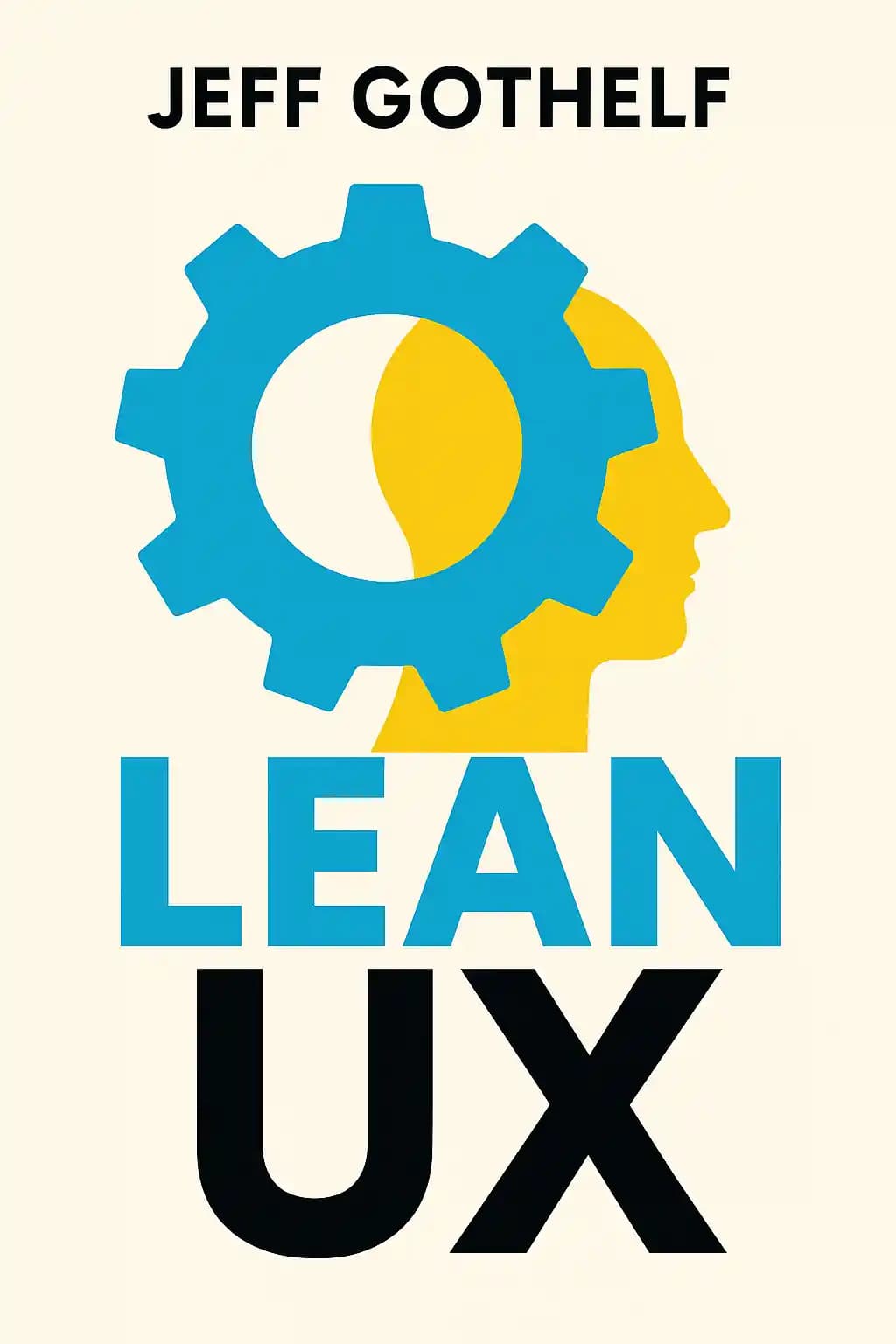
Revolutionize product design with "Lean UX" - the award-winning guide that transformed how tech teams collaborate. Going beyond deliverables to outcomes, Gothelf's methodology has influenced global industries by combining design thinking with agile development. What if your greatest products are waiting in untested assumptions?
Jeff Gothelf, co-author of Lean UX: Applying Lean Principles to Improve User Experience and a leading voice in Agile and Lean UX methodologies, is a seasoned product design expert and keynote speaker. With Josh Seiden, he pioneered the Lean UX framework, merging design thinking, Agile development, and Lean Startup principles to redefine collaborative product design.
The book, a staple in UX and product management, emphasizes outcomes over deliverables, cross-functional teamwork, and rapid experimentation, themes rooted in Gothelf’s decades of experience advising companies like PayPal, Dropbox, and GE.
A frequent contributor to industry platforms, Gothelf co-authored Sense & Respond and Forever Employable, further cementing his authority in adaptive product strategies. His Lean UX Canvas, central to the book’s third edition, is widely adopted for aligning teams on user-centric goals. Recognized by thought leaders like Teresa Torres and Christina Wodtke, Lean UX has been translated into multiple languages and remains essential reading for product teams globally.
Lean UX outlines a collaborative, iterative approach to user experience design that integrates Lean Startup and Agile methodologies. It emphasizes rapid experimentation, cross-functional teamwork, and prioritizing user feedback over exhaustive documentation. The third edition focuses on shifting from deliverables to product outcomes, using tools like the Lean UX Canvas to align teams on customer-centric goals.
This book is ideal for UX designers, product managers, developers, and Scrum masters working in Agile environments. It’s particularly valuable for teams seeking to break silos, reduce wasted effort, and validate designs through continuous user testing. The practical frameworks also benefit leaders aiming to foster a culture of experimentation.
Yes—the third edition addresses modern product development challenges, offering updated tactics for integrating AI-driven workflows and remote collaboration. Critics note some concepts feel familiar if you know Agile or Lean Startup methods, but its actionable templates (e.g., experiment stories, success criteria) remain widely applicable.
Three key principles guide Lean UX:
Traditional UX relies on heavy documentation and linear processes, while Lean UX emphasizes rapid prototyping, cross-functional collaboration, and validating assumptions early. For example, instead of creating detailed wireframes, teams might sketch ideas and test them within a single sprint.
The Lean UX Canvas is a strategic tool to align teams on problem statements, business outcomes, and user success metrics before designing solutions. It replaces lengthy requirements documents with a one-page visual framework, ensuring all stakeholders share priorities.
The book teaches how to embed design work into every sprint, using techniques like:
This ensures UX evolves alongside development.
Some argue it oversimplifies complex organizational challenges, particularly in large enterprises with rigid processes. Others note it requires significant cultural shifts that can be difficult to implement without leadership buy-in.
The book suggests virtual collaboration tools like Miro for real-time canvas updates, asynchronous user testing platforms, and daily standups to maintain alignment. Case studies show success when teams adopt tools that mimic in-person dynamics.
It advocates dedicating 20–30% of team capacity to discovery activities like customer interviews and prototype testing. The “Assumption Mapping” technique helps identify riskiest hypotheses to validate first, reducing time-to-insight.
Почувствуйте книгу через голос автора
Превратите знания в увлекательные, богатые примерами идеи
Захватите ключевые идеи мгновенно для быстрого обучения
Наслаждайтесь книгой в весёлой и увлекательной форме
The goal is to validate or invalidate our assumptions as quickly and inexpensively as possible.
Working software is the primary measure of progress.
Outcomes, not output.
The ultimate goal isn't prettier documentation or faster deliverables-it's better outcomes.
Collaborative design brings designers and non-designers together in co-creation.
Разбейте ключевые идеи Lean UX на понятные тезисы, чтобы понять, как инновационные команды создают, сотрудничают и растут.
Погрузитесь в Lean UX через яркие истории, превращающие уроки инноваций в запоминающиеся и применимые моменты.
Задавайте любые вопросы, выбирайте свой стиль обучения и создавайте идеи, которые действительно вам подходят.

Создано выпускниками Колумбийского университета в Сан-Франциско
"Instead of endless scrolling, I just hit play on BeFreed. It saves me so much time."
"I never knew where to start with nonfiction—BeFreed’s book lists turned into podcasts gave me a clear path."
"Perfect balance between learning and entertainment. Finished ‘Thinking, Fast and Slow’ on my commute this week."
"Crazy how much I learned while walking the dog. BeFreed = small habits → big gains."
"Reading used to feel like a chore. Now it’s just part of my lifestyle."
"Feels effortless compared to reading. I’ve finished 6 books this month already."
"BeFreed turned my guilty doomscrolling into something that feels productive and inspiring."
"BeFreed turned my commute into learning time. 20-min podcasts are perfect for finishing books I never had time for."
"BeFreed replaced my podcast queue. Imagine Spotify for books — that’s it. 🙌"
"It is great for me to learn something from the book without reading it."
"The themed book list podcasts help me connect ideas across authors—like a guided audio journey."
"Makes me feel smarter every time before going to work"
Создано выпускниками Колумбийского университета в Сан-Франциско

Получите резюме книги «Lean UX» в формате PDF или EPUB бесплатно. Распечатайте или читайте офлайн в любое время.
Picture a designer spending three weeks crafting pixel-perfect mockups, only to watch developers build something entirely different because they misunderstood the intent. Or imagine a team launching a beautifully documented feature that nobody uses. These scenarios play out daily in organizations worldwide, revealing a fundamental mismatch: our design processes evolved for manufacturing-where you can't change a car door after production begins-but software has no such constraints. We can update continuously, yet we still design as if every decision is permanent. Lean UX emerged from this tension, offering a radically different approach. Instead of treating design as a solitary craft that produces deliverables, it reimagines design as collaborative problem-solving focused on outcomes. The shift is profound: from "Did I create beautiful wireframes?" to "Did we solve the customer's problem?" This isn't about abandoning craft-it's about channeling that craft toward what actually matters. Lean UX synthesizes three powerful movements into something greater than their sum. Design thinking contributes solution-focused methods that tackle business challenges creatively, encouraging teams to work beyond traditional boundaries. Agile development adds principles that value working software over comprehensive documentation, customer collaboration over contract negotiation, and responding to change over following rigid plans. The Lean Startup method introduces the build-measure-learn feedback loop, minimizing risk through rapid experimentation. What makes this synthesis transformative is how it addresses software's unique nature. Unlike physical products, software can evolve continuously. Lean UX embraces this reality by stripping away heavy documentation in favor of building shared understanding across teams. Rather than spending weeks perfecting wireframes in isolation, practitioners sketch ideas with developers at whiteboards, immediately identifying technical constraints and opportunities. Instead of creating comprehensive specifications that become outdated before implementation, they build just enough shared understanding to start creating working software that can be tested with real users. This represents a fundamental shift from "getting it all figured out first" to learning through making and measuring-from comfort to effectiveness.
Lean UX treats requirements as testable assumptions. Instead of "Users need feature X," teams ask, "We believe users need feature X - how will we know if we're right?" Teams state assumptions about users, markets, and solutions, then prioritize by risk. These become hypothesis statements: "We believe [statement] is true. We will know we're right when we see [specific feedback]." Effective hypotheses require three elements: outcomes (behaviors predicting business goals), personas (user sketches refined through research), and features (ideas driving customer behavior). Lean UX introduces "proto-personas" using a four-quadrant layout: sketch and name, demographics, needs and pain points, and potential solutions. A team building a Community-Supported Agriculture app created "Susan," assuming users were women who liked to cook. Field research revealed their audience was actually young men, prompting a quick pivot to "Timothy." This flexibility - being wrong quickly rather than right slowly - distinguishes Lean UX from traditional approaches. Lean UX reimagines design as collaborative, not solitary. This isn't design-by-committee - it's designer-led co-creation maintaining clear decision-making. Early, frequent conversations unite teams around shared vision and enable parallel development. A TheLadders designer struggling with a complex recruiter dashboard collaborated with the lead developer at a whiteboard. Two hours of sketching produced a layout both usable and technically feasible. The designer refined wireframes while the developer began infrastructure code simultaneously - completing the first version within their two-week sprint.
Lean UX employs Design Studio to bring cross-functional teams together. Team members independently sketch six low-fidelity ideas in five minutes, present their thinking in three-minute sessions while receiving critique, then refine based on feedback. The team converges on a single idea, sketching components and workflows together on whiteboards. This democratizes design while maintaining momentum. When Greg Petroff took over GE's global UX practice in 2011, he faced 500 developers per designer and inconsistent experiences across business lines. His team created the Industrial Internet Design System-a comprehensive pattern library targeting GE's 8,000 software engineers. This system shortened project lifecycles by up to six months, saved millions annually, and enabled teams to create clickable prototypes in days instead of months. By codifying design patterns into reusable components, they freed designers from reinventing standard elements, creating leverage that multiplied effectiveness across hundreds of projects simultaneously.
With hypotheses ready, teams must validate what works. The Minimum Viable Product approach minimizes effort on unproven concepts while quickly identifying worthwhile features. MVPs serve two purposes: learning-focused MVPs discover market needs, while value-focused MVPs deliver immediate benefits while enabling learning. Prototyping creates effective MVPs efficiently. Options range from paper prototypes to clickable wireframes, high-fidelity mockups, and coded prototypes. Paper prototypes are quick but provide limited feedback. Coded prototypes offer realistic experiences but require significant time. Match your approach to what you need to learn, focusing on core workflows. Non-prototype MVPs sometimes test concepts more efficiently. Email campaigns measure engagement, AdWords tests messaging resonance, and landing pages validate ideas through conversion rates. "Buttons to nowhere" gauge feature interest by tracking clicks on non-functional elements. Cheryl Yeoh exemplified this with CityPockets, creating a "Concierge MVP" - a working frontend where she manually processed coupon emails behind the scenes. She set a 500-email daily target to validate demand before building automation, embodying core Lean UX principles: design only what's needed, deliver quickly, and maintain customer contact for meaningful feedback.
Lean UX embeds research into every sprint through collaborative practices. Teams review questions together, create interview guides, and conduct interviews in mixed-discipline pairs, switching roles to broaden perspectives. A PayPal team split into pairs and took a prototype to nearby malls. Each pair spent two hours interviewing strangers, switching roles midway. Patterns emerged that validated or disproved assumptions. They adjusted their prototype and conducted another round the same day, starting the next sprint with shared understanding-no secondhand reports. The "3-12-1" approach brings three users into testing by noon, weekly. Modern usability testing requires only a quiet office with a computer and webcam. Meetup evolved from everyone in one room to just the moderator joining the user while the team watches remotely. They scaled to daily testing, conducting about 600 sessions annually for roughly $30,000. Customer support agents interact with more customers daily than designers will during entire projects. Teams should regularly meet with support staff to understand trends and test hypotheses through call scripts, transforming support from reactive function into proactive design insight.
Lean UX requires fundamental organizational shifts. First, measure outcomes over output - track business goal progress, not feature completion. Second, replace rigid roles with collaborative capabilities, letting team members contribute their full skill range beyond job descriptions. Third, designers must develop facilitation skills, opening the design process to team ownership rather than individual control. Fourth, create small, cross-functional teams - single-discipline collaboration produces narrow ideas. Keep teams small enough to feed with two pizzas. Fifth, design collaborative workspaces. Co-locate teams in open spaces with ample wall space for shared work - even one cubicle wall hinders conversation. Sixth, eliminate "hero designers" and Big Design Up Front. Lean UX thrives on broad collaboration, where design as hypothesis embraces failure as learning. Finally, prioritize speed over aesthetics. As Jason Fried said, "Speed first, aesthetics second." Don't perfect transient artifacts - they serve the moment, then evolve.
Lean UX transforms product development through shared understanding - the collective knowledge teams build together. Greater shared understanding reduces dependence on detailed documents. It values externalizing work: getting ideas onto whiteboards, walls, and sticky notes, creating ambient information flow and equal participation. It prioritizes making over analysis. Creating the first version beats endless debate. Answers come from customers, not conference rooms - requiring something concrete for people to respond to. It embraces learning over growth, recognizing that scaling unproven ideas wastes resources. It grants permission to fail - creating safe environments where teams try ideas without fear of penalty. Most fundamentally, it refocuses from creating documents to achieving outcomes. In a world where software changes continuously, clinging to manufacturing-era processes ignores reality. Lean UX offers a different path: teams learning together, failing fast, and focusing relentlessly on outcomes. Beautiful wireframes that don't solve real problems are expensive decoration. Choose learning over perfection, collaboration over heroism, outcomes over outputs. That's where real craft lives.