Глава 1
The AI Revolution: Becoming Indispensable in a Machine-Driven World
Have you ever wondered what makes you truly irreplaceable? In a world where AI can write poetry, diagnose diseases, and even create art, what remains uniquely human? Pascal Bornet's groundbreaking book "Irreplaceable" tackles this existential question head-on, offering a roadmap for thriving alongside artificial intelligence rather than being replaced by it. The book has become required reading in Silicon Valley boardrooms and has been endorsed by tech luminaries like Marshall Goldsmith, who calls it "a hands-on guide for enhancing our humanity in harmony with AI." Its cultural impact extends beyond tech circles-celebrities from Elon Musk to Yuval Noah Harari have cited its framework for human-AI symbiosis as essential reading in our rapidly evolving digital landscape.
Глава 2
The Looming AI Challenge: Choose Your Path
We stand at a critical crossroads in human history. AI is rapidly infiltrating every aspect of our lives-influencing decisions, automating jobs, capturing our children's attention, threatening privacy, and competing against businesses. As Pascal Bornet warns, we face two stark choices in this new reality.
Option 1 is to surrender passively to AI, letting it strip away our humanity by prioritizing speed over depth and convenience over human connection. Bornet introduces the concept of "AI obesity"-our addiction to fast creativity, fast connections, fast decisions, and even fast love through AI, similar to our addiction to fast food. This path leads to settling for "good enough" rather than excellence, resulting in lost jobs, businesses, attention, children's safety, and ultimately our humanity. This passive surrender represents a far greater danger than any hypothetical robot apocalypse.
Option 2 is to choose quality over convenience-swapping "fast food" AI for a "gourmet dining experience" by embracing authenticity, uniqueness, and depth. The key difference is that while parents warned us about food obesity, no one has taught us how to avoid "AI obesity." Bornet's IRREPLACEABLE approach offers practical strategies for personal life, children, work, and organizations, promising remarkable outcomes including 30% increased efficiency, 40% enhanced work quality, and greater life satisfaction.
The book introduces the "Three Competencies of the Future": AI-Ready (leveraging AI while protecting against negative impacts), Human-Ready (developing uniquely human capabilities AI can't match), and Change-Ready (building resilience for the rapidly evolving landscape). These competencies form the foundation for becoming truly irreplaceable in the AI era.
Глава 3
Debunking AI Myths: Separating Fact from Fiction
Before diving into solutions, Bornet dispels common misconceptions about AI that prevent us from effectively adapting to this new reality.
First, AI isn't just for tech enthusiasts-it's already woven into our daily lives through smart homes, navigation systems, workplace tools, and entertainment. Our entire supply chains, banking systems, and medical care increasingly rely on AI, raising important questions about delegation and safety.
Second, success in an AI world doesn't mean becoming more machine-like. The outdated mentality of success through number-crunching and hyper-productivity is now obsolete. Rather than becoming more like AI, success requires emphasizing uniquely human qualities that AI cannot replicate-creativity, empathy, leadership, and active listening.
Third, using AI tools isn't cheating but demonstrates clever efficiency. AI should be considered as fundamental as electricity or the internet, seamlessly integrated into our work without special mention. Forward-thinking companies are already embracing this cultural shift, while those clinging to "pure human toil" will quickly become obsolete.
Fourth, while it's true that AI will take jobs across all industries, the solution isn't fighting to save specific positions but shifting focus from job security to skill adaptability. The key is actively engaging with AI technology while enhancing uniquely human skills like creativity, emotional intelligence, and strategic thinking.
Perhaps most importantly, Bornet clarifies that AI and human intelligence are fundamentally different. He illustrates this through a comparison between a human artist whose painting reflects emotions, memories and experiences, and a robot artist that analyzes thousands of images to calculate patterns without truly feeling or understanding. While AI can generate novel combinations, it lacks the emotional depth, intentional creativity, and lived experience that drives genuine human creativity.
Глава 4
The Essence of Being Irreplaceable: Human Capabilities in the AI Age
What makes us truly irreplaceable? Bornet argues it's our "Humics"-uniquely human capabilities that AI cannot authentically replicate. These three core abilities form the foundation of our irreplaceability:
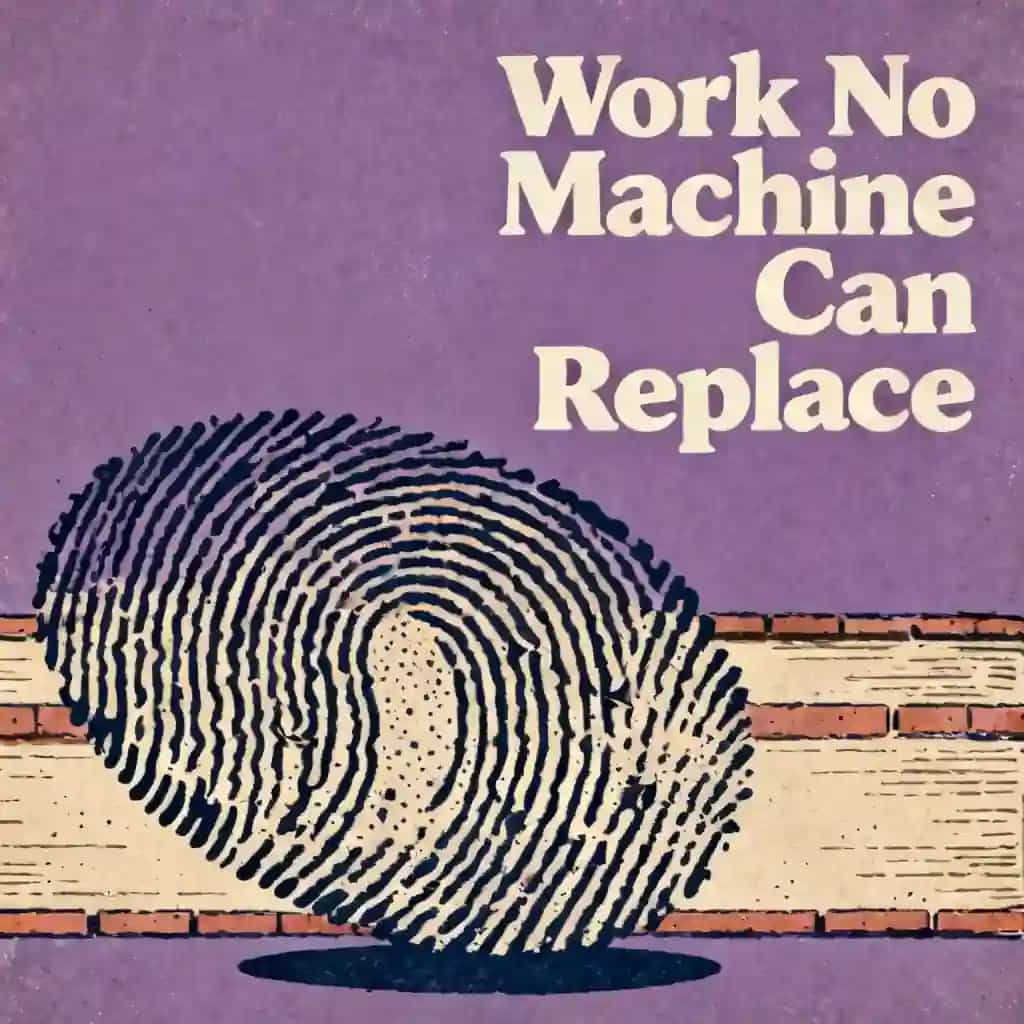
1. Genuine creativity: The ability to generate truly original ideas drawing from our personal experiences and emotions. While AI can combine existing ideas, it cannot replicate the depth of human creativity that's intertwined with our emotions, life experiences, and personality. Our creativity is as unique as our fingerprints.
2. Critical thinking: The capacity to analyze information using independent judgment, ethical reasoning, intuition, and self-reflection. Critical thinking involves questioning information validity, using intuition, and engaging in self-reflection to understand one's biases and motivations. While AI processes information, it lacks the depth of human insight to connect diverse ideas meaningfully.
3. Social authenticity: Understanding emotions, effective communication, empathy, and leadership. These qualities AI can simulate but never genuinely feel or comprehend. Human interactions thrive on authenticity and sincerity that build trust and meaningful relationships.
These Humics aren't separate entities but deeply interconnected abilities that form a cohesive whole. Like primary colors that blend to create thousands of hues, these abilities combine to create a spectrum of capabilities. They form a triad of virtuous abilities that bolster each other: creativity generates ideas while critical thinking evaluates them; creativity improves storytelling which enhances communication; and critical thinking's self-reflection helps understand and manage emotions in relationships.
The Humics are deeply intertwined with our inner selves, emotions, personal journeys, and individual personalities-and with love. Love strengthens these capabilities, guiding them with purpose and compassion toward a richer human experience. These connections to our authentic selves make the Humics truly powerful and distinctly human.
Глава 5
Creating a Symbiotic Relationship with AI
Rather than competing against AI, Bornet advocates for a symbiotic relationship where humans and AI complement each other's strengths and weaknesses. He references Garry Kasparov's revealing story about a 2005 chess tournament where human+AI teams defeated both standalone supercomputers and lone grandmasters. Surprisingly, the champions weren't grandmasters with high-end tech but everyday chess enthusiasts with modest computers.
This demonstrates two crucial principles: first, partner with AI rather than competing against it; second, embrace what makes you uniquely human. The most effective human-AI collaboration resembles natural symbiosis-where complementary skills create value greater than the sum of individual parts. Like bees pollinating flowers while collecting nectar, each party contributes uniquely to benefit the whole.
Beyond basic symbiosis principles, human-AI collaboration has two unique characteristics. First, AI Supremacy in Scalability and Speed means humans shouldn't compete with AI in areas where both have skills-AI will always win through superior scale and speed in calculation, medical diagnoses, text summarization, and repetitive tasks. Second, the Unreplicable Human Essence Principle highlights uniquely human capabilities beyond AI replication-rooted in our life experiences, emotions, and personalities.
Bornet challenges the common belief that technical skills like coding are paramount in the AI era. While experts have emphasized computer science education over the past decade, today's reality is completely opposite. Modern AI allows everyone to become programmers without knowing code-plain language prompting has replaced traditional programming. Tasks requiring significant technical expertise are now performed instantly by AI, from analyzing X-rays to reviewing legal contracts.
This doesn't mean technical skills are worthless-we still need to learn them, similar to how we learn calculus despite having calculators. Understanding technical foundations enhances critical thinking and problem-solving abilities, providing the groundwork for tackling complex concepts. However, the extent and methods of learning and testing these skills will need to evolve.
Глава 6
Developing Your Humics: Becoming Ultra-Human
To thrive in the AI era, we must strengthen our uniquely human abilities to their highest levels. Bornet provides comprehensive strategies for elevating each of the three Humics through systematic practice and intentional development.
For creativity enhancement, he recommends three highly effective practices: Regular physical exercise proves particularly powerful, boosting creativity through multiple mechanisms. Moderate cardio activities like running or cycling trigger endorphin release and increase brain blood flow, while activities like yoga combine movement with mindfulness. The resulting stress reduction creates mental space for innovative thinking, while the semi-meditative state during exercise encourages associative thinking and unexpected connections. The hypnagogic state between wakefulness and sleep provides unique creative opportunities - Salvador Dali famously used this twilight consciousness by holding a key that would drop and wake him just as creative insights emerged. This state increases alpha brain wave activity linked to creativity and allows access to typically subconscious connections. Finally, achieving flow state through immersive activities creates an optimal neurochemical balance of dopamine, norepinephrine, and other neurotransmitters. Musicians, artists, and athletes regularly report breakthrough ideas during flow states, which combine intense focus with reduced self-consciousness.
To sharpen critical thinking, Bornet suggests becoming intimately familiar with cognitive biases by studying the 188 known biases documented by behavioral scientists. Key biases like confirmation bias, anchoring, and the availability heuristic regularly impact business and personal decisions. Building and trusting intuition requires systematically analyzing past decisions - keeping a decision journal helps distinguish between genuine expert intuition and impulsive reactions. Developing sophisticated critical analysis of media involves examining sources, understanding context, identifying potential biases, and considering unstated assumptions and motivations. Regular reflective thinking through practices like meditation, journaling, and structured review sessions helps examine thought processes and decision patterns.
For deepening social abilities, Bornet recommends developing empathy through active listening practices - maintaining eye contact, asking clarifying questions, and consciously setting aside judgment to truly understand others' perspectives. Improving communication involves mastering clarity and precision in language, developing compelling storytelling abilities, and ensuring non-verbal cues align with verbal messages. Conflict resolution skills require acknowledging different viewpoints without immediately trying to change them, finding common ground through shared interests and values, and working toward mutually beneficial solutions. Cultivating broader social awareness includes studying micro-expressions and body language patterns, understanding and respecting cultural differences in communication and relationships, strengthening team collaboration through trust-building and shared goals, and developing authentic leadership abilities that inspire and empower others.
Глава 7
Augmenting Yourself with AI at Work
Becoming irreplaceable isn't about avoiding AI but strategically partnering with it. Bornet introduces a three-phase approach to AI integration that begins with mindset change: viewing AI as a partner rather than rival. Next, continuously build AI literacy by staying current with developments without getting overwhelmed by details. Finally, implement AI strategically in your work to avoid becoming the tool's assistant rather than its master.
The AI mindset fundamentally contradicts traditional work values through five key principles: (1) Efficiency over Effort - being "smartly lazy" by valuing results over hours spent; (2) Value over Volume - focusing on quality and impact rather than quantity of output; (3) Collaboration over Control - embracing delegation to AI through building trusted partnerships; (4) Balance over Burnout - rejecting the "work till you drop" mentality by using AI to create sustainable work-life harmony; and (5) Reflection over Rush - approaching AI implementation thoughtfully and ethically.
For strategic implementation, Bornet recommends a four-step process: (1) Identify Your Activities - document all your tasks, their time requirements, and the value they provide; (2) Automate, Elevate, or Eliminate Activities - strategically decide which tasks to handle with AI based on time consumption and value generation; (3) Select, Integrate, and Educate - choose the right tools that align with your specific goals; and (4) Monitor, Adapt, and Evolve - continuously evaluate AI's effectiveness and adjust your approach as technology advances.
Глава 8
Building Resilience and Adaptability in the AI Era
The accelerating pace of technological change has created intertwined global crises that affect virtually every aspect of modern life. Economic instability spreads rapidly through our interconnected economies, with market shifts in Asia immediately impacting jobs in America and Europe. Industries that once seemed permanent can now become obsolete within years - consider how streaming services disrupted video rental chains or how ride-sharing apps transformed transportation. Job insecurity increases as automation and AI capabilities expand, with an estimated 40% of current jobs at risk of significant transformation by 2030. Environmental pressures intensify through technological advancement's unintended consequences, from electronic waste to increased energy consumption. The mental toll is severe-Americans' happiness reached record lows in 2022, addiction rates climb 4% yearly, and depression cases increased by almost 50% from 1990 to 2017, with younger generations particularly affected by digital overwhelm and constant connectivity.
Drawing from his experiences with the Tuaregs, nomadic people of the Sahara Desert, Bornet shares their practice of "In'Gall" (peace/tranquility) built on three foundational pillars for building resilience. First, breathe consciously using techniques like coherent breathing (six-second inhalation, six-second exhalation) to combat anxiety and promote relaxation. This technique has been shown to lower cortisol levels by up to 20% in studies. Regular practice can help manage stress responses during challenging transitions or workplace pressures. Second, connect with nature regularly, even briefly, to activate repair mechanisms in our nervous system. This could mean a 10-minute walk in a local park, maintaining indoor plants, or simply watching the sunset - activities that the Tuaregs integrate naturally into their daily routines. Third, practice mindfulness by observing thoughts and emotions without attachment, recognizing that many negative thoughts aren't true but rather temporary mental constructs. The Tuaregs demonstrate this through their desert meditation practices, finding clarity in simplicity.
For enhancing adaptability, Bornet identifies four powerful strategies drawn from both ancient wisdom and modern research. First, trigger change in your life rather than waiting for it-the Tuaregs relocate their camps regularly to keep minds agile, following the philosophy "when you trigger change, it rewards you." This could mean regularly learning new skills, changing work environments, or adopting new technologies before they become necessary. Second, focus on potential gains through visualizing benefits of upcoming changes rather than fixating on losses - a practice that research shows can increase success rates in transitions by up to 35%. Third, celebrate adversity by transforming challenges into stories of resilience-viewing setbacks as learning experiences that make you "antifragile," growing stronger through hardship. The Tuaregs exemplify this by viewing harsh desert conditions as opportunities for growth rather than obstacles. Finally, build community connections-shared knowledge and mutual support fortify collective resilience. This includes both traditional support networks and modern digital communities, creating diverse networks that can provide different perspectives and resources during times of change.
Глава 9
Reimagining Work and Education in the AI Age
As AI increasingly assumes routine and repetitive tasks, we face a pivotal moment to fundamentally reconsider our relationship with work. Current workplace realities are stark - approximately 85% of global workers find their jobs unengaging and repetitive, a statistic that represents billions of unfulfilled individuals worldwide. Beyond mere frustration, work poses serious risks: nearly 2.8 million annual work-related fatalities worldwide result in societal costs of $3 trillion yearly. These numbers encompass both immediate workplace accidents and long-term health impacts from stress, sedentary lifestyles, and exposure to harmful conditions.
The transition to new work paradigms is already underway across various sectors. Polish school districts are pioneering four-day weeks, dedicating the fifth day to experiential learning, creative projects, and skill development outside traditional classroom settings. This approach has shown promising results in student engagement and well-being. Companies like New Zealand's Perpetual Guardian have successfully implemented 32-hour workweeks without salary reductions, witnessing productivity increases of 30-40% as employees developed better time management strategies and experienced significantly decreased stress levels. Similar experiments at Microsoft Japan resulted in a 40% productivity boost, while Iceland's nationwide trials led to improved work-life balance without economic downsides.
Education systems require fundamental transformation to remain relevant in the AI era. While artificial intelligence excels at information retrieval, data processing, and routine calculations, many education systems remain fixated on standardized testing and rote memorization rather than developing critical thinking, creativity, empathy, and ethical judgment. The recent controversy over AI tools like ChatGPT in academic settings mirrors the calculator debates of the 1980s - attempting to ban these technologies proves both futile and counterproductive. Instead, educators should embrace AI as a teaching tool while helping students develop critical evaluation skills.
The future of education lies in teaching the Three Competencies of the Future: knowledge application through critical thinking, creative problem-solving across disciplines, and enhanced learning through gamification. Schools in Finland and Singapore are already implementing these approaches, incorporating project-based learning, cross-subject integration, and technology-enabled personalized learning paths. Students learn to verify AI-generated information, understand algorithmic bias, and develop the human skills that will remain valuable as automation increases. This includes emotional intelligence, complex problem-solving, and the ability to navigate ethical dilemmas - capabilities that AI currently cannot replicate.
Reducing traditional work hours could address multiple societal challenges simultaneously, creating space for continuous learning, personal development, and community engagement beyond professional identity. This shift requires reimagining not just work schedules but our entire relationship with productivity, success, and fulfillment in the AI age.
Глава 10
Protecting Children and Ourselves from AI's Dark Side
AI-induced distractions can devastate our ability to focus. The consequences are severe: forgotten chores, unfinished homework, suffering classwork, career impacts, procrastination, time loss, and burnout. Studies show it takes an average of 23 minutes to refocus after an interruption, significantly impacting concentration and performance. The endless stream of notifications and personalized content harms mental health, contributing to anxiety, stress, and depression.
For controlling notifications, Bornet recommends turning them off completely on all devices-calls, emails, texts, messages, news, reminders-enabling them only for rare, important calls. For social media, limit engagement to once daily for a focused period (about an hour), prioritizing quality over quantity. For emails, check messages only in the morning and late afternoon. Most importantly, treat these tech rules as non-negotiable daily habits, as essential as eating, sleeping, and exercising.
Tech addiction manifests when devices become your best friend and you stop noticing the world around you. Five warning signs indicate addiction: neglecting important responsibilities for technology, inability to cut down usage, becoming restless when away from devices, using tech to escape real-world problems, and continuing despite relationship harm. A 2021 study found 41% of people were either addicted or at considerable risk due to AI, with 14% severely addicted.
To help children overcome technology addiction, parents should follow five key strategies: educate them about risks of excessive screen time; establish clear boundaries by creating tech-free zones and times; lead by example; foster alternative interests by introducing screen-free hobbies; and consider professional help if needed. Rather than imposing strict limits, involve children in setting their own technology rules to prevent resentment and teach self-regulation.
Глава 11
Leading Irreplaceable Companies in the AI Era
Being IRREPLACEABLE is as crucial for businesses as it is for individuals. In today's AI-accelerated market, companies face digital Darwinism: evolve or face extinction. With about half of the S&P 500 likely to be replaced in the next decade due to technological disruption, businesses must either ride the digital wave or be submerged by it.
An IRREPLACEABLE company weaves AI into a distinctive value proposition by blending technological innovation with human-centric qualities. Key principles include: synergy between AI and human creativity, where AI augments rather than replaces creativity; emphasis on emotional intelligence to keep operations sensitive to customers' emotional needs; building trust and brand loyalty through strong emotional connections; maintaining human oversight for complex judgments and ethical considerations; and ethical use of technology to build trust in a market increasingly concerned about tech ethics.
The IRREPLACEABLE framework for companies focuses on three key pillars: 1) AI-Ready - equipping the organization to leverage AI while upholding ethical standards; 2) Human-Ready - cultivating skills AI can't replicate like innovation, ethical judgment, and emotional intelligence; and 3) Change-Ready - developing corporate agility and adaptability to thrive amid rapid technological changes.
Implementing AI requires addressing fairness, explainability, and privacy. The author illustrates the importance of fairness through a case study comparing two individuals: Person A (a young Black woman who stole items worth $50) and Person B (a middle-aged white man with a serious criminal history who stole items worth $150). Despite Person B objectively posing a higher risk, an AI assessment tool rated Person A as higher risk (7/10) compared to Person B (4/10). This mirrors findings from a 2016 ProPublica report showing systemic bias against Black defendants.
Глава 12
Your Personal Action Plan for Becoming Irreplaceable
Becoming IRREPLACEABLE requires concrete action. Bornet provides a progressive 15-step plan organized into timeframes:
For the first week, focus on four foundational actions: assess your IRREPLACEABLE Quotient to identify improvement areas; develop an AI mindset that prioritizes efficiency and balance; identify activities for AI automation to create time for growth; and take control of digital distractions to reclaim focus and productivity.
In the first month, add five additional actions: dedicate daily time to developing Humics; maintain AI literacy through continuous learning; identify tasks for AI enhancement; customize data privacy settings; and practice daily resilience-building through mindfulness, breathing exercises, and physical activity.
Over the first three months, add four more actions: nurture children's autonomy and competence with AI; advocate for responsible AI through consumer choices and ethical initiatives; practice resilience by embracing change and celebrating adversity; and share knowledge with colleagues through discussions and collaborative exploration of AI concepts.
Long-term, reassess your IRREPLACEABLE Quotient to measure progress, update professional profiles to highlight new skills, and share your journey to inspire others. This approach emphasizes that becoming IRREPLACEABLE isn't a destination but an ongoing journey requiring continuous learning, unlearning, and relearning in our ever-changing landscape.
The journey to becoming IRREPLACEABLE isn't merely about survival but transformation. By embracing the three-part framework-AI-Ready, Human-Ready, and Change-Ready-we position ourselves to thrive in the AI era. AI isn't our replacement but our ally, freeing us from mundane tasks to pursue higher-order activities. We're evolving from answer-providers to question-askers, from being the engine of progress to becoming its compass. This shift elevates us toward self-actualization, allowing us to redefine success beyond productivity metrics to focus on human flourishing.