Обзор книги Intellectuals and society
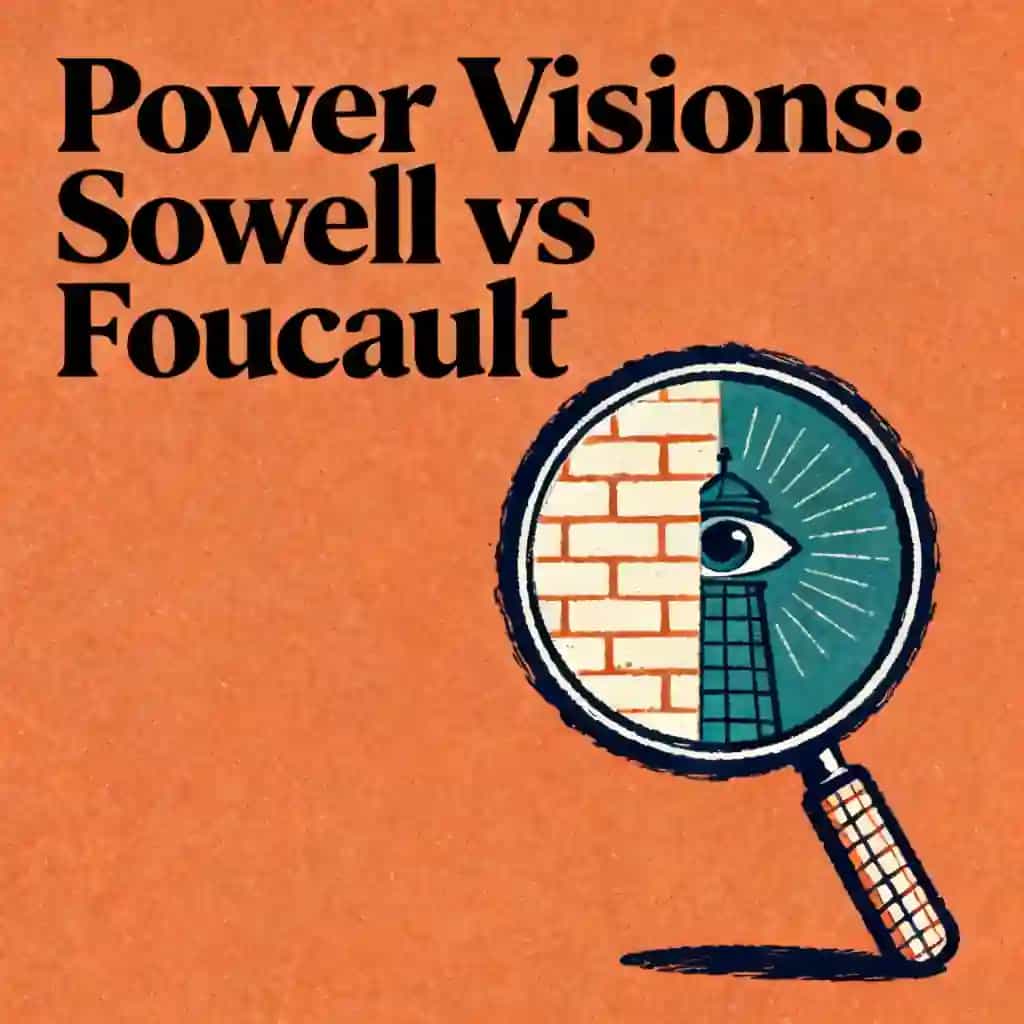
In "Intellectuals and Society," Thomas Sowell brilliantly exposes how elite thinkers shape policies despite disastrous consequences. Praised by Steve Forbes as "Nobel Prize worthy," this controversial work challenges intellectual hubris. Why are society's smartest minds often its most dangerous influencers?
- Thomas Sowell critiques intellectuals' utopian visions versus real-world policy failures
- "Vision of the anointed" clashes with Sowell's "tragic vision" of human limitations
- Intellectuals face no accountability for harmful social engineering experiment outcomes
- Sowell exposes how peer validation replaces empirical proof in intellectual circles
- Income quintile mobility data disproves static "poor versus rich" narratives
- Specialists' tangible results contrast with intellectuals' untested societal blueprints
- Media and academia amplify unconstrained visions over market-tested solutions
- Social justice rhetoric often masks political power grabs over equity
- Twentieth-century disasters reveal intellectuals' dangerous detachment from consequences
- Cultural narratives about systemic racism ignore personal responsibility factors
- Sowell's "fatal misstep" concept explains intellectual overreach beyond expertise
- Book challenges assumption that idea producers deserve societal decision-making roles
Об авторе книги Intellectuals and society
Thomas Sowell, author of Intellectuals and Society, is a distinguished economist, social theorist, and senior fellow at Stanford University’s Hoover Institution. A National Humanities Medal recipient, his work critically examines the role of elites in shaping public policy, blending political theory, economics, and cultural analysis.
Born in 1930 in North Carolina and raised in Harlem, Sowell’s journey from high school dropout to Harvard- and Chicago-trained scholar informs his incisive critiques of ideological agendas. His expertise spans decades of academic roles at Cornell, UCLA, and other institutions, alongside prolific authorship that includes 49 books, including the bestselling Basic Economics and A Conflict of Visions, his self-described magnum opus.
Known for challenging conventional wisdom, Sowell’s analyses often draw from his early Marxist leanings and subsequent shift to classical liberalism. His works, such as Black Rednecks and White Liberals and Charter Schools and Their Enemies, combine rigorous research with accessible prose, earning global recognition and translations into multiple languages.
Intellectuals and Society extends his exploration of how ideas influence societal outcomes, cementing his reputation as a fearless commentator. The book, like much of his catalog, remains essential reading for understanding policy debates and has solidified his legacy as one of conservatism’s most influential thinkers.
Часто задаваемые вопросы о Intellectuals and society
What is Intellectuals and Society by Thomas Sowell about?
Intellectuals and Society examines how intellectuals shape public policy and culture, despite often advocating utopian ideals detached from practical realities. Thomas Sowell argues that their influence can lead to harmful policies, citing historical examples like 20th-century social engineering programs. The book critiques intellectuals’ lack of accountability and contrasts their vision with real-world outcomes.
Who should read Intellectuals and Society?
This book is essential for readers interested in political theory, public policy, and the societal role of academia. Policymakers, historians, and anyone skeptical of elite-driven narratives will gain insights into how intellectual ideas impact governance and culture. Sowell’s analysis appeals to those seeking a critical perspective on the disconnect between ideological advocacy and measurable results.
Is Intellectuals and Society worth reading?
Yes, for its rigorous critique of intellectual accountability and its exploration of how ideas translate into policy. Sowell’s evidence-based approach, backed by historical examples like failed social programs, offers a counter-narrative to mainstream intellectual discourse. The book remains relevant for understanding modern debates on governance and cultural influence.
What are the main ideas in Intellectuals and Society?
Key ideas include:
- Intellectuals often prioritize ideals over practical constraints, leading to flawed policies.
- Their cultural influence persists despite minimal consequences for ineffective ideas.
- Historical case studies (e.g., economic centralization) demonstrate the real-world costs of utopian thinking.
How does Thomas Sowell define "intellectuals" in the book?
Sowell defines intellectuals as idea-driven professionals (academics, writers, pundits) whose work impacts public opinion but lacks direct accountability for outcomes. He distinguishes them from practitioners like engineers or doctors, whose ideas face immediate real-world tests.
What critiques does Intellectuals and Society offer about academia?
The book argues that academia often promotes groupthink, rewarding conformity to progressive ideals over empirical rigor. Sowell highlights how intellectual echo chambers insulate theories from criticism, enabling policies that ignore historical precedents or economic realities.
How does Sowell analyze the impact of intellectuals on policy?
Sowell demonstrates how intellectuals’ advocacy for centralized planning and social engineering often leads to unintended consequences, such as economic stagnation or reduced individual freedoms. He contrasts their theoretical frameworks with data-driven outcomes, showing systemic flaws in top-down policy approaches.
What historical examples does Sowell use to support his arguments?
The book cites 20th-century socialist experiments, failed welfare programs, and regulatory overreach as consequences of intellectual-driven policies. Sowell also references the persistence of discredited theories (e.g., price controls) to illustrate the gap between academic ideals and practical efficacy.
How does Intellectuals and Society compare to Sowell’s other works?
Unlike Sowell’s economics-focused books (e.g., Basic Economics), this work targets the cultural influence of intellectuals. It aligns with The Vision of the Anointed in critiquing elitism but expands the analysis to historical trends and systemic accountability gaps.
Why is Intellectuals and Society relevant today?
The book’s themes resonate in debates over tech governance, climate policy, and education reform, where expert-led initiatives often face public skepticism. Sowell’s warning about unaccountable intellectual authority provides a framework for evaluating modern policy challenges.
What criticisms exist about Intellectuals and Society?
Critics argue Sowell overlooks intellectuals’ positive contributions (e.g., civil rights advocacy) and oversimplifies their role as uniformly detrimental. Some contend his focus on ideological elites ignores systemic factors influencing policy outcomes.
How does Sowell address solutions in Intellectuals and Society?
The book advocates for humility in policymaking, emphasizing empirical testing over ideological certainty. Sowell urges greater public scrutiny of intellectual narratives and supports decentralized decision-making to mitigate the risks of centralized control.
Почувствуйте книгу через голос автора
Превратите знания в увлекательные, богатые примерами идеи
Захватите ключевые идеи мгновенно для быстрого обучения
Наслаждайтесь книгой в весёлой и увлекательной форме
Персонажи в Intellectuals and society
- Thomas SowellAuthor and economist who analyzes intellectuals
- Paul EhrlichAcademic known for failed starvation predictions
- Eric HofferSocial writer who commented on intellectuals
- Robert BartleyEditor who noted the intelligence of markets
Ключевые темы в Intellectuals and society
- intellectual accountability
- dispersed knowledge
- unintended consequences
- expert fallibility
- practical vs academic knowledge
Цитаты из Intellectuals and society
The first lesson of economics is scarcity: There is never enough of anything to fully satisfy all those who want it. The first lesson of politics is to disregard the first lesson of economics.
What I don't know isn't knowledge.
The market is smarter than the smartest of its individual participants.
Intellect is not wisdom.
Исследуйте Свой Способ Обучения
 Режим Краткое резюме
Прочитайте или прослушайте краткое содержание Intellectuals and society за 9 минут
Разбейте ключевые идеи Intellectuals and society на понятные тезисы, чтобы понять, как инновационные команды создают, сотрудничают и растут.

 Режим Развлекательно
Уроки из Intellectuals and society в 20-минутных историях
Погрузитесь в Intellectuals and society через яркие истории, превращающие уроки инноваций в запоминающиеся и применимые моменты.
 Режим Персонализация
Изучайте Intellectuals and society в своем собственном стиле обучения
Задавайте любые вопросы, выбирайте свой стиль обучения и создавайте идеи, которые действительно вам подходят.
Создано выпускниками Колумбийского университета в Сан-Франциско
"Instead of endless scrolling, I just hit play on BeFreed. It saves me so much time."


"I never knew where to start with nonfiction—BeFreed’s book lists turned into podcasts gave me a clear path."


"Perfect balance between learning and entertainment. Finished ‘Thinking, Fast and Slow’ on my commute this week."
"Crazy how much I learned while walking the dog. BeFreed = small habits → big gains."
"Reading used to feel like a chore. Now it’s just part of my lifestyle."

"Feels effortless compared to reading. I’ve finished 6 books this month already."
"BeFreed turned my guilty doomscrolling into something that feels productive and inspiring."

"BeFreed turned my commute into learning time. 20-min podcasts are perfect for finishing books I never had time for."
"BeFreed replaced my podcast queue. Imagine Spotify for books — that’s it. 🙌"

"It is great for me to learn something from the book without reading it."
"The themed book list podcasts help me connect ideas across authors—like a guided audio journey."
"Makes me feel smarter every time before going to work"
Создано выпускниками Колумбийского университета в Сан-Франциско
"Instead of endless scrolling, I just hit play on BeFreed. It saves me so much time."
"I never knew where to start with nonfiction—BeFreed’s book lists turned into podcasts gave me a clear path."
"Perfect balance between learning and entertainment. Finished ‘Thinking, Fast and Slow’ on my commute this week."
"Crazy how much I learned while walking the dog. BeFreed = small habits → big gains."
"Reading used to feel like a chore. Now it’s just part of my lifestyle."
"Feels effortless compared to reading. I’ve finished 6 books this month already."
"BeFreed turned my guilty doomscrolling into something that feels productive and inspiring."
"BeFreed turned my commute into learning time. 20-min podcasts are perfect for finishing books I never had time for."
"BeFreed replaced my podcast queue. Imagine Spotify for books — that’s it. 🙌"
"It is great for me to learn something from the book without reading it."
"The themed book list podcasts help me connect ideas across authors—like a guided audio journey."
"Makes me feel smarter every time before going to work"
"Instead of endless scrolling, I just hit play on BeFreed. It saves me so much time."
"I never knew where to start with nonfiction—BeFreed’s book lists turned into podcasts gave me a clear path."
"Perfect balance between learning and entertainment. Finished ‘Thinking, Fast and Slow’ on my commute this week."
"Crazy how much I learned while walking the dog. BeFreed = small habits → big gains."
"Reading used to feel like a chore. Now it’s just part of my lifestyle."
"Feels effortless compared to reading. I’ve finished 6 books this month already."
"BeFreed turned my guilty doomscrolling into something that feels productive and inspiring."
"BeFreed turned my commute into learning time. 20-min podcasts are perfect for finishing books I never had time for."
"BeFreed replaced my podcast queue. Imagine Spotify for books — that’s it. 🙌"
"It is great for me to learn something from the book without reading it."
"The themed book list podcasts help me connect ideas across authors—like a guided audio journey."
"Makes me feel smarter every time before going to work"
"Instead of endless scrolling, I just hit play on BeFreed. It saves me so much time."
"I never knew where to start with nonfiction—BeFreed’s book lists turned into podcasts gave me a clear path."
"Perfect balance between learning and entertainment. Finished ‘Thinking, Fast and Slow’ on my commute this week."
"Crazy how much I learned while walking the dog. BeFreed = small habits → big gains."
"Reading used to feel like a chore. Now it’s just part of my lifestyle."
"Feels effortless compared to reading. I’ve finished 6 books this month already."
"BeFreed turned my guilty doomscrolling into something that feels productive and inspiring."
"BeFreed turned my commute into learning time. 20-min podcasts are perfect for finishing books I never had time for."
"BeFreed replaced my podcast queue. Imagine Spotify for books — that’s it. 🙌"
"It is great for me to learn something from the book without reading it."
"The themed book list podcasts help me connect ideas across authors—like a guided audio journey."
"Makes me feel smarter every time before going to work"

Скачать резюме книги «Intellectuals and society»
Получите резюме книги «Intellectuals and society» в формате PDF или EPUB бесплатно. Распечатайте или читайте офлайн в любое время.