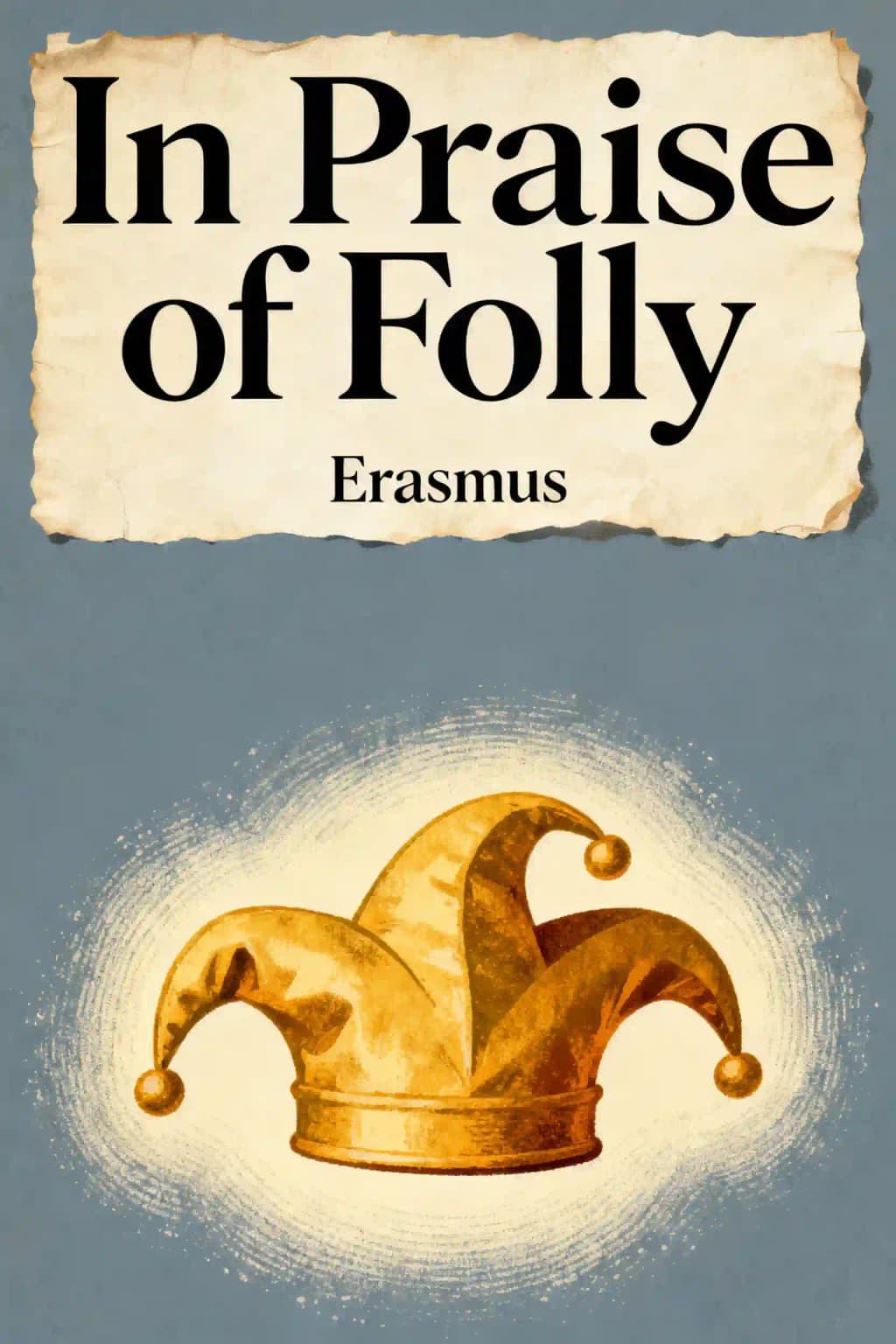
Erasmus's satirical masterpiece, where Folly herself mocks human folly and religious corruption. With 24,000 copies in its first run, this Renaissance bombshell helped spark the Protestant Reformation. What sacred cow would this witty intellectual skewer in today's world?
Desiderius Erasmus Roterodamus (1466–1536) was a Dutch Renaissance humanist and scholar, best known as the author of In Praise of Folly. This groundbreaking satirical work critiques societal hypocrisy, religious dogma, and intellectual pretension.
Born in Rotterdam, Erasmus rose from humble beginnings as an illegitimate child to become Europe’s foremost classical scholar. He leveraged his training as a priest and mastery of Greek and Latin to reform education and theology.
In In Praise of Folly, Erasmus's witty, incisive prose is narrated by the allegorical figure of Folly. The work challenged the corruption of the Church and the folly of human ambition, cementing his reputation as a foundational voice of the Northern Renaissance. Erasmus’s translation of the New Testament into Greek revolutionized biblical scholarship, while his Adagia popularized ancient proverbs.
A moderate critic during the Reformation, he influenced thinkers like Thomas More and Martin Luther. In Praise of Folly remains a literary cornerstone, translated into over 30 languages and studied for its timeless exploration of human delusion and wisdom.
In Praise of Folly is a 1511 satirical essay by Desiderius Erasmus, where the personified goddess Folly humorously argues that human happiness stems from foolishness, not wisdom. Through biting irony, the work critiques societal norms, religious corruption, and scholarly pretensions, suggesting that folly drives human relationships, art, and even faith.
This book appeals to readers interested in Renaissance humanism, religious satire, or classical rhetoric. Scholars of early modern literature, theology, or social critique will find its layered irony and historical context valuable, while general readers enjoy its timeless humor and sharp observations on human nature.
Yes—Erasmus’s masterpiece remains a cornerstone of Western literature for its wit, intellectual depth, and influence on the Protestant Reformation. Though dense with classical allusions, its themes of hypocrisy and human folly resonate in modern discussions of power, culture, and religion.
Key themes include:
Folly personifies humanity’s irrational tendencies, arguing that self-deception and ignorance underpin relationships, ambition, and faith. Her speech blends humor and darkness, revealing Erasmus’s critique of societal and religious excess.
Erasmus satirizes clerical greed, empty rituals, and the sale of indulgences, portraying Church leaders as more focused on wealth than spirituality. Folly sarcastically praises theologians for convoluted debates and monks for performative piety.
Notable lines include:
Erasmus blends classical references (e.g., Greek myths) with Christian theology, emphasizing critical thinking and moral reform. His satire aligns with humanist values by challenging dogma and advocating for intellectual humility.
The book fueled the Protestant Reformation by exposing Church corruption, though Erasmus distanced himself from Luther’s radicalism. It also popularized Renaissance satire, influencing writers like Voltaire and Swift.
Folly’s exaggerated self-praise and paradoxical arguments—like claiming wisdom causes misery—create layered irony. Readers must discern Erasmus’s true critique beneath her seemingly naïve tone.
Some contemporaries accused Erasmus of undermining religious authority, while modern critics note the essay’s ambiguity—its satire sometimes blurs genuine praise for folly. Others argue it oversimplifies human motivation.
Its themes of anti-intellectualism, institutional hypocrisy, and the duality of human nature mirror modern debates on politics, social media, and cultural conformity. The work reminds readers to question dogma and embrace humility.
Почувствуйте книгу через голос автора
Превратите знания в увлекательные, богатые примерами идеи
Захватите ключевые идеи мгновенно для быстрого обучения
Наслаждайтесь книгой в весёлой и увлекательной форме
Perhaps folly, not wisdom, deserves our praise.
Laughter could open minds where stern argument failed.
Folly becomes an unreliable narrator.
To treat trifles seriously can be more beneficial.
Wisdom comes disguised as foolishness.
Разбейте ключевые идеи In Praise of Folly на понятные тезисы, чтобы понять, как инновационные команды создают, сотрудничают и растут.
Выделите из In Praise of Folly быстрые подсказки для запоминания, подчёркивающие ключевые принципы открытости, командной работы и творческой устойчивости.

Погрузитесь в In Praise of Folly через яркие истории, превращающие уроки инноваций в запоминающиеся и применимые моменты.
Задавайте любые вопросы, выбирайте голос и совместно создавайте идеи, которые действительно находят у вас отклик.

Создано выпускниками Колумбийского университета в Сан-Франциско
"Instead of endless scrolling, I just hit play on BeFreed. It saves me so much time."
"I never knew where to start with nonfiction—BeFreed’s book lists turned into podcasts gave me a clear path."
"Perfect balance between learning and entertainment. Finished ‘Thinking, Fast and Slow’ on my commute this week."
"Crazy how much I learned while walking the dog. BeFreed = small habits → big gains."
"Reading used to feel like a chore. Now it’s just part of my lifestyle."
"Feels effortless compared to reading. I’ve finished 6 books this month already."
"BeFreed turned my guilty doomscrolling into something that feels productive and inspiring."
"BeFreed turned my commute into learning time. 20-min podcasts are perfect for finishing books I never had time for."
"BeFreed replaced my podcast queue. Imagine Spotify for books — that’s it. 🙌"
"It is great for me to learn something from the book without reading it."
"The themed book list podcasts help me connect ideas across authors—like a guided audio journey."
"Makes me feel smarter every time before going to work"
Создано выпускниками Колумбийского университета в Сан-Франциско

Получите резюме книги «In Praise of Folly» в формате PDF или EPUB бесплатно. Распечатайте или читайте офлайн в любое время.
Picture a jester stepping onto a stage in 1511, bells jingling, ready to deliver the most dangerous speech of the Renaissance. But this fool isn't just any entertainer-she's Folly herself, come to praise her own virtues before a European audience hungry for change. Within weeks, "In Praise of Folly" sold thousands of copies, an unprecedented success that would help ignite the Protestant Reformation. Written in just seven days while Erasmus recovered from illness at Thomas More's home, this slim volume became so controversial the Catholic Church banned it, yet so beloved that Benjamin Franklin quoted it regularly centuries later. What made a satirical monologue by the personification of foolishness so explosively influential? Because sometimes truth arrives not through solemn philosophy but through laughter-and sometimes the wisest voice in the room belongs to the one wearing the cap and bells.