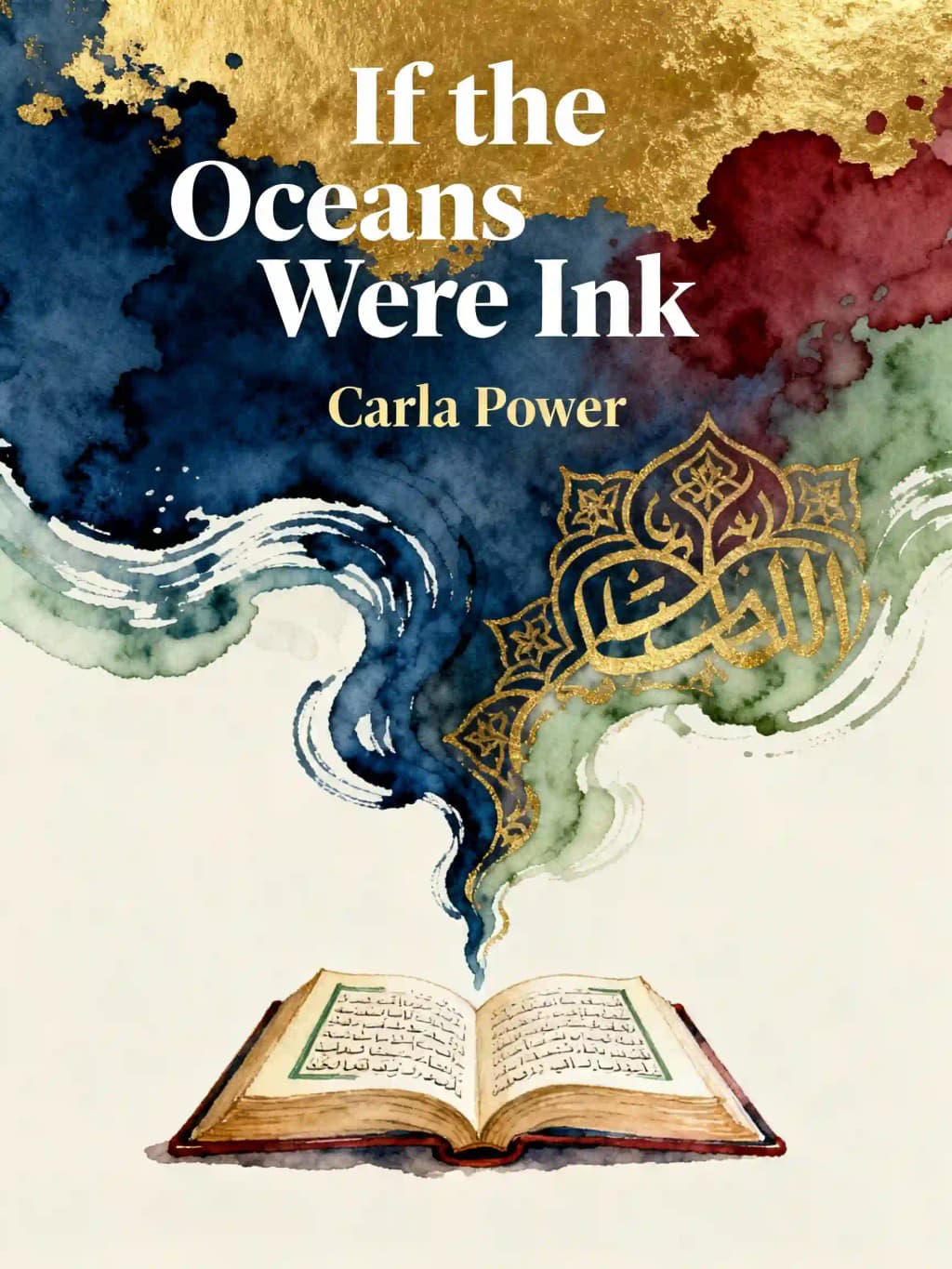
A Pulitzer finalist exploring Islam through friendship, "If the Oceans Were Ink" follows journalist Carla Power's year studying the Quran with Sheikh Akram Nadwi. Praised by Fareed Zakaria as "the conversation that needs to be taking place around the world."
Carla Power, Pulitzer Prize-finalist author of If the Oceans Were Ink: An Unlikely Friendship and a Journey to the Heart of the Quran, is celebrated for her nuanced exploration of cross-cultural and interfaith dialogue. A narrative nonfiction work, the book intertwines her decade-long friendship with a conservative Islamic scholar, offering a deeply personal lens into Quranic teachings and Muslim identity.
Power’s global upbringing across Iran, India, Afghanistan, and Egypt informs her empathetic approach to bridging cultural divides, further enriched by her academic background in Middle Eastern studies from Oxford and Columbia.
A seasoned journalist, Power’s career began at Newsweek, with bylines in Time, The New York Times, and The Guardian. Her follow-up book, Home, Land, Security: Deradicalization and the Journey Back from Extremism, was also a Pulitzer finalist, cementing her authority on global security and ideological reconciliation. Translated into multiple languages, If the Oceans Were Ink has been hailed as a seminal work in understanding contemporary Islam, lauded for its “lyrical precision” (The Washington Post) and adopted in university curricula worldwide.
If the Oceans Were Ink by Carla Power is a memoir exploring Islam through dialogues with Oxford scholar Sheikh Mohammad Akram Nadwi. Structured around Quranic lessons, it addresses misconceptions about jihad, women’s rights, and Sharia, blending personal narrative with theological insights. The book humanizes Islamic teachings by framing them within a cross-cultural friendship and post-9/11 societal tensions.
This book is ideal for readers seeking to understand Islam beyond stereotypes, including interfaith dialogue enthusiasts and those interested in Quranic interpretation. It appeals to fans of memoirs blending personal growth with cultural exploration, offering nuanced perspectives on contentious topics like the niqab and political Islam.
Key themes include reconciling faith with modernity, the role of women in Islamic history, and jihad as spiritual self-improvement. Power and Akram challenge stereotypes by emphasizing education’s role in empowerment and contrasting cultural practices with Quranic principles. Their friendship symbolizes bridging divides through mutual respect.
The book redefines jihad as a personal struggle for moral growth, not violence. Akram explains its Quranic roots in justice and self-discipline, citing historical examples. Power contrasts this with post-9/11 media narratives, highlighting how extremist groups distort the term.
It uncovers forgotten legacies of female Islamic scholars, showcasing their historical influence on theology and law. Akram’s 57-volume work on women hadith experts underscores their intellectual contributions. The book critiques patriarchal cultural practices misattributed to Islam, advocating for Quran-based gender equity.
Power contrasts literalist and contextual approaches, analyzing verses on polygamy and inheritance. Akram emphasizes ijtihad (independent reasoning), arguing Islamic law adapts to time and place. Their discussions reveal the Quran’s layered meanings, from allegorical stories to ethical directives.
Power’s 30-year friendship with Akram models interfaith dialogue, demonstrating how trust dismantles prejudice. Their debates—whether on hijab or Sufism—show respectful disagreement fostering deeper understanding. This dynamic humanizes theological debates, making abstract concepts relatable.
While Power admires Akram’s scholarship, she critiques issues like gender segregation and apostasy laws. The book balances reverence for Quranic wisdom with journalistic scrutiny of rigid interpretations, offering a secular Jewish perspective on Islamic traditions.
Metaphors like “oceans as ink” (from Quran 18:109) symbolize divine knowledge’s vastness. The “cycle of life” analogy illustrates surrendering control to faith. Power interweaves memoir, reportage, and Quranic exegesis, creating a hybrid narrative accessible to non-academic readers.
Some readers note Power’s limited challenges to Akram’s views, wishing for deeper theological rigor. Others praise its accessibility but desire more Muslim voices beyond Akram. Despite this, it’s widely lauded for bridging divides in an era of rising Islamophobia.
It contextualizes debates on immigration, terrorism, and religious freedom, showing how Quranic values intersect with contemporary life. Akram’s progressive stances on education and gender equality offer a counter-narrative to extremist ideologies.
For deeper dives, consider Akram’s Al-Muhaddithat on female scholars or Reza Aslan’s No God but God for Islamic reform history. Memoirs like Lesley Hazleton’s The First Muslim complement its personal approach to theology.
Почувствуйте книгу через голос автора
Превратите знания в увлекательные, богатые примерами идеи
Захватите ключевые идеи мгновенно для быстрого обучения
Наслаждайтесь книгой в весёлой и увлекательной форме
I'm not this, I'm not that. I'm just Muslim.
It is You we serve.
Islam is not an idea. It is a history.
I think we know what they're thinking.
Разбейте ключевые идеи If the oceans were ink на понятные тезисы, чтобы понять, как инновационные команды создают, сотрудничают и растут.
Выделите из If the oceans were ink быстрые подсказки для запоминания, подчёркивающие ключевые принципы открытости, командной работы и творческой устойчивости.

Погрузитесь в If the oceans were ink через яркие истории, превращающие уроки инноваций в запоминающиеся и применимые моменты.
Задавайте любые вопросы, выбирайте голос и совместно создавайте идеи, которые действительно находят у вас отклик.

Создано выпускниками Колумбийского университета в Сан-Франциско
"Instead of endless scrolling, I just hit play on BeFreed. It saves me so much time."
"I never knew where to start with nonfiction—BeFreed’s book lists turned into podcasts gave me a clear path."
"Perfect balance between learning and entertainment. Finished ‘Thinking, Fast and Slow’ on my commute this week."
"Crazy how much I learned while walking the dog. BeFreed = small habits → big gains."
"Reading used to feel like a chore. Now it’s just part of my lifestyle."
"Feels effortless compared to reading. I’ve finished 6 books this month already."
"BeFreed turned my guilty doomscrolling into something that feels productive and inspiring."
"BeFreed turned my commute into learning time. 20-min podcasts are perfect for finishing books I never had time for."
"BeFreed replaced my podcast queue. Imagine Spotify for books — that’s it. 🙌"
"It is great for me to learn something from the book without reading it."
"The themed book list podcasts help me connect ideas across authors—like a guided audio journey."
"Makes me feel smarter every time before going to work"
Создано выпускниками Колумбийского университета в Сан-Франциско

Получите резюме книги «If the oceans were ink» в формате PDF или EPUB бесплатно. Распечатайте или читайте офлайн в любое время.
What happens when a secular American journalist sits down with a conservative Islamic scholar to study the Quran? In a world quick to draw battle lines between East and West, Muslim and non-Muslim, religious and secular, Carla Power's friendship with Sheikh Mohammad Akram Nadwi shouldn't make sense. Yet their year-long journey through Islam's holiest text reveals something far more interesting than conflict: the messy, beautiful complexity of faith in practice. Power, raised Jewish-Quaker and shaped by feminist ideals, found herself spending weekly sessions in Oxford cafes with a man who seemed her opposite in every way. But the Sheikh defied easy labels. When asked if he was Salafi, liberal, or conservative, he simply replied, "I'm not this, I'm not that. I'm just Muslim." This refusal to fit neatly into boxes would become the theme of their entire relationship-and perhaps the most important lesson about understanding Islam in our polarized age. Sheikh Akram's independence had a way of unsettling people on all sides. He'd stand before conservative congregations and declare that prayer caps were merely South Asian custom, not Islamic requirement. He'd tell traditional audiences that women could cut their hair short based on examples from the Prophet's wives. These weren't provocations for their own sake-they emerged from his meticulous research into Islamic history, which revealed a faith far more flexible than modern practice suggested.