Глава 1
When Disagreement Becomes a Bridge, Not a Barrier
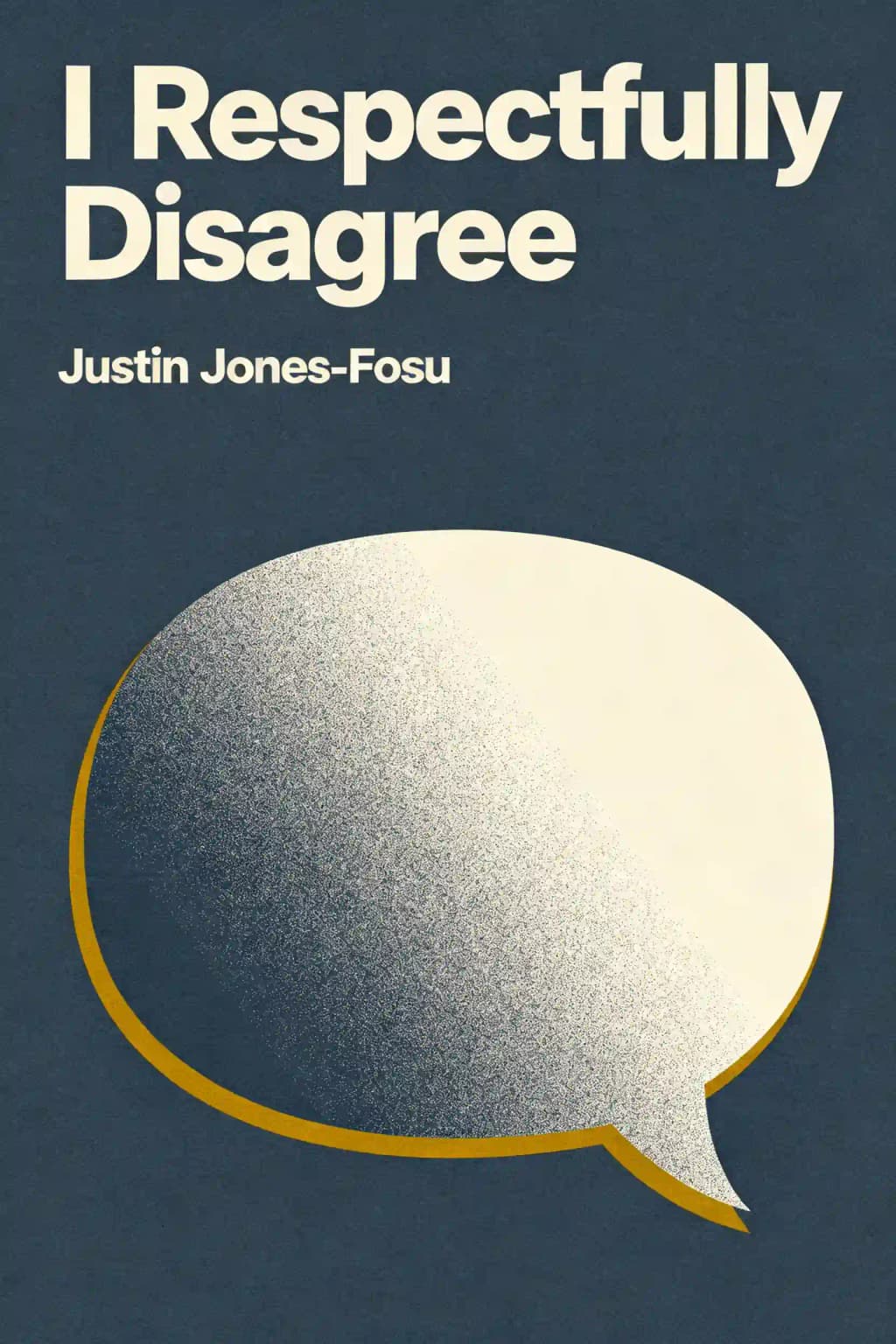
In a world increasingly defined by division, Justin Jones-Fosu offers a revolutionary perspective: what if our disagreements could bring us closer instead of driving us apart? "I Respectfully Disagree" arrives at a critical moment when political polarization has reached unprecedented levels, with studies showing that Americans now view political opponents as not just wrong, but immoral and unintelligent. The book has garnered praise from conflict resolution experts and business leaders alike, with Brene Brown calling it "essential reading for anyone who values authentic connection." Jones-Fosu, whose TEDx talk on respectful disagreement has garnered over 2 million views, draws from his unique background as both an academic researcher and a practical workplace consultant who has delivered his message to organizations across five continents. What makes this book particularly compelling is how it transforms the seemingly impossible task of bridging divides into an achievable daily practice-offering hope that we might yet create spaces where differing perspectives strengthen rather than shatter our connections.
Глава 2
The Disagreement Divide: Understanding Our Current Crisis
We're living in an era where disagreement has become dangerous territory. The evidence surrounds us-from family gatherings that erupt into political battles to workplace tensions that simmer beneath a veneer of professionalism. Social media amplifies these divisions, with studies showing that 67% of Americans report feeling anxious about discussing their views in public settings. Jones-Fosu illustrates this reality through three illuminating stories that showcase how disagreements typically derail.
In the first story, friends Jen and Alisha's relationship fractures over a simple movie recommendation. When Jen criticizes a film Alisha loved, what should have been a trivial difference in taste spirals into defensiveness, false claims, and eventually a permanent strain in their friendship. The situation escalates when Jen questions Alisha's judgment, leading to a broader argument about their different values and worldviews. This pattern, Jones-Fosu notes, is increasingly common in friendships where minor disagreements become proxy battles for deeper ideological differences.
The second story reveals how Mike's avoidance of direct disagreement with his colleague Henrietta-sharing concerns with others instead of addressing her directly-creates a "disrespectful agreement" that damages their professional partnership. This passive-aggressive approach, which research shows occurs in 78% of workplace conflicts, leads to decreased productivity, increased stress, and a toxic team environment. The ripple effects impact not just Mike and Henrietta but their entire department's morale and effectiveness.
The third story depicts the Baker family's Christmas celebration deteriorating when siblings Sarah and Michael escalate a political discussion into personal attacks, only recognizing their harmful behavior when Michael's eight-year-old son breaks down in tears. This scenario highlights how political polarization has invaded intimate family spaces, with recent surveys indicating that 40% of Americans have experienced similar holiday conflicts.
These narratives reveal a fundamental truth: our problem isn't disagreement itself but how we handle it. We either retreat into silence to maintain false harmony or become trapped in endless conflict that tears relationships apart. Jones-Fosu introduces his Four Responses of Conversation Conflict model, which maps the intersection of agreement/disagreement and respect/disrespect. The model identifies four distinct zones: Respectful Agreement (ideal but rare), Disrespectful Agreement (passive-aggressive behavior), Respectful Disagreement (constructive dialogue), and Disrespectful Disagreement (hostile conflict).
Most of us oscillate between disrespectfully disagreeing (where we attack others' views) and disrespectfully agreeing (where we pretend to agree while harboring resentment). The author's mission is to guide us toward respectfully disagreeing-a challenging but valuable space where we can increase belief accuracy through exposure to new perspectives. This approach requires developing specific skills: active listening, emotional regulation, and the ability to separate ideas from identity.
The divide isn't just interpersonal but societal. With 25% of the world's population living in conflict zones and over 80 million people displaced by violence, the stakes of our collective inability to disagree respectfully couldn't be higher. Economic studies estimate that workplace conflict costs U.S. companies $359 billion annually in lost productivity. While respect alone can't solve global problems, Jones-Fosu argues that transforming our everyday interactions is where meaningful change begins. He emphasizes that learning to disagree respectfully isn't just about personal relationships-it's essential for maintaining democratic societies and fostering innovation in an increasingly complex world.
Глава 3
Redefining Respect: Beyond Aretha's Demand
Despite his admiration for Aretha Franklin, Jones-Fosu "respectfully disagrees" with one aspect of her iconic song: today's society doesn't need just "a little respect"-it demands a lot. But what kind of respect? The author introduces the concept of "Golden Respect," which differs dramatically from conventional interpretations.
Where society says respect must be earned, Golden Respect believes everyone deserves dignity. Instead of giving respect only when reciprocated, Golden Respect courageously offers it regardless of the other person's behavior. Rather than passive agreement, Golden Respect means honest communication filtered through a heart that aims to help, not harm. It values humanity even when disagreeing with beliefs and sees healthy conflict as an opportunity for growth.
Power dynamics significantly impact how disagreements unfold. The more powerful party often controls the narrative, potentially dismissing concerns of the less powerful and steering outcomes to their advantage. This imbalance hinders fair resolution, stifles open dialogue, and damages the emotional wellbeing of the less powerful. Recognition of these dynamics is crucial; those with power must approach disagreements with responsibility rather than seeking victory.
Cultural backgrounds also profoundly shape our understanding of respect. Growing up, Jones-Fosu saw playful trash talk as camaraderie, but this approach caused misunderstandings with people from different backgrounds. Japanese culture, for instance, shows respect through the depth of a bow, addressing elders properly, and valuing silence-quite different from his loud, opinion-sharing household.
Many businesses today suffer from "surface-level respect" where people politely agree in meetings while harboring resentment. This raises the question: are we merely humoring people or truly humanizing them? True respect isn't about maintaining the status quo at the cost of addressing injustices. Sometimes "respect" is weaponized to stifle progress, as seen during the civil rights era when challenging harmful norms was condemned as "impolite."
Even in the face of disrespect, we can choose to respond with dignity. Viktor Frankl, Holocaust survivor and author of "Man's Search for Meaning," discovered that even when stripped of all freedoms, we retain the freedom to choose our attitude. Similarly, during a 2020 Black Lives Matter protest, Patrick Hutchinson, a Black man, rescued an injured white counterprotester despite their political differences. These examples demonstrate that respect isn't earned; it's given as a testament to our own humanity.
Глава 4
The Shadow of Our Past: How History Shapes Disagreement
Our approach to disagreement doesn't emerge in a vacuum-it's profoundly shaped by our personal histories. Jones-Fosu vulnerably shares his own story of growing up in Detroit and later Grand Rapids after his parents' divorce, experiencing financial instability and homelessness. The most influential moments were painful ones-particularly the physical and emotional abuse he suffered from his older brother.
After years of hiding this trauma, he finally told his mother the truth and forgave his brother-a choice that freed him from toxic emotions. Through therapy and self-reflection, he realized his instinctual "fight" mode in disagreements stemmed from a determination never to let anyone have power over him again. This personal revelation underscores a crucial insight: understanding our own stories is essential for genuine respectful disagreement rather than merely performing the act.
The author introduces the concept of Life Disagreement Markers (LDMs)-significant moments that have shaped how we handle conflicts. He encourages readers to reflect deeply on different life stages to identify pivotal experiences that influence their disagreement patterns. Our family environment serves as our first classroom for handling disagreements. The patterns we observe in childhood-whether conflict was loud and aggressive or passive and suppressed-echo into our adult lives.
We also must confront naive realism-the psychological tendency to believe we see the world objectively while others who disagree must be uninformed or biased. Using the example of family members arguing at dinner, Jones-Fosu illustrates how people like "Aunt Martha" and "Cousin Bob" each believe their perspective represents reality, forgetting how their different upbringings shaped their views.
Many workplaces and social environments prioritize superficial agreement over honest dialogue, with people choosing silence over expressing genuine concerns. These echo chambers stifle progress and well-being. Research shows organizations thrive when diverse opinions can be shared freely with underlying respect. Creating environments where people feel safe to disagree respectfully requires awareness and care, as people struggle to disagree respectfully when they don't feel safe.
Глава 5
The 5 Pillars of Bridging the Divide
Jones-Fosu presents a comprehensive framework for transforming how we approach disagreement: the 5 Pillars of Bridging the Divide. These pillars form the backbone of respectful disagreement practice.
Pillar 1: Challenge Your Perspective
How we see others fundamentally shapes our interactions with them. Just as teachers' expectations influenced student performance in the famous 1968 Pygmalion Effect study, our perception of those we disagree with determines how we interact with them.
The author introduces the 3Self Model to help us understand how self-perception influences our responses:
• The Inferior Self stems from feelings of inadequacy that lead to self-sabotage or accepting mistreatment. When operating from this mindset, we either become passive-aggressive to gain acceptance or disagree disrespectfully to prove our worth.
• The Superior Self represents an inflated sense of self-worth that dehumanizes others. Jones-Fosu illustrates this with a personal story about dismissing his daughter's knowledge about age restrictions at an entertainment park, only to discover she was right.
• The Equal Self represents an ideal balanced state that recognizes the inherent worth of oneself and others. A person operating from their Equal Self is both compassionate and full of conviction, able to hold their truth while making space for others' perspectives.
Cognitive reframing helps us reconsider snap judgments about others. Instead of labeling someone "unfriendly," we might consider they're introverted or having a rough day. This practice helps us question the stories we tell ourselves about others, especially those outside our immediate social circles.
Pillar 2: Be the Student
A learner's mindset means treating every new experience as an opportunity to learn. Jones-Fosu shares his mother's wisdom: "Always be a learner!" - emphasizing that we can learn from anyone regardless of their status.
During a 2003 trip to Kenya, his mentor Carlos advised him to be "a fly on the wall"-observing and absorbing rather than imposing his limited wisdom. This revelation taught him that being consumed with teaching, he had forgotten to learn. Paradoxically, embracing the student role made him a more insightful and empathetic teacher.
The inverted U concept suggests optimal learning occurs at a balance point between knowing nothing and knowing everything. At the "knowing nothing" extreme, people feel overwhelmed or inadequate. At the "knowing everything" end, overconfidence prevents seeking new information. The optimal learning zone lies in the middle-where individuals are confident enough to engage but humble enough to recognize limitations.
True listening requires being both student and teacher simultaneously. The Power of 3 approach breaks listening into levels: Level 1 is merely hearing words before responding; Level 2 involves asking a question and hearing two responses; Level 3 means allowing speakers to express themselves at least three times before sharing your thoughts.
Pillar 3: Cultivate Your Curiosity
The "exit" represents our tendency to disengage from people outside our comfortable spheres rather than building bridges of understanding. Like habitually taking the same highway exit, we veer away from truly knowing others before we learn about their authentic selves.
The Dotted Line Dilemma occurs when we complete incomplete information with our own assumptions rather than facts. For example, how we'd complete "Drivers who drive on the left side of the street are..." depends entirely on our cultural context. This tendency creates distorted perceptions of others.
The illusion of asymmetric insight is our conviction that we understand others better than they understand us. This psychological bias, fueled by ego and our desire to feel superior, stifles genuine understanding. Research shows people who resist this illusion build more successful relationships, becoming better listeners and more empathetic.
Jones-Fosu uses Curious George as a metaphor for the childlike wonder we should bring to human interactions. Like the mischievous monkey whose curiosity leads to learning and problem-solving, we should approach people with eager exploration rather than presumptions.
Pillar 4: Seek the Gray
The author contrasts two approaches to disagreement: competition versus collaboration. In the competitive approach, disagreements become an "unending race" where everything is black and white, with the sole goal being to win. This mindset damages relationships despite momentary satisfaction. Alternatively, the collaborative "teamwork challenge" transforms disagreements into opportunities for collective learning.
Jones-Fosu advocates for transforming disagreements from debates to discoveries. While debates involve deflecting questions to destabilize opponents rather than genuine listening, discoveries create a world where people genuinely engage with different perspectives, potentially sparking entirely new ideas through productive friction.
The author illustrates how dialogue transforms tense disagreements into opportunities for connection. Dialogue fosters understanding by allowing us to see through others' perspectives, serves as a learning tool that broadens our viewpoints, enables collaborative problem-solving, demonstrates respect for others' dignity, and surprisingly strengthens relationships through shared vulnerability.
Pillar 5: Agree to Respect
Rather than simply "agreeing to disagree," which can be done disrespectfully, Jones-Fosu advocates for acknowledging others in our disagreements. The transformative question posed is: "What if we listened to others as if they could actually teach us something?"
The author introduces the 3FA Framework for acknowledgment with three types of Full Acknowledgment (FA): FA+FA (Full Agreement), FA+PA (Partial Agreement), and FA+NA (No Agreement). Even when there's no agreement, acknowledgment remains possible through phrases like "Thank you for sharing your perspective."
The "Thank you, because" approach creates more inclusive conversations where participants feel heard and perceive common ground. This technique isn't weakness but strength-acknowledging value in another's viewpoint even during disagreement. Research shows this approach helps people feel valued and promotes collaborative dialogue.
Глава 6
From Theory to Practice: Implementing Respectful Disagreement
Knowing the principles of respectful disagreement is one thing; putting them into practice is another. Jones-Fosu provides practical guidance for implementation through several key strategies, emphasizing that mastery comes through deliberate practice and conscious application.
The medium we choose for disagreement significantly impacts outcomes. While people often prefer writing about ideological differences, particularly in today's digital age through social media and email, research shows that speaking directly enhances humanization, reduces conflict, and fosters understanding. Studies indicate that hearing someone's voice activates different neural pathways than reading text, making the interaction more emotionally resonant. Surprisingly, hearing someone's opinion rather than reading it makes them appear more intelligent and human, with vocal tone and inflection providing crucial emotional context that written words often fail to convey.
The author suggests asking permission before sharing our viewpoint-a simple courtesy that paves the way for deeper connection. This approach, while seemingly basic, creates psychological safety and demonstrates respect for boundaries. When someone declines, we should respond graciously: "If you ever feel open to hearing my perspective, let me know." He introduces the "QS Method"-asking for consent to provide feedback (Question) followed by acknowledging the other person had good intentions (Statement). This method has proven particularly effective in workplace settings, where power dynamics can complicate disagreements.
Jones-Fosu provides four specific actions to implement respectful disagreement in everyday life, each designed to build competency progressively:
1) Share key insights with someone close, explaining why they matter and what you'll do differently. This might involve discussing a disagreement you handled well or poorly with a family member, analyzing what worked or didn't.
2) Begin practicing with trusted people before expanding to others. Start with low-stakes disagreements about preferences or opinions where emotional investment is minimal.
3) Take the "Choose Your Own Circles of Grace Challenge" by intentionally learning about groups you disagree with. This might involve attending different religious services, political meetings, or cultural events outside your comfort zone.
4) Try the "No Disagreement Challenge" by focusing on asking questions rather than disagreeing. This exercise helps develop curiosity and understanding before jumping to counterarguments.
The author emphasizes starting small with consistent actions (the Tortoise Principle) to create lasting change. This approach recognizes that behavioral change happens gradually through repeated small wins rather than dramatic transformations. He illustrates this through a personal story about disrespectfully disagreeing with a friend over gender ratios on a hiking trip. After quickly realizing his error in dismissing his friend's perspective, he apologized, acknowledging his friend's right to prioritize his relationship as he saw fit. This experience taught him that even experts in respectful disagreement can fall short, and recovery through genuine apology and acknowledgment is crucial for maintaining relationships.
The implementation process also includes specific techniques for different contexts - workplace disagreements require different approaches than personal relationships, and public disagreements need different strategies than private ones. The author provides context-specific examples and scripts for various situations, helping readers adapt these principles to their unique circumstances.
Глава 7
Building Bridges in a Divided World
Jones-Fosu concludes with the powerful concept of the Human Library-a metaphorical library where individuals become "books" available to be "borrowed" by others interested in their unique stories. Created in Denmark in 2000 and now spread across 80+ countries, this initiative aims to break stereotypes by allowing people to engage with diverse life narratives. The Human Library has facilitated over 100,000 conversations worldwide, featuring "human books" ranging from refugees and religious minorities to people with rare medical conditions and unique life experiences. These face-to-face interactions have proven particularly effective in challenging prejudices and fostering empathy across social divides.
The author's vision describes a world where people are treated with value regardless of appearance, identity, or beliefs; where curiosity and wonderment drive engagement; where respectful disagreement honors others' perspectives; where everyone feels included and marginalized voices are amplified; where people stand against injustice; where grace is extended for mistakes; and where diversity and inclusion become mindsets rather than initiatives. This vision is supported by concrete examples of successful bridge-building initiatives, such as interfaith dialogue programs, cross-cultural exchange projects, and community reconciliation efforts that have transformed local communities.
Nelson Mandela's extraordinary challenge in 1990s South Africa serves as inspiration. Despite the violence and chaos following the Boipatong massacre, where 45 people were killed, Mandela chose patience and empathy, ultimately leading to the 1993 Interim Constitution and the first democratic elections in 1994. His example demonstrates that disagreements can become bridges to unity rather than chasms of division. Mandela's Truth and Reconciliation Commission became a global model for healing divided societies, showing how acknowledging past wrongs while focusing on future reconciliation can transform seemingly insurmountable conflicts.
Jones-Fosu reminds us that none of us are flawless, but the power of a sincere apology can bridge divides when we make mistakes. He provides specific examples of effective apologies, emphasizing the importance of acknowledging harm, expressing genuine remorse, and committing to changed behavior. Each moment offers a choice between respect and disrespect, and even when we falter, the 5 Pillars provide a path back to acknowledging others' humanity. The author shares case studies of organizations and individuals who have successfully rebuilt trust after significant conflicts through consistent application of these principles.
In a world where 25% of the population lives in conflict zones and political opponents are increasingly viewed as enemies rather than fellow citizens, "I Respectfully Disagree" offers a timely alternative. Recent studies show that political polarization has reached historic highs in many democracies, with over 60% of people reporting they've lost friendships over political differences. By choosing to see the humanity in those we disagree with, we can transform our conversations, our relationships, and potentially our world-one respectful disagreement at a time. The book concludes with practical exercises and discussion guides designed to help readers implement these principles in their daily lives, whether in workplace conflicts, family disagreements, or community tensions.
Глава 8
The Journey of Respectful Disagreement Begins Within
At its core, "I Respectfully Disagree" is about transformation that begins with deep self-awareness. Jones-Fosu's approach recognizes that sustainable change must begin with the heart (emotional connection to the topic) before engaging the head (knowledge) and hand (practical tools). This three-part framework emphasizes that lasting change requires emotional investment, intellectual understanding, and consistent practice.
The author positions himself not as a perfect expert but as a fellow traveler committed to more humane interactions. He shares personal stories of his own missteps and learning moments, including heated family discussions and workplace conflicts that taught him valuable lessons. His concept of "Golden Respect" acknowledges every person's inherent worth and value, recognizing that respecting others doesn't require agreement but does entail honoring their humanity even amid major disagreements. This principle applies equally to casual disagreements about entertainment preferences and profound disputes about fundamental beliefs.
Boundaries in disagreements serve as crucial guidelines that keep discussions respectful and productive. Like fences marking property lines, boundaries delineate acceptable behaviors and prevent conversations from devolving into personal attacks. These boundaries include specific communication protocols: avoiding inflammatory language, maintaining appropriate tone and volume, respecting physical space, and acknowledging when a discussion needs to pause. They preserve discourse integrity and allow engagement with differing viewpoints without fear of causing harm or experiencing emotional damage.
The book doesn't promise instant transformation but encourages small, daily improvements that accumulate over time. Jones-Fosu provides practical exercises for developing these skills, such as the "pause and reflect" technique during heated moments and the "perspective-taking challenge" that asks readers to genuinely consider opposing viewpoints. By reflecting on past challenges we've overcome, we can become catalysts for respectful disagreement in our daily interactions, creating ripple effects in our families, workplaces, and communities that we might never imagine.
In the end, respectful disagreement isn't about saying all the right things, but rather speaking from the right heart. It's about seeing the person beyond the opinion, recognizing our shared humanity despite our differences, and choosing-again and again-to build bridges rather than barriers. The author emphasizes that this practice requires constant renewal and recommitment, especially when facing deeply emotional or controversial topics. Through numerous case studies and real-world examples, from workplace conflicts to family disagreements, the book illustrates how this approach can transform even the most challenging conversations. In a world desperate for connection across divides, where social media often amplifies division and conflict, this message couldn't be more timely or essential.