Глава 1
When Women Philosophers Challenged the Status Quo
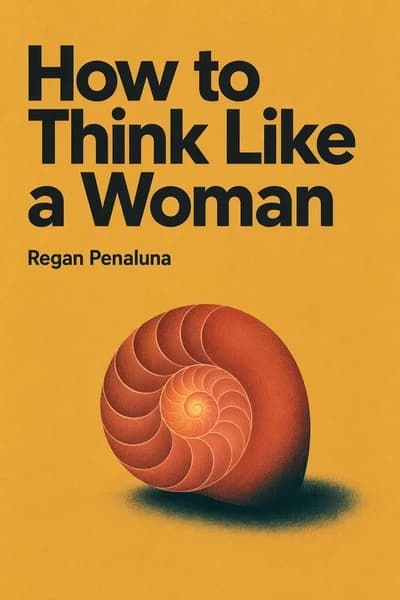
In the quiet corners of philosophical history lies a revolutionary book that's been making waves since its publication. "How to Think Like a Woman" by Regan Penaluna has become a favorite among celebrities like Emma Watson and Gloria Steinem, who have praised its illuminating excavation of forgotten female philosophers. The book has sparked reading groups across university campuses and inspired countless women to reconsider their relationship with intellectual pursuits. What makes this work particularly compelling is how Penaluna weaves her personal journey through academia with the rediscovery of brilliant women thinkers who challenged philosophical traditions centuries ago. As we navigate contemporary discussions about gender equality in intellectual spaces, this book offers both historical perspective and personal resonance, reminding us that women have always been thinking deeply-even when the philosophical canon pretended they weren't.
Глава 2
The Awakening of a Woman Thinker
My philosophical journey began in graduate school, when Professor Berg posed a question that would haunt me for years: "Why haven't women achieved the highest levels of thought?" As one of only two women in the room, I felt suddenly trapped, my identity as a thinker called into question. Though I'd been raised to believe gender wouldn't limit me professionally, this moment revealed the uncomfortable truth that in philosophy, I wasn't simply a thinker but a "woman thinker"-a category laden with assumptions about intellectual capacity.
Growing up in Iowa, I'd always been drawn to metaphysical questions. My childhood was filled with religious questioning, first finding intellectual stimulation in Bible studies led by Stella, a farmer who had once hoped to become a Catholic priest. She showed me how philosophical ideas could be liberating, though I eventually outgrew the confines of religious thinking. In college, philosophy replaced religion as my intellectual home, particularly during a sophomore class on early modern philosophy where Pascal's concept of humans existing between two infinities electrified me.
Despite feeling intellectually at home in philosophy, graduate school gradually eroded my confidence. The department seemed uncomfortable around female students-male professors kept their distance, creating unequal mentoring opportunities. I scrutinized my behavior constantly, growing increasingly timid and passive. Most troublingly, I completed my coursework without ever studying a single woman philosopher.
What I discovered outside of class was even more disturbing. In my own reading, I began collecting the philosophers' misogynistic statements in notebooks-Democritus declaring that "to be ruled by a woman is the ultimate outrage for a man," Aristotle describing females as "disabled males" and "natural mutilations," Galen calling women "colder" and "less perfect" than men. This documentation became unexpectedly therapeutic, offering brief transcendence from the grinding effects of sexism.
As I struggled with whether philosophy was truly for me, I made a discovery that would change everything. While researching the Cambridge Platonists for my dissertation, I found a footnote mentioning Damaris Cudworth (Lady Masham), who had written philosophical treatises. This led me to uncover early women philosophers who argued that women were intellectually equal to men-women who had faced the same doubts and obstacles I was experiencing centuries later.
Глава 3
A Room of Her Own: Mary Astell's Radical Vision
Mary Astell (1666-1731) captivated me with her boldness and unapologetic ambition. During a time when only 25 percent of English women could write and philosophy was considered inappropriate for women, Astell produced four books of philosophy, political essays, and poetry. She challenged sexist ideas from famous philosophers and advocated for women's education as essential for both personal happiness and societal contribution.
In 1694, Astell anonymously published "A Serious Proposal to the Ladies," offering an ethics of the good life specifically for women. Central to her book was a radical proposal for an all-women's college-a revolutionary concept that would provide women space to develop intellectually away from patriarchal thinking. She argued women were as rational as men but lived as "Machins" devoid of mind-following orders mechanically rather than thinking for themselves. This wasn't natural inferiority but social conditioning that "spreads its ill Influence through all our Lives."
Her proposed college would be located outside town as a "blissful recess from the noise and hurry of the World" where women could escape patriarchal thinking. Unlike Socrates who preferred philosophy in the city among men, Astell recognized women needed supportive community to foster self-esteem and ambition. Students would study Descartes, Malebranche, and female scholars while cultivating their souls and discovering their God-given talents.
Despite her book selling well through multiple editions, Astell never secured funding for her college. Princess Anne reportedly considered donating 10,000 pounds until philosopher Gilbert Burnet advised against it, finding the proposal too similar to a Catholic nunnery during England's anti-Catholic period.
Beyond changing women's minds, Astell aimed to transform philosophy itself. She critiqued Hobbes, Locke, and Milton for their contradictory views on freedom and equality, famously asking: "If all Men are born free, how is it that all Women are born slaves?" She identified a fundamental flaw in male intellectual attitudes-a pride that led to falsehoods. Writing during a pivotal shift when curiosity was becoming acceptable for men, Astell noted that women's curiosity remained condemned, with intellectually gifted women often viewed as "Monsters" or biological anomalies.
Most audaciously, Astell proposed the single woman as an intellectual ideal-one with sharp reason and compassion, best suited to manifest God's will. "The whole World is a single Lady's Family," she wrote, suggesting unmarried women could reform society through their "natural and unprejudic'd Sentiments." Though largely forgotten after her death from breast cancer in 1731, Astell influenced Virginia Woolf, who credited her with originating the idea for a women's college.
Глава 4
The Women Behind the Men: Love and Intellectual Partnership
The stories of women philosophers and their relationships with male philosophers reveal patterns of intellectual subordination and dismissal. Maria von Herbert wrote to Kant about her suicidal thoughts, seeking guidance from his moral philosophy. Kant responded as her "moral physician," offering cold advice while privately believing women were inferior in reason and virtue. When Herbert wrote again confessing she'd abandoned her studies because she wasn't "genius enough," Kant never replied, instead collecting their correspondence as an "Example of Warning" for another woman.
Similarly, Harriet Taylor's intellectual partnership with John Stuart Mill was dismissed despite Mill's insistence that works like "On Liberty" belonged "as much to her as to me." Though he proclaimed her co-authorship of all his published writings, critics claimed she merely "bewitched" him and had nothing to do with his best ideas. After her death, history largely erased her contributions, revealing our cultural default: we know Mill, but who was Taylor?
My own relationship with Alex, a graduate teaching fellow whose theoretical explanations transformed difficult concepts into objects I could grasp, followed similar patterns. Our intellectual dynamic grew painful-I increasingly relied on his validation of my philosophical ideas, which paradoxically undermined my confidence and led to intellectual isolation. When he proposed, I accepted, believing his presence would help me navigate philosophy's "boys' club."
I often framed my romantic and intellectual life as a ladder, following Socrates's teaching in Plato's Symposium where we ascend from imperfect lovers toward apprehending truth through reason alone. Yet I felt more like Alcibiades, who loved Socrates not for his embodying universal truths but for his unique traits, experiencing both love and humiliation in this attachment.
My relationships with Alex and with philosophy itself weren't ennobling me as promised. Instead, I felt both love and shame, afraid to let go of either attachment for fear of disintegrating into "nothingness" or becoming "a lesser being." These insecurities resonated with Damaris Masham's writings, where I recognized how a relationship with a more advanced philosopher could provide self-worth but create intellectual dependency that would destabilize a woman's intellectual life in ways it wouldn't for a man.
Глава 5
'Fitts' and Starts: Damaris Masham's Philosophical Journey
Damaris Cudworth Masham maintained a twenty-year correspondence with John Locke that was intellectual, personal, and occasionally romantic. Born in 1659, Masham grew up at Christ's College, Cambridge, where her father Ralph Cudworth served as master. Despite living at one of Europe's oldest research centers, she faced severe restrictions as a woman, denied instruction in Latin and Greek despite her intellectual curiosity.
At twenty-two, still living with her parents, Masham attended a London Christmas party where she met John Locke. He was forty-nine, already famous though not yet the philosophical giant we know today. Their correspondence became playful, humorous, and cerebral, with Locke eager to learn about Cambridge Platonism from Masham, whom he praised as exceptionally brilliant. Despite this flattery, Masham often fell into dark moods she called "Fitts" when faced with his philosophical questions, feeling overwhelming pressure to perform intellectually.
As their relationship deepened, Masham realized she was in love with Locke, writing that she "cannot forget you." When political upheaval forced Locke to flee to Holland, their relationship stalled. After two years of waiting and heartache, Masham finally accepted that Locke would not commit, lamenting that of all things, she "should the most Hate to be thought a Neglected Mistress."
At twenty-six, Masham resolved her "Puzling Difficultie about Matrimonie" by accepting a proposal from Sir Francis Masham, a widower with nine children. Though Masham initially believed she could maintain her intellectual life alongside her new domestic responsibilities, reality proved otherwise. Six months after her marriage, she lamented to Locke that "Household Affaires are the Opium of the Soul," as her philosophy books now shared space with "Receits and Account Books" and her "Spining Wheel."
In her writings, Masham described the nightmare of being an intelligent woman in rural England. A smart woman was intimidating, mocked, and gossiped about. Her local parson avoided her, her doctor found her peculiar, and neighbors rarely visited. "Her very being is a threat to the world as such," Masham observed. Even with leisure for philosophy, a woman faced "general dislike" that a male philosopher would never experience.
When Masham was thirty-one, Locke moved into her home at Oates. Their intellectual companionship flourished as Locke introduced her to prominent thinkers like Isaac Newton and connected her with respected publisher Awnsham Churchill. In December 1694, Locke shared with Masham the philosophical exchange between John Norris and Mary Astell. This provoked Masham to emerge from obscurity and write her first book, "A Discourse Concerning the Love of God" (1696), criticizing Astell and Norris for defending Malebranche's ideas about women.
Masham forcefully countered Malebranche's philosophy, which claimed mothers transferred humanity's intellectual handicap to their babies in the womb. She defended the necessity of loving people and things, using parenting as an example: "We love our Children, or Friends" and naturally desire their well-being. She mocked those who claimed otherwise as "Heads cast in Metaphysical Moulds."
In her 1705 book "Occasional Thoughts," Masham addressed women's education, arguing women's minds weren't truly free. She boldly asserted that "all Science lyes as open to a Lady as to a Man," while acknowledging women should prioritize knowledge related to their duties. Recognizing the challenge of confidence after lifelong messaging about women's intellectual inferiority, Masham proposed a two-tiered reform: women cultivating individual thought autonomy and society providing girls rigorous education.
Глава 6
The Demons of Doubt: Overcoming Internal and External Obstacles
The author explores how philosophers invoke demons when doubtful, noting Descartes' famous demon thought experiment likely came from Teresa of Avila, a sixteenth-century nun whose demon visitations couldn't make her doubt the act of thinking itself. Women are especially adept at philosophical doubt because their judgment and authority are undermined during socialization. Unlike Descartes, whose demon was merely theoretical, the author's self-doubt operates like a persistent demon on her shoulder.
Throughout her academic struggles, the author's inner demon voice constantly undermines her confidence. This voice questions her worth, suggesting she was only hired to keep her spouse around, and argues she chose dependency over autonomy. The demon accuses her of willfully embracing impotence to avoid judgment and suggests her depression and anxiety stem from fear of using her own voice. When the author asks how to gain self-respect, the demon responds "by taking risks," though she recognizes the risks seem greater for women. Despite her love for philosophy, the demon reminds her there was "no promise that it would love you back."
The author draws inspiration from philosopher Damaris Masham, who advocated diving into love despite its risks. Unlike philosophers who sought safety in loving unchanging ideals like God, Masham embraced the messy interdependence of human love as the only path to enlightenment. The author recognizes this path is particularly challenging for women, whose "feelings, opinions, presence, life, works, and impact are belittled, glanced at, or ignored," explaining why women often develop more slowly professionally than men. Masham's message resonates: "Do not retreat. A woman's path to self-knowledge requires her to risk losing herself to find herself."
Глава 7
Heroes: Finding Freedom Through Difficult Choices
One balmy July evening, I'm studying French in a Vermont dorm room I share with Alex, my husband of four years. We've pushed twin beds together and signed a language pledge to speak only French for seven weeks, reducing our communication to single words and gestures. Away from home, I fill my time with language study and new friendships, experiencing an unexpected joy and fullness I hadn't felt in years.
While reading a children's book in French, I gaze out the window at distant plane trees, triggering a memory from nine years earlier when I'd traveled alone in India. With sudden clarity, I realize I've sidelined myself into passivity, filling me with sadness and rage.
During our second week of French class, Zuzanna, a beautiful, charismatic student, convinces me to attend the program's costume ball. That day in class, I pair with Orhan, a medical student from Istanbul, for an exercise about furnishing an imaginary apartment. We share a playful chemistry, and I begin noticing other married students' behavior-Sarah openly criticizing her absent husband while flirting with a younger classmate, and John pursuing another woman despite his wife being at home.
Zuzanna convinces me to attend the costume ball while Alex studies at the library. She and Sarah transform me with makeup and hair styling, placing a medal made of red foam and gold glitter around my neck to complete my track star costume. Their gentle touches and acceptance make me realize how lonely I've been. Looking in the mirror at my bright smile, I feel ignited but also struck by a clear realization: I don't want Alex to join me, and I don't want to be with him anymore.
Days later, I find Alex in the library and ask to talk. Sitting in Adirondack chairs on the quad, I end our marriage. I explain my struggle to be my own person despite years of trying. Alex doesn't protest, and we agree to finish the program separately.
Weeks later in our Iowa apartment, we sign divorce papers. I move back with my parents eighty miles away, borrowing their convertible to commute to the college where Alex and I both teach. When my parents ask about my future plans, I reveal I've resigned from my tenure-track position without alternatives. I mention possibly moving to Brooklyn, Portland, or Chicago.
What I don't tell them is how after separating from Alex, I confessed my feelings to Orhan in French, and we spent several nights together before the program ended. Now, despite my daydreams about meeting his family, Orhan repeatedly cancels calls and avoids me, finally making his disinterest clear.
Facing myself, I'm repulsed to see how quickly I'd attached my future to another man after leaving Alex. I realize I don't need a man to stifle me-I can do it myself. Despite dreaming of independence, I've fallen into the sidekick role, enjoying proximity to a hero if I can't be one. Like Wollstonecraft, who was susceptible to Imlay despite championing women's freedom, I see my knee-jerk submissiveness as a warning of what could happen without vigilance.
In October, I secure an adjunct teaching position in New York City, planning to move before January. Leaving behind job security, community, and a good partner terrifies me, but also makes me feel alive-I finally grasp that only I can save myself.
Глава 8
Into the Hands of Virginia Woolf: Rediscovering Lost Voices
I rent a small fifth-floor bedroom in a shared East Village apartment, with large windows overlooking the street and rooftops. Free from seeing myself through a man's lens, I discover joy in simple activities-choosing my own food, making friends, browsing used bookstores, and observing city life. My days feel slow and rich with meaning.
I teach three courses at a university in Queens, taking the F train to its second-to-last stop. The department chair offers me a future four-year contract with health insurance, though it won't be renewable due to budget constraints. Despite this temporary security, I face the grim reality of academia's job market, especially for someone specializing in early modern women philosophers.
I become interested in how early women philosophers survived in historical memory despite their exclusion from the canon, discovering the story of George Ballard, an eighteenth-century English historian. Ballard, a dressmaker from humble origins, became interested in forgotten British women writers through his friendship with Elizabeth Elstob, a former Saxon scholar. He decided to document these overlooked women, declaring: "I know not how it hath happened that very many ingenious women of this nation... have been passed by in silence by our greatest biographers."
Despite thirteen years of research, Ballard's 1752 book "Memoirs of Several Ladies of Great Britain" faced resistance. Male colleagues forced him to remove his passionate defenses of women, including his critique of men who claimed exceptional women merely "acted above their sex." The compromised book sold poorly, and Ballard died three years later from "too intense application to his studies."
I discover that Ballard was just one of many writers throughout history who tried to preserve women's intellectual contributions. Despite these efforts, most women philosophers remain unknown today. What's most striking is that the female philosophical perspective isn't a modern invention. Women philosophers weren't late arrivals-they've been present since philosophy's beginnings, offering critical perspectives on their oppressive conditions.
Глава 9
Bedtime Stories: A Global History of Women Philosophers
Very little is known about philosopher Gargi Vacaknavi, who lived in India twenty-eight hundred years ago. During a prestigious philosophical debate hosted by King Janaka, Gargi was the only sage able to hold her own against Yajnavalkya. When she pressed him with difficult questions, he warned: "Gargi, do not ask too many questions, or your head will shatter apart."
Another renowned woman in King Janaka's time was Sulabha, a Hindu nun who mastered rhetoric and yoga while wandering in pursuit of truth. She believed women's minds equaled men's and could be sages too. When Sulabha heard Janaka claimed wisdom, she traveled to test him, questioning how one could achieve spiritual freedom while holding power.
Across continents and centuries, women philosophers persisted despite overwhelming barriers. Charlotte Perkins Gilman challenged economic systems dependent on women's unpaid labor in her 1898 work "Women and Economics." Black women intellectuals like Maria W. Stewart questioned how long "fair daughters of Africa" would bury their talents beneath kitchenware. Sojourner Truth famously asked "Ain't I a woman?" to white feminists ignoring Black women. Anna Julia Cooper's 1892 book "A Voice from the South" argued that women's cause must be broader than "aristocratic pink tea," examining how race, gender and class intersect.
During my early months in New York, I built a city of women from library materials-not lonely work, as their ideas animated my consciousness. I joined a vast scholarly conjuring that connected independent imaginations across time and space, revealing a philosophy less male, white, and European-more human, complex, and alive.
Глава 10
Monsters: Catharine Cockburn's Revolutionary Vision
As a new mother, I find particular resonance in Catharine Trotter Cockburn's work, which addresses the unacknowledged crisis of reconciling women's intellectual freedom with traditional duties to others. Maternal guilt, I realize, emerged as a byproduct of Enlightenment thinking, and Cockburn was among the earliest to explore this territory.
Born Catharine Trotter (either in 1674 or 1679), she lost her father to plague in 1684. Despite family connections to royalty, she faced financial hardship afterward. Young Cockburn immersed herself in books, teaching herself logic and French, and impressing relatives with spontaneous poetry recitations. Her intellectual independence manifested early-as a teenager, she converted to Catholicism against family tradition, demonstrating remarkable self-determination.
Cockburn emerged into public view through her writing, beginning with a poem to Bevil Higgons after his recovery from smallpox. That same year she published her novella "The Adventures of a Young Lady," which championed girls' education through its protagonist Olinda, a thirteen-year-old who navigates unwanted attention from older men through her own judgment rather than relying on others.
Cockburn's theatrical ambitions went beyond entertainment-she wanted transformation. Unlike most English playwrights, her plays' "chief design is to instruct whilst they delight." She used surprising plot turns to keep audiences engaged while showcasing brilliant female characters with reasoning powers equal to men's.
In 1702, Cockburn published "A Defence of Mr. Locke's Essay of Human Understanding" anonymously, knowing "a woman's name would give a prejudice against a work of this nature." She expanded Locke's hints about morality into a vision compatible with Christianity. When Locke discovered her identity, he sent books, money, and praise for her "strength and clearness of reasoning."
After becoming a mother, Cockburn published nothing for almost seventeen years. She later explained to Alexander Pope that she "bid adieu to the muses, and so wholly gave myself up to the cares of a family, and the education of my children." Despite her claims of abandoning intellectual pursuits, Cockburn secretly continued writing, composing fictional letters between women discussing friendship and domestic challenges.
In 1726, with her children more independent, Cockburn resumed publishing philosophical works. She died in 1749 at seventy-five, nearly forgotten by the world. Before her death, Cockburn and her friend Henry Etough compiled her works for publication. Her portrait shows no outward agitation, though frustration was her first response to patriarchy. Instead, it reveals calm rejection-living with personal integrity while working to change an unfair world, her intelligent eyes showing the unmovable female gaze.
Глава 11
Muses: Finding My Own Path
Those same eyes were staring at me from a book on my office desk as I packed up my belongings after resigning from my teaching job in Queens. With my newly earned master's degree in journalism, I was leaving a year earlier than planned to seek new opportunities. My three-year-old son helped me load books and papers, shook my colleague Jim's hand, and sat drawing and eating candy during my final feminist philosophy class.
Soon after, I joined an ambitious science magazine startup in Manhattan. The work proved intellectually stimulating and collaborative-fact-checking, writing, and editing alongside a team producing high-caliber content. Throughout, I advocated for greater representation, pushing for more pieces by women, people of color, and LGBTQI community members, highlighting both their achievements and their historical suppression in science.
Standing in a bookstore years later, I discovered a new philosophy history text that, across 584 pages of individual thinkers, included not a single woman. This transported me back to Berg's classroom, but instead of feeling shame, I felt angry defiance. I imagined confronting him, building networks of allies, and studying under professors who valued gender theory. The torment associated with that memory had diminished; I felt suddenly free.
My philosophical journey wasn't shaped by contemplating eternal truths as Aristotle described, but through confronting systems of oppression. In this sense, I am a woman thinker. While I don't believe there's one way to think like a woman, patriarchy makes it difficult for women to think independently and voice their thoughts. Astell, Masham, Cockburn, and Wollstonecraft provided me intellectual community and taught me that freedom comes through helping others find their voices. We need to rethink the concept of a philosophical canon itself, creating a history of thought that represents the true human intellectual endeavor: inconclusive, constantly renewing, and wildly dynamic.