Глава 1
The Attachment Crisis: How Peer Culture Is Replacing Parents
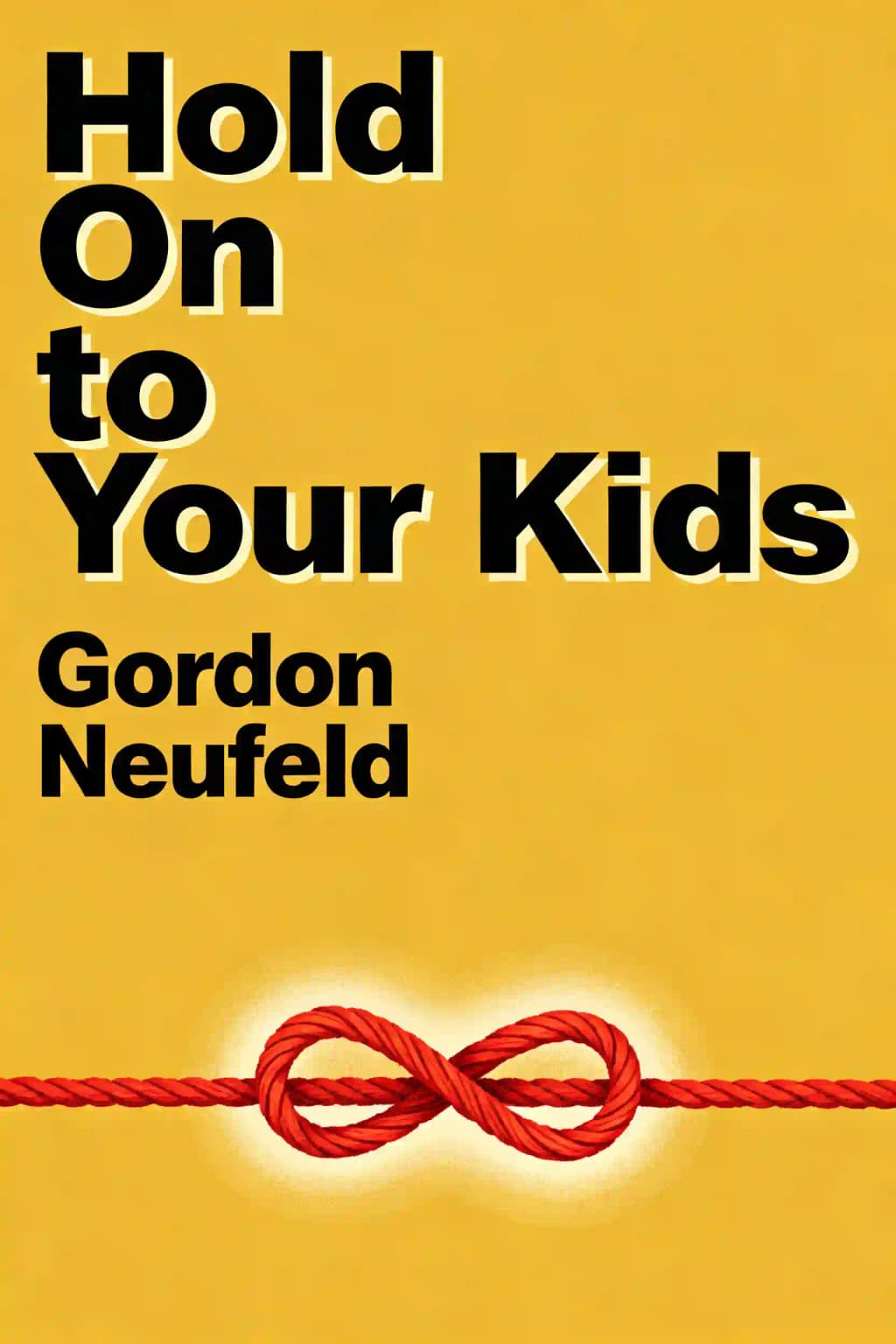
In a world where children increasingly look to peers rather than parents for guidance, acceptance, and values, "Hold On to Your Kids" delivers a profound wake-up call. This revolutionary book, beloved by celebrities like Goldie Hawn and praised by leading psychologists, identifies a silent epidemic that's fundamentally altering childhood development. When Gabor Mate and Gordon Neufeld first published their groundbreaking work in 2004, they struck a chord that continues to resonate with parents worldwide. The book has since been translated into over twenty languages and remains as relevant today as ever-perhaps even more so in our digitally-dominated era. What makes this work so powerful is its radical reframing of common parenting challenges: what if your child's difficult behavior isn't a discipline problem but a relationship problem?
Глава 2
When Children Orbit Around Peers Instead of Parents
The fundamental premise of "Hold On to Your Kids" is both simple and profound: for the first time in history, children are turning to their peers rather than parents for their sense of direction, values, identity, and codes of behavior. This "peer orientation" represents a seismic shift in human development that began after World War II and has accelerated dramatically in recent decades.
Consider twelve-year-old Jeremy, hunched over his computer at 8 PM, ignoring homework to chat with friends about social dynamics-who likes whom, who's friends or enemies. When his father reminds him about schoolwork, Jeremy snaps, "Stop bugging me!" The interaction escalates into a shouting match ending with Jeremy slamming his door, leaving his father feeling helpless and confused.
This scene plays out in countless homes today. Parents find themselves increasingly ineffective despite loving their children as much as ever. The problem isn't that parents have changed fundamentally, nor have children. What's changed is the context for parenting-specifically, the attachment relationship between parent and child.
For parenting to work, children must be actively attaching to adults-wanting contact and closeness. This psychological umbilical cord is what allows parental guidance and love to get through. Without it, even the most skillful parenting techniques fall flat. The secret lies not in what parents do but in who they are to their children. When properly attached, parents become empowered as nurturers, guides, and teachers.
The most damaging competing attachment undermining parental authority today is children's increasing bonding with peers. Nature never intended immature individuals to be placed in a parenting role, yet that's effectively what happens when children turn to each other for guidance instead of adults. This peer orientation has muted parenting instincts and eroded natural authority, forcing parents to parent from manuals rather than from the heart.
Though peer orientation has become the norm in modern society, it is neither natural nor healthy. Until about the Second World War, adult orientation was the standard pattern in human development. Culture was traditionally handed down vertically from generation to generation. Today's children generate their own distinct culture transmitted horizontally within their peer group. Their music, dress, celebrations, and customs are dictated by peers rather than cultural heritage passed down by parents.
The warning signs first appeared decades ago when researcher James Coleman discovered that for seven thousand young people studied in the 1960s, relationships with friends took priority over those with parents. Though initially dismissed as alarmist, this phenomenon has now become widespread. Parents often believe they should "let go" to foster independence, but the authors argue that fitting in with immature peer expectations doesn't create self-respecting adults. Children may know what they want, but they don't know what they need.
Глава 3
How Attachment Works-And When It Goes Wrong
When fourteen-year-old Cynthia suddenly became rude, secretive, and hostile toward her parents while remaining charming with friends, her confused parents viewed it as a behavior problem requiring discipline. But the authors reframe this as a relationship problem-like a spouse having an affair. Cynthia's preoccupation with peers was competing with her attachment to family, creating what the authors call an "attachment affair."
Attachment is the powerful force that creates proximity and connection-physically, behaviorally, emotionally, and psychologically. Like gravity, it normally operates without our awareness, orchestrating our instincts automatically. But when attachments break down, our instincts become skewed.
Attachment creates a compass point in the person a child is attached to, preventing the child from feeling lost. Children fear nothing more than losing contact with this compass point. While parents should naturally serve as this orienting force, peer attachment subverts this natural order, causing children to revolve around each other rather than adults.
Six progressive ways of attaching reveal how children connect:
1. Senses - Physical proximity through sight, sound, touch
2. Sameness - Imitating and identifying with attachment figures
3. Belonging and Loyalty - Possessively claiming attachment figures
4. Significance - Seeking to matter to someone
5. Feeling - Pursuing emotional intimacy
6. Being Known - Sharing oneself psychologically
Healthy development integrates all six strands into a strong connection. Peer-oriented children typically remain limited to the most primitive, superficial modes, especially sameness, making their attachments desperate and intense.
Given the central importance of attachment, whoever a child is most attached to will have the greatest impact on their life. Like a compass that cannot function with two magnetic North Poles, a child cannot simultaneously orient by peer values and parent values. The attachment brain must select one orienting influence; otherwise, emotions become confused and motivation paralyzed.
The hostile behavior children direct toward parents when peer-oriented stems from attachment's bipolar nature. Like magnetism, human attachment has two poles-one attracts, the other repels. When a child pursues closeness with peers, they instinctively resist those perceived as competing attachments. This explains why children previously close to parents suddenly treat them with disdain when peer orientation takes hold.
Глава 4
Why We've Come Undone: The Cultural Breakdown
The cause of children transferring attachments from adults to peers isn't individual parental failure but an unprecedented cultural breakdown. Our society no longer serves children's developmental needs. Children have powerful genetic drives to attach but no innate preference for adults over peers. Historically, this wasn't problematic as natural order ensured bonding with adult caregivers until maturity.
Today's children find themselves in "attachment voids"-situations lacking consistent, deep connections with nurturing adults. Economic changes since World War II have resulted in children being placed early in situations where they spend most of their day with other children rather than significant adults. This begins shortly after birth and accelerates as they grow older.
Society generates economic pressure for both parents to work but makes little provision for children's emotional needs. Caregivers and educators rarely receive training about attachment, and day care remains underfunded with problematic child-to-caregiver ratios. Schools inadvertently promote peer orientation through large classes, limited teacher connection, and policies that keep children together without adult supervision.
The nuclear family itself faces extreme pressure. Divorce creates both competing attachments and attachment voids for children. When parents separate, children can't maintain simultaneous closeness with both, especially when parents compete for their loyalty. Even intact families struggle with attachment. Economic pressures force both parents to work full-time, leaving less time and energy for connection.
Our rapidly changing society has outpaced cultural evolution. Electronic transmission of culture has replaced intergenerational sharing of customs and traditions. Communication technology, designed to facilitate attachments, has been put into children's hands who use it to connect with peers instead of adults.
The village of Rognes in Provence offers a striking contrast to North American society, demonstrating a culture that successfully preserves traditional attachments. Children and adults greet each other respectfully. Socializing involves whole families rather than age-segregated groups. Village activities unite rather than divide families. Even at the village fountain, teens mix with seniors. Cultural rituals take precedence over materialism, and schools maintain strong attachment customs.
Глава 5
The Power to Parent Is Slipping Away
When seven-year-old Kirsten suddenly became resistant and difficult after entering second grade, her previously loving relationship with her parents deteriorated into battles, anger, and withdrawal. This illustrates how parenting, designed to be "power-assisted," becomes nearly impossible when that power fails.
Many people today resist the concept of power, associating it with abuse or confusing it with force. However, parental power means the spontaneous authority that flows naturally from an appropriately aligned relationship with the child. This power arises without effort when things are in their natural order.
The true source of parental power lies not in techniques but in the child's dependence. Children are naturally dependent, but the critical factor is whether they depend specifically on their parents or on others. Parents cannot effectively guide children who don't welcome their direction or who aren't leaning on them emotionally.
Effective parenting requires three ingredients: a dependent child needing care, an adult willing to assume responsibility, and a working attachment from child to adult. The most critical and overlooked factor is the child's attachment to the parent. Many experts mistakenly assume parenting difficulties stem from lack of skills rather than attachment problems.
When parenting becomes difficult, we often search for labels to explain our children's problems. Parents seek formal diagnoses or grasp at informal labels like "difficult" or "spirited" child. While these diagnoses remove blame from both parent and child, they camouflage the reversible attachment dynamics causing the misbehavior.
Глава 6
When Attachment Works Against Us
Attachment is what makes parenting possible, enabling us to tolerate the challenges of raising children. When attachment functions properly, parents can be effective even without formal "parenting skills." But when a child's attachments are misaligned, the same dynamics that should support parenting instead undermine parental authority.
Attachment naturally arranges adults and children in a hierarchical order, with children in the dependent, care-seeking mode. When properly attached, children instinctively look up to parents, seek their guidance, and defer to them. Peer orientation subverts this natural hierarchy.
Attachment not only prepares a child to be taken care of but also triggers caregiving instincts in adults. When children express desire to attach to us, it makes them sweeter and easier to parent. Without being primed by our children's attachment, we must rely solely on love and commitment, which for many parents isn't enough.
Getting children to pay attention is fundamental to parenting, yet impossible to force. Attention naturally follows attachment-the stronger the attachment, the easier it is to secure a child's attention. When children become peer-oriented, their attention instinctively turns toward peers while adult communication registers as mere noise.
A primary function of attachment is keeping children close to parents. Like an invisible leash, attachment programming allows parents freedom-instead of constantly monitoring children, we can trust their instincts to follow us. Peer orientation redirects this connection-seeking toward friends instead.
Children don't automatically model themselves after parents or teachers-they only emulate those to whom they're strongly attached. This modeling happens naturally and effortlessly, providing "power-assisted learning" without conscious teaching or studying. When peers replace parents as attachment figures, they become the models instead.
Perhaps the most significant benefit of attachment is instilling in children the desire to be good for their parents. This "attachment conscience" functions as an internal alarm warning against behaviors that might trigger parental disfavor. When peer orientation occurs, this conscience becomes recalibrated to serve peer relationships instead.
Глава 7
The Flight from Feeling: Emotional Shutdown in Peer-Oriented Children
Walking through high school halls, one is struck by the eerie invulnerability displayed by teenagers-their posturing, gestures, and interactions bespeak a shallow but unassailable confidence. The ultimate ethic in peer culture is "cool"-complete absence of emotional openness. Yet humans are inherently vulnerable creatures.
Children become emotionally hardened when vulnerability becomes too much to bear. While this defensive reaction is expected in traumatized children from orphanages or abusive homes, surprisingly, peer-oriented children without obvious trauma develop similar levels of defensiveness.
Peer-oriented children lose their natural protection against emotional wounds. In a world filled with potential hurts-exclusion, disapproval, ridicule-attachment to parents normally serves as a shield. When a child uses parents as their compass point, the opinions of others matter less.
Just as adult-oriented children are vulnerable to parents' words, peer-oriented children become hypersensitive to peer interactions. The problem is that children's natural interactions are rarely careful or considerate. When peers replace parents as attachment figures, this careless interaction takes on devastating power.
When children are peer-oriented, any sign of vulnerability attracts attack from those already shut down emotionally. Children quickly learn to hide any signs of weakness, sensitivity, alarm, fear, eagerness, or curiosity.
The vulnerability of peer-oriented children stems from the fundamentally insecure nature of peer relationships. Unlike parent-child bonds, peer attachments offer no unconditional acceptance, no maturity to lean on, no commitment to depend on. Children live with constant anxiety: "What if I don't connect with my peers? What if my friend likes someone else more than me?"
The unbearable vulnerability experienced by peer-oriented kids explains their attraction to vulnerability-quelling drugs. These substances function as emotional painkillers, helping young people escape both their painful feelings and the benumbed state imposed by their defensive detachment.
Глава 8
Stuck in Immaturity: How Peer Orientation Arrests Development
When children fail to mature psychologically despite physical growth, they exhibit what the authors call the "preschooler syndrome"-behaviors appropriate only for very young children. Peer orientation is the main culprit behind this widespread immaturity, creating a society of "half-adults" who never truly grow up.
Maturity involves the brain's ability to integrate different perceptions, thoughts, feelings, and impulses simultaneously without confusion-what the Romans called "temper." Immature individuals cannot tolerate mixed feelings, becoming impulsive, reactive, and untempered in their expressions.
Maturation follows a consistent pattern: first differentiation (splitting things apart), then integration of the separated elements. This sequence applies across biological and psychological development. Psychologically, thoughts, feelings, impulses, and values must first become distinct before they can be mixed to produce tempered experience.
Maturation cannot be commanded or taught-it's spontaneous but requires activation. Like plants needing roots before bearing fruit, children need secure attachment before becoming independent beings. Paradoxically, dependence fosters independence; attachment nurtures separation.
Peer orientation impedes maturation in five critical ways:
1. Parental nurturance cannot get through when children are peer-oriented
2. Peer attachments, being insecure, cannot bring a child to rest
3. Peer-oriented children are unable to feel fulfilled
4. Peer-oriented children cannot let go of impossible attachment desires
5. Peer orientation crushes individuality
Unlike individualism (putting one's rights above community), true individuality forms the foundation of authentic community. Emerging individuality requires protection, as it's tentative and vulnerable like a turtle sticking its head out. Children cannot provide this protection for each other. Instead, peer-oriented children actively trample budding individuality.
Глава 9
Reclaiming Our Children: Practical Strategies for Parents
Having shown how peer orientation devastates our educational system and disconnects children from adult guidance, the authors turn to solutions. Parents and teachers must reassume their natural roles as mentors by deliberately collecting children-drawing them under our wing and making them want to belong with us.
The first step in collecting children is to attract their attention positively-seeking eye contact, evoking smiles and nods. With infants this comes naturally, but as children age, we often only engage when something goes wrong. We must deliberately maintain warm connections beyond early childhood.
To engage a child's attachment instincts, we must offer something they can hold onto emotionally. Our attention, interest, affection, warmth, and delight are powerful connection activators. Physical contact remains important-hugs and embraces warm children long after they're over.
The third step in collecting children is inviting their dependence-conveying that they can trust us, count on us, and lean on us. Our cultural preoccupation with independence undermines this essential process. We readily invite infants' dependence but quickly push older children toward self-sufficiency, fearing regression.
The fourth collecting step is orienting the child-serving as their compass point and guide. This begins naturally with infants as we name things and familiarize them with their environment. While we intuitively orient young children, we often lose this instinct with older ones, no longer introducing them to people, explaining what will happen, or interpreting meanings.
When children are deeply peer-oriented, reclaiming them requires understanding that peer orientation functions like a cult. The challenge is winning back their hearts and minds, not just having their bodies under our roof. The key strategy involves creating an attachment void by separating the child from peers, then positioning ourselves in that void.
The parent-child relationship is sacred and must be protected against the peer culture's influence. Our highest priority should be maintaining this connection, no matter what challenges arise. Children experience our priorities through our tone and behavior, not our intentions, so we must live these priorities consistently.
Глава 10
Discipline That Preserves Connection
Traditional behavioral approaches to discipline that focus on short-term compliance through punishment, time-outs, and "tough love" ultimately undermine the parent-child relationship. These methods create adversarial dynamics, trigger emotional hardening, and push children toward peer orientation.
True discipline extends beyond punishment to encompass training, control, and imposing order in developmentally safe, attachment-friendly ways. Rather than formulaic strategies that insult both parent and child, effective discipline requires principles that awaken parental intuition.
Seven principles guide natural discipline:
1. Use connection, not separation, to bring a child into line
2. When problems occur, work the relationship, not the incident
3. When things aren't working for the child, draw out the tears instead of trying to teach a lesson
4. Solicit good intentions instead of demanding good behavior
5. Draw out the mixed feelings instead of trying to stop impulsive behavior
6. When dealing with an impulsive child, try scripting the desired behavior instead of demanding maturity
7. When unable to change the child, try changing the child's world
The final principle of natural discipline recognizes that the less a child needs discipline, the more effective any method will be. When reasonable attempts fail, we shouldn't discipline harder but differently-by changing the child's environment rather than trying to change the child directly.
Глава 11
The Digital Challenge: Technology and Attachment in the Modern Age
Since the original publication of "Hold On to Your Kids," the digital revolution has dramatically transformed children's lives. Understanding this phenomenon requires grasping attachment theory, as our primary need is togetherness, not information. The technology designed for information has been repurposed for connection, particularly by peer-oriented youth.
The digital revolution was built on a fundamental misunderstanding of human needs. While we assumed children would use digital devices for education or entertainment, humans primarily seek connection, not information. Technology originally designed for information sharing has been repurposed to serve attachment needs, but digital connection often provides only fleeting sensations rather than genuine intimacy.
Digital social connections act like persistent weeds that crowd out healthy attachment plants in the garden. The problem is that digital intimacy doesn't deliver true fulfillment-it creates insatiable hunger rather than satisfaction. When attachment activity doesn't lead to fulfillment, development is arrested as children cannot find the emotional rest needed for growth.
Digital intimacy fails for six key reasons:
1. Digital interaction doesn't convey the attachment invitation effectively
2. The defenses required for unprotected social interaction render it unfulfilling
3. Self-presentation works only one-on-one, not in group broadcasts
4. There's no satisfaction when manipulation is involved
5. There's no fulfillment unless the provision is greater than the pursuit
6. Digital intimacy spoils the appetite for what a child truly needs
Digital technology isn't inherently evil, but its timing in children's lives is crucial. The right time for digital connection is after children are satiated by adult contact. When children are filled with meaningful connection from parents-through morning rituals, after-school check-ins, family meals, and bedtime routines-they become immunized against attachment addictions plaguing their peers.
Parents must create digital-free zones in homes and schedules to nurture real connection. Mealtimes, family times, evenings, and bedtimes should remain screen-free. The goal isn't battling symptoms but addressing the root problem: fulfilling children's attachment hunger so digital cravings diminish.
Глава 12
Rebuilding the Attachment Village
Many adults recall childhoods where an "attachment village" existed-neighborhoods where people knew each other, local merchants were familiar faces, and extended family provided support. This invisible matrix of connections created a sense of rootedness where culture passed vertically from generation to generation. Today, these villages have largely vanished.
We must cultivate relationships between our children and interested adults, creating customs that connect them to extended family. Genuine relationships, not mere biological connection, are what matter. Our socializing needs to change from peer-oriented (adults with adults, children with children) to hierarchical connections that span generations.
In traditional villages, children's attachments developed through their parents' connections. Today, we often have little choice over adults like teachers who care for our children. The challenge becomes matchmaking-priming two people to form an attachment. Introductions are vital, giving our "attachment blessing" by being seen in friendly interaction with caregivers.
We live in a world full of attachment competition. Schools, divorce, and remarriage all generate competing attachments that can disintegrate the attachment village and make children vulnerable to peer orientation. We must defuse this competition by turning either/or relationships into this-and-that relationships.
The message of "Hold On to Your Kids" is ultimately one of hope. Despite the social and economic forces driving peer orientation, parents can prevent being prematurely replaced by restoring the natural foundation of the parent-child relationship. When relationships are solid, parents can act from understanding and empathy rather than relying on techniques or manuals. Nature is on our side-children inherently want to belong to their parents, even when their words or actions suggest otherwise. By understanding attachment and consciously working to strengthen these vital bonds, we can raise children who are not only connected to us but capable of genuine maturity and independence.