Глава 1
Liberty's Radical Vision: The Case Against the State
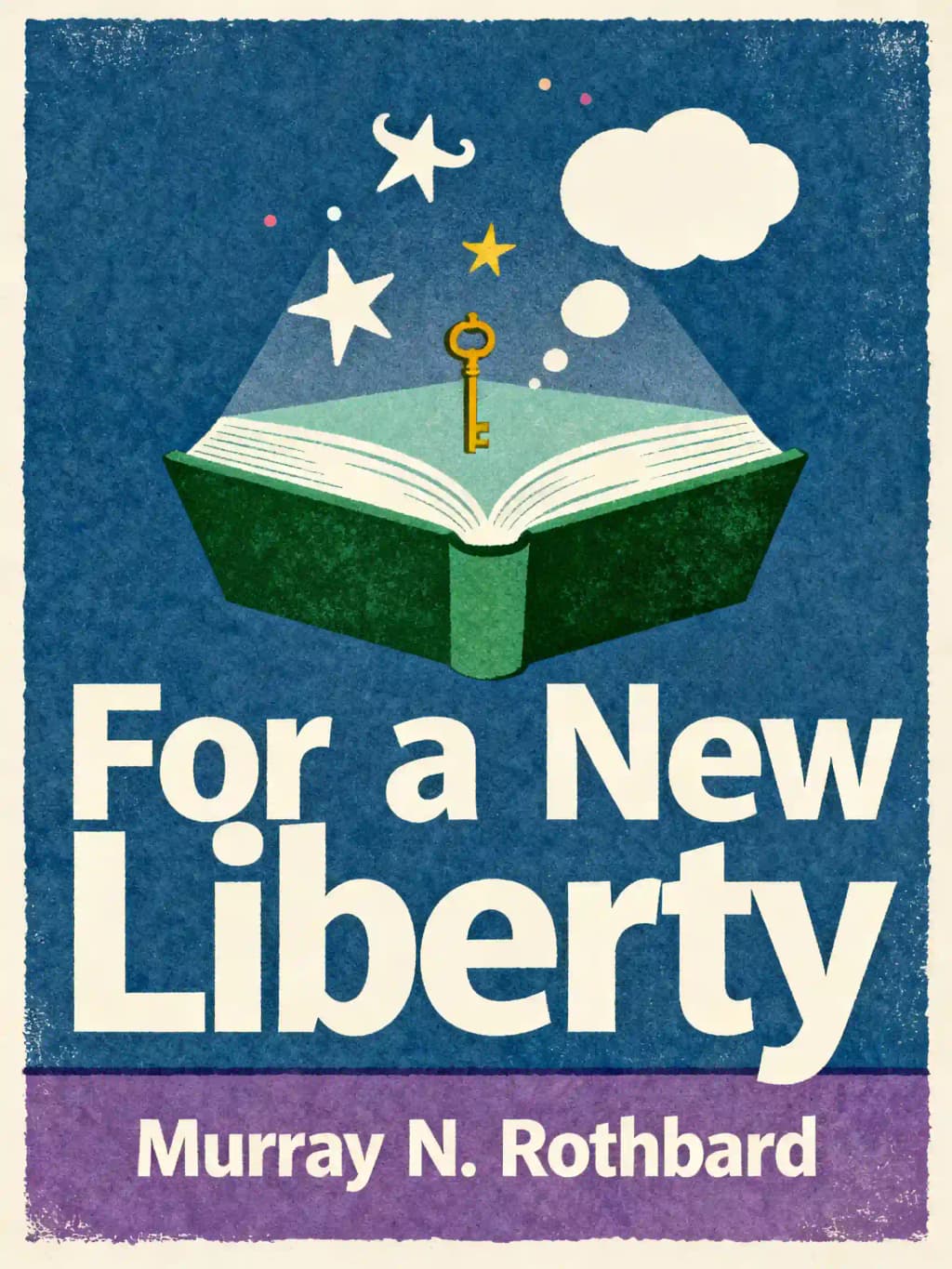
What if the greatest threat to your freedom isn't foreign enemies or criminals, but the very institution created to protect you? In 1973, when Murray Rothbard first published "For a New Liberty," this was a radical proposition. Yet today, this foundational libertarian text has influenced generations of thinkers, from Nobel Prize-winning economists to grassroots activists. The book has been translated into over a dozen languages and remains a bestseller among political philosophy texts, with tech entrepreneurs like Peter Thiel citing it as formative to their worldview. What began as a fringe manifesto has become increasingly mainstream as government growth has confirmed many of Rothbard's predictions. As government debt approaches $34 trillion and regulations touch every aspect of American life, Rothbard's warning about the dangers of unchecked state power feels more relevant than ever.
Глава 2
America's Libertarian Heritage: From Revolution to Retreat
America was born from a libertarian revolution, emerging from a profound struggle against British imperial control. The American revolutionaries fought against multiple forms of oppression: arbitrary taxation without representation, restrictive trade monopolies like the East India Company, and unchecked executive power embodied by King George III. Their response was to create a government with unprecedented restrictions on state authority, including explicit protections for individual rights, checks and balances between branches, and limits on federal power through the Bill of Rights.
Early America embraced this libertarian vision with remarkable consistency and vigor. The Jeffersonians championed a minimalist government, opposing Hamilton's plans for a national bank and strong federal authority. The Jacksonians later expanded this vision, advocating for the virtual elimination of government power across multiple domains: they opposed standing armies as tools of tyranny, fought against any form of direct taxation beyond essential functions, and promoted free banking by destroying the Second Bank of the United States. As journalist H.L. Mencken later idealized it, they sought "a government that barely escapes being no government at all" - a vision that influenced American political thought for generations.
This libertarian tradition faced determined resistance from two directions. Externally, the entrenched ruling elites who benefited from the Old Order mounted fierce opposition. This included not just British aristocrats, but privileged merchants who held royal monopolies, state bureaucracies dependent on tax revenue, and established churches fearing religious freedom. Though liberals won significant victories through various revolutions and reforms, conservatives proved adaptable, managing to preserve many traditional power structures: landed monopolies remained intact, religious establishments maintained influence, and militaristic policies continued. By the late nineteenth century, conservatives had evolved a sophisticated new strategy: they claimed to embrace industrial progress while advocating for regulation "for the public good," replacing free market competition with "organized cooperation" under state guidance, and substituting peaceful trade with aggressive nationalism and military expansion.
Even more damaging was liberalism's internal decay. After achieving partial victories in areas like free trade and religious tolerance, many liberals lost their revolutionary fervor. They became increasingly content with preserving their gains rather than pushing for complete liberty across all domains. This transformed them from radical reformers into cautious conservatives, inadvertently allowing socialism to claim the mantle of hope and progress. Two critical philosophical shifts accelerated liberalism's decline: first, the abandonment of natural rights philosophy in favor of utilitarian pragmatism, which weakened moral arguments against state power; second, the embrace of social Darwinism's view of gradual social evolution, which replaced the revolutionary spirit with passive acceptance of incremental change.
The final blow to classical liberalism came when its advocates abandoned their principled opposition to war and empire. In England, the Manchester School's strict anti-imperialism gave way to "Liberal Imperialism" under leaders like Joseph Chamberlain. In America, the Democratic Party's libertarian heritage was first undermined when captured by William Jennings Bryan's populist forces in 1896, then completely abandoned with Woodrow Wilson's interventionist policies and entry into World War I. The Anti-Imperialist League, formed by aging libertarians like William Graham Sumner to oppose American expansion in the Philippines, represented classical liberalism's last organized resistance before its apparent eclipse by progressive and conservative ideologies.
Глава 3
The Moral Foundation: Self-Ownership and Property Rights
The libertarian creed rests upon one central axiom: no person or group may initiate aggression against another's person or property. This principle makes libertarians consistently "leftist" on civil liberties while "rightist" on economics. The State, as history's central aggressor, receives no moral exemption for actions considered criminal when committed by individuals - war is mass murder, conscription is slavery, taxation is robbery.
But how do we determine legitimate property ownership? The libertarian natural-rights position begins with self-ownership but recognizes humans must interact with the physical world to survive. By mixing labor with previously unowned resources, one creates property - whether gathering acorns, mining ore, or farming land. The homesteader who transforms unused land through labor establishes the most legitimate claim to it. As John Locke declared, "As much land as a man tills, plants, improves, cultivates, and can use the product of, so much is his property."
This principle extends to all production and exchange. When a wheat farmer trades with a fisherman, both voluntarily transfer ownership, making the exchanged items legitimately the property of the new owner. People may also exchange their labor, which they own as part of themselves. The free-market economy, with its specialization and division of labor, consists merely of countless voluntary two-person exchanges - whether buying a newspaper or teaching at a university.
Liberals attempt to uphold "human rights" while rejecting "property rights," but these are inseparably intertwined. Without property rights, "human rights" become meaningless - how can one exercise free press if government owns all newsprint? The right to free speech requires property rights to own or rent assembly halls; free press requires the right to buy materials and sell publications. Individual rights remain absolute, but they are properly understood as property rights.
Глава 4
The State: History's Supreme Aggressor
The libertarian position uniquely focuses on the State as the supreme aggressor against persons and property. Throughout history, the State has committed mass murder under the guise of "war," enslavement through "conscription," and robbery through "taxation." From ancient empires to modern nations, governments have consistently been the primary source of violence and coercion. Two crucial distinctions separate government from all other institutions: first, only government obtains income through coercion rather than voluntary exchange, forcing citizens to pay under threat of imprisonment; second, only government can legally use violence against peaceful citizens who have not aggressed against others.
The State maintains its power through a sophisticated alliance with society's intellectuals. While the masses generally accept ideas passively from opinion-molders, the State desperately needs these intellectuals to spread and legitimize the notion that rulers are wise, good, and inevitable. Historical examples abound, from the court philosophers of ancient China to modern academic defenders of state power. In return, intellectuals receive power, status, and material security as part of the ruling elite, often through prestigious positions in universities, think tanks, and government agencies.
The State employs multiple sophisticated strategies to maintain its power. It portrays its rule as historically inevitable, using deterministic arguments to suggest that resistance is futile and alternatives impossible. This can be seen in how modern states present democracy as humanity's final political form. It actively discourages "conspiracy theories" that might attribute responsibility to specific rulers rather than vague "social forces," thereby deflecting accountability from actual decision-makers. The State instills fear of alternatives by suggesting that chaos, disorder, and social collapse would ensue without its protection. Through nationalism, it masterfully converts what should be seen as conflicts between rulers into wars between peoples, mobilizing entire populations for state purposes.
Modern intellectuals eagerly ally with the State because it offers security and prestige unavailable in the free market. This relationship has evolved from obvious forms of patronage to more subtle arrangements. Just as German professors proudly called themselves the "intellectual bodyguard of the House of Hohenzollern," today's experts serve as "national security managers" and policy advisors who operate without electoral accountability, making crucial decisions sealed from public scrutiny. These modern court intellectuals shape public opinion through media appearances, academic publications, and policy papers, all while enjoying protected positions and government funding. Only when intellectuals have an independent property base, separate from State control - as was historically the case with independently wealthy philosophers and religious institutions - can they function as effective critics of power rather than its apologists.
Глава 5
Personal Liberty: Beyond Involuntary Servitude
Libertarians must fundamentally oppose involuntary servitude - forced labor that denies self-ownership. Conscription represents the most blatant example, where young men are seized by authorities and potentially forced to kill or risk their lives. The author rejects utilitarian arguments for conscription, asking why defenders can't be hired voluntarily like other dangerous professions. The military structure itself constitutes involuntary servitude - unlike any civilian occupation, military personnel face severe penalties including imprisonment or execution for "desertion."
The entire taxation system represents another form of involuntary servitude, with income tax forcing citizens to work several months yearly for the government without compensation. The withholding system is particularly egregious, compelling employers to serve as unpaid tax collectors. Additionally, requiring taxpayers to calculate their own tax liability constitutes forced unpaid labor and violates Fifth Amendment protections against self-incrimination.
Freedom of speech must be understood within the framework of property rights rather than as an absolute. The classic example of shouting "fire" in a crowded theater isn't protected speech because it violates the contractual property rights of the theater owner and patrons. However, beyond such property invasions, libertarians uphold freedom of speech "to the uttermost" as an absolute right.
The libertarian position on pornography transcends the conservative-liberal debate. While conservatives condemn pornography as immoral and liberals defend it as healthy, both miss the crucial point: regardless of consequences, outlawing pornography violates property rights. Government's role isn't to enforce morality but to defend against violence. Prohibiting pornography makes the government the true outlaw by invading people's rights to produce, sell, buy or possess materials.
Laws against gambling are absurd and unenforceable. Prohibiting every private bet would require an enormous surveillance apparatus, plus another force to monitor the monitors. Unlike murder, which the public broadly condemns, gambling is widely practiced and accepted, making prohibition impractical. Similarly, drug prohibition creates more problems than it solves. The connection between addiction and crime is actually reversed from what prohibitionists claim: crimes are committed by addicts driven to theft by the artificially high prices caused by prohibition itself.
Глава 6
Education: Breaking the Government Monopoly
The public school system, once considered sacred in America, has become increasingly recognized as problematic. Public schools, supported by compulsory attendance laws, effectively function as a vast prison system for youth, leading to widespread unhappiness, discontent, and rebellion. Urban schools have deteriorated into environments where crime, theft, and drug addiction flourish while little genuine education occurs.
From America's earliest days, public schooling aimed to mold and control the population rather than simply educate. Massachusetts established public schools to suppress religious dissent from groups like Quakers. Throughout history, compulsory schooling has frequently been used to oppress ethnic minorities and colonized peoples, forcing them to abandon their languages and cultures. As Ludwig von Mises observed, whoever controls schools "has the power to injure other nationalities and benefit his own."
The very nature of public schooling requires uniformity and suppresses diversity. Government bureaucracies must establish and enforce uniform rules to avoid accusations of discrimination, regardless of how poorly these rules serve individual needs. Public school bureaucrats face controversial decisions about educational approaches - traditional or progressive, competitive or egalitarian, religious or secular - and whatever they decide inevitably deprives substantial numbers of families of the education they desire.
By contrast, a private education market would allow diverse schools to emerge meeting varied parental demands, just as the free magazine and book markets serve different tastes and interests. If education were strictly private, parents could patronize schools matching their values - whether traditional or progressive, religious or secular, competitive or egalitarian. The libertarian vision for education isn't radical; it simply calls for a school system as free and varied as other educational media.
The public school system creates an unjust network of coerced levies and subsidies. Parents who choose private schools bear a double burden - forced to subsidize public schools while paying for their own children's education. Religious parents must subsidize secular schools contrary to their beliefs. The childless are forced to subsidize families with children, and perversely, these subsidies increase with family size. Even more absurdly, poor childless couples subsidize wealthy families with children.
Public higher education creates an even more perverse redistribution - forcing poorer citizens to subsidize the education of the wealthier! Three factors cause this: tax structures for schools aren't particularly progressive; college students generally come from wealthier families; and college graduates earn higher lifetime incomes. Studies in Wisconsin, California, and Florida all confirm this regressive effect.
Глава 7
The Welfare State: Creating Dependency, Not Independence
The welfare crisis has accelerated at a staggering rate. While poverty has steadily decreased since the 1930s, welfare rolls have exploded due to changing incentives. When welfare payments rise faster than wages, people rationally choose welfare over work. From 1952-1970, monthly welfare benefits more than doubled from $82 to $187, increasing 130% while consumer prices rose only 50%. The traditional stigma of welfare dependency has been systematically removed by modern liberalism, with social workers now actively recruiting recipients rather than helping them achieve independence.
Cultural values, not income levels, determine welfare dependency. Albanian-Americans in New York, despite being extremely poor slum dwellers, have not a single person on welfare because "Albanians do not beg, and to Albanians, taking welfare is like begging in the street." Similarly, the poor Polish-American Northside community in Brooklyn has virtually no welfare recipients because "they consider welfare an insult."
The welfare state, far from redistributing wealth from rich to poor, actually burdens the poor while subsidizing the wealthy. Minimum wage laws generate unemployment among the least skilled workers. Urban renewal demolishes housing for the poor while benefiting wealthier tenants and developers. Farm price supports help wealthy farmers while hurting poor consumers and farm workers. Government licensing restricts poor workers from entering occupations, while zoning laws keep the poor out of suburbs.
The libertarian answer to helping the poor is simple: government should get out of the way. Four major steps would dramatically improve conditions for the poor: First, abolish or drastically reduce taxation, which cripples productive energies, savings, investment, and technological advancement. Second, reduce government expenditures proportionally, freeing resources from wasteful programs. Third, stop taxing the poor to subsidize the wealthy through higher education, farm subsidies, irrigation projects, corporate bailouts, and similar programs. Fourth, remove government roadblocks to the productive energies of the poor, including minimum wage laws that disemploy the least productive workers, union privileges that exclude minorities, and licensing laws that prevent the poor from starting small businesses.
Глава 8
Money and Banking: The Root of Economic Crisis
By 1973-74, the Keynesian economic orthodoxy faced a devastating reality check when the economy experienced both severe inflation and deep recession simultaneously. Their models couldn't explain how "stagflation" could occur. The Austrian School of economics, developed by Ludwig von Mises and Friedrich Hayek, offers answers where Keynesianism failed.
Contrary to modern assumptions, inflation isn't inevitable. During most of the nineteenth century, prices actually fell while the economy grew and industrialized. Falling prices put no damper on prosperity - they were the normal function of a growing market economy. Our current experience of continuous inflation only became the norm after World War II.
Money originally emerged on the market as people chose useful commodities - eventually settling on gold and silver as ideal due to their durability, divisibility, and stable value. But governments gradually seized control of money creation from the market. Rather than allowing money supply to be determined by natural market forces, the state claimed monopoly power over currency. This wasn't done for public benefit but as an alternative to taxation - rulers could simply create money and spend it on themselves and their allies.
In the United States, the Federal Reserve controls the entire commercial banking system. Banks can pyramid demand deposits ("checkbook money") on top of their reserves at a ratio of approximately 6:1. This means when bank reserves increase by $1 billion, banks can create $6 billion in new money - a powerful multiplier effect that fuels inflation while remaining largely invisible to the public.
The business cycle emerges from government-controlled fractional reserve banking, where banks expand credit by pyramiding notes and deposits on gold. This credit expansion artificially lowers interest rates, misleading businesses into malinvestment - particularly in capital goods industries. The Austrian prescription for addressing business cycles is precisely opposite to Keynesian approaches. During booms, government must immediately cease inflation, even though this will trigger the inevitable recession. The sooner the depression readjustment occurs, the better.
Глава 9
War and Peace: The Ultimate Libertarian Issue
War is the health of the State - a profound observation that reveals how armed conflict serves as the ultimate catalyst for expanding government power and control. During wartime, the State dramatically accelerates its authority over society, mobilizing both human and economic resources under the banner of patriotic necessity while systematically suppressing dissent and alternative viewpoints. Society transforms into an armed camp where wartime morality prevails, suspending normal ethical constraints and civil liberties. The fundamental deception enabling this expansion is the myth that war represents the State's noble defense of its citizens, when in reality, it represents the State's mobilization of its subjects to wage battle against another State's subjects who have been similarly conscripted.
Throughout American history, each major conflict has served as a ratchet mechanism, permanently expanding government power and never fully returning to pre-war levels. The War of 1812 introduced unprecedented economic controls through inflationary banking practices, protective tariffs, expanded federal taxation, and the establishment of a standing military force. The Civil War marked a decisive shift toward neomercantilism, establishing a system of corporate subsidies, railroad land grants, and protective tariffs that fundamentally altered the relationship between government and business. World War I represented perhaps the most dramatic transformation, decisively shifting America from its traditional laissez-faire orientation toward a corporate state monopoly system with global interventionist ambitions. The creation of the Federal Reserve, income tax, and vast regulatory apparatus all emerged from this period. World War II completed this transformation, cementing "corporate liberalism" - a permanent tripartite alliance between big government, big business, and big labor unions, undergirded by an ever-expanding military-industrial complex that became a dominant force in American society and politics.
The cornerstone of any coherent libertarian foreign policy must therefore be America's complete withdrawal from global interventionism. This means immediate military withdrawal from Asia, Europe, Latin America, the Middle East, and all other regions where American forces are deployed. The United States should systematically dismantle its worldwide network of military bases, withdraw all troops to domestic soil, end political interference in other nations' affairs, abolish interventionist agencies like the CIA, and terminate all foreign aid programs. These aid programs, despite humanitarian rhetoric, effectively coerce American taxpayers into subsidizing exports and providing support to politically favored foreign states while creating dependency relationships that ultimately harm recipient nations.
While strategic isolation is essential, the question of appropriate arms policy remains critical. Even from a purely military perspective, America could maintain an effective nuclear deterrent with a dramatically reduced force structure centered on Polaris-class submarines armed with multiple-warhead nuclear missiles - a minimal but credible deterrent. However, true global security ultimately requires worldwide nuclear disarmament through verifiable international agreements. Libertarians should therefore advocate systematic joint disarmament of all weapons capable of mass cross-border destruction, particularly strategic missiles and long-range bombers which cannot be precisely targeted and inevitably result in massive civilian casualties. The elimination of these weapons would effectively enforce isolation and peace by depriving governments of offensive capabilities while maintaining defensive sufficiency through conventional forces.
Глава 10
The Path to Victory: Why Liberty Will Triumph
The essential condition for libertarian victory is education - persuading and converting large numbers to the cause. This education has two vital components: making people aware the libertarian system exists, and converting them to it. Without substantive ideas, publicity efforts would be empty; without publicity, theoretical work would remain unknown.
If libertarians won't champion pure principles, nobody will. F.A. Hayek, though no extremist himself, eloquently argued for holding the pure ideology aloft as a never-forgotten creed. He noted socialism's success came from its "courage to be Utopian" which inspired intellectuals and guided action. "We need intellectual leaders willing to work for an ideal, however remote its realization," Hayek wrote.
The libertarian must desire liberty achieved by the most effective and speediest means available. This doesn't mean unrealistic expectations about how quickly goals will be achieved, but rather moral clarity about the ultimate objective. Unlike communism, libertarianism isn't truly utopian because it aligns with human nature rather than contradicting it.
I am convinced not only that libertarianism will triumph eventually, but that its victory will come remarkably soon. The case for optimism can be made in concentric circles, from broad to specific. In the longest run, liberty will win because only it aligns with human nature and enables prosperity. More immediately, the Industrial Revolution created irreversible conditions requiring freedom to function - an industrial economy simply cannot work under statism.
The crucial point is that we've now entered the "long run" the early libertarians foresaw. The statist chickens have come home to roost. The cushion of wealth created by 19th century free markets has been exhausted, and government interventions now produce immediate negative feedback. Communist countries are retreating from central planning, Western nations face fiscal crises, and America specifically entered permanent crisis in 1973-1975.
The libertarian creed offers the fulfillment of America's heritage along with the promise of a better future. We are the true heirs of Jefferson, Paine, and the abolitionists, more traditionally American than conservatives yet more radically transformative than the Left. While conservatives cling to European monarchical traditions and the Left proposes only more statism, libertarianism breaks sharply with the encroaching state power of the twentieth century. Only libertarianism rejects all aspects of the liberal State - its welfare and warfare, monopoly privileges and egalitarianism, victimless crime laws affecting both personal and economic freedom. We offer technology without technocracy, growth without pollution, liberty without chaos, and defense of property rights in both person and possessions.