Глава 1
The Psychology of Persuasion: How to Make Anyone Buy Anything
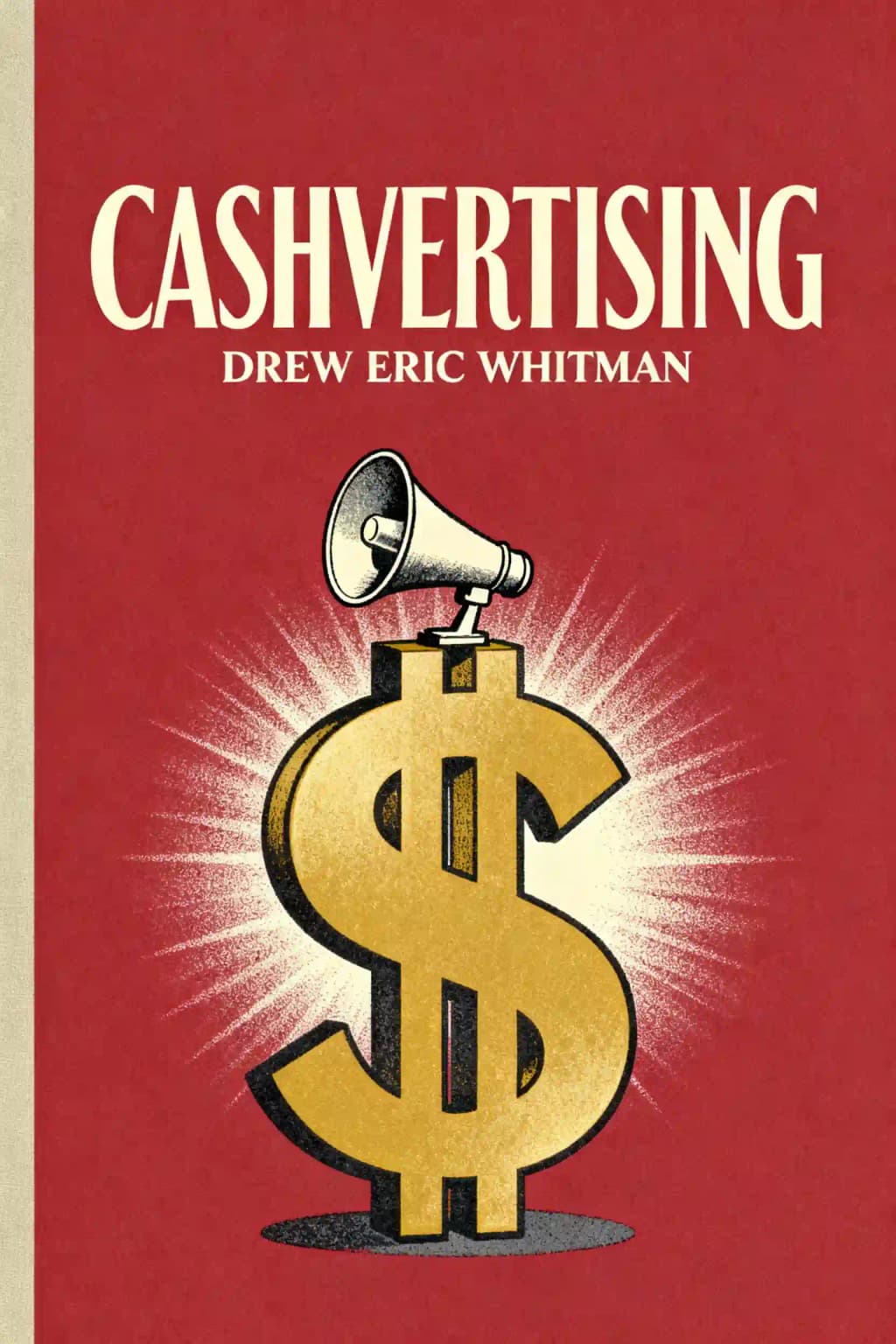
Have you ever wondered why some advertisements seem to reach into your mind and make you desperately want what they're selling, while others barely register? Drew Eric Whitman's "CA$HVERTISING" reveals the psychological triggers that make people buy-techniques so powerful that some consider them almost manipulative. As a former creative director for multimillion-dollar ad agencies, Whitman distills decades of research into actionable strategies that have influenced billions in consumer spending. This isn't just another marketing book; it's the secret playbook used by the world's highest-paid copywriters and designers. Celebrities like Tony Robbins and marketing legends like Joe Sugarman swear by these principles. In an age where the average person encounters thousands of ads daily, understanding these psychological triggers isn't just valuable for marketers-it's essential knowledge for anyone who wants to understand how their own purchasing decisions are being influenced every day.
Глава 2
The Life-Force 8: The Biological Desires That Drive All Purchasing
What truly motivates human buying behavior? According to Whitman, it's not clever slogans or catchy jingles-it's eight fundamental biological desires hardwired into our brains. These "Life-Force 8" desires are responsible for more sales than all other human wants combined.
The first and most powerful is survival and enjoyment of life. We're biologically programmed to stay alive and extend our lives, which is why health products, safety equipment, and life insurance sell so effectively. The second is enjoyment of food and beverages-explaining why food commercials showing people savoring delicious meals trigger our salivary glands and wallets simultaneously.
Freedom from fear, pain, and danger represents our third biological imperative. Home security systems, pain relievers, and insurance all tap into this primal desire. Sexual companionship-the fourth desire-explains why sex sells everything from perfume to cars. Our fifth desire for comfortable living conditions drives purchases of furniture, air conditioners, and ergonomic office chairs.
The final three biological drives include our desire to be superior and win admiration (luxury goods), our need to care for and protect loved ones (family-oriented products), and our craving for social approval (fashion and status symbols).
What makes these desires so powerful? They create tension that demands resolution. When advertisers trigger these biological imperatives, they create a psychological itch that can only be scratched by purchasing their product. This explains why book publisher Haldeman-Julius sold 200 million books simply by changing titles to tap into these desires. "The Art of Controversy" sold poorly until renamed "How to Argue Logically," while "Patent Medicine" became a bestseller as "The Truth About Drug Companies."
Beyond these primary biological desires lie nine "learned wants" that also drive consumer behavior: being informed, curiosity, cleanliness, efficiency, convenience, dependability, expression of beauty, economy, and bargains. While powerful, these secondary desires lack the biological imperative of the Life-Force 8.
The most successful advertisers don't just inform consumers about product features-they deliberately appeal to these hardwired desires. When you understand which specific desires your product satisfies, you can craft messages that speak directly to your prospects' deepest motivations.
Глава 3
Fear: The Ultimate Motivator in Consumer Psychology
Fear might be the most powerful motivator in the advertiser's arsenal. When properly deployed, it creates immediate psychological tension that demands resolution-and your product becomes the solution. But there's a science to using fear effectively.
For fear appeals to work, you must follow a precise four-step formula. First, thoroughly scare your audience by highlighting a legitimate threat. Second, offer specific recommendations to overcome this threat. Third, ensure your solution is perceived as effective. Finally, make prospects believe they can easily implement your recommended action.
Skip any of these steps, and your fear appeal collapses. Too much fear without a clear solution paralyzes rather than motivates. As one study showed, graphic anti-smoking ads without practical quitting strategies actually increased smoking as a stress response.
The most effective fear appeals target specific, widely recognized concerns rather than trying to create new ones. Consider how Listerine revitalized sales by focusing on "halitosis"-a clinical term for bad breath that made the condition seem more serious and scientific. Suddenly, social rejection became a tangible fear that only their product could solve.
Deadlines and scarcity tap into our fear of missing out. "Limited time offer," "one-day sale," and "while supplies last" create urgency by triggering loss aversion-our psychological tendency to fear missing opportunities more than we desire gaining benefits.
Remember, fear is just the motivator-you still need to convince prospects that your product provides the solution. The insurance industry masterfully combines fear of disaster with the promise of protection. Home security companies show terrifying break-in scenarios followed by their systems preventing tragedy.
What makes fear so effective? Neuroscience reveals that fear processing occurs primarily in the amygdala, bypassing rational thought centers. This creates an immediate emotional response that drives action before logical consideration kicks in. It's why we instinctively jump at sudden noises before determining if there's actual danger.
When using fear in advertising, ethical considerations matter. Exploiting irrational fears or creating panic for profit damages trust. The most effective fear appeals address legitimate concerns with proportional responses, positioning your product as the logical solution to a real problem.
Глава 4
The Power of Identity: How Products Become Extensions of Ourselves
Why do people pay thousands extra for a Mercedes when a Toyota provides the same basic transportation? The answer lies in what Whitman calls "Ego Morphing"-our tendency to adopt product identities as extensions of ourselves. This psychological principle explains why branding can be more valuable than the physical product itself.
Your ego-your sense of self-drives purchasing decisions far more than rational thinking. Through Ego Morphing, advertisers create product identities that consumers want to adopt as part of their self-image. We don't just buy products; we buy the identities they represent.
This works because humans naturally want to enhance their egos through purchasing the "right stuff." When you buy a Rolex, you're not just buying a timepiece-you're buying membership in an exclusive club of successful people. The product becomes a symbol that communicates your identity to others and reinforces it to yourself.
For businesses, this means associating your products with high-status individuals or groups. A stationery business might offer free services to local celebrities, then mention them in marketing. Security firms highlight that bank presidents and jewelry store owners trust them. These associations create instant ego appeal through what psychologists call "aspirational reference groups"-people we want to be like.
Luxury brands like Rolls-Royce masterfully employ this technique. Their classic advertisement showing envious Mercedes drivers looking at Rolls owners positioned their product at the pinnacle of status. The message wasn't about transportation but identity: "Own our car and become the person others envy."
This principle works across all price points. Nike doesn't sell shoes; they sell athletic identity. Apple doesn't sell computers; they sell creative, innovative identity. Even budget brands like Walmart sell a savvy-shopper identity that makes customers feel smart and resourceful.
The psychological mechanism behind this is what researchers call "self-concept attachment"-we form emotional bonds with brands that reflect our actual or desired self-image. These attachments can become so strong that criticism of a brand feels like personal criticism, explaining the fierce loyalty of Apple fans or Harley-Davidson enthusiasts.
To leverage this principle in your marketing, identify the identity your customers want to embody, then position your product as the natural expression of that identity. Don't just sell features; sell who your customer becomes when they use your product.
Глава 5
The Science of Persuasion: Shortcuts to Influence
We'd like to believe we make rational purchasing decisions, but research reveals we rely heavily on mental shortcuts-what psychologists call "heuristics." Robert Cialdini, after three years undercover in sales roles, identified six powerful shortcuts that bypass careful thought and drive consumer behavior.
The first shortcut is Comparison (social proof)-we look to others for guidance on what to do. When we see friends using certain products, we feel compelled to follow suit. This explains why testimonials and "bestseller" labels work so effectively. The underlying psychology is simple: if others like it, it must be good.
The second shortcut is Liking-we're more likely to say yes to people we like. This explains why attractive people in ads boost sales and why brands use likable celebrities as spokespeople. The effect is so powerful that even actors stating "I'm not really a doctor, but I play one on TV" still influence medical product purchases.
Authority represents the third shortcut-we trust official-looking figures and credentials. The classic "man in the white coat" in healthcare advertising works because we're conditioned to accept expert opinions without question. Even when we know someone is merely portraying an authority figure, their recommendations carry weight.
Reciprocation, the fourth shortcut, taps into our sense of obligation. When someone gives us something, we feel compelled to give back. Free samples, complimentary consultations, and "no obligation" information offers all trigger this response. Once we've accepted something, saying no to the sales pitch becomes psychologically uncomfortable.
The fifth shortcut, Commitment/Consistency, exploits our need to remain consistent with positions we've already taken. Once we commit to a stance, we feel compelled to behave consistently with it. Smart salespeople use the "Four Walls" technique-asking a series of questions designed to elicit agreement, making the final purchase request almost impossible to refuse.
Scarcity, the final shortcut, taps into our desire for what we cannot have. When products appear limited or exclusive, their perceived value skyrockets. The 1983 Cabbage Patch Kids craze exemplifies this perfectly-limited supply drove consumers to near-violent frenzy. Phrases like "limited offer," "while supplies last," and "exclusive opportunity" all trigger this powerful psychological response.
These shortcuts work best when consumers aren't using careful thought-what psychologists call "peripheral route processing." For everyday purchases where we don't want to invest significant mental energy, these cues provide convenient decision-making tools that marketers can leverage.
Глава 6
The Psychology of Message Structure: Clarity Conquers All
Even the most revolutionary product with the strongest testimonials will fail if your message is disorganized or unclear. The psychology of message structure reveals that simplicity isn't just preferable-it's essential for persuasion.
Dr. Rudolf Flesch's readability research from the 1940s provides the scientific foundation for effective communication. His formula measures how easy your writing is to understand on a scale of 1-100, with higher scores indicating greater readability. For maximum effectiveness, aim for sentences around 11 words and include at least 14 personal references per 100 words.
Computer analysis shows dramatic differences between easy and difficult writing. A test paragraph written at a 6th-grade level scored 72.1 (easy), while a complex version scored only 34.1 (college level). Since only 30% of Americans have bachelor's degrees, simpler writing reaches more people.
The prescription is clear: use short, simple words and sentences. Express only one thought per sentence. Aim for 70-80% one-syllable words. This approach isn't about "dumbing down" your message-it's about removing barriers to understanding.
Top copywriters use a clever technique to keep readers engaged: ask a question or make a statement in one paragraph, then answer or continue the thought in the next paragraph using just a few words. This moves readers' eyes down the page, quickens their pace, and makes your ad look more inviting than a solid block of text.
Personal pronouns-especially "you" and "I"-transform mass communication into personal communication. It's nearly impossible to overuse "you" in well-written copy. Sprinkle it throughout your text like parmesan on pizza. Start sentences with it, end with it, put it in headlines, and use it in questions: "Do you...Can you...Would you..."
The psychology behind these techniques is straightforward: humans are inherently lazy thinkers. As Thomas Edison noted, "There is no expedient to which a man will not go to avoid the labor of thinking." When faced with complex information, most people simply move on rather than exert the mental effort to understand.
This explains why the "Length-Implies-Strength Heuristic" works so powerfully in advertising: when prospects see lengthy copy packed with numerous facts and figures, they assume "it must be true" simply because there's so much information. They don't actually read everything-they just assume the volume of information indicates credibility.
Глава 7
The Power of Specificity: Crushing Competition With Details
Vague generalities are the death of effective advertising. When you describe your products with precise, vivid details rather than generic claims, you educate customers and create stronger desire. This principle of extreme specificity gives you a powerful competitive advantage endorsed by advertising legends like Claude Hopkins and Eugene Schwartz.
Consider two pizza shops. The first claims to have "better ingredients" and "tastier pizza." The second explains they use "San Marzano tomatoes grown in volcanic soil near Naples, buffalo milk mozzarella in chunks (not shredded), hand-stretched dough fermented for 72 hours, and a 900-degree coal-burning oven imported from Italy." Which creates a more compelling mental image?
Even when competitors offer identical products, the business that communicates specifics wins because customers develop stronger mental imagery and appreciation for what they're buying. This psychological principle works through what neuroscientists call "embodied cognition"-our brains process specific details by creating richer mental simulations that engage more sensory regions.
Hardware stores illustrate the same principle. While one generically advertises "hammers, screwdrivers, power tools," the winning approach details "343 kinds of fasteners, 28 types of nails, 86 gauges of wire, 43 grit sizes of sandpaper." This specificity triggers the Length-Implies-Strength heuristic, making customers perceive the store as superior even when competitors carry identical merchandise.
The psychology works because detailed information suggests expertise, thoroughness, and confidence. When you provide specific numbers, measurements, ingredients, or processes, you communicate that you've done your homework and understand your product intimately. This builds trust and credibility that vague claims cannot match.
Specificity also overcomes skepticism. When a weight loss program promises "Lose weight fast!" consumers are rightfully dubious. But when it claims "Lose 8.6 pounds in the first two weeks following our three-phase nutrition plan," the specificity makes the claim more believable.
To implement this principle, audit your marketing materials for generic claims and replace them with precise details. Don't say "high-quality materials"-specify "aircraft-grade aluminum with a tensile strength of 35,000 psi." Don't claim "fast service"-promise "15-minute response time, guaranteed, or your service call is free."
Remember that specificity isn't just about numbers. Sensory details create powerful mental images. Don't say your restaurant has "great atmosphere"-describe the "hand-carved mahogany bar, Italian marble floors, and custom lighting that creates a warm amber glow."
Глава 8
The Psychology of Visual Communication: Designing for Maximum Impact
The visual elements of your advertising communicate powerful psychological messages beyond the words themselves. Research reveals specific principles that dramatically affect how your message is received.
David Ogilvy's Two-Thirds/One-Third Principle creates highly effective advertisements by placing one large photograph in the top two-thirds of the ad, with the headline directly beneath it followed by sales copy. This layout cleverly positions the headline and copy to function as a caption for the image-significant because studies show twice as many people read captions as body copy.
Typefaces communicate emotions and meanings beyond the words themselves. Despite claims that "whatever you're used to reading is easiest," research consistently shows some typefaces are objectively more readable than others. For printed materials, serif fonts (with little feet and embellishments) significantly outperform sans serif fonts. In Wheildon's study, 67% of readers comprehended text in serif typefaces versus only 12% for sans serif.
Headlines longer than a few words should use Initial Caps (capitalizing first letters) rather than ALL CAPS. Studies by Paterson and Tinker found all-uppercase slowed reading by 11.8%. The reason is simple: our eyes recognize words by their distinctive outlines. Words in all caps form rectangular blocks with uniform tops and bottoms, while initial caps create unique "roller coaster" shapes that make words more visually distinct.
Advertising professionals strongly warn against using reverse type (white text on dark backgrounds). Research proves it dramatically reduces readability. G. Holmes discovered that black-on-white text could be read from 66 inches away, while white-on-black required viewers to move 11 inches closer. Daniel Starch found reversed type slowed reading speed from six words per second to just four.
Color psychology reveals consistent patterns across cultures. Blue ranks first in preference, followed by red, green, violet, orange, and yellow. Color dramatically increases reader engagement-boosting in-depth reading by 60% over black-and-white and 40% over two-color ads. In fact, adding color often has more impact than increasing ad size.
For maximum readability, black ink on yellow paper offers the best combination, while red on green is practically unreadable. Online reading differs from print due to lower screen resolution. Multiple studies show sans serif fonts perform better on screens, with Arial, Courier, and Verdana proving most legible.
Stand out from competitors by breaking the rectangular mold that dominates advertising layouts. Circular ads dramatically increase visibility on crowded pages. This technique, reported as effective by Printer's Ink decades ago, remains underutilized. Your ad will stand out like a neon sign regardless of surrounding competition.
Глава 9
Long Copy vs. Short: The Settled Debate in Advertising
The long versus short copy debate has been settled for decades through real-world testing: well-written long copy invariably outsells short copy. As Gary Halbert said, "Copy can never be too long, only too boring!" When someone says "keep it short because no one reads long copy," they're revealing their advertising ignorance.
All the copywriting giants-Caples, Hopkins, Ogilvy, Kennedy, Schwartz-agree that comprehensive copy works better. Why? If someone is genuinely interested in your product, they'll devour well-written information. Think about it: you'd be more likely to buy after two hours with a good salesperson than just ten minutes.
The psychology behind this principle is straightforward. Consumers make purchases to satisfy desires, and longer copy provides more opportunities to connect with those desires. It allows you to address multiple buying motivations, overcome objections, provide evidence, and build emotional connection-all essential elements of persuasion.
Long copy satisfies both types of readers-those who need extensive information can get it, while those ready to buy quickly can stop reading anytime and place their order. This principle holds true even online, where studies by User Interface Engineering and MarketingExperiments.com consistently show that longer copy outperforms shorter versions, sometimes increasing conversions by 20% or more.
The key distinction isn't length but relevance. Every word must contribute to the persuasion process. As advertising legend David Ogilvy noted, "I believe in long copy-the more you tell, the more you sell." But he also emphasized that every word must count.
Psychological research supports this approach. When making important purchases, consumers engage in what psychologists call "central route processing"-carefully analyzing facts and arguments. This happens with products of "high personal relevance" that are expensive or personally important. For example, buying a house involves left-brain thinking: comparing mortgage rates, calculating debt ratios, and weighing options.
By contrast, "peripheral route processing" applies to low-importance purchases where minimal thought is required. When advertising peripheral route products, still include basic features and benefits, but recognize these aren't "deep thought" purchases requiring extensive persuasion.
The most effective approach is tailoring your copy length to your product's complexity and price point. A $20,000 investment opportunity justifies several pages of detailed explanation. A candy bar doesn't. But even for simple products, providing enough information to trigger desire and overcome objections will outperform bare-bones copy every time.
Глава 10
Putting It All Together: Creating Advertising That Actually Works
After exploring the psychological principles behind effective advertising, the question becomes: how do you implement these insights to create advertising that drives real results? The answer lies in following a systematic approach based on proven techniques rather than reinventing the wheel.
First, identify which of the Life-Force 8 desires your product satisfies. Does it enhance survival? Provide enjoyment? Offer protection? Create sexual appeal? Determine your primary biological hook, then craft your message around it. Remember that benefits (what the customer gets) always outweigh features (what the product has).
Put your biggest benefit in your headline. Since 60 percent of people read only headlines, this placement is critical. Your headline must immediately select your target audience and grab attention with your strongest selling point. Short headlines generally get higher readership-studies show readership decreases as headline length increases, with the biggest drop occurring after 12 words.
Combat human inertia by creating perception of scarcity through deadlines. When people think they can't have something, they want it more. Without deadlines, you're essentially telling customers "take your time deciding"-a sales disaster. Simple phrases like "Call Before April 5th," "Supplies Are Strictly Limited," or "Good Only for the First 50 Callers" tap into the fear of loss and dramatically boost response rates.
Use the power of questions to create an "open loop" in your reader's brain that compels them to keep reading for the answer. Questions act like mini pop quizzes that keep readers alert and involved, turning passive reading into active participation. According to NLP proponents, once an open loop is installed, the brain continues searching for information to close it.
Testimonials sell! Since Ponds first used them in 1926, customer endorsements have proven incredibly effective. Get them by writing to customers saying "We want to make you famous!" Ask specific questions about your service, pricing, and whether they'd recommend you. Always include a self-addressed stamped envelope-never make customers pay to respond!
Strong guarantees build buyer confidence. Every purchase decision is a battle between skepticism and desire to believe. A strong guarantee tips the scale toward desire. Ironically, longer guarantees (six months to lifetime) result in fewer returns than short ones (30-90 days), which create a "beat the clock" mindset.
Finally, remember that advertising isn't about being clever, winning awards, or entertaining people-it's about selling products and services. As Rosser Reeves put it: do you want fine writing or rising sales curves? The most effective advertising communicates clearly, taps into fundamental human desires, and makes it easy for customers to take action.