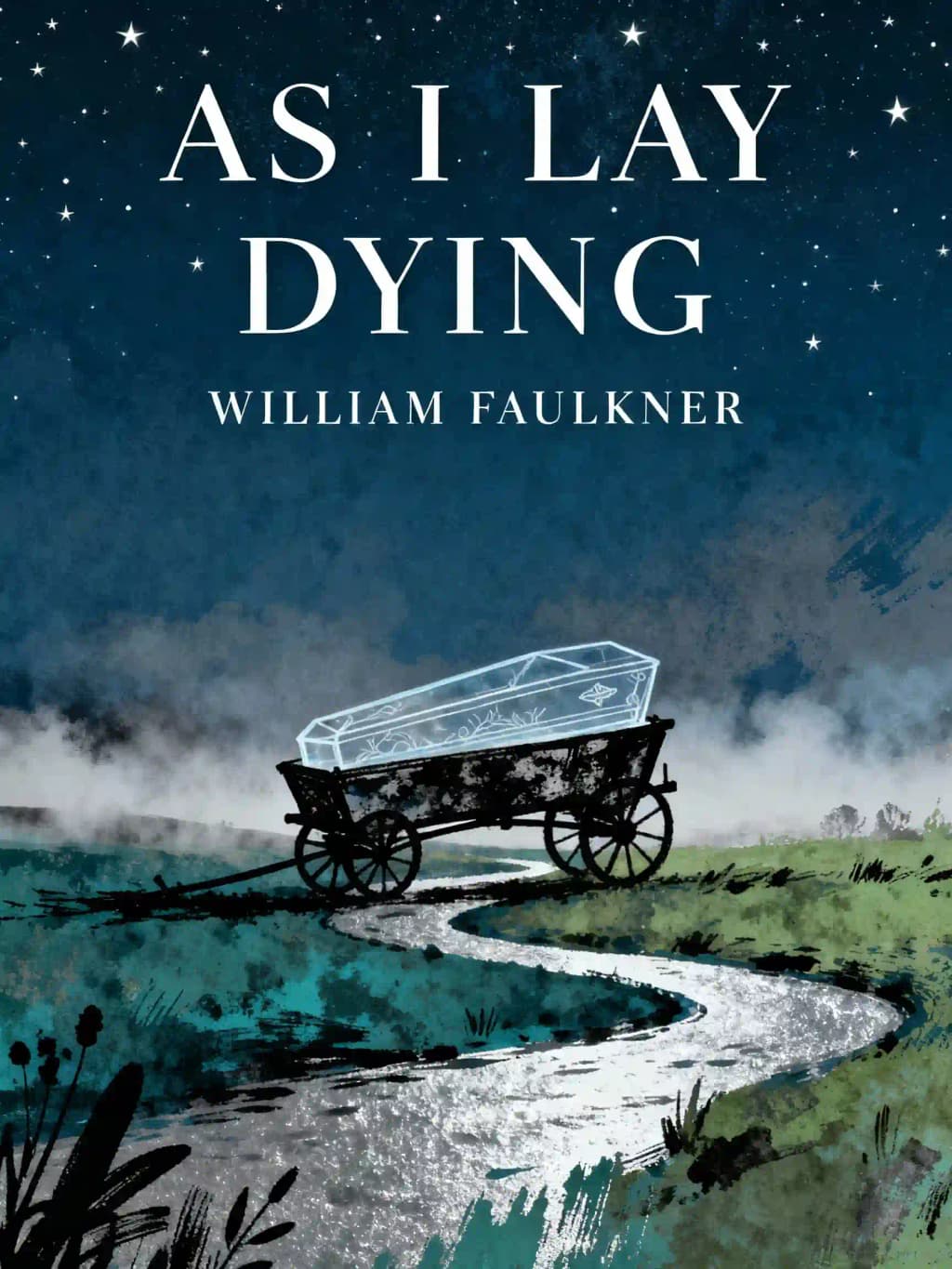
Faulkner's masterpiece narrates a family's journey through death using 15 voices across 59 chapters. This Nobel Prize-contributing work inspired metalcore band As I Lay Dying and influenced award-winning authors like Jesmyn Ward. Can 15 different perspectives reveal one universal truth?
William Cuthbert Faulkner (1897–1962), Nobel Prize-winning author of As I Lay Dying, redefined modern Southern Gothic literature with his innovative stream-of-consciousness narratives. Set in his fictional Yoknapatawpha County, this 1930 novel explores themes of mortality, family resilience, and the human condition through the Bundren family’s grueling burial journey.
A Mississippi native, Faulkner drew from his deep Southern roots to craft psychologically complex characters and layered social critiques, cementing his reputation as one of America’s greatest literary modernists. His groundbreaking works include The Sound and the Fury, Absalom, Absalom!, and Light in August, all notable for their experimental style and exploration of legacy and decay.
Awarded the 1949 Nobel Prize in Literature for his "powerful and artistically unique contribution to the modern American novel," Faulkner later received two Pulitzer Prizes for A Fable (1955) and The Reivers (1963). As I Lay Dying remains required reading in literature programs worldwide and has been translated into over 30 languages.
As I Lay Dying follows the Bundren family’s grueling journey to bury their matriarch, Addie, in her hometown. Told through 15 distinct perspectives, the novel explores themes of grief, identity, and existential struggle using Faulkner’s stream-of-consciousness style. Symbols like the coffin, Jewel’s horse, and Vardaman’s fish underscore the family’s fractured relationships and futile quest for meaning.
Fans of Southern Gothic literature, modernist narrative techniques, and psychological depth will appreciate this novel. Ideal for readers interested in experimental prose, existential themes, and complex family dynamics. Those seeking a challenge in unpacking unreliable narrators and layered symbolism will find it rewarding.
Yes—it’s a cornerstone of American literature, acclaimed for its innovative structure and haunting portrayal of human resilience. While its fragmented narrative demands attention, the novel’s exploration of mortality, selfishness, and perseverance offers profound insights. It’s frequently studied for its symbolic richness and Faulkner’s mastery of voice.
The coffin represents the physical and emotional burden of Addie’s death, mirroring the family’s deteriorating unity. Its uneven weight during the journey reflects their moral imbalance and futile efforts to fulfill Addie’s wish. Cash’s meticulous construction contrasts with the others’ selfish motives, symbolizing loyalty amid chaos.
Jewel’s wild horse symbolizes his defiance and emotional isolation. As Addie’s illegitimate son, he channels his pain into controlling the horse, which mirrors his struggle to reject Bundren identity. The horse’s untamed nature parallels Jewel’s inner turmoil and sacrificial role in saving Addie’s coffin.
Vardaman associates Addie’s death with the fish he gutted, linking decay to existential confusion. His childlike reasoning—declaring “my mother is a fish”—reveals his inability to grasp death’s finality. This metaphor underscores the novel’s theme of fragmented reality and the futility of language.
Dewey Dell’s unwanted pregnancy mirrors her powerlessness as a woman in a patriarchal society. Her desperation to abort the child—contrasted with her care for a cow—highlights her isolation and the family’s neglect. It symbolizes unspoken trauma and the cyclical nature of suffering.
By using 15 conflicting perspectives, Faulkner shows how personal biases and secrets distort truth. Darl’s existential musings clash with Anse’s selfish pragmatism, while Vardaman’s confusion contrasts with Cash’s logic. This technique questions whether objective reality exists beyond individual perception.
Critics note its challenging narrative structure and bleak tone, which can alienate casual readers. Some argue the characters’ moral ambiguity lacks redemption, while others critique its fragmented pacing. However, these elements are often defended as intentional reflections of human complexity.
Their treacherous trip to Jefferson—marked by floods, fire, and injury—mirrors life’s unpredictable hardships. Each obstacle tests their resolve, revealing selfishness (Anse’s new teeth) and fleeting solidarity. The journey becomes a metaphor for the inevitability of suffering and the illusion of purpose.
Addie’s posthumous monologue critiques hollow social conventions, declaring “words are no good.” Her affair with Whitfield and disdain for motherhood expose repressed desires and the futility of societal roles. This chapter reframes the entire narrative, questioning the authenticity of familial bonds.
Like The Sound and the Fury, it employs stream-of-consciousness and Southern decay themes but focuses more on communal trauma. Its darker tone and rural setting distinguish it from Light in August’s racial tensions. Faulkner’s exploration of death here is more visceral and ritualistic.
Почувствуйте книгу через голос автора
Превратите знания в увлекательные, богатые примерами идеи
Захватите ключевые идеи мгновенно для быстрого обучения
Наслаждайтесь книгой в весёлой и увлекательной форме
How often have I lain beneath rain on a strange roof, thinking of home.
I'm a luckless man.
I learned that words are no good; that words don't ever fit what they're trying to say.
I knew that living was terrible and this was the answer to it.
Разбейте ключевые идеи As I Lay Dying на понятные тезисы, чтобы понять, как инновационные команды создают, сотрудничают и растут.
Выделите из As I Lay Dying быстрые подсказки для запоминания, подчёркивающие ключевые принципы открытости, командной работы и творческой устойчивости.

Погрузитесь в As I Lay Dying через яркие истории, превращающие уроки инноваций в запоминающиеся и применимые моменты.
Задавайте любые вопросы, выбирайте голос и совместно создавайте идеи, которые действительно находят у вас отклик.

Создано выпускниками Колумбийского университета в Сан-Франциско
"Instead of endless scrolling, I just hit play on BeFreed. It saves me so much time."
"I never knew where to start with nonfiction—BeFreed’s book lists turned into podcasts gave me a clear path."
"Perfect balance between learning and entertainment. Finished ‘Thinking, Fast and Slow’ on my commute this week."
"Crazy how much I learned while walking the dog. BeFreed = small habits → big gains."
"Reading used to feel like a chore. Now it’s just part of my lifestyle."
"Feels effortless compared to reading. I’ve finished 6 books this month already."
"BeFreed turned my guilty doomscrolling into something that feels productive and inspiring."
"BeFreed turned my commute into learning time. 20-min podcasts are perfect for finishing books I never had time for."
"BeFreed replaced my podcast queue. Imagine Spotify for books — that’s it. 🙌"
"It is great for me to learn something from the book without reading it."
"The themed book list podcasts help me connect ideas across authors—like a guided audio journey."
"Makes me feel smarter every time before going to work"
Создано выпускниками Колумбийского университета в Сан-Франциско

Получите резюме книги «As I Lay Dying» в формате PDF или EPUB бесплатно. Распечатайте или читайте офлайн в любое время.
The Bundren family's world crumbles when matriarch Addie takes her final breath in their Mississippi farmhouse. Outside her window, her eldest son Cash meticulously builds her coffin, each saw stroke echoing through the stifling summer air. This striking image sets the stage for one of literature's most harrowing journeys-a family's quest to honor their mother's dying wish to be buried forty miles away in Jefferson with her blood relatives. What follows is no simple funeral procession but a nightmarish odyssey that will test each family member's resolve and expose the complex web of love, resentment, and madness binding them together. The Bundrens are a study in damaged humanity: Anse, the selfish patriarch who hides behind a facade of duty; Cash, the methodical carpenter whose quiet competence masks deep feeling; Darl, whose perceptive intelligence borders on supernatural; Jewel, fierce and action-oriented, born from Addie's secret affair; Dewey Dell, the only daughter concealing her pregnancy; and young Vardaman, who in his confusion famously declares "My mother is a fish." As they load Addie's coffin onto their wagon and set off toward Jefferson, they have no idea how their journey will transform them-or what secrets will surface along the way.