Глава 1
The Suspended Moment Between Life and Death
"An Occurrence at Owl Creek Bridge" stands as one of the most ingenious short stories in American literature, a masterpiece of misdirection that has influenced countless writers and filmmakers since its publication in 1890. Ambrose Bierce's psychological thriller about a man's final moments before execution has become a cultural touchstone, inspiring episodes of "The Twilight Zone" and earning a place in film history when a French adaptation won the 1962 Academy Award for Best Short Subject. Stephen King has cited it as a formative influence, praising Bierce's ability to manipulate time and perception. The story's twist ending has become so iconic that the term "Owl Creek Bridge ending" is now shorthand in literary circles for a narrative that reveals everything experienced was merely illusion or dream. What makes this tale particularly haunting is how it forces us to confront the ultimate human experience-the moment of death-and the mind's desperate attempt to escape the inevitable. How far will consciousness go to deny its own extinction?
Глава 2
The Anatomy of an Execution
The scene opens with meticulous precision-a man stands on a railroad bridge in northern Alabama, hands bound behind his back, a noose encircling his neck. The Federal troops surrounding him operate with mechanical efficiency, each soldier knowing his role in this grim tableau. Two privates stand ready to remove the plank beneath the condemned man's feet. Officers maintain their formal positions while sentinels stand at attention, rifles at parade rest. Across the stream, more soldiers form a line, silent witnesses to the impending execution.
The condemned man himself presents a striking figure-not a common criminal but a gentleman of about thirty-five, with a well-groomed mustache and aristocratic bearing. His gray eyes reveal intelligence and a certain dignity even in these final moments. He wears a frock coat and well-fitting trousers, the attire of a civilian planter of means and social standing.
As death approaches, his senses heighten to an almost supernatural degree. The rushing water below seems to slow, becoming a whisper that drowns out all other sounds. When he closes his eyes, attempting to conjure the faces of his beloved wife and children, the ticking of his watch intrudes-no longer a gentle rhythm but hammer blows against an anvil that reverberate through his skull.
Time itself becomes elastic. Each second stretches to unbearable lengths as his mind races with desperate calculations. If only he could free his hands, he thinks, he might dive into the stream below, swim to shore, and escape through the forest to his home. The distance to the water seems both impossibly far and tantalizingly close. He imagines the bullets that would follow him, visualizes dodging them, pictures himself running through the woods toward freedom.
This heightened awareness-this stretching of seconds into eternities-reflects the mind's rebellion against its own extinction. When faced with death, consciousness fights back with its most powerful weapon: the ability to perceive time differently, to make final moments last as long as possible. The condemned man's racing thoughts aren't merely desperate fantasies but the mind's attempt to create space where none exists, to carve out a few more precious moments of existence.
Глава 3
The Southern Gentleman: Peyton Farquhar
The identity of the condemned man is revealed: Peyton Farquhar, a wealthy Alabama plantation owner and ardent supporter of the Southern cause. Though passionate about the Confederacy, circumstances have prevented him from joining the army officially. Instead, he burns with the desire to serve in any capacity possible, eager to prove his loyalty and courage.
Farquhar embodies the Southern gentleman archetype-educated, refined, committed to a code of honor that demands action when his way of life is threatened. His plantation represents not just wealth but identity, a physical manifestation of his place in the social order. The Civil War has upended this order, bringing Northern troops onto Southern soil, threatening everything he values.
One evening, a gray-clad soldier rides up to Farquhar's gate requesting water. While his wife fetches it, the soldier mentions that Union forces have reached Owl Creek bridge, about thirty miles away, and are rebuilding it for their advance. The Federal commander, he explains, has issued orders to hang any civilian interfering with the railroad.
This information ignites Farquhar's imagination. When he inquires about the possibility of sabotaging the bridge, the soldier notes that driftwood has accumulated against the pier and would burn easily. The suggestion is subtle but clear-here is an opportunity for a civilian to strike a blow for the Confederate cause.
What Farquhar doesn't know, in a cruel twist of fate, is that this soldier is actually a Federal scout in disguise, deliberately baiting a trap. The Northerner plays perfectly on Southern psychology-the planter's desire to prove himself, his frustration at being sidelined from the conflict, his need to defend his homeland through direct action. The scout dangles the opportunity like bait before a fish, knowing that a man like Farquhar cannot resist.
This interaction reveals the psychological warfare underlying the physical conflict. The Northern scout understands his enemy well enough to manipulate him without force, using Farquhar's own values and desires against him. It's a chess move of particular cruelty, exploiting the Southerner's code of honor to lead him directly to his death.
Глава 4
The Escape That Never Was
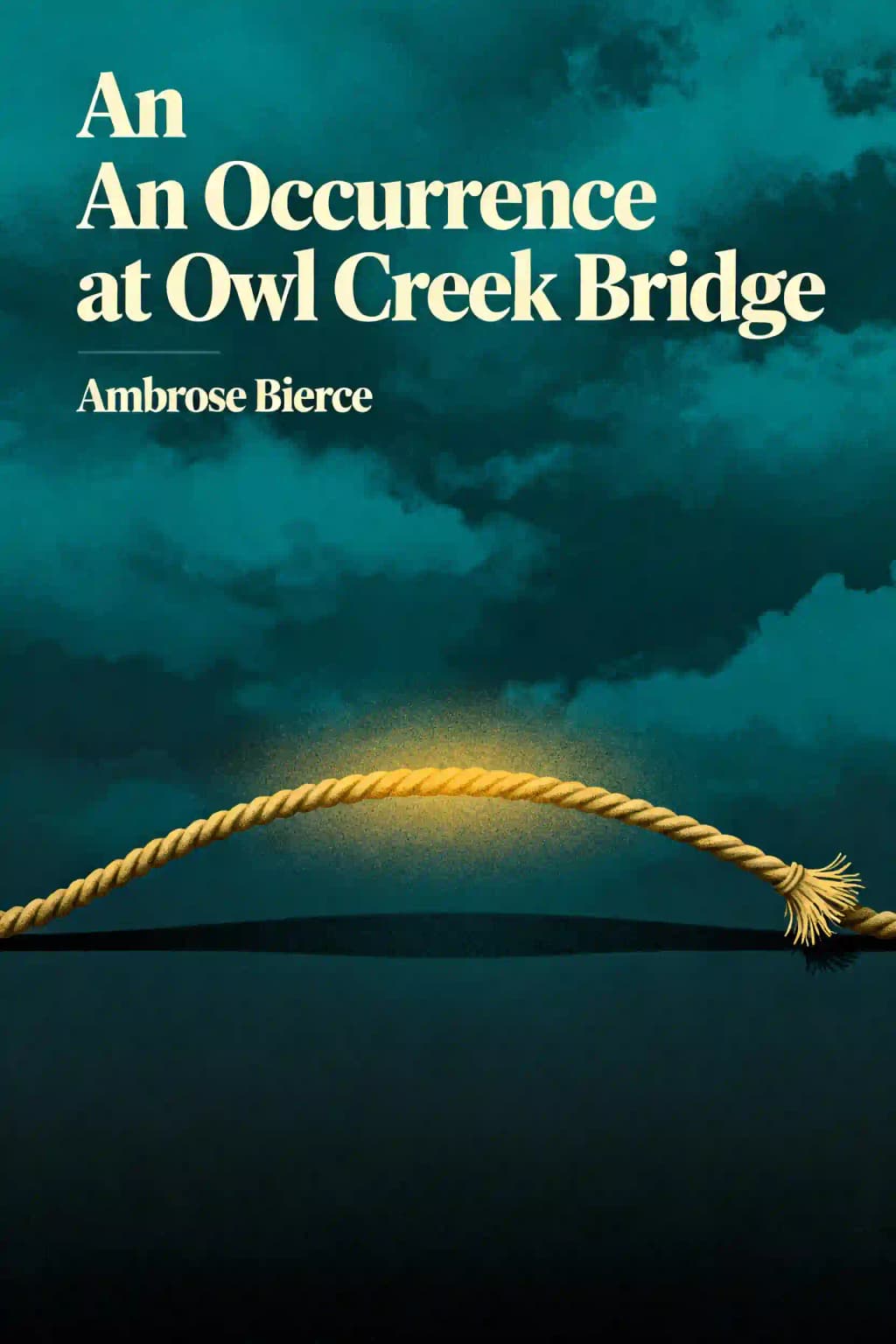
As the plank beneath Farquhar's feet falls away, he plummets downward-but then something extraordinary happens. The rope breaks. He loses consciousness briefly but awakens in the water below, the noose still around his neck but no longer tethered to the bridge. His senses become preternaturally acute, transforming into something beyond normal human perception.
He can see individual insects on the surface of the water. He hears distinct ripples and perceives the veins in each leaf on the trees along the shore. Looking up at the bridge, he observes the soldiers with impossible clarity-the buttons on their coats, the texture of their skin, even the gray eye of a marksman peering through rifle sights. When the lieutenant gives the order to fire, Farquhar can distinguish each syllable, noting the cruel precision in the officer's voice.
Diving deep to escape the volley of bullets, he hears the muffled thunder of gunfire underwater and feels flattened metal pieces falling around him like hail. His mind works with remarkable strategic clarity, calculating the trajectory of shots, planning his escape route, analyzing the patterns of the soldiers' fire. When artillery joins the assault, he's caught in a vortex created by a cannonball and flung onto the southern bank.
His perceptions continue to intensify beyond normal human experience. The sand appears as precious gems, each grain distinct and glittering. The trees transform into giant garden plants with ethereal music emanating from their leaves. He travels all day through what seems an endless forest, his hunger and fatigue both acute and somehow distant, as if happening to someone else.
Eventually, he finds a straight road that leads homeward. By nightfall, exhausted and disoriented, he sees his home in the distance. His beautiful wife stands waiting for him, a smile of welcome on her face. As he rushes toward her with outstretched arms, just before their embrace, he feels a stunning blow to his neck and sees a blinding white light.
The narrative then snaps back to reality with brutal efficiency: "Peyton Farquhar was dead; his body, with a broken neck, swung gently beneath the timbers of Owl Creek bridge." The entire escape was nothing more than the final fantasy of a dying brain, compressed into the split second between falling from the bridge and the rope reaching its full extension.
Глава 5
The Mind's Final Rebellion
What makes Farquhar's imagined escape so compelling is how it represents the mind's ultimate rebellion against death. In those final microseconds, his consciousness creates an elaborate alternate reality - one where the rope breaks, where he outswims bullets, where he navigates through a forest and finally reaches home. The mind, faced with its own extinction, constructs a complete narrative of survival, demonstrating the remarkable capacity of human consciousness to resist its own demise through creative imagination.
This psychological phenomenon has been extensively documented in near-death experiences - the sensation of time slowing, heightened perception, life flashing before one's eyes. Modern research has revealed that up to 20% of cardiac arrest survivors report such experiences, characterized by vivid sensory impressions and a distorted perception of time. Bierce captures this with remarkable insight, decades before modern neuroscience began to understand the brain's response to mortal danger. His prescient portrayal aligns with contemporary findings about the brain's ability to compress vast amounts of perceived experience into brief moments of actual time.
Farquhar's imagined journey follows a logical progression, addressing each obstacle he would face in a real escape with meticulous attention to detail. First, the rope must break - a plausible enough occurrence given the physical stresses involved in hanging. Then he must avoid the bullets - so his mind creates a scenario where he dives deep enough to escape them, complete with vivid sensations of the water's temperature and current. He needs to travel home - so his consciousness fabricates a day-long journey through the forest, filling it with rich sensory details like the texture of bark beneath his hands and the sound of wind through leaves. Each problem is solved in sequence, creating the illusion of possibility while maintaining internal logic that makes the escape seem achievable.
Yet subtle clues suggest the unreality of his experience, growing more numerous as the narrative progresses. His perceptions become increasingly surreal - the sand appearing as gems, the trees producing symphonic music, the forest taking on an otherworldly quality. Time and distance warp in impossible ways: he travels "all day" yet covers what should be thirty miles without adequate explanation or fatigue. Colors become more vivid than naturally possible, and his senses seem to operate independently of physical limitations. These inconsistencies hint at what the reader discovers in the final paragraph - that none of this is happening in physical reality but rather in the fraction of a second between the drop and the snap of the rope.
The mind's ability to create such elaborate alternative realities raises profound questions about consciousness itself. If Farquhar's brain can construct such a detailed escape in mere milliseconds - complete with tactile sensations, visual details, and complex problem-solving - what does this tell us about the nature of perception? Modern neuroscience suggests that our experience of reality is always, to some degree, a construction of our minds, with our brains filling in gaps and creating coherent narratives from incomplete information. How much of what we consider "reality" is actually a construction of our minds? The story suggests that consciousness is not merely a passive receiver of sensory information but an active creator of our experienced reality, constantly generating and maintaining our perception of the world around us.
Глава 6
Time's Elastic Nature
One of the most fascinating aspects of Farquhar's experience is how it manipulates time. At the beginning of the story, as he stands on the bridge awaiting execution, seconds stretch to unbearable lengths. The ticking of his watch becomes deafening, each click reverberating through his consciousness like thunder. Every minute detail - the rough hemp of the noose, the glint of morning sun on the water below, the measured breathing of the soldiers - takes on extraordinary significance. Later, during his imagined escape, time becomes even more elastic - he perceives individual bullets in flight, watches ripples form on water with hyper-detailed precision, and notices the individual veins of leaves as he flees through the forest.
This manipulation of temporal perception reflects actual psychological phenomena documented in numerous studies. In life-threatening situations, many people report that time seems to slow down - a phenomenon known as "chronostasis" or "temporal dilation." This isn't because time itself changes, but because the brain processes information differently under extreme stress. The amygdala - the brain's fear center - kicks into overdrive, recording memories with unusual density and detail. Adrenaline floods the system, heightening awareness and creating the subjective experience of time dilation. Combat veterans, accident survivors, and extreme sports athletes frequently report similar experiences, describing seconds that seemed to last for minutes.
Bierce's genius lies in how he uses this psychological reality as a narrative device. The story's structure mirrors Farquhar's subjective experience - beginning with meticulous, almost painfully slow descriptions of the execution scene, then accelerating through his imagined escape, before snapping back to the brutal reality of his death. Each section's pacing precisely matches the protagonist's psychological state. The methodical preparations for hanging are described with excruciating detail, while the escape sequence flows with dreamlike fluidity. The reader experiences the same temporal distortion as the protagonist, creating a deeply immersive psychological experience.
This manipulation serves a deeper purpose than mere suspense. It forces us to confront how subjective our experience of time truly is. What we perceive as a continuous flow is actually constructed moment by moment by our consciousness. Under extreme circumstances, this construction can be radically altered. Farquhar's final moments - objectively just a fraction of a second - contain subjectively an entire day's journey and the full emotional arc of hope, struggle, and homecoming. The story explores how the mind can compress or expand time based on emotional intensity and survival instinct.
The story thus becomes not just about a man's death but about the nature of experience itself. If a dying brain can create such a complete alternative reality in an instant - complete with sensory details, emotional resonance, and narrative coherence - what does this suggest about our everyday perceptions? How much of what we consider "real" is actually a construction of consciousness, assembled from sensory data but fundamentally shaped by our minds? Bierce's masterful manipulation of temporal perception raises profound questions about the nature of reality, consciousness, and the human experience of time.
Глава 7
The Civil War as Psychological Battlefield
While ostensibly a story about one man's death, "An Occurrence at Owl Creek Bridge" offers profound insights into the psychology of the Civil War. Farquhar represents the Southern planter class-wealthy, educated, committed to a way of life that the war threatens to destroy. His inability to join the Confederate army officially has left him with a desperate need to prove his courage and loyalty.
This psychological vulnerability makes him the perfect target for the Federal scout's manipulation. The Northern soldier, disguised in Confederate gray, understands exactly how to exploit Southern honor culture. He doesn't need to explicitly suggest sabotage-merely mentioning the bridge's vulnerability is enough to plant the idea in Farquhar's mind.
The interaction between Farquhar and the disguised scout reveals how psychological warfare operated alongside physical battles. The North didn't just fight the South with bullets and cannons but with intelligence operations that exploited their understanding of Southern psychology. The scout's manipulation of Farquhar demonstrates a sophisticated grasp of enemy motivation-knowing that for a certain class of Southerner, the need to take action for the Confederacy would override caution or common sense.
Bierce himself served in the Union Army and participated in some of the Civil War's bloodiest battles, including Shiloh and Chickamauga. His firsthand experience of combat informs the story's unflinching portrayal of military execution. The Federal soldiers at Owl Creek bridge operate with mechanical efficiency-the officers maintain proper distance, the sentinels stand at attention, the infantry company watches impassively from across the stream. Death has become bureaucratized, a matter of procedure rather than passion.
This clinical approach to killing represents the modernization of warfare that the Civil War introduced. Traditional concepts of individual courage and honor-which Farquhar still embraces-have been replaced by industrial-scale violence administered with technological precision. The railroad bridge itself symbolizes this modernization-the very infrastructure Farquhar attempts to sabotage represents the Northern industrial might that will ultimately defeat the agrarian South.
Глава 8
The Homecoming That Never Was
The most poignant aspect of Farquhar's imagined escape is its culmination-the vision of homecoming that he never achieves. After his day-long journey through the forest, he finally glimpses his plantation in the distance. The house appears "bright and beautiful" in the morning sunshine, surrounded by trees and with a "grand avenue" leading to it. His wife, described as "looking fresh and cool and sweet," waits for him at the bottom of the steps.
This vision represents everything Farquhar is fighting for-not abstract political ideals but this specific place, this specific woman. His home embodies his identity as a Southern gentleman, his place in the social order, his sense of self. His wife, waiting with a smile of joy and surprise, represents the emotional center of that identity-the love and connection that give his life meaning.
The tragedy deepens when we realize that this vision occurs in the microsecond before his death. As he rushes toward his wife with arms outstretched, he feels a stunning blow to his neck and sees a blinding white light-the moment when the rope snaps taut and breaks his neck. The homecoming he so desperately desires exists only in his mind, a final consolation created by his consciousness before extinction.
This imagined reunion reveals what Farquhar truly values. When facing death, his mind doesn't conjure military glory or political victory but the simple human connection of returning to his beloved. In his final moments, the cause he was willing to die for fades away, replaced by the more fundamental desire to return home, to embrace his wife once more.
The story thus becomes not just about how we die but about what we live for. When stripped to its essence by the approach of death, Farquhar's life is defined not by ideology but by love and connection. The tragedy lies not just in his execution but in the fact that his final conscious experience is of reaching for something he can never attain-a homecoming that exists only in his dying imagination.
Глава 9
Bierce's Masterful Deception
The true brilliance of "An Occurrence at Owl Creek Bridge" lies in how completely it deceives the reader. Bierce constructs Farquhar's escape with such vivid detail and psychological plausibility that we accept it as actually happening within the story world. The revelation in the final paragraph that none of it occurred-that it was merely the hallucination of a dying brain-forces us to reconsider everything we've just read.
This narrative sleight-of-hand works because Bierce understands how readers construct meaning. We naturally assume that what's described in a story is "really" happening unless explicitly told otherwise. By presenting Farquhar's imagined escape with the same objective tone used for the execution scene, Bierce exploits this assumption. Only subtle clues-the increasingly surreal perceptions, the compression of time and distance-hint at the unreality of the experience.
The story's structure reinforces this deception. By interrupting the execution scene with the flashback explaining Farquhar's identity and how he came to be at the bridge, Bierce creates a narrative gap. When we return to the hanging, we're primed to expect something to happen-for the story to continue beyond the execution. The apparent escape satisfies this expectation, making us less likely to question its reality.
This manipulation of reader expectations serves a deeper purpose than mere surprise. It makes us complicit in Farquhar's self-deception, experiencing the same false hope he does. When the truth is revealed, we share something of his shock and disappointment. The emotional impact of the ending comes not just from learning Farquhar's fate but from recognizing how completely we've been fooled.
Bierce's technique has influenced countless works since-from "The Twilight Zone" to films like "Jacob's Ladder" and "The Sixth Sense." The "twist" revealing that what we thought was happening was actually illusion or hallucination has become a standard narrative device. But Bierce's original implementation remains particularly powerful because it serves a profound thematic purpose-illustrating how desperately the mind fights against acknowledging its own extinction.
Глава 10
The Enduring Power of the Final Moment
More than a century after its publication, "An Occurrence at Owl Creek Bridge" continues to resonate because it addresses universal human concerns. We all face death eventually, and the question of what happens in those final moments-what we experience, what we think about, how our minds process the end of existence-holds eternal fascination.
Bierce suggests that consciousness, when confronted with its own extinction, might create elaborate alternative realities-not as supernatural phenomena but as the brain's natural response to mortal threat. This psychological insight has been validated by modern research into near-death experiences, which often include elements similar to Farquhar's hallucination: time dilation, heightened perception, life review, and visions of loved ones.
The story's enduring power also comes from how it balances psychological realism with philosophical inquiry. On one level, it's a precisely observed account of a man's execution during the Civil War, grounded in historical reality and human psychology. On another, it raises profound questions about the nature of time, perception, and consciousness itself.
Perhaps most powerfully, it forces us to confront the gap between subjective experience and objective reality. For Farquhar, his escape feels completely real-as real as the execution that preceded it. Yet objectively, it never happens. This disconnect challenges our understanding of what constitutes "reality." If experience is fundamentally subjective-constructed by our consciousness from sensory data-then in what sense was Farquhar's final hallucination not "real" to him?
This question has taken on new relevance in our age of virtual reality and digital simulation. As technology increasingly allows us to create convincing alternative realities, the boundary between actual and simulated experience becomes increasingly blurred. Bierce's story, written long before such technologies existed, anticipated this philosophical problem by showing how the mind itself can create experiences indistinguishable from "reality."
In its final moments, "An Occurrence at Owl Creek Bridge" collapses the distinction between subjective and objective with brutal efficiency. The sentence "Peyton Farquhar was dead" returns us from the elaborate construction of consciousness to the simple physical fact of a body hanging from a bridge. The mind's final rebellion has failed. Reality reasserts itself. The rope holds.