Глава 1
A World of Fire and Chains
In a realm where Scholars live under the brutal rule of the Martial Empire, two souls from opposite sides of the divide find themselves entangled in a dangerous game of survival, loyalty, and rebellion. Sabaa Tahir's "An Ember in the Ashes" took the literary world by storm when it debuted, quickly becoming a #1 New York Times bestseller and earning praise from Entertainment Weekly as "a deft, polished debut." The novel resonated deeply with readers for its unflinching look at oppression and resistance, with celebrities like Emma Watson recommending it to her book club. What makes this fantasy particularly compelling is how it draws from real historical oppression while creating a richly imagined world that feels both ancient and timeless. As political divisions and conversations about power continue to dominate our cultural landscape, Tahir's exploration of how individuals navigate systems designed to crush them remains startlingly relevant.
Глава 2
The Martial Empire: A World Built on Cruelty
The Martial Empire stands as a monument to brutal efficiency and ruthless domination. Once the proud homeland of the Scholar people, the territory has been under Martial rule for five centuries, transforming from a place of learning and culture into a militaristic regime where Scholars exist as little more than slaves. At the heart of this empire lies Blackcliff Military Academy, where the elite soldiers known as Masks are forged through years of brutal training.
The world Tahir creates is meticulously stratified. At the top sit the Martials-pale-skinned warriors who value strength and loyalty above all else. The Illustrians form the aristocratic upper class, while the common Martials serve as soldiers and merchants. The conquered Scholars, once keepers of knowledge and innovation, now live as an underclass-forbidden from reading or writing, constantly monitored, and subject to raids, imprisonment, and execution at the slightest provocation. The Tribes exist on the fringes, maintaining their independence in the desert but viewed with suspicion by the Empire.
What makes this world particularly chilling is how normalized its cruelty has become. Public executions are treated as entertainment. Students at Blackcliff are forced to watch as deserters are whipped to death, expected to cheer at the spectacle. The Commandant casually brands her slave with her initial, marking her as property. Even the architecture reflects this ethos-Blackcliff's walls are lined with iron spikes, and the Scholar Quarter is deliberately designed to be easily contained and controlled.
Yet beneath this rigid structure, whispers of resistance persist. The Scholar Resistance operates in shadows, planning strikes against their oppressors while struggling with internal divisions. And beyond human politics, ancient forces stir-the jinn, the Nightbringer, and the Augurs with their mysterious powers-suggesting that the Empire's dominance may not be as absolute as it appears.
Глава 3
Laia: From Cowardice to Courage
When we first meet Laia, she is defined by fear and self-perceived cowardice. During a raid on her family home, she flees while her brother Darin is captured, an action that haunts her with crushing guilt. "I am a coward," she repeatedly tells herself, the refrain becoming both her burden and her motivation. Her journey begins not with heroic ambition but with desperate love for her brother-the last remaining member of her family.
Laia's transformation unfolds gradually as she navigates increasingly dangerous situations. Initially, she seeks help from others, placing her trust in the Resistance and following their orders even when her instincts warn her otherwise. Her position as the Commandant's slave forces her to endure horrific abuse-beatings, brandings, and constant degradation. Yet with each new trauma, something within her hardens rather than breaks.
The pivotal moment in Laia's development comes when she discovers the Resistance has been manipulating her, lying about her brother's location and using her merely as a distraction. This betrayal catalyzes a fundamental shift in her approach: "I no longer want someone else to save me-I must take action myself." She begins formulating her own plans, making her own allies, and taking increasingly bold risks.
What makes Laia's character compelling is that her courage doesn't emerge from fearlessness but from acting despite her fear. When she confronts Marcus after he brutally beats her, she fights back "clawing, screaming, determined not to be passive like during the raid." Even when overwhelmed, she refuses to surrender her agency. By the novel's climax, when she orchestrates the explosion that disrupts Elias's execution, she has transformed from someone who runs from danger to someone who charges directly into it, driven by love and newfound determination.
Глава 4
Elias: The Reluctant Mask
Elias Veturius presents a fascinating contradiction-the Empire's most skilled soldier who secretly despises everything the Empire stands for. From our first encounter with him, we learn he plans to desert Blackcliff immediately after graduation, unable to stomach the cruelty he's been trained to inflict. "I'd rather die than become like her," he thinks about his mother, the Commandant, "soulless and merciless."
Unlike Laia, who grows into her courage, Elias begins with physical bravery but struggles with moral courage. His internal conflict centers on reconciling his training with his conscience. When forced to watch the execution of a deserter, he maintains the expected facade while inwardly disgusted: "I force myself to join the bloodthirsty cheering while inwardly disgusted." This pattern-outward compliance masking inner rebellion-defines much of his early character.
The Trials push Elias to his breaking point, particularly the Third Trial where he must lead his men against his closest friends. The experience shatters him: "I led my men to slaughter, murdered my friends, nearly killed Helene." This moral injury weighs on him far more than any physical wound could. When faced with the final Trial-executing Laia to prove his loyalty-he makes the choice that defines his character, refusing to cross that final line even at the cost of his own life.
Elias's relationship with his mother, the Commandant, adds another layer of complexity to his character. Despite her abandonment and cruelty, their shared features-"the same high cheekbones and pale gray eyes"-serve as a constant reminder of their connection and the path he refuses to follow. When she visits him in his cell before his execution, revealing how she almost killed him as an infant, his response is not hatred but pity-recognizing that her cruelty has trapped her far more effectively than his cell has confined him.
Глава 5
The Commandant: Cruelty Incarnate
Keris Veturia, the Commandant of Blackcliff, stands as one of the most chilling antagonists in contemporary fantasy. Her power lies not in supernatural abilities or overwhelming force but in calculated cruelty and psychological manipulation. She embodies the Empire's values taken to their logical extreme-discipline without mercy, strength without compassion, loyalty only to power.
The Commandant's physical description hints at her nature-tall and lean with "pale gray eyes like chips of ice" that seem to "look right through you." Her movements are described as precise and economical, reflecting her methodical approach to both violence and leadership. The blue tattoo that winds around her torso, spelling out "ALWAYS VICTO" with letters of different ages, suggests a lifelong commitment to victory at any cost.
Her relationship with Elias reveals the depths of her inhumanity. Having abandoned him in the desert as an infant after failing to abort him, she later attempted to return and kill him, only to find him gone. When he arrives at Blackcliff years later, she treats him with particular coldness, seeing in him both a reminder of her "weakness" and a rival for her father's approval. Her confession before his execution-that his death will finally free her from the mistake of showing him mercy-demonstrates how thoroughly she has rejected any human connection.
The Commandant's treatment of her slaves further illustrates her sadism. She brands Laia with her initial, marking her as property. She carves up Cook's face and forces her to swallow hot coals for attempting to poison her. These acts aren't merely punitive but deliberately designed to break her victims psychologically. As Cook explains, "She doesn't just want your obedience. She wants your spirit."
What makes the Commandant truly terrifying, however, is her strategic brilliance. She manipulates the Resistance into assassinating the Emperor, ensuring her favored candidate Marcus will take the throne. She plants spies within the Resistance itself. Even her cruelty serves a purpose-creating an atmosphere of such fear that resistance seems futile. In her perfect control and utter lack of empathy, she represents not just individual evil but the systemic cruelty of the Empire itself.
Глава 6
Helene: Duty and Divided Loyalties
Helene Aquilla walks perhaps the most difficult path of any character in the novel-torn between her unwavering loyalty to the Empire and her deep love for Elias. As the only female student at Blackcliff, she has fought twice as hard for her position, earning respect through sheer skill and determination. Her family motto-"loyal unto death"-isn't just words to her but the foundation of her identity.
When we first meet Helene, she appears straightforward-the perfect soldier, dedicated to the Empire and suspicious of Elias's growing discontent. Yet as the story progresses, her complexity emerges. She dreams of reforming the Empire from within, imagining "expanded trade, women in the army, improved relations with Mariners, and better treatment of Scholars." Her vision reveals both her compassion and her blindness-she wants to improve the system but cannot imagine dismantling it.
The Trials force Helene to make increasingly difficult choices. When ordered to fight against her friends, she does so with grim determination, later telling Elias, "They were soldiers who died in battle, with honor." This ability to compartmentalize allows her to function within the Empire's brutal system but widens the gulf between her and Elias.
Helene's most poignant conflict centers on her feelings for Elias. Though she never directly confesses her love until near the end, it shapes her actions throughout. When Elias is sentenced to death, she makes a desperate bargain with the Augurs-swearing fealty to whoever wins the Trials in exchange for Elias's life. This forces her into the impossible position of having to execute her closest friend while bound by oath to his enemy.
In the novel's final moments, Helene makes a choice that defines her character-returning Elias's weapons and helping him escape, even while warning him they'll be enemies thereafter. This act encapsulates her essential nature: torn between competing loyalties, finding small ways to honor both, and paying the price for her divided heart.
Глава 7
Supernatural Elements: Jinn, Augurs, and Ancient Powers
Beneath the political conflicts of the Martial Empire runs a deeper current of supernatural forces that add richness and mystery to the world. The most prominent of these are the Augurs-fourteen ageless, seemingly immortal beings with the ability to read minds and glimpse the future. They operate as kingmakers and enforcers of the Empire's traditions, yet their true nature and motivations remain enigmatic.
The Augurs' intervention drives much of the plot, from their selection of the four Aspirants to their orchestration of the brutal Trials. Cain, the Augur who appears most frequently, speaks in cryptic prophecies about Elias featuring "prominently in their visions-a thread of silver in a tapestry of night." Their powers seem vast but not unlimited; they cannot read the Commandant's mind because "darkness cloaks her," suggesting forces that even they cannot fully control.
More ancient than the Augurs are the jinn-immortal creatures of "sinless, smokeless fire" with vast knowledge and power. Cook's tale reveals how the Scholar Empire's attempt to enslave the jinn led to their downfall. Only the Nightbringer, king of the jinn, escaped imprisonment in the Star, driven mad by his failure to save his people. His alliance with the Martials led to the destruction of the Scholar Empire-a historical twist suggesting the current political situation stems from ancient supernatural conflicts.
The presence of ghuls-shadow creatures that feed on human sorrow-adds another layer to the supernatural ecosystem. These entities appear to Laia in moments of extreme distress, taking forms calculated to increase her suffering. Spiro Teluman reveals they are real creatures, not hallucinations, and can be banished with certain weapons.
Helene's unexpected healing abilities hint at yet another supernatural dimension. When she sings to the gravely injured Elias and later to Laia, she transfers her own vitality to heal them-a power she must keep secret for fear of being accused of witchcraft. This suggests that supernatural abilities may lie dormant in ordinary humans, waiting to be awakened by necessity or trauma.
These supernatural elements serve not just as plot devices but as metaphors for the novel's themes. The imprisoned jinn mirror the enslaved Scholars. The Augurs' manipulation of the Trials reflects the Empire's control of its citizens. The ghuls that feed on sorrow represent how systems of oppression thrive on human suffering. Together, they create a world where the supernatural and political are inextricably intertwined.
Глава 8
Resistance and Rebellion: The Cost of Freedom
The Scholar Resistance represents hope in a seemingly hopeless world-a network of fighters committed to overthrowing Martial rule despite overwhelming odds. Yet Tahir avoids romanticizing rebellion, instead portraying it as messy, morally complex, and fraught with internal conflicts.
The Resistance operates from the catacombs beneath Serra, divided into factions with different approaches. The older fighters led by Sana emphasize Izzat-a code of honor encompassing "strength, honor, pride, and freedom." The younger faction under Mazen favors pragmatism and strategic violence. This division reflects real-world revolutionary movements, where ideological differences often create internal strife.
Through Laia's experiences, we see both the Resistance's inspiring courage and its troubling compromises. When she first approaches them seeking help for her brother, she expects them to embody the heroic ideals her parents fought for. Instead, she finds Mazen willing to use her as a disposable spy with little concern for her survival. His later betrayal-revealing he never intended to help rescue Darin and was using Laia merely as a distraction-shatters her idealized view of the Resistance.
Cook's history with the Resistance adds another layer of complexity. Once a skilled explosives expert, she was captured, tortured, and forced to watch her loved ones die. Her bitterness toward the movement that failed to protect her raises uncomfortable questions about the responsibilities revolutionary organizations have toward their members. Her warning to Laia-"They'll use you... and then they'll throw you to the wolves"-proves tragically accurate.
The assassination of the Emperor demonstrates both the Resistance's capabilities and its vulnerabilities to manipulation. What seems like a victory-killing the Empire's leader-actually plays directly into the Commandant's plans, ensuring Marcus's succession and preventing civil war. This sobering outcome suggests that violence alone cannot dismantle systems of oppression without strategic understanding of power dynamics.
By the novel's end, both Laia and Elias have moved beyond institutional frameworks-neither fully aligned with the Empire nor the Resistance-suggesting that true liberation might require forging entirely new paths rather than working within existing structures.
Глава 9
Love and Connection in a World of Violence
Against the backdrop of brutal oppression, genuine human connection becomes both rare and precious. The novel explores various forms of love-romantic, familial, platonic-and how they provide strength and purpose in a world designed to isolate and dehumanize.
Laia's love for her brother Darin drives her entire journey. Despite learning he may have collaborated with the Empire by drawing Martial weapons, her commitment to saving him never wavers. This familial bond provides her with purpose when all else seems lost: "Save Darin. Find the Resistance." This mantra becomes her north star, guiding her through increasingly dangerous situations.
The relationship between Elias and Helene demonstrates the complexity of lifelong friendship evolving into something more complicated. Their bond, forged through years of shared training and mutual protection, creates a deep understanding-"I watch your back, you watch mine." Yet Helene's romantic feelings for Elias, which he cannot reciprocate, create painful asymmetry. Their almost-kiss during training captures this tension perfectly: a moment of potential connection immediately followed by the recognition of all that stands between them.
The growing attraction between Laia and Elias develops across seemingly insurmountable barriers-she a Scholar slave, he a Martial elite. Their connection begins with small acts of kindness: his protection from Marcus, her recognition of his humanity beneath the mask. Their night of conversation in his quarters reveals how rare honest connection is in their world-"Scholar slave and Mask, each trying to persuade the other that they're not evil." Their kiss represents a brief escape from their prescribed roles, "a plea to forget who we are," even as they both know the world won't allow them such freedom for long.
Keenan's interest in Laia adds another dimension to the romantic landscape. His connection to her father and his gentle treatment of her injuries create a foundation of trust, yet their interactions are always colored by the mission at hand. When he kisses her passionately before they part, Laia finds herself thinking of Elias instead-suggesting that true connection cannot be forced or manufactured.
Even smaller relationships demonstrate the power of human bonds in resisting dehumanization. Izzi's friendship with Laia provides crucial support within Blackcliff's hostile environment. The loyalty among Elias's platoon members contrasts sharply with the Empire's demand for absolute obedience to authority. These connections, however fragile, offer glimpses of a different way of being in a world defined by cruelty and power.
Глава 10
The Price of Freedom: Sacrifice and Moral Compromise
At its core, "An Ember in the Ashes" asks a profound question: What price are we willing to pay for freedom, and what compromises can we make before losing the very thing we're fighting for? Each character faces this dilemma in different forms, forced to weigh their principles against practical necessities in a world that punishes idealism.
Elias confronts this question most directly during the Trials. His refusal to execute Laia-choosing certain death over moral compromise-represents his line in the sand: "I'd rather die than become like her." Yet earlier, he made the devastating choice to order his men to kill their friends during the Third Trial, recognizing that showing mercy resulted in his own men dying to Augur magic. This contradiction haunts him, raising the question of whether one can remain moral within an immoral system.
Laia's journey involves increasingly difficult compromises. She begins with relatively clear moral boundaries but gradually accepts more morally ambiguous actions as necessary for her brother's survival. She spies on the Commandant, endangers Izzi, and ultimately orchestrates the explosion that kills and injures many at Elias's execution. Each step takes her further from the person she was, raising the question of how much one can compromise before becoming unrecognizable to oneself.
Helene's position is perhaps the most painful-torn between her oath to the Empire and her love for Elias. Her decision to swear fealty to Marcus in exchange for Elias's life represents an impossible choice: betraying either her closest friend or her deepest principles. When she tells Elias, "After this, we're enemies," we see the full cost of her compromise-sacrificing their friendship to save his life.
Even the Resistance faces this dilemma on an organizational level. Mazen justifies his manipulation of Laia and assassination of the Emperor as necessary steps toward eventual liberation. Yet these compromises ultimately serve the Commandant's plans, raising questions about whether ends-justify-means thinking leads to genuine freedom or merely replaces one form of oppression with another.
The novel offers no easy answers to these questions, instead suggesting that the struggle to maintain one's humanity while fighting inhumane systems is ongoing and imperfect. As Laia tells Elias, "There are two kinds of guilt-the kind that's a burden and the kind that gives you purpose." Perhaps the key lies not in avoiding compromise entirely but in ensuring that each compromise serves a purpose beyond mere survival-keeping alive the ember of hope that might eventually ignite change.
Глава 11
Embers of Hope in the Darkness
As the novel concludes, Laia and Elias escape into the catacombs beneath Blackcliff, taking their "first steps into darkness-into freedom." This powerful image captures the essential paradox at the heart of the story: freedom often begins not with triumph but with uncertainty, not with light but with darkness. Yet within this darkness, embers of hope persist.
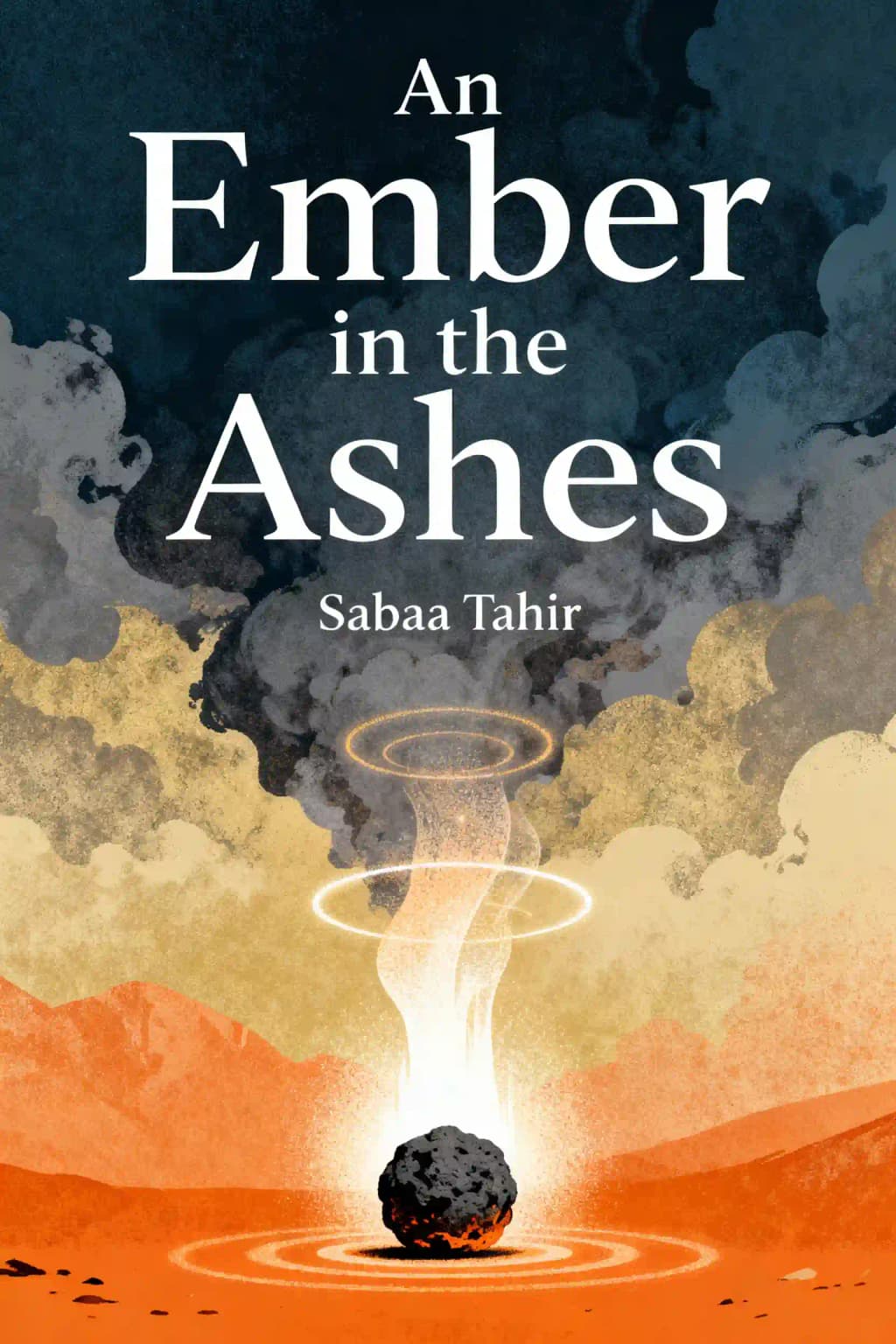
The title "An Ember in the Ashes" perfectly encapsulates this central theme. Throughout the narrative, characters maintain small flames of resistance against overwhelming oppression. Laia's determination to save her brother despite impossible odds. Elias's refusal to surrender his conscience despite years of conditioning. Helene's dream of reforming the Empire from within. Cook's quiet acts of rebellion through her stories. Izzi's kindness despite her trauma. Each represents an ember that refuses to be extinguished.
What gives these embers their power is not their immediate impact but their potential. A single ember, properly nurtured, can ignite a conflagration. When Laia whispers, "I'm coming for you, Darin. You stay alive. I'm coming, and nothing's going to stop me," she transforms from victim to agent of change. When Elias reaches for Laia's hand in the darkness, accepting uncertainty rather than predetermined paths, he chooses possibility over resignation.
The novel doesn't offer easy resolution or triumphant victory-Darin remains imprisoned, Marcus ascends to Emperor, and the protagonists face a perilous journey to Kauf Prison. Yet in choosing to act despite these challenges, the characters demonstrate that hope isn't about certainty of success but about refusing to accept defeat as inevitable.
This message resonates beyond the novel's fantasy setting. In our own world, where systems of oppression often seem insurmountable, the courage to maintain one's ember of resistance-however small-matters profoundly. As Cook's story about the jinn reveals, even the mightiest empires eventually fall, often beginning with small acts of defiance that grow into movements for change.
The final image of Elias and Laia facing three entrances in the catacombs, uncertain which path to take but determined to move forward together, reminds us that liberation is rarely a straight line. It's a journey through darkness guided by the small, persistent light of hope-an ember that, with care and courage, might someday become a flame.