Глава 1
A Champion's Quest for Equality On and Off the Court
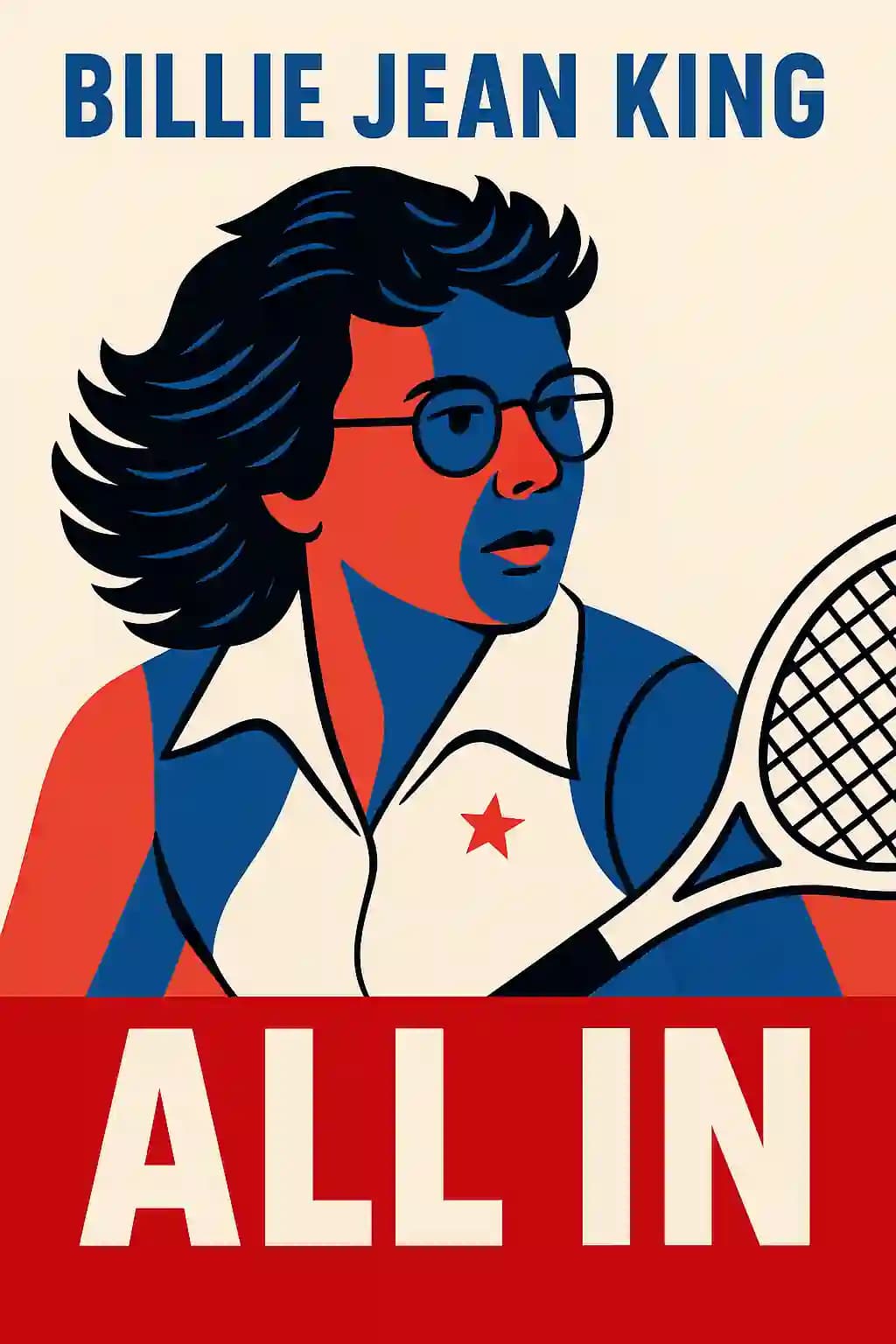
Imagine being a young girl in the 1950s, standing on a public tennis court with a borrowed racket, declaring to your mother: "I want to be the No. 1 tennis player in the world!" Now picture that same girl growing up to win 39 Grand Slam titles, defeat Bobby Riggs in the legendary "Battle of the Sexes" watched by 90 million viewers worldwide, and fundamentally transform women's sports forever. Billie Jean King's autobiography "All In" isn't just a sports memoir-it's the story of a social revolution told through the eyes of its unlikely leader. The book has earned praise from Barack Obama, who credits watching King's victory over Riggs at age twelve with shaping how he raised his daughters. With her signature blend of fierce determination and unwavering principle, King's journey from a working-class Long Beach neighborhood to global icon illuminates how one person's refusal to accept the status quo can change the world.
Глава 2
From Public Parks to Wimbledon's Centre Court
The journey began in 1954 when ten-year-old Billie Jean Moffitt attended her first tennis lesson with coach Clyde Walker at Houghton Park in Long Beach. After trying the sport at her friend Susan Williams' suggestion, Billie Jean asked her firefighter father which sport would be best for a girl "in the long term." When he suggested swimming, golf, or tennis, she chose tennis, drawn to its variety and mental challenges. She saved money from odd jobs to buy her first wooden racket for $8.29-a purple and white one she slept with for many nights. Under Clyde Walker's free instruction, she fell in love with the sport, particularly the feeling of connecting with the ball and the strategic possibilities. By the end of her first lesson, she confidently told her mother she wanted to be the world's best tennis player.
Billie Jean's parents were conservative but never limited their children's ambitions. Both she and her younger brother Randy pursued professional sports careers-Randy playing Major League Baseball for twelve years while Billie Jean went on to win thirty-nine Grand Slam titles. Their success stemmed from a combination of genetics, devoted parents, opportunity, and Southern California's ideal climate for year-round athletics. Unlike today's "snowplow parents," the Moffitts supported without pushing, focusing more on being "life coaches" who cared about effort and enjoyment rather than winning.
After meeting tennis instructor Clyde Walker, Billie Jean threw herself into tennis, practicing relentlessly against her home's fence until her father replaced it with a cinderblock wall and added a spotlight for night practice. Despite losing her first tournament match 6-0, 6-0, she was only more motivated. When she asked Clyde, "Can you make me a champion?" he responded, "No, Billie Jean. But with hard work, you can." This sparked her determination. When Clyde initially refused to teach her the American twist serve because "girls don't do the American twist," Billie Jean persisted and mastered it on her first try, earning the right to serve like the boys.
By 1960, Billie Jean had risen to the fourth-ranked player nationally. After declining a sponsor's offer to fund her Wimbledon trip the previous year-feeling she hadn't earned it yet-she finally accepted in 1961. Arriving in England, she was mesmerized by the intensely green landscape and Wimbledon's historic atmosphere. When she first saw Centre Court, she was awestruck by its perfect symmetry and sacred atmosphere, promising herself she wouldn't miss a tournament there-a vow she kept for sixty years until the pandemic canceled it in 2020. In her debut, she and doubles partner Karen Hantze upset Australian champions Jan Lehane and Margaret Smith to become the youngest team (at 18 and 17) to win Wimbledon-a record they still hold.
Глава 3
Finding Her Voice in a Changing World
The early 1960s marked the beginning of Billie Jean's awakening to social issues. At Los Angeles State College (now Cal State L.A.), she noticed glaring inequalities-male tennis stars like Arthur Ashe at UCLA received full scholarships while women received nothing. Her boyfriend Larry King was the first to bluntly point out sexism to her, noting how she was treated as a second-class citizen despite being the school's best athlete while he received better treatment as the seventh man on a six-man tennis team.
This conversation happened during the spring of 1963, just as Betty Friedan's "The Feminine Mystique" was published and the women's liberation movement was gaining momentum. The President's Commission on the Status of Women had documented tremendous inequality, leading to the Equal Pay Act. Meanwhile, the civil rights movement was exploding across America with Medgar Evers' assassination and Dr. Martin Luther King Jr.'s "I Have a Dream" speech.
Billie Jean's journey into the women's movement was gradual. In the late 1960s, women were fighting for basic rights that seem obvious today-birth control wasn't legal for all women until 1972, abortion wasn't legalized until 1973, and pregnancy discrimination remained legal until 1978. While her doubles partner Rosie Casals embraced the protest movement enthusiastically, Billie Jean took a more strategic approach, carefully choosing her words to keep dialogue open.
As a female athlete-activist, she was breaking new ground. While a few sportswomen had become sensations before her-Suzanne Lenglen, Alice Marble, Althea Gibson, Babe Didrikson Zaharias-none except Alice had been overtly political. Watching videos of her measured tone from that era makes her laugh now, especially compared to today's outspoken athletes like Megan Rapinoe. She was called radical despite her careful approach, and every action was magnified and dissected.
What truly resonated with Billie Jean was Maxwell Maltz's work on Psycho-Cybernetics, particularly his visualization techniques. Even before discovering Maltz, she'd mentally rehearse matches from three perspectives: her side of the court, her opponent's view, and an aerial perspective. This visualization practice helped her anticipate and dictate points, giving her an edge over opponents.
Глава 4
The Open Era and the Fight for Women's Tennis
The tennis world changed dramatically in December 1967 when Wimbledon officials announced they would welcome professionals and amateurs starting in 1968, triggering the Open Era-the most significant event in tennis history. While Billie Jean danced around her Berkeley apartment celebrating, Larry warned her, "Once men get open tennis, they're going to squeeze the women out."
His prediction proved prophetic. With the advent of open tennis, women players theoretically had more opportunities, but men quickly tried to push them out. Despite previously enjoying good relationships with male players, when Billie Jean tried to enlist their support for equal treatment and prize money, she was stunned by their rejection. The men forming the Association of Tennis Professionals in 1972 never responded to her inquiries about including women, and when John Newcombe organized the International Players Association in 1969, she was dismissively told, "You must be joking."
The breaking point came when Jack Kramer announced the 1970 Pepsi Pacific Southwest Championships would offer $65,000 to men versus just $7,500 for women, with women only paid if they reached quarterfinals. This disparity sparked an uprising that would forever change tennis and women's sports.
During the 1970 U.S. Open, Billie Jean wasn't playing due to knee surgery but was working as a television commentator for CBS. In the women's locker room, she and Rosie Casals began polling players about protesting Kramer's prize money decisions. They sought advice from Gladys Heldman, the brilliant publisher of World Tennis magazine, who attempted to negotiate with Kramer but reported back that "Kramer's an ass."
The rebellion came to a head when Gladys offered to organize an eight-woman tournament at the Houston Racquet Club the same week as Kramer's Pacific Southwest tournament, with $5,000 prize money. Nine players committed: Rosie Casals, Nancy Richey, Kerry Melville, Judy Dalton, Val Ziegenfuss, Peaches Bartkowicz, Kristy Pigeon, Patti Hogan, and Billie Jean, despite her recovering knee. When the USLTA threatened suspensions, they defiantly signed $1 contracts with Gladys Heldman's World Tennis magazine, becoming the "Original 9." Philip Morris agreed to sponsor their tournament through their Virginia Slims brand. They voted unanimously to control their own destiny, risking their careers for the principle that women deserved fair pay and opportunities to compete.
After their Houston rebellion, they immediately focused on building a sustainable tour. With Philip Morris's crucial backing, they launched the Virginia Slims Circuit in 1971 with nineteen tournaments offering $310,000 in prize money. By 1973, prize money had grown to $750,000 with rising stars like Martina Navratilova and Chris Evert joining. Philip Morris proved to be an ideal partner, providing marketing expertise that helped transform them into celebrities.
Глава 5
The Battle of the Sexes and Its Lasting Impact
Bobby Riggs, the former tennis champion and hustler, had been pestering Billie Jean for years to play him in a high-stakes challenge match. When Margaret Court accepted his $10,000 challenge and lost badly on Mother's Day 1973 in what became known as the "Mother's Day Massacre," Billie Jean immediately knew she had to play him. They negotiated a $100,000 winner-take-all purse, and she insisted on the men's standard best-of-five sets format to eliminate any potential excuses.
At the remove of a half century, it might be difficult to understand why so much importance was placed on a tennis match. But the significance was real, and the aftereffects were seismic. The America of 1973 was gripped by Watergate hearings, the Vietnam withdrawal, soaring inflation, and an energy crisis. American exceptionalism and traditional gender roles were being challenged. Riggs wasn't the only man saying women belonged in the home or were constitutionally incapable of handling tough jobs. By the mid-1970s, only 9 percent of physicians were female, with similarly low representation in law, politics, and executive positions.
The match would be watched by 30,472 spectators-the largest crowd ever for tennis-and an estimated 90 million worldwide. When play began, Billie Jean methodically constructed each point. Though Bobby broke her serve to lead 3-2 in the first set, she broke right back. She noticed he couldn't hit a backhand down the line, forcing him to play to her strength. At 4-4, she took the ninth game, and Bobby double-faulted on set point. She'd won the first set 6-4.
In the second set, she continued mixing up her shots, passing him with running backhands and forcing him out of his comfort zone. Bobby was panting between points while she remained focused. She took the second set 6-3. By the third set, Bobby was cramping and rubbing his hand. The final games were tormented affairs, but on her third match point, Bobby's weak backhand volley floated into the net. He jumped the net to congratulate her, admitting "You're too good. I underestimated you."
When news of her 6-4, 6-3, 6-3 victory flashed across television screens, celebrations erupted nationwide. At Smith College, five hundred women poured from their dormitories, rang the school bells, and marched with signs declaring "Today, tennis-tomorrow the world." The impact became clearer during her promotional tour for Philadelphia's new World TeamTennis team. A city worker shouted congratulations from a manhole, a police officer apologized for requesting her autograph, and the fire department made her an honorary chief. At The Philadelphia Bulletin, women told her they'd finally asked for raises after seeing her win-and got them!
The match happened at a crucial time for women's sports equality. A 1973 Sports Illustrated cover story had revealed shocking disparities: 50,000 men had college sports scholarships versus fewer than 50 women nationwide; one Syracuse school board budgeted $90,000 for boys' sports and just $200 for girls; and most girls surveyed couldn't name even a few female athletes.
Глава 6
Creating a Legacy Beyond the Court
Billie Jean launched the Women's Sports Foundation eight months after the Battle of the Sexes with the $5,000 award from Gillette's Cavalcade of Champions. Initially created to fight for gender equality in sports at all levels, the WSF evolved to provide research, education, legal referrals, grants, coaching, and leadership development. By Title IX's fiftieth anniversary in 2022, the WSF had invested over $100 million to expand opportunities for women and girls in sports. The impact has been extraordinary: female high school sports participation grew from just 3% in 1972 to 43% by 2020.
Creating a team tennis league had been her dream since childhood. After the Riggs match, she and Larry partnered with sports entrepreneur Dennis Murphy to launch World TeamTennis. Their vision was revolutionary: equal numbers of women and men on each roster, with their matches contributing equally to the final score. World TeamTennis introduced numerous innovations: music during matches, multicolor courts, no-ad scoring, player substitutions, paid linespeople, and electronic line-calling. Billie Jean made history coaching the Philadelphia Freedoms, becoming the first woman to coach men in professional sports.
Alongside the Women's Sports Foundation and World TeamTennis, they launched womenSports magazine in 1974. Despite launching during a recession with skyrocketing paper, ink, and postage costs, their market research showed female sports participation had increased 175% in just three years. As an editorial product, womenSports was progressive, creative, informative, and empowering. They covered everything from backpacking to women's tackle football, and even published an action manual on fighting Title IX non-compliance.
The demands of her expanding business empire and personal struggles took a toll. By October 1972, she was completely exhausted from the Slims tour, pushing her body beyond reason while working countless hours off-court. Fame had created complications-she couldn't eat in restaurants without interruption, with fans sometimes pulling up chairs uninvited to join her table. The questions about her marriage to Larry continued, and though she'd achieved most of her competitive goals, she lacked peace of mind.
Глава 7
Personal Struggles and Coming Out
In May 1972, Billie Jean met Marilyn Barnett, a Beverly Hills hairstylist. What drew her to Marilyn was that she knew nothing about tennis despite Billie Jean's recent Roland-Garros, Wimbledon, and U.S. Open titles. It felt wonderful to escape the tennis world. They began casually with dinner, and their relationship soon became physical. Being with Marilyn was liberating-she wasn't being judged as a player or businessperson.
Being gay in the 1970s was terrifying. There were no legal protections, contracts had morals clauses, and one scandal could destroy a career. LGBTQ+ people faced violence, arrest, family rejection, and worse. She was in a particularly difficult position as the tour's leading spokesperson and "Mother Freedom"-a truth-teller living a lie. Her religious upbringing and homophobic parents conflicted with her authentic self.
The worst happened in April 1981 when Marilyn filed a "palimony" lawsuit against her, effectively outing her to the world. The media created the term "galimony" for Marilyn's demands, and Billie Jean's life was forever changed. Her betrayal was a soul-destroying violation-she would never wish being outed on anybody. She might have eventually come out on her own, but it should have been her choice.
In the first two months after Marilyn's lawsuit, she lost at least $500,000 in endorsements and marketing deals-millions in the long run. Squibb immediately stopped running her vitamin commercials. A nearly completed $500,000 Wimbledon clothing line was canceled, along with contracts from Murjani Jeans, Japanese clothing, and Charleston Hosiery (whose CEO called her a "slut"). Within a year, she was the only major tennis player without a sportswear contract, despite her 39 Grand Slam titles.
After being outed, she played only six tournament singles matches in 1981, losing five. Though NBC kept her as a commentator at Wimbledon, executives were spooked by the scandal and limited her airtime. Producer Don Ohlmeyer fought for her to call part of the men's final between Borg and McEnroe-making her the first woman broadcaster to do so-before NBC pulled her after the first set.
Глава 8
Reconciliation and Renewed Purpose
At fifty-one, forty pounds overweight and emotionally at rock bottom, Billie Jean stood at the threshold of the Renfrew Center for Eating Disorders in Philadelphia, facing her moment of truth. Through therapy, she discovered her binge eating was an attempt to numb emotional pain. She realized being overweight provided "relief, comfort, protection from being harassed, especially over my sexuality." It took until she was fifty-one to finally tell her parents "I am gay," and her time at Renfrew showed her how her eating disorder connected to so many deeper issues.
After Renfrew, she embraced a new beginning with her partner Ilana Kloss. They became more open about their relationship, gradually expanding their circle of disclosure. Her parents finally accepted them as partners, with her mother ending their calls by saying, "Give Ilana our love." In 2006, when HBO aired a documentary about her, Ilana discussed their relationship on camera for the first time. That same year, when the USTA renamed the U.S. Open complex the Billie Jean King National Tennis Center, she publicly acknowledged Ilana as her partner after 27 years together.
Though much attention focuses on her early life and career, Billie Jean and Ilana have been together for forty years, yet their story remains largely untold. They complement each other perfectly-Billie Jean brings emotion, energy and vision, while Ilana excels at execution, selling concepts, and closing deals. As she turned seventy in 2013, they began thinking about her legacy, which led to founding the Billie Jean King Leadership Initiative in 2014, a nonprofit promoting equality, inclusion, and pay equity in the workplace.
In September 2020, the International Tennis Federation renamed the Fed Cup to the Billie Jean King Cup. The tournament had grown from a 16-team event in her day to 116 participating nations. The rebranding helped attract significant sponsorships, offering $12 million in prize money to the twelve finalist teams in 2021-equal to the pro-rata amount for the men's Davis Cup, finally closing the gender pay gap for international team competitions.
Глава 9
The Ongoing Fight for Equality
The Trump administration's attacks on hard-won protections exceeded anything Billie Jean had witnessed since the civil rights era of the 1960s. From family separations at the border to the violent response against peaceful protesters, these actions reminded her that progress is painfully slow but can be undone quickly without vigilance. Yet she found encouragement in the Black Lives Matter movement's momentum following the killings of George Floyd, Breonna Taylor, and Ahmaud Arbery. The diverse coalitions that formed-across races, genders, and backgrounds-gave her hope that we were finally approaching true equality.
The 2020 Black Lives Matter protests and the 2017 Women's March represented something starkly different from earlier movements-they featured truly diverse coalitions of people from all backgrounds marching together for shared humanity. Even majority-white communities demonstrated solidarity with Black Lives Matter. For the first time, she believed we were approaching a formula for achieving equality because the effort was genuinely inclusive.
After witnessing Emma Gonzalez's powerful speech at the March for Our Lives in Washington, Billie Jean sought her out at the NYC Pride March where they were both invited guests. Emma and her generation understand that human rights, women's rights, and LGBTQ+ rights are interconnected. All these movements-#NeverAgain, Black Lives Matter, TIME'S UP, #MeToo-share the same fundamental goal: equality for every human being. That's why she's made working for equity her life's calling.
Глава 10
A Legacy of Inspiration and Hope
In fall 2019, Billie Jean returned to Long Beach for the dedication of the new Billie Jean King Main Library. During this visit, she surprised fifth-graders at her elementary school, Los Cerritos, who were reading a book about her. When asked about their aspirations, they shared impressive goals like protecting the environment, fighting gun violence, and becoming doctors. She encouraged them to support each other regardless of race or gender, to do what's right rather than what's popular. When one boy with two dads expressed his desire to be an anti-bullying activist, she affirmed his understanding that everyone deserves to be themselves.
Billie Jean King is now in a happy place emotionally, though she wishes she'd found this well-being earlier in life. The journey has been rewarding despite its struggles. She often tells people she'd be upset to die now because she's not finished-she's always had a sense of urgency. Progress is slow; what seems like overnight revolutions usually represents tipping points after long struggles. She encourages people to imagine their end-of-life reflection: how will you want to remember yourself? What will you have stood for?
To children today, she says neither perfection nor constant bravery is realistic. To LGBTQ+ youth, she promises they'll make it through with allies who love them unconditionally. Living truthfully has finally allowed her to breathe freely. Despite a sometimes lonely, soul-shaking journey, she came through it. She is free.
Глава 11
The Champion's Philosophy: All In
Billie Jean King learned that effective activism requires more than just marching in streets-you must organize, mobilize, and focus on concrete achievements. Success demands putting your ego aside, adapting, listening, and cultivating allies even among those you're fighting, as they often hold the power to make change happen. Her ability to avoid taking things personally helped tremendously throughout her career.
Sports consistently shows us how talent emerges from everywhere and what we can achieve together without prejudice. All champions, herself included, hate losing more than they love winning. In tennis, everyone fails except one player per tournament. Champions adjust, showing resilience when facing the brutal truth that no one can help you on court. As Chris Evert's father said, "You're going to get out there and look at that big green rectangle and decide."
The guiding question for all Billie Jean's work is "When this is done, will we have helped make the world a better place?" She defines success as both doing well and doing good. Her journey from a public park in Long Beach to becoming a global icon for equality demonstrates the power of going "all in"-not just in tennis, but in the pursuit of justice and human dignity for all.