Глава 1
The Relentless Rush: How Modern Work Steals Our Time and Thought
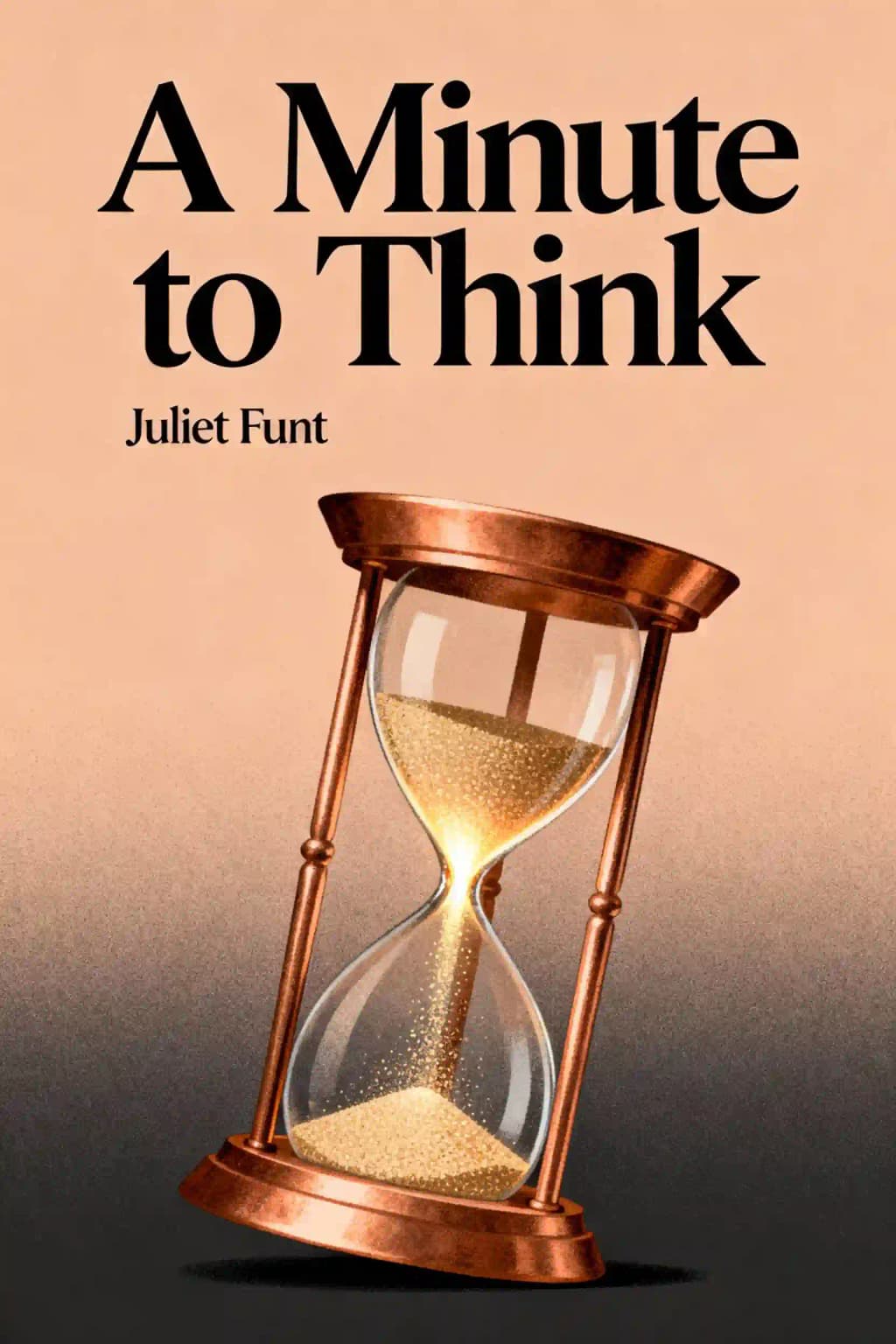
In a world where we're perpetually connected and constantly busy, Juliet Funt's "A Minute to Think" arrives like a cool washcloth on a fevered brow. The book has become a quiet revolution in corporate America, with companies like Google, Nike, and Spotify implementing its principles to combat what Funt calls our "culture of insatiability." As burnout rates skyrocket-with 23% of workers reporting frequent burnout-this book's message has never been more timely. What makes this work particularly compelling is Funt's personal journey; a self-described "natural-born interrupter" with a brain that "runs at breakneck speed," she now champions what she naturally lacks: white space-freed time to think, breathe, and create. This irony gives her message authenticity that resonates with overwhelmed professionals seeking a more sustainable way of working without sacrificing results.
Глава 2
The Missing Element: Our Desperate Need for Space
Think about building a fire. Without proper spacing between combustibles-fluffed pine needles, staggered fire starter, arranged wood-oxygen can't flow, and the fire dies. Our work lives operate on the same principle: without space, we can't sustain ourselves or ignite our brilliance.
Our days are packed like winning Tetris games, with no breathing room. We sprint through false productivity, maniacally checking boxes while uncertain of each task's relevance. From the moment our alarms jolt us awake, we're bombarded with emails, meetings, and interruptions. We multitask frantically, filling every gap with activity. The guilt follows-for not solving our own busyness, for neglecting family, for sabotaging health.
Consider Mindy, the "Peanut Butter Manager" who skips lunch while ironically supplying IV nutrients to patients, or Pete, the former EMT who ended up in the ER himself from work stress. We're consenting to a paradigm that's killing us.
This busyness is everywhere-even in tiny Motrone, Italy (population thirty), where a B&B host constantly checks his phone while driving treacherous mountain roads, muttering "It's a busy day!" There's no "they" doing it to us anymore. We've internalized it completely, carrying this pressure wherever we go.
Remember those quiet Sunday catch-up sessions when colleagues are absent and your inbox sits frozen? In that protected environment, you contemplate before acting, take breaks as needed, and accomplish in hours what would take days during the week. This isn't coincidence-you had oxygen to burn brightly.
Previous generations respected thinking as valuable work; seeing the boss staring out a window meant backing away quietly to preserve their thought process. Today, we'd interrupt a thinking colleague with "What are you working on?" Visible activity and actual productivity aren't the same. Thinking, pondering, questioning-these invisible forms of work often yield our greatest contributions.
The missing element is white space-"time with no assignment." The strategic pause, a moment of chosen cessation of activity, is the catalyst for white space to appear. Without these pauses, our days become endless streams of activity with no room for thoughtful work. By giving ourselves permission to pause, we create space for reflection, preparation, and recovery that transforms the entire nature of our work.
Глава 3
The False God of Busyness: Our Collective Delusion
We've fallen prey to the false god of busyness, driven by three main factors: insatiability, conformity, and waste. The path of more is unsustainable, with studies showing 80% of men wish to work fewer hours. Yet "less" can liberate us-Microsoft Japan found a four-day workweek increased productivity by 40% while reducing overhead costs by nearly 25%.
Some companies intentionally build "less" into their business models: Southwest Airlines flies only Boeing 737s for operational simplicity; In-N-Out Burger chooses employee celebration over maximum profits; and Basecamp implements 32-hour summer workweeks. These choices stem from values of simplicity, logic, and restraint-a refreshing alternative to our lemming-like march toward overwork.
We lack permission to pause because we don't have enough company doing so. This social conformity was famously demonstrated by Allen Funt's "Candid Camera" show, where subjects in elevators would unconsciously mirror actors who faced backward or removed their hats. We follow the same patterns at work-if everyone stays late or constantly checks email, we do too, creating a reciprocal feedback loop of overwork.
This conformity is reinforced by corporate brainwashing that normalizes illogical behaviors. Even powerful executives like Devon sit through unnecessary meetings, feeling powerless to change the system. Face-time demands particularly threaten white space, as demonstrated by new hires who struggle to adapt to Results Only Work Environments where only outcomes matter, not when or where work happens.
Waste threatens our ability to pause through sheer stupidity-low-value work that's both costly and grueling. Harvard Business Review's Bureaucracy Mass Index found workers spend 28% of their time-more than one day weekly-on bureaucratic chores like pointless meetings and needless reports.
Companies that redline their talent with busywork are hemorrhaging money but don't measure it. Whether your $100,000 COO revolutionizes your business or wastes half her day in her inbox, you pay the same amount. Analysis shows organizations waste over one million dollars annually in busywork for every fifty professionals. This inefficiency would never be tolerated in manufacturing, where Lean Six Sigma consultants would immediately address it.
When large organizations try to solve efficiency problems, they typically start with logistical adjustments: reorganizations, technology improvements, automation. These are the "bricks" in the house of efficiency. However, most companies forget the essential "mortar"-behavioral changes. Without teaching team members how to say no to unnecessary requests, write concisely, or preserve concentration without interruption, even the most sophisticated logistical solutions will fail to create true efficiency.
Глава 4
The Strategic Pause: Creating Space for Thought
A strategic pause-giving yourself a minute to think-can transform your work and life. Danielle Bishop, once a national accounts director at Pinehurst Resort, used white space to develop clarity about her entrepreneurial ambitions. By regularly pausing for strategic thinking, she launched HB Hospitality and grew it to seventy-five annual events. When the 2020 economic crisis threatened her business, white space helped her reimagine her entire business model within two months.
Science confirms that pauses enhance performance. Neuroscientist Adam Gazzaley explains that without breaks, our brains-particularly the frontal lobe controlling executive function-experience cognitive fatigue that impairs performance. Research shows strategic pauses allow our brains to regroup, leading to more efficient neural processing, increased productivity, and enhanced creativity. Studies demonstrate that even brief mental breaks improve concentration, with one showing that computer users improved work accuracy by 13% when reminded to take short breaks.
Strategic pauses come in four essential forms: pauses to recuperate (rebooting exhausted brains and bodies), pauses to reduce (lessening your workload), pauses to reflect (gaining objectivity and improving decisions), and pauses to construct (generating new ideas and solutions). Reflection has powered the success of leaders like LinkedIn CEO Jeff Weiner, who schedules "nothing" on his calendar, Phil Knight of Nike who had a designated daydreaming chair, and Bill Gates with his famous "Think Weeks" in isolated cabins.
The Wedge is a small portion of white space inserted between two activities that would otherwise be connected. This elegant, adaptable tool creates moments to think, plan, or compose yourself in the midst of a busy day. Wedges can be brief-from seconds to minutes-but they transform your experience by creating space between receiving and responding to emails, between meetings, or between work and home life.
Network engineer Sean McDonald faced a crisis when his school's network crashed. As panic grew among staff, he used his "wedge" technique-stepping away from the problem to think clearly. This mental pause helped him realize someone had created an infinite loop by connecting both ends of a cable to different ports. By removing himself from the chaos, he found the solution that restored the network.
Our minds naturally gravitate toward negative thoughts, making our pauses vulnerable to worry and rumination. While emotions should be felt in real time, worry can be contained by scheduling it-dedicating specific time each day to address concerns rather than letting them hijack every moment of white space.
Глава 5
The Thieves of Time: Identifying What Steals Our Space
Just as ocean swimmers must understand currents to navigate safely, we must recognize the invisible forces pulling us away from white space. Our struggle isn't simply personal failure but results from external pressures. Four key drivers-Drive, Excellence, Information, and Activity-are positive assets that become "Thieves of Time" when they overgrow their boundaries, transforming into overdrive, perfectionism, information overload, and frenzy.
The four Thieves of Time are like morning glory vines-beautiful and vital but potentially invasive when unchecked. These manifest when we mindlessly accept meetings because we're driven, overtweak presentations in pursuit of excellence, go too deep into data to stay informed, or impulsively tackle to-do lists to remain active. The thieves lure us with stimulation and minor victories while preventing heroic wins, hiding their true nature behind cons that contrast with reality.
Drive powers every achievement and creation in history. Without it, nothing significant happens. Yet drive's voraciousness emerges in a culture that demands we "do it all" and never release anything. Drive-oriented people constantly take on challenges, say yes reflexively, and struggle to let go of even low-value tasks. Leaders with excessive drive push teams in too many directions simultaneously, failing to appreciate recovery as a professional necessity.
Excellence creates precision and beauty in professional work. Every detail makes the world more dependable. But excellence-driven people apply the same exacting standards to everything-from departmental flyers to major client proposals. They forget that excellence is a finite daily resource, like a pouch of gold coins that runs out when spent indiscriminately.
One weekday New York Times contains more information than a 17th-century person might encounter in a lifetime. Information junkies fall into bottomless pits of dashboards, spreadsheets and internet research, with employees spending over half their workdays receiving and managing information rather than applying it. Despite information's obvious value, nearly two-thirds of professionals report their work quality suffers from information overload.
Activity drives people like directionless moles-heads down, digging frantically without a plan. We've created products like "Soup to Go" because even lunch has become portable in our unrestrained busyness. Activity-driven people crave the satisfaction of checking boxes, sometimes even writing down completed tasks just for the pleasure of marking them done. More people score high on activity than any other thief.
We often remain blind to our thieves' downsides because we're enchanted by them. What feels enjoyable about the thieves is precisely what makes them dangerous. Like the value system of "more," they operate on the "hedonic treadmill"-we adapt to each new level and soon want more. Without a sense of "enough," we're left chronically deprived of arrival.
Глава 6
The Simplification Questions: Reclaiming Our Best Work
When value replaces quantity in our goals, we unleash our potential. It's time to "de-crapify" our days by adopting a reductive mindset-seeing the world in a way that makes eliminating the unnecessary second nature. Like Michelangelo chiseling away everything that wasn't David, we must remove everything that isn't our best work and life.
Four powerful questions can help pause and redirect the thieves' energy. Each maps to a specific thief: "Is there anything I can let go of?" controls Drive's overdrive; "Where is 'good enough,' good enough?" tames Excellence's perfectionism; "What do I truly need to know?" manages Information's overload; and "What deserves my attention?" quiets Activity's frenzy. These twenty-five words provide a framework that can be used at individual or team levels, helping discern between habitual and practical applications of our energy.
People naturally gravitate to the question they most need. Donna, a marketing director and self-described perfectionist, found freedom in asking "Where is 'good enough,' good enough?" to distinguish between business-relevant perfectionism and "recreational" perfectionism. Mark Baublit, who learned an intense work ethic from his father but nearly sacrificed his health and family, now relies on "What deserves my attention?" to focus on intentional mentorship in his business.
When people grasp how much waste exists in their workload, they often want to slash everything immediately. But hasty cuts risk eliminating the wrong things. Instead, we should slow down and observe like anthropologist Jane Goodall, studying our work environment with curious neutrality before making changes.
When reducing waste in your work, you can target either "tuna" (massive projects like canceling a three-day offsite) or "krill" (small improvements like shaving five minutes off meetings). While newcomers to reduction crave the dramatic impact of landing a tuna, starting with krill is often wiser. These small changes compound effectively-like eliminating one field from tracking software saving half a second per salesperson, multiplied across hundreds of interactions daily.
We often resist delegation due to mistrust, fear of becoming expendable, guilt about asking for help, or perfectionism. Some "half-delegate" by maintaining control over supposedly released projects, defeating the purpose entirely. Like trees in the Biosphere 2 that fell over because they never faced wind, our teams need challenges to grow strong. Delegate not just to your trusted first tier but also to your "almost trusted" second tier to develop new talent.
In publishing, "kill your darlings" means cutting beloved writing to strengthen the whole piece. Similarly, we must sacrifice cherished work projects to free our energy. This proves difficult because of the IKEA effect-we overvalue things we've created ourselves. Effort justification, a type of cognitive dissonance, makes us believe there must be good reason for all the work we've invested, making it nearly impossible to walk away from low-value projects we've parented.
Глава 7
Hallucinated Urgency: Breaking Free from False Emergencies
We operate in a state of "hallucinated urgency"-a chronic condition where everything feels equally time-sensitive, keeping us in perpetual fight-or-flight mode. This altered mental state causes us to send emails prematurely, blurt out hasty answers, and respond to every notification with equal panic. We define everything as time-sensitive by default, crying "Wolf!" from every corner.
During a 1998 trip to Israel as a liaison on a Palestinian-Israeli peace project, Funt discovered how stubborn our minds are when stuck in expectations. Staying with various hosts, she repeatedly expected large hot dinners (the American norm) but was served cold snacks and endless cucumbers, as Arabs eat their main meal at noon. This mirrors our workplace expectations around pace-we assume faster is better, waiting is weakness, and any gap in responsiveness signals a problem.
To understand real urgency, Funt worked with emergency room nurses who face genuine life-or-death situations daily. Even in this environment of true urgency, they discovered opportunities for strategic pauses. Nurses found that elaborate hand-washing routines provided time for mental white space, and they could allow their minds brief recuperative pauses while their bodies remained in motion. When triaging rooms full of injured people, one nurse shared her approach: "I pause. I smile. And I say to the whole line of them, 'One at a time.'" This perspective reminds us what "urgent" truly means-blood and pulses, not reports and presentation decks.
To manage hallucinated urgency, use the Wedge to pause before responding to any "when" or "how soon" question. This strengthens impulse control and allows you to categorize tasks into three types: NOT TIME SENSITIVE (rare but important to identify explicitly), TACTICALLY TIME SENSITIVE (where speed genuinely affects business results), and EMOTIONALLY TIME SENSITIVE (needs masquerading as urgent due to curiosity, anxiety, control issues, or excitement).
The Yellow List is a tool for "parking" non-time-sensitive communications until the appropriate moment. Instead of letting thoughts become immediate interruptions, collect questions, ideas, and issues for each person you regularly interact with. When the list grows, schedule brief meetings to address items in batches rather than creating "death-by-a-thousand-cuts" outreach.
When dealing with demanding clients, frame any boundary-setting as beneficial to them rather than yourself. Instead of saying you'll check email less often, explain you'll check it more predictably. This approach mirrors a hospital study where nurses who announced regular check-ins reduced patient call button usage, as patients naturally distinguished between urgent and non-urgent needs.
Curbing urgency enhances executive presence-that intangible blend of calm, confidence, humbleness, clarity and power that marks true leaders. Those with executive presence treat few things as urgent, give full attention during interactions, follow through reliably, and speak with a relaxed cadence. They claim calm pacing as their right. In contrast, most of us race through our days, appearing rattled and slightly unhinged.
Глава 8
Creating a White Space Team: Transforming Culture Together
White space principles can be cemented through creating norms-authoritative standards binding group members. When something becomes normal, it's easier to do because friction is reduced. Norms can exist between individuals, families, teams or entire organizations, and collectively they create culture. While white space belongs to you regardless of whether others join you, practicing it together makes it dramatically easier to maintain.
Though you can practice white space principles alone, it's significantly more effective with others. Leslie Perlow's research at Boston Consulting Group demonstrated this through a "Predictable Time Off" experiment where team members rotated having one completely disconnected night per week. The coalition of mutual support made it work, even during intense client deadlines.
Before trying to change others, ardently apply white space principles to your own work and sphere of influence. Clean up your side of the street before handing your neighbor a broom. If you're still sending senseless meeting invites, interrupting others, and writing four-hundred-word emails, you won't be a magnetic role model.
To engage others in white space practices, you must speak their "love language" at work. People generally respond to one of three primary frequencies: money, people, or ideas. Finance Folks care about spreadsheets, ROI, and cost-cutting-speak to them about quantification, improved workflow, and the illogical nature of paying for unnecessary work. People People prioritize feeling good and thriving holistically-highlight the themes of sanity and humanity. Idea Lovers obsess over innovations and solutions-present white space as an accelerant for creativity.
Like rock climbing instructors who demonstrate the "empty shoe" technique rather than just saying "trust your feet," effective white space advocates focus on specific practices rather than abstract philosophy. Share your favorite tools and concepts as actionable samples people can try. David Peckinpaugh at Maritz Global Events introduced white space to 1,200 busy event professionals through a simple webinar series showcasing just three specific tools: the Simplification Questions, the Yellow List, and avoiding one-word emails.
Leaders must address the "power distance" that inhibits honest communication by asking for help and being open to input. For white space adoption specifically, leadership permission is crucial since taking strategic pauses contradicts traditional workplace rewards. Senior executives should: question assumptions about time freedom (recognizing that lower-level staff have less autonomy); directly ask about pain points; make vulnerable admissions about their own complicity in creating urgency; model white space behaviors authentically; fix the organizational environment ("the road") rather than just optimizing employees ("the cars") with wellness perks; and maintain availability for spontaneous interaction rather than scheduling every moment.
Patience is essential both in personal white space practice and when trying to influence others. Tara Barbieri's story demonstrates this patience-she practiced white space principles for six years before they spread throughout her organization at CDW. By implementing "microactions" that sparked curiosity and partnering with a supportive leader (Andy Eccles), she eventually transformed team communication, reduced urgency, and achieved outstanding employee engagement scores.
Глава 9
Life Beyond Work: Finding Space for What Matters Most
This chapter explores how white space principles extend beyond professional settings to enrich our personal lives. Funt contrasts work's "Technicolor" dopamine-rich environment with home life, where we often tune out and put in less effort. She argues that strategic pauses in our personal lives increase the "aliveness" of moments with family and friends, creating a slow-motion effect that reminds us "This is important."
We struggle to give ourselves permission to embrace balance guiltlessly. Funt illustrates this through "Kim," a VP who loves sailing but feels guilty leaving work early for it, partly due to workplace shaming around work-life balance. This discomfort deepens when surrounded by colleagues who sacrifice their personal lives. Funt counters with research showing balanced people actually work harder, perform better, take less sick leave, and make sharper decisions.
She describes how difficult it is to truly rest at home, as household tasks constantly demand attention-the gutters say "clean me," the dishes say "wash me"-creating a cacophony that makes stopping nearly impossible.
Comparing ourselves to others robs us of white space and contentment. We see neighbors' fancy possessions without knowing about their credit card debt, or observe seemingly perfect marriages without seeing their private struggles. Funt shares her fantasy of a "Lower the Bar" tour where she'd encourage people to proudly display benevolent mediocrity-unmade beds, fitness enthusiasts enjoying donuts, perfect parents losing their cool-to help everyone rest in our shared human imperfection.
The Thieves of Time follow us home: Drive pushes us toward impressive wealth and possessions; Excellence demands perfection in fitness, parenting and hobbies; Information insists we stay current on everything; and Activity convinces us to fill every moment. The Simplification Questions can help individuals and families counter these thieves by identifying what to let go of, where "good enough" is sufficient, what we truly need to know, and what genuinely deserves our attention.
Funt shares her deep concern about screens destroying human connection, describing a wedding scene where engaged grandparents contrasted sharply with screen-absorbed preteens. She confesses her militant stance against devices stems from her own susceptibility to screen addiction, and while acknowledging people have always found ways to escape the present moment-from newspapers to daydreaming-she argues it's "never been like it is today" with our always-on devices.
For parents, Funt emphasizes that strategic pausing can profoundly change both the experience and results of parenting. She cautions against "the subtle violence of self-improvement" where awareness of imperfection creates vulnerability, especially in parenting where stakes are high. Instead, she encourages aiming to be just "1 percent more white space-y" than before.
Funt defines her personal meaning of life as bringing joy to others and ourselves. She notes that despite material wealth increasing, happiness peaked in 1957 when houses averaged just 900 square feet, suggesting our pursuit of what we think will bring joy often leads us astray. She introduces the Italian concept of "dolce far niente" (the sweetness of doing nothing) as an antidote to constant busyness.
She concludes with a poignant story about a woman whose mother declined joining a family picnic with her husband and daughter because she was "busy." When the husband died two days later, the mother spent the rest of her life regretting that she "didn't take the ride." The message is clear-whatever matters most, white space in your day allows you to prioritize it before it's too late.