BeFreed
    Categories>Philosophy & Spirituality>Plato’s Republic: The Ring of Gyges and Glaucon’s Challenge

    Plato’s Republic: The Ring of Gyges and Glaucon’s Challenge

    17분
    |
    |
    2026년 8월 22일
    • Philosophy & Spirituality
    • Psychology
    • Self-Growth

    Explore Plato’s Republic and the Ring of Gyges. Join the debate on Glaucon’s challenge to Socrates regarding justice, morality, and the social contract theory.

    Plato’s Republic: The Ring of Gyges and Glaucon’s Challenge
    0:00 / 0:00
    전달 방식을 선택하세요

    하나의 에피소드, 다양한 청취 방식.

    Plato’s Republic: The Ring of Gyges and Glaucon’s Challenge의 같은 아이디어를 나에게 맞는 목소리, 깊이, 속도로 만나보세요. 언제든 바꿀 수 있습니다.

    전체 대본 및 챕터

    챕터 1

    The Illusion of the Social Contract

    Joel: Imagine you’re handed a ring that makes you completely invisible—no one can see what you’re doing, no matter how bold or illegal the act—would you still follow the rules of society, or would you finally do exactly what you want? This isn't just a hypothetical from a superhero movie; it’s the core of a massive challenge Plato recorded in his personal account of a conversation between Socrates and a man named Glaucon.

    Chase: It’s a heavy start, but that’s the stakes of Book II of The Republic. Glaucon isn’t just asking if it’s "nice" to be good; he’s demanding to know if justice has any value at all when you strip away the fear of getting caught. He pushes Socrates to prove that being a just person is actually better for your soul than being a successful criminal.

    Joel: I have to say, looking at how the world works, I’m leaning toward Glaucon’s skepticism here. If we’re honest, most of us follow the law because we don't want a fine or a jail cell. Glaucon argues that justice is basically a "lesser of two evils" deal that people made because they were tired of being stepped on.

    Chase: That’s exactly the "Social Contract" theory he lays out. He says the "best" thing is to do wrong and get away with it, while the "worst" is to be a victim with no power to fight back. Since most people can't guarantee they'll always be the predator, they settle for a middle ground: laws that keep everyone in check.

    Joel: It feels a bit cynical, doesn't it? The idea that we only treat each other well because we’re too weak to be tyrants. But Glaucon isn't just venting; he’s setting up a logical trap for Socrates, trying to see if there’s a version of justice that isn't just a defensive crouch.

    Chase: And that's why this matters for you today. Whether it’s how you act when your boss isn't looking or how you treat people online when you’re anonymous, we’re all constantly testing whether our "justice" is real or just a performance. Let’s dive into the legend Glaucon uses to prove his point—the story of a shepherd who found a way to become a ghost.
    챕터 2

    The Shepherd and the Ring of Invisibility

    Joel: So, Chase, set the scene for this shepherd story because it sounds like the original "corrupted by power" trope. Glaucon brings up an ancestor of a guy named Gyges, right?.

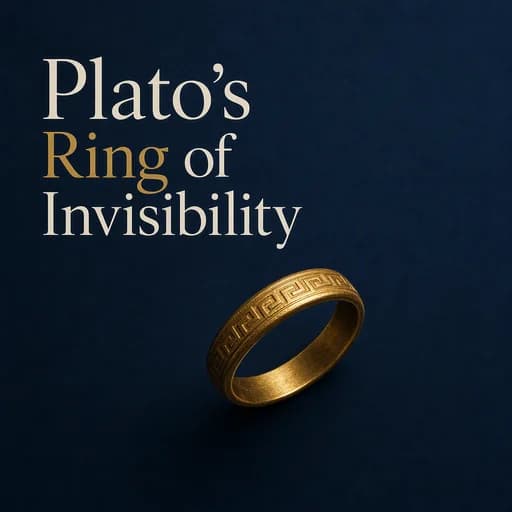
    Chase: Exactly. This shepherd is out tending his flock when a massive earthquake splits the ground open. He climbs down into this chasm and finds—of all things—a hollow bronze horse with windows in it. Inside is a giant corpse wearing nothing but a gold ring.

    Joel: Okay, that is definitely a weird start for a philosophy book. So he takes the ring, and what happens?.

    Chase: He realizes that when he turns the setting of the ring toward the inside of his hand, he becomes invisible to everyone else. They start talking about him as if he’s left the room. When he turns it back out, he reappears.

    Joel: And let me guess—he doesn't use this power to rescue kittens or fix the plumbing for free. Glaucon says he immediately uses it to seduce the queen, kill the king, and seize the throne.

    Chase: Precisely. And Glaucon’s point to Socrates is that if you gave that ring to a "just" man and an "unjust" man, they would both end up doing the exact same thing. He argues that no one is so "incorruptible" that they’d stay on the path of justice if they could steal, kill, or do whatever they wanted with total impunity.

    Joel: I hate to admit it, but he might be right. I mean, look at the internet. People are "semi-invisible" behind usernames, and they say things they’d never dream of saying to someone’s face. Glaucon is saying that "justice" isn't a choice we make because it's good; it’s a burden we carry because we're afraid of the consequences.

    Chase: He goes even further. He says that if you found a guy who had the ring and didn't use it to benefit himself, everyone would call him a saint in public, but in private, they’d think he was an absolute idiot. They’d praise him to his face only because they’re afraid of being his next victim.

    Joel: It’s the ultimate "who are you when no one is watching" test. But Glaucon isn't finished with the thought experiment yet. He wants to strip away every possible benefit of being good to see if the core of it still holds any weight.

    Chase: That’s where the "mighty scouring" of the two characters comes in. He’s about to set up a comparison that makes the shepherd story look like a warm-up.

    이 에피소드로 더 깊이 배우기

    이 에피소드의 아이디어를 BeFreed의 가이드 학습 경험으로 더 깊이 탐구해 보세요.

    챕터 3

    Scouring the Statues of Justice and Injustice

    Joel: Glaucon tells Socrates that to really judge which life is better, we have to look at the "perfectly unjust" man versus the "perfectly just" man. And his definition of "perfectly unjust" is fascinating—it’s not just a common criminal; it’s a guy who is a master of the craft.

    Chase: Right, he compares the unjust man to a top-tier navigator or a physician. If he makes a mistake while doing something wrong, he’s smart enough to fix it and keep it secret. The "extreme" of injustice, according to Glaucon, is to commit the greatest crimes while maintaining a flawless reputation for being a good person.

    Joel: So this guy is essentially a sociopath who everyone thinks is a saint. He’s rich, he’s powerful, he’s a persuasive speaker, and because everyone thinks he’s "just," he gets all the rewards of society—the best marriages, the best jobs, the respect of the city.

    Chase: Now, contrast that with the "perfectly just" man. Glaucon says we have to strip this man of everything except his justice. That means we take away his reputation. In fact, we give him the "greatest reputation for wrongdoing" even though he hasn't done a single thing wrong.

    Joel: That’s brutal. So the good guy spends his whole life being hated, mocked, and eventually tortured and killed, all while being completely innocent. Glaucon’s question is: who is happier? The guy who is evil but "appears" good, or the guy who is good but "appears" evil?.

    Chase: It’s a terrifying setup. Glaucon even quotes the poet Aeschylus to say that the unjust man is the one actually living in reality, because he’s pursuing real power and wealth, while the just man is just clinging to a hollow ideal that gets him impaled on a stake.

    Joel: I can see why Socrates was "thrown" by this. If the only reason to be just is the "reputation" it brings, then the guy who fakes the reputation while being a crook has actually "won" the game of life. He gets the loot and the applause [74f464a1-bcdc-4aa9-ba01-e7aa57f0 than the guy who actually does the work of being good.

    Chase: And just when Socrates thinks he has to answer that nightmare, Glaucon’s brother, Adeimantus, jumps in. He says, "Wait, you haven't even heard the worst part yet." He wants to talk about how we actually teach kids about justice, and how that makes the problem even worse.

    챕터 4

    Why We Teach Our Children to Be "Good"

    Joel: Adeimantus shifts the focus from the individual to the culture. He points out that when parents tell their kids to be just, they don't actually praise "justice itself." They praise the "reputation" for justice because it leads to good jobs and "marriages into any family he wants to".

    Chase: It’s essentially "marketing" justice. He mentions how poets like Homer and Hesiod are used to tell kids that if you’re good, the gods will make your "oak trees bear acorns" and your "sheep heavy with wool". It’s all about the payoff. The underlying message is: "Be good so you get stuff."

    Joel: Which completely undermines the idea of justice being a "good" in itself. If I’m only being "just" to get the acorns and the wool, then the moment I can get even more acorns by being a little "unjust" in secret, why wouldn't I?.

    Chase: Exactly. Adeimantus even brings up the religious angle. He says people are taught that you can basically "buy off" the gods. There are "begging priests" who go to rich men’s doors and tell them they can perform sacrifices to "remedy" any crimes they’ve committed.

    Joel: So you can be a total monster, get rich through injustice, and then use a small fraction of that stolen money to pay for a "ritual" that clears your tab with the divine? That’s the ultimate "get out of jail free" card.

    Chase: And that’s the "crooked deceit" Adeimantus is worried about. He asks what a talented young person is supposed to think when they hear everyone—from their parents to the famous poets—saying that "moderation is beautiful but difficult," while "injustice is sweet and easy".

    Joel: It sounds like a recipe for a world of "greedy and crafty foxes" who wear a "facade of justice" on the outside. If the "wise men" tell you that "appearance overwhelms truth," then the smartest move is to become a master of appearances.

    Chase: Adeimantus is pushing Socrates to show that there’s a reason to be just that isn't about the afterlife, or the reputation, or the sheep, or the acorns. He wants to know what justice does to the "soul" of the person who has it, even if no one else ever sees it.

    이 에피소드로 더 깊이 배우기

    이 에피소드의 아이디어를 BeFreed의 가이드 학습 경험으로 더 깊이 탐구해 보세요.

    챕터 5

    The Fox Behind the Facade

    Joel: This idea of the "fox behind the facade" is so vivid. Adeimantus is describing a person who builds a "conspiratorial society" or a "political club" to protect their secrets while they manipulate everyone around them. It’s a very modern-sounding critique of corruption.

    Chase: It really is. He’s saying that if you’re smart and powerful, you can use "teachers of persuasion" to become clever in court and in public assemblies. You can use "force" where you need to and "persuasion" where you can, all to "secure your own advantage without penalty".

    Joel: And if someone says, "But the gods see everything," Adeimantus has a counter-argument for that too. He says either the gods don't exist, or they don't care about us—or, if they do care, they’re the same ones the poets say can be "influenced by gentle prayers and offerings".

    Chase: It’s a complete "moral hazard." If the proceeds of your "sin" can pay for the "absolution" of that sin, the system is fundamentally broken. You do wrong, you get the profit, and then you use the profit to escape the punishment.

    Joel: So why would anyone choose justice? Adeimantus argues that only three types of people stay "just": someone with a "godlike character" who just finds injustice disgusting, someone with "superior knowledge," or people who are too old, too weak, or too "cowardly" to actually get away with being bad.

    Chase: That last part is the "sting." He’s saying that if you’re "just," it might just mean you’re a failure who couldn't figure out how to be a successful "fox." The moment any of these "just" people get real power, he claims, they’re the first to do "wrong as much as they are able".

    Joel: It’s such a relentless attack on the concept of morality. He’s essentially saying that "justice" is a word used by the losers to keep the winners from taking everything. And he’s challenging Socrates—who has "spent his whole life investigating this"—to prove him wrong.

    Chase: This is the "prelude" being over. Now the real work starts. Socrates has to find a way to talk about justice not as a "contract" or a "reputation," but as something that makes the soul "healthy" in and of itself, even if you’re being tortured and everyone hates you.

    챕터 6

    Is Justice a Internal Good or an External Tool?

    Joel: Chase, I’m stuck on this "internal versus external" thing. Glaucon and Adeimantus are basically saying that justice is like a "wearisome" physical training session—you only do it because you want the "rewards" of health and a good body, not because you actually enjoy the "pain" of the workout.

    Chase: That’s a great analogy. They put justice in that "third class" of goods—things that are "wearisome but beneficial." Socrates, however, wants to move it into the "finest class": things we welcome for their own sake and for their consequences, like "sight" or "health".

    Joel: But if I’m "just" and it doesn't get me anything—no money, no friends, no status—how is that a "good"? If I have "sight" but there’s nothing to look at but my own suffering, is sight still a "good"?.

    Chase: That’s the core of the debate. Socrates is going to argue that "injustice" is the "greatest evil the soul can contain," while "justice" is the "greatest good". He’s suggesting that doing wrong actually "corrupts" you in a way that makes happiness impossible, regardless of how much money you have in the bank.

    Joel: So it’s like "spiritual rot." You might have the gold ring and the king’s crown, but if your "soul" is a mess of "greedy and crafty foxes," you’re actually "miserable" even if everyone thinks you’re a god.

    Chase: Precisely. Adeimantus is begging Socrates to "not merely give us a theoretical proof," but to show "how each, in and by itself, affects a man". He wants to know the "psychological" reality of being an unjust person versus a just person.

    Joel: It makes me think about the "unjust man" who has to constantly "protect his secret" and live in fear of being "caught". Even if he’s a "master craftsman" at lying, there’s a "cost" to that. You’re never really "at peace" because your entire life is a "facade."

    Chase: And that's where we start to see a "playbook" for how to think about this in our own lives. It’s about moving beyond "what do people think of me" to "who am I becoming through my actions?".

    이 에피소드로 더 깊이 배우기

    이 에피소드의 아이디어를 BeFreed의 가이드 학습 경험으로 더 깊이 탐구해 보세요.

    챕터 7

    A Playbook for Your Own "Ring of Gyges"

    Joel: So, if you’re listening to this and thinking, "Okay, I don't have a magic ring, and I’m not planning to kill any kings today," how do you actually apply Plato’s challenge to your life?.

    Chase: The first step is to identify your own "invisibility." We all have moments where we think we can "get away with it"—whether it’s a small lie, a shortcut at work, or being "mean" to someone who has no power to fight back. In those moments, you are the shepherd with the ring.

    Joel: I think that’s a powerful way to look at it. Ask yourself: "If I was 100% sure I wouldn't get caught, would I still do this?" If the answer is "no," then you’re practicing "reputation-based justice," not "soul-based justice".

    Chase: Exactly. The second step is to look at your "facade." Are you spending more energy "appearing" to be a good person—on social media, at the office, in your community—than you are actually being a good person?.

    Joel: It’s about that "deep furrow in the heart" that the poet spoke about. Are you "harvesting" good counsels and real character, or are you just "painting a statue" to look good in a competition?.

    Chase: And finally, realize that "injustice" is its own "penalty." Even if you get the "rewards" and the "honours," the "presence of injustice in the soul" is, as Adeimantus said, the "greatest evil". It’s about the "internal health" of your mind and your conscience.

    Joel: It’s a tough "sell" in a world that rewards the "clever navigators" and the "persuasive speakers". But Plato’s point is that if you "sell your soul" for those rewards, you’ve actually made a "terrible bargain."

    Chase: It’s about becoming your "own best guardian" so you don't have to "watch one another to see we do no wrong". That’s the real "freedom"—not the freedom to do whatever you want, but the freedom from being a "slave" to your own "desire for undue gain".

    챕터 8

    The Weight of Your Invisible Actions

    Joel: As we bring this to a close, I keep coming back to that image of the "just man" being "stretched on the rack" while everyone thinks he’s a criminal. It’s such an extreme example, but it really highlights the question: is there a version of "good" that is so deep it doesn't need anyone to clap for it?

    Chase: That’s the "mighty scouring" Plato is doing. He’s stripping away every "fake" reason to be good to see if the "real" reason is strong enough to stand on its own. It’s a challenge to every one of us to look at our own "rings" and our own "facades."

    Joel: It makes you wonder: if the "life of the unjust man is much better" in every external way—more money, more power, more praise—why does the idea of being that "unjust man" still feel so... "wrong"?. Is there something in us that "disgusts" us about injustice, even when it’s "profitable"?.

    Chase: That’s the "godlike character" Adeimantus was talking about. Or maybe it’s just the "superior knowledge" that being a "fox" is a "miserable" way to live, because you’re always "hiding" and "fearing" the truth.

    Joel: So, the next time you have the chance to "get away with it"—the next time your "ring" is turned inward—what are you going to do?. Are you going to "scale the high wall" by "justice" or by "crooked deceit"?.

    Chase: It’s a question that never goes away. Thanks for exploring these ancient but incredibly relevant ideas with us today. It’s been a fascinating look at the "prelude" to one of the most important discussions in history.

    Joel: Definitely. Take some time to reflect on your own "facades" and where your "justice" really comes from. Thanks for listening.

    ★★★★★

    Plato’s Republic: The Ring of Gyges and Glaucon’s Challenge의 끝까지 도달했어요

    “23일째 매일 사용하고 있어요. 이제 제 일상의 한 부분이 되었습니다.”

    jayallen

    Plato’s Republic: The Ring of Gyges and Glaucon’s Challenge 베스트 인용

    “

    If you gave that ring to a just man and an unjust man, they would both end up doing the exact same thing; no one is so incorruptible that they would stay on the path of justice if they could do whatever they wanted with total impunity.

    ”
    F

    Generated by Freedee_4C4C091A

    질문 입력

    An exploration of Book II of Plato's Republic, focusing on Glaucon's challenge to Socrates and the core arguments regarding whether it is better to be just than unjust, as presented in the provided text 'Plato, The Republic_pdf.pdf'.

    호스트 음성
    Lenaplay
    Lenaplay
    지식 출처
    Plato%2C+The+Republic_pdf.pdf

    자주 묻는 질문

    The Ring of Gyges is a thought experiment presented by Glaucon in Book II of Plato’s Republic. It asks whether a person would remain just if they possessed a ring that made them completely invisible, allowing them to commit illegal acts without fear of consequences. This challenge forces a discussion on whether people practice justice for its own sake or simply because they fear being caught and punished by society.

    Glaucon argues that justice is a 'lesser of two evils' agreement made by people who are tired of being victims. According to this theory, the best-case scenario is to do wrong without consequences, while the worst is to suffer injustice without power to fight back. Because most people cannot guarantee they will always be the ones in power, they create laws and social contracts to maintain order and protect themselves.

    The core of the debate centers on the value of justice and morality. Glaucon challenges Socrates to prove that being a just person is inherently better for the soul than being a successful criminal who never gets caught. He suggests that most people only follow the rules of society to avoid fines or jail time, rather than out of a genuine commitment to being a good person.

    컬럼비아 대학교 동문들이 제작 | 샌프란시스코에서 개발

    BeFreed는 호기심 넘치는 글로벌 커뮤니티를 하나로 연결합니다

    4.7

    평균 평점

    앱 평가 7.84천 개 이상

    BeFreed 커뮤니티

    정말이지 아직 앱을 다 써 보지도 않았는데, 며칠 써 본 것만으로도 깊은 인상을 받았어요… BeFreed는 제가 써 본 어떤 학습 앱과도 차원이 달라요. 몰입감이 엄청나고 집중력도 실제로 좋아져서, 스마트폰을 하염없이 스크롤하는 분들께 딱이에요!

    @ladyInfinity

    정확히 23일 전에 BeFreed를 구입했는데, 그날부터 하루도 빠짐없이 쓰고 있어요. 제 일상 업무 흐름과 학습 습관에 완전히 자리 잡았어요.

    @jayallen

    솔직히 이 앱은 제 기대를 전부 뛰어넘었어요. 어떤 주제든 오디오로 만들어 달라고 할 수 있고, 결과물이 놀라워요. 제 전문 분야는 심리치료 쪽이고 여러 학문이 얽혀 있는데도 답변이 아주 정확해요.

    @Raguipa

    제일 고마운 건 스크롤하는 시간이 확 줄었다는 거예요. 검색하는 시간은 줄고 흡수하는 시간은 늘었어요. 오디오북 전권, 팟캐스트, 학습 플랜의 조합이 정말 훌륭해요.

    @colonyofcreatorsNGO

    저는 24년째 PhotoReading 속진 학습 강사로 일하고 있어요… 책과 독서, 배움이 제 전문인데, BeFreed는 정보를 소화하기 쉽게 전달하는 혁신적인 방식을 정말 잘 구현했어요.

    @BeFreed user

    단순한 책 요약 앱이 아니에요. '재미' 스타일을 써 봤는데, 전통적인 방식보다 훨씬 나은 요약이고 아이디어를 이해하기도 쉬워요. 이것만으로도 값어치를 해요.

    @austinakon

    이 앱이 정말 좋아요. 며칠 써 봤는데 듣는 걸 멈출 수가 없어요. 시작하기에 이보다 좋을 수 없어요.

    @jcrules328

    정말 마음에 들어요. 한 달 정도 써 봤는데 숨은 보석을 찾은 기분이에요. BeFreed로 제가 원하는 주제를 직접 만들 수 있어서 좋고, 목소리도 훌륭한 데다 내레이션 선택지가 무궁무진해요.

    @DanielCZ

    정말이지 아직 앱을 다 써 보지도 않았는데, 며칠 써 본 것만으로도 깊은 인상을 받았어요… BeFreed는 제가 써 본 어떤 학습 앱과도 차원이 달라요. 몰입감이 엄청나고 집중력도 실제로 좋아져서, 스마트폰을 하염없이 스크롤하는 분들께 딱이에요!

    @ladyInfinity

    정확히 23일 전에 BeFreed를 구입했는데, 그날부터 하루도 빠짐없이 쓰고 있어요. 제 일상 업무 흐름과 학습 습관에 완전히 자리 잡았어요.

    @jayallen

    솔직히 이 앱은 제 기대를 전부 뛰어넘었어요. 어떤 주제든 오디오로 만들어 달라고 할 수 있고, 결과물이 놀라워요. 제 전문 분야는 심리치료 쪽이고 여러 학문이 얽혀 있는데도 답변이 아주 정확해요.

    @Raguipa

    제일 고마운 건 스크롤하는 시간이 확 줄었다는 거예요. 검색하는 시간은 줄고 흡수하는 시간은 늘었어요. 오디오북 전권, 팟캐스트, 학습 플랜의 조합이 정말 훌륭해요.

    @colonyofcreatorsNGO

    저는 24년째 PhotoReading 속진 학습 강사로 일하고 있어요… 책과 독서, 배움이 제 전문인데, BeFreed는 정보를 소화하기 쉽게 전달하는 혁신적인 방식을 정말 잘 구현했어요.

    @BeFreed user

    단순한 책 요약 앱이 아니에요. '재미' 스타일을 써 봤는데, 전통적인 방식보다 훨씬 나은 요약이고 아이디어를 이해하기도 쉬워요. 이것만으로도 값어치를 해요.

    @austinakon

    이 앱이 정말 좋아요. 며칠 써 봤는데 듣는 걸 멈출 수가 없어요. 시작하기에 이보다 좋을 수 없어요.

    @jcrules328

    정말 마음에 들어요. 한 달 정도 써 봤는데 숨은 보석을 찾은 기분이에요. BeFreed로 제가 원하는 주제를 직접 만들 수 있어서 좋고, 목소리도 훌륭한 데다 내레이션 선택지가 무궁무진해요.

    @DanielCZ

    유용한 정보와 아이디어를 8~15분짜리 팟캐스트 스타일 오디오로 압축해서 들을 수 있다는 게 정말 좋아요. 원래 팟캐스트는 군더더기가 많아서 안 좋아했는데, 여기는 그걸 싹 걷어냈어요.

    @BeFreed user

    박사 과정을 마무리하는 중이라 낯선 자료를 많이 읽어야 해요… BeFreed에서는 프롬프트만 입력하면 앱이 자료를 찾아서 오디오 팟캐스트로 만들어 줘요. BeFreed의 과정이 NotebookLM보다 더 매끄럽게 느껴져요.

    @Brad

    아침을 준비하거나 산책하거나 출퇴근할 때 들을 것을 YouTube에서 자주 찾곤 했는데, BeFreed는 광고도 군더더기도 없이 훨씬 더 딱 맞는 걸 들려줘요!

    @BeFreed user

    이 플랫폼의 가장 큰 장점은 활용도예요. 다루지 못하는 주제가 말 그대로 하나도 없어요. 무엇을 던져도 다 소화해요… 제한이 전혀 없으면서 약속을 실제로 지키는 학습 도구는 정말 드물어요.

    @jayallen

    BeFreed는 환상적이에요. 디자인이 편해서 헤매는 시간은 줄고 배우는 시간은 늘었어요. 오디오북, 팟캐스트, 학습 플랜의 조합은 천재적이에요. 제 하루가 완전히 달라졌어요.

    @BeFreed user

    처음엔 이탈리아어로 팟캐스트를 만드는 방법을 이해하는 데 시간이 좀 걸렸는데, 알고 나니까 — 와! 정말 대단해요! 어떤 주제든 설명해 달라고 하면 정말 똑똑하게 잘 설명해 줘요!

    @matteo77

    BeFreed는 제가 매일 쓰는 오디오북 앱이 됐어요… 제일 마음에 드는 건 텍스트를 넣으면 이동 중에도 들을 수 있는 오디오로 만들어 준다는 점이에요.

    @kotanzu1

    유용한 정보와 아이디어를 8~15분짜리 팟캐스트 스타일 오디오로 압축해서 들을 수 있다는 게 정말 좋아요. 원래 팟캐스트는 군더더기가 많아서 안 좋아했는데, 여기는 그걸 싹 걷어냈어요.

    @BeFreed user

    박사 과정을 마무리하는 중이라 낯선 자료를 많이 읽어야 해요… BeFreed에서는 프롬프트만 입력하면 앱이 자료를 찾아서 오디오 팟캐스트로 만들어 줘요. BeFreed의 과정이 NotebookLM보다 더 매끄럽게 느껴져요.

    @Brad

    아침을 준비하거나 산책하거나 출퇴근할 때 들을 것을 YouTube에서 자주 찾곤 했는데, BeFreed는 광고도 군더더기도 없이 훨씬 더 딱 맞는 걸 들려줘요!

    @BeFreed user

    이 플랫폼의 가장 큰 장점은 활용도예요. 다루지 못하는 주제가 말 그대로 하나도 없어요. 무엇을 던져도 다 소화해요… 제한이 전혀 없으면서 약속을 실제로 지키는 학습 도구는 정말 드물어요.

    @jayallen

    BeFreed는 환상적이에요. 디자인이 편해서 헤매는 시간은 줄고 배우는 시간은 늘었어요. 오디오북, 팟캐스트, 학습 플랜의 조합은 천재적이에요. 제 하루가 완전히 달라졌어요.

    @BeFreed user

    처음엔 이탈리아어로 팟캐스트를 만드는 방법을 이해하는 데 시간이 좀 걸렸는데, 알고 나니까 — 와! 정말 대단해요! 어떤 주제든 설명해 달라고 하면 정말 똑똑하게 잘 설명해 줘요!

    @matteo77

    BeFreed는 제가 매일 쓰는 오디오북 앱이 됐어요… 제일 마음에 드는 건 텍스트를 넣으면 이동 중에도 들을 수 있는 오디오로 만들어 준다는 점이에요.

    @kotanzu1

    웹에서 BeFreed가 어떻게 논의되고 있는지 더 보기
    129.7K19.5K
    55.2K19.2K
    154.2K10827355
    48.1K2.5K
    81.2K6.6K
    82.3K1.8K
    지금 바로 학습 여정을 시작하세요
    BeFreed 앱
    BeFreed

    무엇이든 개인화된 학습

    DiscordLinkedIn
    추천 도서 요약
    Crucial ConversationsThe Perfect MarriageInto the WildNever Split the DifferenceAttachedGood to GreatSay Nothing
    인기 카테고리
    Self HelpCommunication SkillRelationshipMindfulnessPhilosophyInspirationProductivity
    유명인 추천 도서
    Elon MuskCharlie KirkBill GatesSteve JobsAndrew HubermanJoe RoganJordan Peterson
    수상작 컬렉션
    Pulitzer PrizeNational Book AwardGoodreads Choice AwardsNobel Prize in LiteratureNew York TimesCaldecott MedalNebula Award
    추천 주제
    ManagementAmerican HistoryWarTradingStoicismAnxietySex
    연도별 베스트 도서
    2025 Best Non Fiction Books2024 Best Non Fiction Books2023 Best Non Fiction Books
    추천 저자
    Chimamanda Ngozi AdichieGeorge OrwellO. J. SimpsonBarbara O'NeillWinston ChurchillCharlie Kirk
    BeFreed vs 다른 앱
    BeFreed vs. Other Book Summary AppsBeFreed vs. ElevenReaderBeFreed vs. ReadwiseBeFreed vs. Anki
    학습 도구
    Knowledge VisualizerAI Podcast Generator
    정보
    회사 소개arrow
    가격arrow
    FAQarrow
    블로그arrow
    채용arrow
    파트너십arrow
    앰배서더 프로그램arrow
    디렉토리arrow
    BeFreed
    Try now
    © 2026 BeFreed
    이용 약관개인정보 처리방침
    BeFreed

    무엇이든 개인화된 학습

    DiscordLinkedIn
    추천 도서 요약
    Crucial ConversationsThe Perfect MarriageInto the WildNever Split the DifferenceAttachedGood to GreatSay Nothing
    인기 카테고리
    Self HelpCommunication SkillRelationshipMindfulnessPhilosophyInspirationProductivity
    유명인 추천 도서
    Elon MuskCharlie KirkBill GatesSteve JobsAndrew HubermanJoe RoganJordan Peterson
    수상작 컬렉션
    Pulitzer PrizeNational Book AwardGoodreads Choice AwardsNobel Prize in LiteratureNew York TimesCaldecott MedalNebula Award
    추천 주제
    ManagementAmerican HistoryWarTradingStoicismAnxietySex
    연도별 베스트 도서
    2025 Best Non Fiction Books2024 Best Non Fiction Books2023 Best Non Fiction Books
    학습 도구
    Knowledge VisualizerAI Podcast Generator
    추천 저자
    Chimamanda Ngozi AdichieGeorge OrwellO. J. SimpsonBarbara O'NeillWinston ChurchillCharlie Kirk
    BeFreed vs 다른 앱
    BeFreed vs. Other Book Summary AppsBeFreed vs. ElevenReaderBeFreed vs. ReadwiseBeFreed vs. Anki
    정보
    회사 소개arrow
    가격arrow
    FAQarrow
    블로그arrow
    채용arrow
    파트너십arrow
    앰배서더 프로그램arrow
    디렉토리arrow
    BeFreed
    Try now
    © 2026 BeFreed
    이용 약관개인정보 처리방침

    비슷한 콘텐츠

    Republic 책 표지
    Republic
    Plato
    27 min
    Plato: The Reality Behind the Shadows 책 표지
    Theory of forms - WikipediaPlato: A Theory of Forms | Issue 90 | Philosophy NowThe Republic: Full Work Summary | SparkNotesPlato's political philosophy
    6 sources
    Plato: The Reality Behind the Shadows
    Struggling to find deeper meaning in a world of surface-level distractions? Explore Plato’s Theory of Forms to see beyond the cave and find truth.
    871 min
    Plato’s Phaedo: The Soul’s Great Escape 책 표지
    Plato: Phaedo24.01S16 Immortality and Forms in the PhaedoPlatonic arguments for the immortality of the soulAnalyzing Socrates' Four Arguments for the Soul's Immortality in the Phaedo
    4 sources
    Plato’s Phaedo: The Soul’s Great Escape
    Facing execution, Socrates argues that death is a release from a glitchy body. Explore his case for the soul’s immortality and the Theory of Forms.
    968 min
    Should Socrates Have Escaped Death? Ancient Dilemma 책 표지
    Should Socrates Have Escaped His Execution? Here's What He ...Plato's Crito: When Should We Break the Law?Obedience and Disobedience in Plato's Crito and the Apology: Anticipating the Democratic Turn of Civil Disobediencesource 4
    6 sources
    Should Socrates Have Escaped Death? Ancient Dilemma
    A deep philosophical examination of Socrates' controversial decision to accept execution rather than escape, exploring the timeless tensions between individual conscience, democratic duty, and moral integrity that still challenge us today.
    21 min
    Socrates: Wisdom Through Questioning 책 표지
    PhaedoSocrates in the CityRight Thing, Right NowThe Republic
    14 sources
    Socrates: Wisdom Through Questioning
    Explore the revolutionary life and enduring wisdom of Socrates, from his method of questioning to his trial and execution, revealing how this 'gadfly' of Athens transformed philosophy and left lessons that still resonate today.
    31 min
    The Load-Bearing Life: Lessons from Socrates and Plato 책 표지
    Open Socrates by Agnes Callard - A review - MunemaIs the Examined Life Enough? – Modern AgeRecently Published Book Spotlight: Why Plato Matters NowWhy Plato Matters Now – Plato's Academy Centre
    7 sources
    The Load-Bearing Life: Lessons from Socrates and Plato
    When daily choices feel like scripts you didn't write, it's time to examine your foundation. Learn to test your beliefs and move toward true flourishing.
    1250 min
    Liars 책 표지
    Liars
    Cass R. Sunstein
    27 min
    Liberty, Security, and the Hobbesian Trap 책 표지
    Safety and SecurityEscaping Hobbes: Liberty and Security for OurJonathan Herington
    8 sources
    Liberty, Security, and the Hobbesian Trap
    When fear shapes our laws, do we trade away more than just privacy? Explore why the 'balance' between safety and freedom is often a dangerous myth.
    1117 min