1장
The Challenge of True Innovation
What important truth do very few people agree with you on? This provocative question opens Thiel's exploration of innovation and serves as a litmus test for original thinking. The most valuable insights come from challenging conventional wisdom and seeing opportunities where others don't.
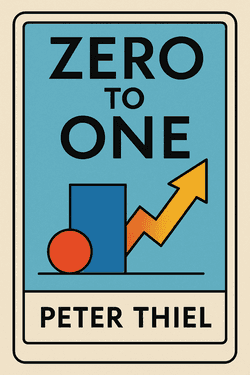
Progress can take two forms: horizontal or vertical. Horizontal progress means taking something that works and replicating it-going from 1 to n. This is globalization in action, spreading existing ideas to more people and places. Vertical progress, however, means creating something genuinely new-going from 0 to 1. This is true innovation, and it's far more difficult and valuable.
Consider how China has mastered horizontal progress by adopting technologies developed elsewhere. They've moved from bicycles to cars, from rural poverty to urban prosperity. But this model of growth has limitations. Eventually, resources become constrained, and copying stops working. The future of humanity depends on vertical progress-on innovation that creates entirely new categories.
Throughout history, technological advancement hasn't been guaranteed. The ancient world had sophisticated mathematics and engineering but lacked modern concepts like corporations or sustained scientific research. The Industrial Revolution marked an unprecedented acceleration in innovation, but we shouldn't take continued progress for granted. Today's startups represent our best hope for creating the breakthrough technologies that will define tomorrow.
Startup thinking isn't about following formulas or best practices. It's about questioning assumptions and seeing possibilities others miss. When PayPal was founded, conventional wisdom held that email payments couldn't work because of security concerns. By challenging this assumption and finding creative solutions, PayPal created an entirely new category of business. This pattern repeats across successful startups-they don't just improve existing products; they reimagine what's possible.
2장
Learning from the Dot-Com Crash
The late 1990s dot-com bubble offers crucial lessons for today's innovators. Before the internet boom, the early '90s were marked by economic malaise and anxiety about globalization. Traditional industries struggled while the nascent tech sector offered a glimmer of hope. When Netscape's IPO in 1995 signaled the internet's commercial potential, it triggered a gold rush mentality.
Silicon Valley transformed into a hub of frenzied activity. Startups defied traditional business wisdom by losing money while multiplying their valuations overnight. This irrational exuberance couldn't last, but it positioned the digital economy as the sole hopeful frontier in an otherwise stagnating global market.
PayPal emerged during this chaotic period with a mission to create a new internet currency. The company employed a risky but inventive strategy of subsidizing new signups with cash, fueling explosive customer growth. While unsustainable long-term, savvy fundraising just before the bubble burst allowed PayPal to stabilize and eventually thrive when many competitors failed.
The crash taught important lessons, but conventional wisdom drew the wrong conclusions. Many believed the key takeaways were: make incremental improvements, stay lean, compete in existing markets, and focus on product over sales. But the deeper insights flip these lessons: embrace bold visions, plan for the future, avoid competition, and recognize that sales matter as much as the product itself.
Consider how Google succeeded not by making incremental improvements but by reimagining search entirely. Amazon didn't stay lean-it invested heavily in infrastructure ahead of demand. Facebook didn't enter a crowded social network market; it created a distinctive experience starting with a specific audience. And Salesforce recognized that enterprise software requires excellent sales capabilities, not just great technology.
The real lesson from the dot-com era isn't caution-it's independent thinking. Success comes not from following trends but from seeing what others miss and having the courage to pursue it.
3장
The Power of Monopoly
Creating value isn't enough; successful companies must capture some of that value. Airlines generate enormous value by enabling global travel but struggle to retain profits due to fierce competition. Google, with its monopolistic control over search, demonstrates how unique positioning trumps scale in creating sustainable profits.
In perfectly competitive markets, profits get competed away. Companies become undifferentiated, fighting for marginal advantages that quickly disappear. Monopolies, by contrast, can set their own terms and focus on long-term innovation rather than day-to-day survival.
Businesses often misrepresent their market position. Monopolists downplay their dominance to avoid regulatory scrutiny, while non-monopolists exaggerate their uniqueness to attract investment. Google exemplifies this by portraying itself as just one player in the vast technology market rather than acknowledging its overwhelming dominance in search advertising.
Conversely, entrepreneurs often mask direct competition by narrowly defining their market. A restaurant owner might claim to be "the only British-Tibetan fusion restaurant in downtown Palo Alto" while ignoring that they compete with all nearby dining options. This deceptive mindset leads to strategic missteps and limited growth potential.
Creative monopolies drive innovation by introducing new categories and choices. Apple revolutionized mobile computing not through competition but by creating something unprecedented. Dynamic monopolies displace old ones without stifling progress-they're the engines of technological advancement.
The path to monopoly begins with dominating a small market before expanding. Amazon started with books before becoming "the everything store." PayPal initially focused on eBay power sellers rather than attempting to create a universal payment system immediately. This strategic approach-start small, monopolize, then expand-provides a roadmap for creating lasting value.
4장
Escaping the Competition Trap
Competition, though celebrated in our culture, often traps individuals and organizations in destructive patterns. Our educational systems prize conformity over individuality, channeling bright students into conventional paths. Elite universities funnel graduates into the same prestigious firms, where they compete intensely for similar rewards.
This mindset carries over into business, where companies become obsessed with beating rivals rather than creating something new. Microsoft and Google wasted resources fighting each other in search and operating systems instead of focusing on their core strengths. Oracle and Siebel Systems engaged in a draining competition that distracted from meaningful innovation.
Sometimes merging with competitors, as PayPal did with X.com, can avert destructive wars and allow focus on shared goals. The key insight is recognizing competition for what it is-a potentially harmful distraction from the pursuit of unique value creation.
War metaphors dominate business thinking, but war destroys while creation builds. Competitors often fight over trivial differences while overlooking bigger opportunities. Escaping competition requires asking fundamental questions: What valuable company is nobody building? What important truth do very few people agree with you on?
The last mover advantage-building something that remains valuable far into the future-matters more than being first to market. Comparing the New York Times with Twitter reveals how investors value future cash flows over current profitability. While low-growth businesses derive most of their value from near-term performance, tech companies gain value from expectations of future monopoly profits.
A sustainable monopoly requires proprietary technology, network effects, economies of scale, and strong branding. Google's search algorithms provide a 10x improvement over alternatives. Facebook's value increases with each new user. Software companies benefit from near-zero marginal costs. Apple's brand reinforces its technological advantages. These elements combine to create lasting competitive advantages that transcend temporary market positions.
5장
Definite Optimism: Taking Control of the Future
The future isn't a lottery ticket-it's something we can shape through deliberate action. Our society has shifted from definite optimism (believing we can build a better future through specific plans) to indefinite optimism (expecting things to improve without concrete visions).
This shift manifests across domains. In finance, capital circulates through banks, investors, and companies without clear direction toward productive innovation. In politics, leaders rely on polling rather than articulating bold visions. In philosophy, thinkers discuss abstract processes rather than concrete futures. Even our approach to extending human life has become probabilistic rather than deterministic.
Definite optimism drove America's greatest achievements-from the Manhattan Project to the Apollo program. Today's indefinite mindset leads to incremental improvements rather than breakthrough innovations. We need to reclaim the ability to plan and execute ambitious projects with clear purposes.
This perspective extends to personal career choices. Every person is effectively an investor in their own life. The power law-where a small number of choices determine the majority of outcomes-applies not just to venture capital but to individual careers. Rather than diversifying efforts across many mediocre opportunities, focus intensely on areas with exponential potential.
The most successful people aren't those who spread themselves thin across many domains but those who identify their unique strengths and double down on them. Bill Gates didn't hedge his bets-he focused singularly on building Microsoft. This concentrated approach yields far greater returns than conventional diversification strategies.
6장
The Hidden Power of Secrets
Every groundbreaking company is built on a secret-a unique insight about how the world works that others haven't yet recognized. Today's conventional truths were once hidden knowledge, and tomorrow's breakthroughs exist as secrets waiting to be discovered.
Modern society has grown skeptical about the existence of secrets. Incremental thinking and risk aversion discourage the pursuit of fundamental discoveries. Elite institutions foster complacency, convincing bright minds that conventional paths represent the height of achievement. This mindset is antithetical to innovation.
Secrets fall into two categories: natural (undiscovered aspects of the physical world) and social (things people don't know or won't admit about human behavior). Both offer tremendous opportunities for those willing to look beyond conventional wisdom.
Andrew Wiles's proof of Fermat's Last Theorem exemplifies the dedication required to uncover profound truths. After years of solitary work, he solved a problem that had stumped mathematicians for centuries. This same spirit drives innovation in business. Airbnb recognized that people would trust strangers to stay in their homes, while Uber saw that smartphone technology could transform urban transportation.
Finding secrets requires looking where others aren't looking. Areas lacking standardization, like nutrition or education, offer fertile ground for discovery. Once found, secrets must be shared carefully-not broadcast indiscriminately, but revealed strategically to those who can help transform them into valuable enterprises.
Every great company operates as a conspiracy to change the world, founded on hidden knowledge shared meticulously among allies. This perspective transforms entrepreneurship from mere business-building to a profound act of creation based on unique insights.
7장
Building Strong Foundations
The initial decisions in a startup are critical because foundational errors typically can't be corrected later. Just as the universe's first moments determined its fundamental properties, a company's beginning shapes its entire trajectory.
Choosing co-founders resembles marriage-compatibility and shared history matter as much as complementary skills. Founder conflicts doom even well-conceived ventures, as exemplified by countless failed startups where personal differences overwhelmed business potential. Evaluating these dynamics honestly before committing can prevent catastrophic breakdowns later.
Alignment among ownership (equity), possession (operational control), and governance (board oversight) is essential. Misalignment creates destructive tensions that can paralyze decision-making. Startups should maintain small boards-ideally three to five people-to ensure effective communication and unified direction.
All stakeholders should be fully integrated into the organization. Part-time employees, consultants, and remote workers often lack the commitment necessary for building something revolutionary. Full-time involvement aligns incentives and focuses energy on long-term value creation rather than short-term gains.
CEO compensation sends powerful signals about company priorities. A low salary demonstrates commitment to future success rather than immediate rewards. When Aaron Levie of Box took minimal pay, he set an example of frugality that rallied the entire team around their shared mission.
Equity allocation must be handled strategically to avoid resentment. Early employees typically receive more generous terms than later hires, but specific allocations should remain confidential to prevent internal conflicts. The goal is to create a unified team working toward shared success rather than individuals maximizing personal gain.
A company's founding moment establishes its culture. Extending this creative spirit beyond inception ensures continued innovation rather than bureaucratic stagnation. As long as a company maintains its capacity for renewal and evolution, it preserves the essential qualities that made it successful in the first place.
8장
Creating a Unified Team
An ideal company culture fosters dedication and camaraderie focused on mission rather than superficial perks. Strong teams like the "PayPal Mafia"-which went on to found companies including LinkedIn, Yelp, SpaceX, and Palantir-thrive on shared vision and deep personal connections.
Beyond hiring talented individuals, successful companies build cohesive teams with strong interpersonal bonds. The PayPal team enjoyed working together and maintained relationships long after the company's acquisition by eBay. This foundation of trust and mutual respect enabled successful collaborations that extended far beyond their initial venture.
When recruiting, emphasize the unique aspects of your team and mission rather than generic benefits. Startups must attract people genuinely excited about the specific work being done, not those seeking prestige or compensation. This alignment ensures cohesive teamwork and commitment that can't be purchased through salary alone.
A company's culture manifests in shared values, language, and even dress. At PayPal, team members bonded over common interests like science fiction and a shared vision for digital currency. This alignment streamlined decision-making and fostered efficient operations by reducing unnecessary diversity in perspective.
Assign each employee a distinct responsibility to focus effort and minimize internal conflict. Avoiding role overlap encourages team harmony and directs energy outward rather than toward internal competition. Defined roles foster long-term bonds as colleagues engage in complementary rather than competing tasks.
Total dedication to a unique mission often appears cult-like to outsiders. Unlike consultancies, which focus on temporary connections across many organizations, successful startups require intense communal focus on overlooked truths. This singular commitment enables breakthrough innovations that more diversified approaches cannot achieve.
9장
The Art of Distribution
Despite its importance, the necessity of sales is often undervalued, particularly in Silicon Valley where product creation receives disproportionate attention. Engineers and technologists frequently dismiss sales as superficial manipulation, failing to recognize the sophisticated skills involved in effective distribution.
Master salespeople conceal their influence through subtle techniques. This unseen persuasion permeates industries where practitioners operate under various guises-from politicians to bankers. Sales adeptness distinguishes exceptional performers across fields, illustrating how deeply the mechanisms of persuasion drive business success.
Distribution strategies vary based on product type and market dynamics. Complex sales, exemplified by SpaceX's dealings with NASA, require extensive personal engagement for high-value deals. Personal sales, like those employed by Box and ZocDoc, build from grassroots adoption to enterprise-level contracts. Marketing and advertising reach mass audiences when direct sales approaches prove impractical.
Viral marketing represents the holy grail of distribution-products that spread organically through user adoption. PayPal achieved this by focusing initially on eBay "PowerSellers" who rapidly integrated the payment system into their operations. This strategic targeting enabled swift market penetration without traditional advertising expenses.
Distribution channels follow a power law-success comes from excelling in one method rather than attempting many simultaneously. A single effective approach can outperform numerous weaker efforts combined. Business failures often result from insufficient distribution rather than product inadequacies.
Beyond selling products, companies must effectively sell themselves to talent, investors, and media. Even technical founders should recognize the importance of strategic communication and relationship-building. The seemingly effortless appeal of successful companies typically results from meticulous cultivation rather than spontaneous recognition.
10장
Human-Computer Complementarity
As technology advances, questions arise about the future relationship between humans and machines. While globalization fostered fears of human interchangeability and substitution, technology offers a more optimistic narrative based on complementarity rather than competition.
Computers excel at processing vast amounts of data and executing well-defined tasks, while humans demonstrate creativity, judgment, and intuition. The optimal approach combines these distinct strengths rather than attempting to replace one with the other.
PayPal's triumph over fraud exemplifies this synergy. When algorithms alone couldn't outsmart sophisticated fraudsters, human analysts identified patterns that automated systems missed. This combination of computational power with human oversight enabled PayPal to reduce fraud rates dramatically while processing billions of dollars in transactions.
Building on this foundation, Palantir Technologies extended these complementarity principles to solve complex problems in intelligence, defense, and financial sectors. By creating tools that amplify human analytical capabilities rather than replacing analysts entirely, Palantir achieved breakthroughs that neither computers nor humans could accomplish independently.
Computer science education often fosters a substitution-driven bias that misses the dynamic power of complementarity. Machine learning and big data analytics excel at automating repetitive tasks but falter when confronted with nuanced, multifaceted challenges. Integrating human insight with computational power enables transformative problem-solving beyond either capability alone.
As artificial intelligence capabilities advance, directing current efforts toward optimizing human-computer collaboration offers the most promising path forward. Rather than fearing technology as a competitor, we should embrace it as a partner in addressing humanity's most pressing challenges.
11장
Learning from Failure: The Cleantech Bubble
The cleantech boom of the 2000s provides valuable lessons about innovation and business fundamentals. Despite over $50 billion invested in thousands of companies aimed at creating environmental solutions, most failed spectacularly. This wasn't merely due to government involvement but reflected deeper flaws in business strategy and execution.
Many cleantech companies ignored seven fundamental questions essential for building successful businesses: proprietary technology, timing, monopoly potential, team composition, distribution strategy, durability, and whether they were tackling secrets others missed. By focusing on social impact at the expense of business fundamentals, these ventures achieved neither profitability nor meaningful environmental change.
Tesla emerged as a rare success by addressing all seven questions effectively. Elon Musk built proprietary battery and powertrain technology that outperformed alternatives. He timed Tesla's launch to coincide with increased environmental awareness and government support. Rather than competing directly with major automakers, Tesla created a monopoly in the luxury electric vehicle segment.
Tesla assembled a world-class team combining automotive expertise with Silicon Valley innovation. The company mastered distribution by creating company-owned showrooms that bypassed traditional dealerships. Tesla's brand and technological advantages provided durability against competitors. Most importantly, Tesla recognized a secret others missed-that electric vehicles could be desirable luxury products rather than merely utilitarian transportation.
Future energy innovations require similar strategic thinking. Rather than attempting to solve global energy challenges immediately, successful startups should target specific niches where they can establish dominance before scaling. Examples include replacing diesel generators in remote locations or developing quick-deploy nuclear reactors for military applications.
The path to transformative energy solutions lies not in grand social entrepreneurship but in building focused, profitable businesses that can scale over time. Like Facebook expanding from a single university campus to global reach, energy startups should conquer defined markets before tackling broader challenges.
12장
The Paradox of Founders
Founders often embody extreme and seemingly contradictory traits, making them simultaneously powerful and vulnerable. They occupy a unique position as both insiders (with institutional authority) and outsiders (with revolutionary vision), navigating dual identities that defy conventional categorization.
Historical figures like Romulus and Oedipus exemplify this paradox-individuals who stand both within and outside society's boundaries. Modern founders like Richard Branson and Sean Parker similarly project larger-than-life personas while maintaining outsider perspectives that enable them to challenge established norms.
Society's fascination with founders mirrors ancient myths, where extreme figures served as vessels for collective emotions. Like celebrities in contemporary culture, founders experience cycles of adoration and criticism as the public alternates between elevating them as visionaries and attacking them as threats to established order.
Steve Jobs's journey with Apple illustrates the irreplaceable value of founder leadership. His temporary ousting and triumphant return demonstrated how his unique vision-combining technical insight with aesthetic sensibility-provided direction that professional managers couldn't replicate. Under his guidance, Apple transformed from a struggling computer maker into the world's most valuable company.
This pattern repeats across successful technology companies. Bill Gates at Microsoft, Mark Zuckerberg at Facebook, and Jeff Bezos at Amazon all maintained founding visions that guided their companies through multiple transformations. Their ability to blend insider authority with outsider perspective enabled them to make bold decisions that conventional executives would avoid.
The founder paradox suggests that truly transformative companies require leaders who transcend traditional categories and embrace seemingly contradictory qualities. By combining visionary thinking with operational execution, founders create organizations that reflect their distinctive perspectives and values.
13장
From Stagnation to Singularity
The distant future presents multiple possibilities, ranging from stagnation to radical transformation. Most people anticipate a globalized plateau where developing nations reach Western living standards while technological progress slows. This scenario may prove unsustainable due to resource limitations and competitive pressures.
Alternatively, humanity could face catastrophic collapse from environmental degradation or conflict. Or we might achieve unprecedented progress through technological advancement-potentially reaching a "Singularity" where innovation accelerates beyond our current comprehension.
Creating a better future requires proactive effort rather than passive expectation. The path from zero to one-from nothing to something-demands creativity, courage, and commitment to building new technologies and institutions. Every moment in business happens only once, and the next breakthrough won't emerge from replicating past successes.
Technology, as the application of knowledge to solve problems, represents humanity's best hope for transcending natural limitations. Unlike globalization, which spreads existing ideas horizontally, technological innovation creates vertical progress that expands human capabilities in unprecedented ways.
The companies and founders who will shape tomorrow's world aren't those who follow established patterns but those who question assumptions and pursue unique visions. By identifying secrets others have missed and building organizations capable of transforming those insights into reality, they create not just profitable businesses but new possibilities for human flourishing.
The journey from zero to one isn't about incremental improvement but fundamental creation. It requires seeing beyond conventional wisdom to glimpse what might be possible. In this pursuit, we don't just build better companies-we build a better future.






![[zero-to-one-by-peter-thiel:c0000] Zero to One p1-1](/_next/image?url=https%3A%2F%2Fd1y2du6z1jfm9e.cloudfront.net%2Fassets%2Fpodcast%2Fgreen.png&w=1024&q=50)
![[zero-to-one-by-peter-thiel:c0001] Zero to One p1-1](/_next/image?url=https%3A%2F%2Fd1y2du6z1jfm9e.cloudfront.net%2Fassets%2Fpodcast%2Fblue.png&w=1024&q=50)
![[zero-to-one-by-peter-thiel:c0002] Zero to One p1-1](/_next/image?url=https%3A%2F%2Fd1y2du6z1jfm9e.cloudfront.net%2Fassets%2Fpodcast%2Fpurple.png&w=1024&q=50)