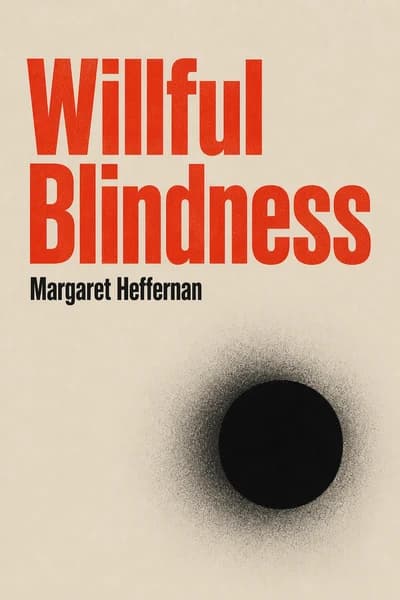
Why do smart people ignore obvious dangers? "Willful Blindness" exposes our psychological blind spots from BP disasters to Weinstein scandals. Daniel Pink calls it "packed with cautionary tales," while Zimbardo hails it "a tour de force" that reveals how conformity threatens our future.
Margaret Heffernan, author of Willful Blindness: Why We Ignore the Obvious at Our Peril, is an award-winning business leader, TED speaker, and professor of practice at the University of Bath School of Management. A former CEO of five companies in tech and media—including ventures praised by The Hollywood Reporter and Streaming Media magazine—Heffernan combines decades of executive experience with sharp insights into organizational psychology.
Her book, blending behavioral science and corporate case studies, explores how systemic complacency enables crises, a theme informed by her work mentoring Fortune 500 leaders and teaching at institutions like Harvard Business School.
A six-time author whose works include A Bigger Prize and Uncharted: How to Navigate the Future (a Financial Times “Best Book of the Year”), Heffernan has been featured in Fast Company, and her TED Talks on ethical leadership have surpassed 12 million views. Willful Blindness was shortlisted for the Financial Times/Goldman Sachs Business Book of the Year and hailed by the FT as one of the “best business books of the decade.” Translated into over 20 languages, it remains a cornerstone text for executives and institutions like Google and the NHS seeking to combat institutional risk.
Willful Blindness examines why individuals and organizations ignore glaring threats, from personal relationships to corporate scandals like Enron. Heffernan explores psychological and systemic factors—such as conformity, exhaustion, and hierarchical structures—that lead people to avoid uncomfortable truths. The book argues that combating this blindness requires embracing dissent and fostering cultures of critical inquiry.
Leaders, policymakers, and professionals in ethics, psychology, or organizational behavior will find this book critical. It’s also valuable for anyone interested in decision-making biases or preventing systemic failures. Heffernan’s blend of case studies and research makes it accessible to general readers seeking to understand societal and institutional complacency.
Yes—it’s praised for its compelling analysis of human behavior and real-world relevance. While some note repetitive examples, the book’s insights into accountability, whistleblowers, and cognitive biases offer actionable lessons for personal and professional growth. Reviews highlight its “tour de force of brilliant insights” and journalistic clarity.
Key drivers include:
The book attributes such failures to cultures that rewarded conformity and punished skeptics. At Enron, employees avoided questioning unsustainable practices due to fear, financial incentives, and leadership’s dismissiveness—classic willful blindness. Heffernan emphasizes that disasters often unfold when dissenters are silenced.
Whistleblowers disrupt complacency by exposing ignored truths, yet they often face backlash. Heffernan argues organizations must protect and incentivize dissenters, as their perspectives prevent catastrophic oversights. Examples like Abu Ghraib illustrate how systemic blindness persists until insiders speak up.
Some reviewers note repetitive case studies and a dense structure. Critics suggest deeper exploration of solutions beyond encouraging dissent. However, most agree the book’s analysis of human psychology and institutional failures remains impactful.
Heffernan advises individuals to:
Legally, willful blindness implies liability—individuals can’t claim ignorance if they should have known about wrongdoing. Heffernan cites cases where courts penalized avoidance of obvious risks, stressing that ethical responsibility requires proactive engagement with truth.
Unlike narrower behavioral economics texts, Heffernan ties cognitive biases to systemic institutional failures, blending psychology with organizational theory. It complements works like Thinking, Fast and Slow but focuses more on collective accountability than individual decision-making.
Yes—by fostering open communication, rewarding critical thinkers, and decentralizing power. Heffernan highlights companies that avoid groupthink through diverse teams and “devil’s advocate” protocols, creating environments where uncomfortable truths surface before crises.
저자의 목소리로 책을 느껴보세요
지식을 흥미롭고 예시가 풍부한 인사이트로 전환
핵심 아이디어를 빠르게 캡처하여 신속하게 학습
재미있고 매력적인 방식으로 책을 즐기세요
Love to faults is always blind.
Nobody really wants to know.
Love requires illusion to thrive.
We seek comfort rather than challenge.
The internet excels at connecting affinity groups.
Willful Blindness의 핵심 아이디어를 이해하기 쉬운 포인트로 분해하여 혁신적인 팀이 어떻게 창조하고, 협력하고, 성장하는지 이해합니다.
Willful Blindness을 빠른 기억 단서로 압축하여 솔직함, 팀워크, 창의적 회복력의 핵심 원칙을 강조합니다.

생생한 스토리텔링을 통해 Willful Blindness을 경험하고, 혁신 교훈을 기억에 남고 적용할 수 있는 순간으로 바꿉니다.
무엇이든 물어보고, 목소리를 선택하고, 진정으로 공감되는 인사이트를 함께 만들어보세요.

샌프란시스코에서 컬럼비아 대학교 동문들이 만들었습니다
"Instead of endless scrolling, I just hit play on BeFreed. It saves me so much time."
"I never knew where to start with nonfiction—BeFreed’s book lists turned into podcasts gave me a clear path."
"Perfect balance between learning and entertainment. Finished ‘Thinking, Fast and Slow’ on my commute this week."
"Crazy how much I learned while walking the dog. BeFreed = small habits → big gains."
"Reading used to feel like a chore. Now it’s just part of my lifestyle."
"Feels effortless compared to reading. I’ve finished 6 books this month already."
"BeFreed turned my guilty doomscrolling into something that feels productive and inspiring."
"BeFreed turned my commute into learning time. 20-min podcasts are perfect for finishing books I never had time for."
"BeFreed replaced my podcast queue. Imagine Spotify for books — that’s it. 🙌"
"It is great for me to learn something from the book without reading it."
"The themed book list podcasts help me connect ideas across authors—like a guided audio journey."
"Makes me feel smarter every time before going to work"
샌프란시스코에서 컬럼비아 대학교 동문들이 만들었습니다

Willful Blindness 요약을 무료 PDF 또는 EPUB으로 받으세요. 인쇄하거나 오프라인에서 언제든 읽을 수 있습니다.
A five-year-old boy watches children die in a hospital ward. Instead of accepting death, the surviving children insist their friends have simply "gone home." This wasn't denial born of ignorance-it was something more deliberate, more human. Years later, that boy, Philip Zimbardo, would become a renowned psychologist studying this very phenomenon: our tendency to look away from truths we find unbearable. We all do this. We ignore the stack of unopened bills, the troubling lump we should get checked, the colleague's concerning behavior. But here's what makes this pattern truly dangerous: history's greatest catastrophes weren't hidden conspiracies orchestrated in shadows. The Catholic Church abuse scandal, Enron's collapse, the 2008 financial crisis-all unfolded in plain sight before people who simply chose not to look. This isn't about stupidity or malice. It's about a predictable human pattern with devastating consequences, one we must understand if we hope to change it.