Discover why your daily anxieties trigger the same biological responses as zebras fleeing lions. Recommended by longevity expert Peter Attia, Sapolsky's masterpiece reveals why modern stress creates disease - and practical solutions to break this devastating cycle.
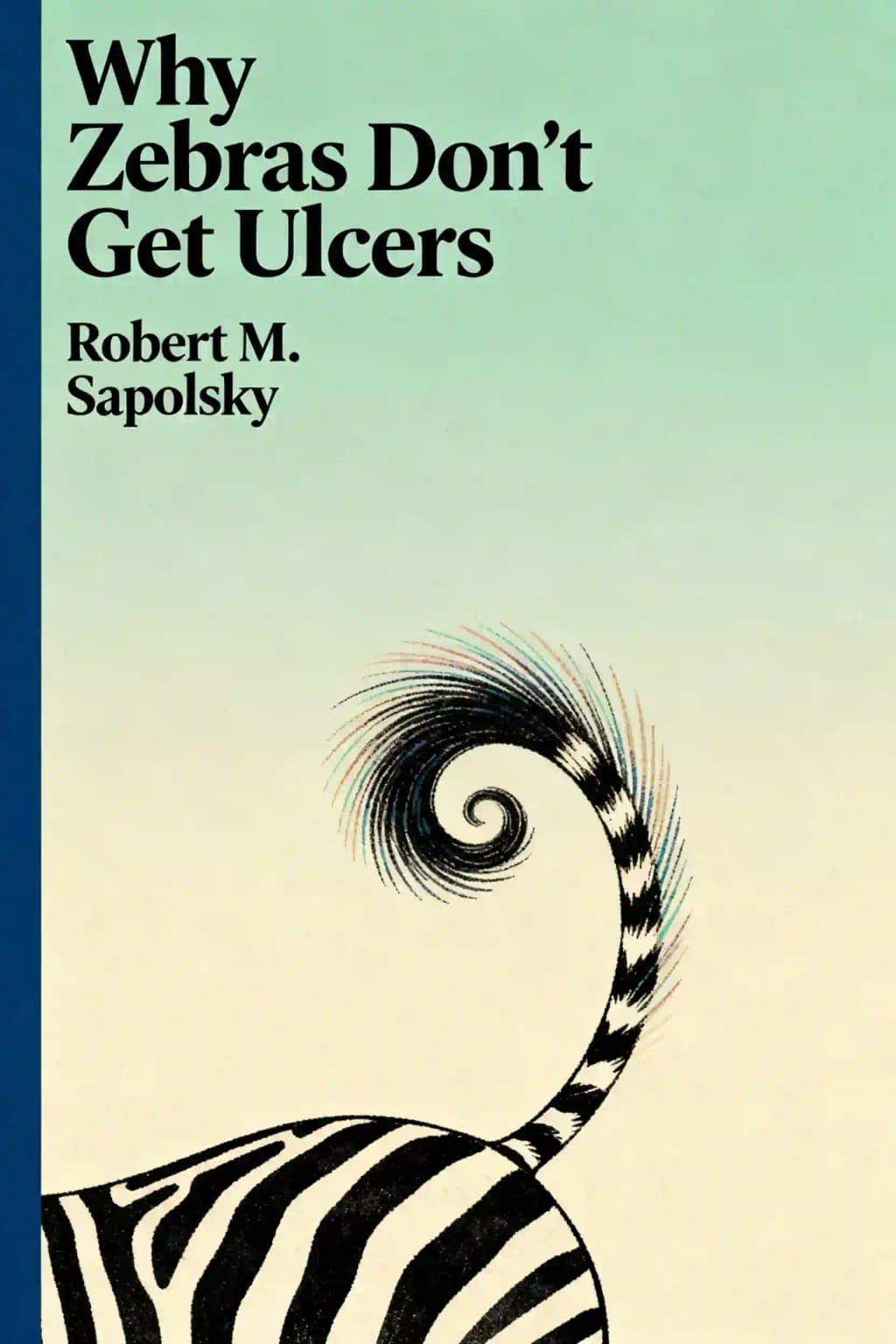
Robert M. Sapolsky, acclaimed author of Why Zebras Don’t Get Ulcers and MacArthur “Genius” Fellow, is a Stanford University professor of biology, neurology, and neurosurgery whose work bridges neuroscience, stress research, and evolutionary biology.
A pioneering neuroendocrinologist, Sapolsky’s decades-long field studies of wild baboons in Kenya informed his groundbreaking insights into stress-related diseases, detailed in this bestselling science classic. His expertise spans glucocorticoid effects on brain aging, gene therapy for neuronal protection, and the biological roots of human behavior.
Sapolsky’s other notable works include Behave: The Biology of Humans at Our Best and Worst (a New York Times bestseller) and A Primate’s Memoir, which won the Bay Area Book Reviewers Award. A frequent contributor to The New Yorker, Discover, and The Wall Street Journal, he received the Lewis Thomas Prize for Writing about Science. Why Zebras Don’t Get Ulcers—revised through multiple editions since 1994—remains a seminal text, translated into over a dozen languages and widely cited in academic and public health circles.
Why Zebras Don't Get Ulcers explores how chronic stress harms human health, contrasting short-term stress responses in animals (like zebras fleeing predators) with modern humans’ prolonged psychological stressors. Robert Sapolsky explains how cortisol and other stress hormones contribute to ulcers, heart disease, and depression, while offering science-backed coping strategies. The book blends biology, neuroscience, and practical advice for stress management.
This book suits anyone seeking to understand stress’s physiological impacts, including professionals in healthcare, psychology, or leadership roles. It’s also valuable for individuals managing anxiety, burnout, or chronic health issues linked to stress. Sapolsky’s accessible writing style appeals to both academic and general audiences.
Yes—it’s a seminal work combining rigorous science with actionable insights. Sapolsky’s exploration of stress-related diseases (e.g., hypertension, immune dysfunction) and his humor make complex concepts engaging. The book remains widely cited in stress research and offers timeless strategies for mitigating modern stressors.
Unlike zebras facing short-term threats, humans experience chronic stress, which overactivates the sympathetic nervous system. This disrupts digestion, increases stomach acid production, and weakens protective mucosal lining, leading to ulcers. Prolonged cortisol exposure also suppresses immune responses that repair damaged tissue.
Zebras avoid ulcers because their stress (e.g., escaping lions) is brief and physical. Humans, however, endure psychological stressors (work deadlines, financial worries), triggering prolonged cortisol release. This mismatch between evolutionary biology and modern life exacerbates diseases like diabetes and depression.
Sapolsky recommends exercise, social connection, and mindfulness to reduce cortisol. He emphasizes regaining control over stressors, reframing negative thoughts, and prioritizing sleep. The book also advocates addressing systemic issues like poverty, which perpetuate chronic stress.
Sapolsky’s baboon research shows low-ranking individuals endure chronic stress due to social instability, increasing disease risk. Similarly, humans in marginalized groups or high-pressure jobs face comparable physiological tolls, linking social dynamics to health disparities.
Some argue Sapolsky oversimplifies stress’s socioeconomic roots (e.g., systemic inequality) by focusing on individual coping mechanisms. Others note the science-heavy sections may overwhelm casual readers, though most praise its thoroughness.
Modern issues like workplace burnout, digital overload, and climate anxiety mirror Sapolsky’s themes. The book’s framework helps contextualize emerging stressors, such as AI-driven job insecurity, making it a foundational resource for understanding 21st-century health challenges.
While Behave examines broader human behavior through biology and sociology, Why Zebras… focuses specifically on stress physiology. Both emphasize interdisciplinary approaches but cater to different audiences: Zebras for stress management, Behave for behavioral science enthusiasts.
저자의 목소리로 책을 느껴보세요
지식을 흥미롭고 예시가 풍부한 인사이트로 전환
핵심 아이디어를 빠르게 캡처하여 신속하게 학습
재미있고 매력적인 방식으로 책을 즐기세요
Humans generate psychological and social disruptions that can persist for weeks, months, or years.
The zebra's stress response becomes harmful when chronically activated.
You can alter blood flow throughout your body through pure thought.
The brain was the true master gland.
Extreme joy can kill just as effectively as extreme grief.
Why Zebras Don't Get Ulcers의 핵심 아이디어를 이해하기 쉬운 포인트로 분해하여 혁신적인 팀이 어떻게 창조하고, 협력하고, 성장하는지 이해합니다.
Why Zebras Don't Get Ulcers을 빠른 기억 단서로 압축하여 솔직함, 팀워크, 창의적 회복력의 핵심 원칙을 강조합니다.

생생한 스토리텔링을 통해 Why Zebras Don't Get Ulcers을 경험하고, 혁신 교훈을 기억에 남고 적용할 수 있는 순간으로 바꿉니다.
무엇이든 물어보고, 목소리를 선택하고, 진정으로 공감되는 인사이트를 함께 만들어보세요.

샌프란시스코에서 컬럼비아 대학교 동문들이 만들었습니다
"Instead of endless scrolling, I just hit play on BeFreed. It saves me so much time."
"I never knew where to start with nonfiction—BeFreed’s book lists turned into podcasts gave me a clear path."
"Perfect balance between learning and entertainment. Finished ‘Thinking, Fast and Slow’ on my commute this week."
"Crazy how much I learned while walking the dog. BeFreed = small habits → big gains."
"Reading used to feel like a chore. Now it’s just part of my lifestyle."
"Feels effortless compared to reading. I’ve finished 6 books this month already."
"BeFreed turned my guilty doomscrolling into something that feels productive and inspiring."
"BeFreed turned my commute into learning time. 20-min podcasts are perfect for finishing books I never had time for."
"BeFreed replaced my podcast queue. Imagine Spotify for books — that’s it. 🙌"
"It is great for me to learn something from the book without reading it."
"The themed book list podcasts help me connect ideas across authors—like a guided audio journey."
"Makes me feel smarter every time before going to work"
샌프란시스코에서 컬럼비아 대학교 동문들이 만들었습니다

Why Zebras Don't Get Ulcers 요약을 무료 PDF 또는 EPUB으로 받으세요. 인쇄하거나 오프라인에서 언제든 읽을 수 있습니다.
Imagine this: a zebra spots a lion and sprints for its life. Heart racing, muscles pumping, the zebra escapes-and minutes later, returns to peaceful grazing. No ruminating about the close call, no lying awake worrying about tomorrow's predators. This stark contrast forms the foundation of stress physiology. While zebras only activate their stress response during actual physical emergencies, we humans have developed a remarkable ability to trigger the same physiological cascade through mere thoughts and worries. We activate our emergency systems for non-emergencies-mortgages, deadlines, relationship tensions-leaving them running indefinitely. Our sophisticated brains, capable of anticipating threats, have become our greatest vulnerability. This fundamental mismatch between our Stone Age bodies and modern psychological stressors explains why zebras don't get ulcers-but we do.