1장
The Wealth Paradox: When Saving Banks Trumps Saving Citizens
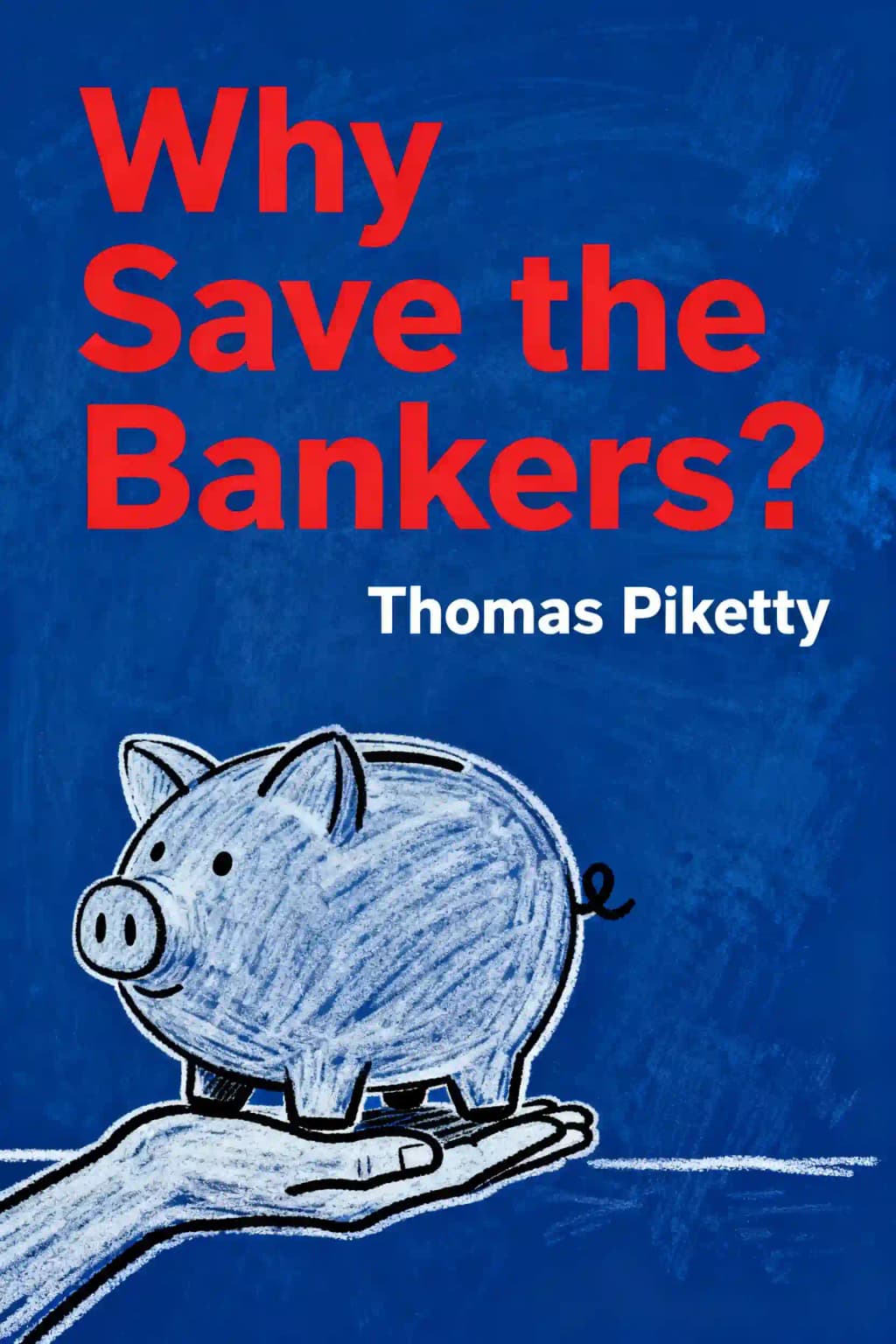
In the wake of the 2008 financial crisis, a French economist with a gift for clarity stepped into the global spotlight. Thomas Piketty's collection of newspaper columns, "Why Save the Bankers?", cuts through economic jargon to expose the fundamental contradictions of our financial system. This book has become required reading in policy circles from Washington to Berlin, with figures like Elizabeth Warren and Bernie Sanders frequently citing its insights. What makes Piketty's analysis so compelling is how he transforms dry economic data into a gripping narrative about power, wealth, and democracy. The collection's popularity surged during the Occupy Wall Street movement, as protesters sought intellectual ammunition against a system that appeared rigged. Even Barack Obama reportedly kept a copy on his nightstand during his second term. Beyond academic circles, Piketty's accessible style has made complex economic concepts understandable to millions, creating a rare bridge between scholarly research and public discourse during one of capitalism's most challenging moments.
2장
Capitalism's Natural State: The Return of Patrimonial Wealth
The 2007-2008 financial crisis marked the first major challenge to 21st-century globalized patrimonial capitalism. Since the 1980s, as memories of the Great Depression faded and 1970s stagflation undermined Keynesian policies, financial deregulation swept across the world. Reagan and Thatcher championed pure capitalism over government intervention, a movement that accelerated after the Soviet Union's collapse seemed to validate unfettered markets.
By 2007, private wealth in countries like France had returned to Belle Epoque levels, with wealth-to-income ratios around 6-to-1, far exceeding the 3-to-1 ratios of the 1950s. This prosperity reflects not just deregulation but a long-term recovery from early 20th-century shocks. The slow recent growth naturally produces high wealth-to-income ratios. What we've discovered is that the "capitalism without capital" of the postwar era was merely temporary-patrimonial capitalism is capitalism's natural state.
This pattern creates a fundamental inequality between the return to capital (r) and economic growth (g), where r > g. When capital consistently earns 4-5% while economies grow at just 1-1.5%, past wealth automatically gains disproportionate weight. The wealthy see their fortunes grow at 6-7% annually while average wealth increases by only 2% worldwide. This mechanical inequality is fundamentally incompatible with democratic meritocratic values.
The deregulation since the 1980s has left our financial system particularly fragile and unpredictable. Financial statistics reveal systematic shortcomings, with negative global net financial positions suggesting significant assets hidden in tax havens. Europe's political fragmentation makes it especially vulnerable to financial instability, as the nation-state is no longer the appropriate level for imposing necessary regulations.
Have you noticed how the ultra-wealthy consistently achieve higher returns than ordinary savers? While most of us earn 2-4% on our modest savings, the super-rich consistently achieve 7-10% returns through better access to risk management and sophisticated financial advisors. Steve Jobs, despite his revolutionary innovations, accumulated "only" $8 billion-six times less than Windows "rentier" Bill Gates and one-third the fortune of Liliane Bettencourt, who merely inherited her wealth. Both Gates and Bettencourt saw their wealth multiply tenfold between 1990-2010. The rich simply get richer regardless of merit.
3장
Banking Bailouts: Pragmatism Without Accountability
When the financial crisis hit, governments rushed to save banks with impressive pragmatism. The American government's bank rescues showed the Treasury and Fed temporarily nationalizing parts of the financial system, with potential costs between 5-10% of GDP, surpassing the 1980s savings and loan crisis.
These interventions largely continued established doctrine. Since the 1930s, American elites believed the 1929 crisis worsened because authorities let banks collapse by withholding needed liquidity. For free-market conservatives, a responsive Fed-not a welfare state-is what saves capitalism.
The race to announce ever-larger bank bailouts (40 billion for French banks, 320 billion in guarantees, 1.7 trillion at European level) carried significant risks. This publicity strategy might not prevent recession, as markets want specifics beyond impressive numbers. Governments behaved like the corporations they're meant to regulate, using accounting tricks and confusing guarantees with actual spending.
The strategy risked disorienting the public who'd been told budgets were tight, yet suddenly unlimited funds appeared for bankers. Bank interventions are legitimate only with conditions: shareholders and managers must pay for mistakes, aggressive financial regulation must prevent toxic assets, tax havens must be addressed, and obscene financial compensation packages need progressive taxation.
By 2009, central banks had deployed unprecedented "unconventional policies" to combat the crisis. The Federal Reserve expanded from $900 billion (6% of GDP) to $2.3 trillion (16%), while the ECB grew from 1.4 trillion to 2.1 trillion (15% to 23% of Eurozone GDP). The key innovation was extending loan duration from days to months, lending directly to non-financial businesses, and increasing lending volumes dramatically.
While these policies prevented cascading bank failures like those of the Great Depression, they reached their limits. Central banks couldn't force traumatized private actors to spend. The monetary expansion primarily financed public deficits indirectly, as private banks purchased government debt. If governments remained the only actors willing to spend, they needed to launch genuine stimulus programs.
Imagine if we'd responded to the banking crisis the way Roosevelt responded to the 1929 crash. His approach was far more dramatic: federal tax rates on highest incomes rose from 25% to 63% (1932), 79% (1936), and 91% (1941), remaining above 70% for nearly fifty years until Reagan's cuts. This system functioned without preventing economic growth and reduced executives' incentive to raid company coffers.
4장
The Eurozone Trap: A Currency Without a State
The euro and ECB were designed when central banks were thought to need only independence and inflation control. We created a currency without a state and a central bank without a government. The crisis taught us that central banks are indispensable for stabilizing markets during crises-both the Fed and ECB printed enormous sums to avoid a 1930s-style depression. Yet we've ignored the crisis's inegalitarian origins and made only timid progress on financial supervision.
The Eurozone's unique debt crisis stems from the ECB's reluctance to lend to governments, unlike the Fed, Bank of England, and Bank of Japan. The fundamental error was creating a currency without a state and monetary policy without fiscal policy. To end speculation on seventeen different interest rates, we must mutualize debt through eurobonds, which requires a legitimate federal political authority.
Five years after the financial crisis began, Europe remained trapped in stagnation while the US and Japan returned to growth-despite Europe's lower public debt, superior social model, and greater total wealth. The fundamental problem is Europe's dysfunctional political architecture: a single currency with seventeen different public debts and twenty-seven competing tax policies cannot work.
Italy's situation demonstrates this clearly: despite achieving a 2.5% primary budget surplus, interest payments alone create deficits and debt spirals. Historically, Italy maintained balanced primary budgets for decades while its debt grew due to high interest payments. The crucial difference now is that Italy can no longer devalue its currency to restart growth.
The Council of Heads of State fails as a governing body because single-representative democracy inevitably leads to national self-interest clashes and collective impotence. To manage a genuine tax and budget union, Europe needs a real budgetary parliament of the Eurozone, perhaps composed of finance committee deputies from national parliaments meeting monthly. This would enable public debates with clear majority decisions rather than the current facade of unanimity where no one takes responsibility.
5장
The Tax Haven Dilemma: When Small Countries Play Dirty
Ireland's catastrophic economic collapse reveals the dangers of tax dumping strategies. After implementing brutal austerity measures including 7.5% public sector wage cuts and across-the-board income tax hikes, the government stubbornly maintained its ultralow 12.5% corporate tax rate. Finance Minister Brian Lenihan insisted they wouldn't abandon the strategy that attracted foreign investment since the 1990s, preferring to hit Irish citizens rather than risk capital flight.
This tax dumping approach, adopted by many small countries including those in Eastern Europe with 10% corporate rates, has proven disastrous. Ireland pays roughly 20% of its domestic production to foreign owners as profits and dividends, making its GNP about 20% smaller than GDP. Despite sharing the euro, Ireland pays nearly double Germany's interest rates on public debt, showing markets are speculating on potential bankruptcy.
The EU's 90 billion bailout of Ireland should have come with demands to raise its corporate tax rate from 12.5% to at least 25-30%. Companies benefiting from European rescue funds should contribute meaningfully to Ireland's tax base. Tax dumping strategies ultimately harm both neighboring countries and the practitioners themselves. With European countries requiring 30-40% of GDP in taxes to fund infrastructure, public services and social protection, a 12.5% corporate tax rate is unsustainable unless labor is massively overtaxed.
The Cyprus crisis similarly highlighted contradictions in financial globalization. This small island nation developed a banking sector with balance sheets exceeding eight times its GDP. European authorities imposed a disastrous flat tax on deposits (6.75% up to 100,000 and 9.9% above), treating ordinary savers and oligarchs nearly identically. A progressive wealth tax would have been far more equitable, as demonstrated by France's wealth tax rates (0% up to 1.3 million, rising to 1.5% beyond 10 million).
How can small countries compete in a globalized world without resorting to tax dumping? The answer lies in European cooperation. Only the EU can end this zero-sum game through a European corporate tax system or minimum rates. Building a monetary union without economic governance has proven dangerously fragile during crisis.
6장
The Greek Scapegoat: Morality Tales and Economic Reality
The portrayal of Greeks as lazy spendthrifts who elect corrupt governments is a classic reactionary trope used by the rich to stigmatize the poor. This household morality metaphor, frequently employed in media narratives and political discourse, breaks down at the national level for two critical reasons: the arbitrary nature of initial inheritance and certain prices, especially returns on capital. The comparison of national economies to household budgets fundamentally misunderstands the complexities of macroeconomics and international finance.
Greece has historically been possessed by other countries, with foreigners owning more Greek assets than Greeks own abroad. This colonial and post-colonial dynamic has created a persistent structural imbalance in the Greek economy. Their available national income has consistently been less than their domestic production, making it mathematically impossible for them to consume more than they produce. Before the crisis, the gap between production and income was approximately 5% - double the fiscal adjustment currently demanded by international creditors. This historical context reveals how external ownership patterns have shaped Greece's economic vulnerabilities.
The crisis largely stems from market operators arbitrarily imposing 6% interest rates instead of 3% on Greek bonds, demonstrating how a few financial decisions made in trading rooms in London, Frankfurt, and New York can plunge an entire country into crisis. These interest rate decisions, often made by traders with limited understanding of Greek economic fundamentals, created a self-fulfilling prophecy of default risk. Germany's position that banks which lent to Greece at high rates should bear responsibility for the crisis is economically sound, but this must happen through an orderly European bank tax rather than through Greek default, which would be chaotic and potentially catastrophic.
Default creates unpredictable consequences because modern financial markets have made it nearly impossible to track who ultimately holds Greek debt after countless transactions, derivatives, and insurance contracts. The biggest financial institutions, despite their impressive trillion-euro balance sheets, operate with surprisingly minimal equity, making them vulnerable to sudden shocks. A tax-based solution would be more surgical, targeting only banks with sufficient capital reserves to absorb the losses, thereby avoiding market panic while potentially establishing the foundation for a more comprehensive European-level tax system.
Syriza's electoral victory in Greece represented a potential turning point that could overturn Europe's austerity-driven status quo, especially with similar anti-austerity movements like Podemos gaining momentum in Spain. For this democratic revolution to succeed, center-left parties, particularly in major economies like France and Italy, must acknowledge their role in perpetuating failed policies and admit that the 2012 fiscal treaty has been counterproductive. While some degree of fiscal coordination is justified in a shared currency zone, critical decisions about national economies must be made through democratic processes rather than through rigid mechanical rules and sanctions that have demonstrably increased unemployment and debt levels across southern Europe. The experience of Greece demonstrates that austerity policies imposed without democratic consent ultimately undermine both economic stability and political legitimacy.
7장
The Forgotten Inequality: When Labor Loses to Capital
Despite surface-level stability in France's national income distribution, with profit-wage shares maintaining a seemingly consistent ratio (32-33% profits, 67-68% wages since 1987), a deeper examination reveals dramatic inequality growth beneath these aggregate figures. The period between 1998-2005 witnessed a stark divergence: while the richest 1% enjoyed a 20% increase in purchasing power and the ultra-wealthy 0.01% saw their wealth surge by over 40%, the bottom 90% of the population struggled with a mere 4% growth. This pattern mirrors the massive wealth transfer to the affluent in America since the 1980s, suggesting a global trend in advanced economies.
The paradox of rising inequality amid stable wage-profit ratios can be explained through several mechanisms. First, the wage structure has undergone a fundamental transformation, with executive compensation reaching unprecedented levels. Top managers have secured enormous salary increases disconnected from productivity gains or company performance, a trend accelerated by successive tax cuts on high incomes. The explosion of executive pay has created a new class of "working rich" who derive their wealth primarily from labor income rather than inherited capital.
Second, the headline wage-profit split masks significant changes in the tax burden distribution. Labor has faced increasing social security contributions and payroll taxes, while capital has benefited from tax relief and preferential treatment. When examining households' disposable income after taxes and transfers, capital's share (including dividends, interest, and rental income) has steadily increased while workers' after-tax wages have eroded in real terms.
Corporate behavior has exacerbated these trends. Companies, caught up in the stock market's speculative fever, have prioritized shareholder returns, doubling dividend payments over two decades. This focus on short-term shareholder value has left many firms struggling to self-finance their operations and investments, creating a dangerous dependency on external financing and increasing economic vulnerability.
The Cotis report's analysis of French national income reveals the psychological and social consequences of these changes. The rapid growth of very high salaries since the 1990s has created visible social tensions and undermined faith in meritocracy. Meanwhile, average workers have seen their net wages stagnate for twenty years as rising social insurance contributions eat away at nominal wage increases. The growth in capital incomes has primarily benefited a small minority, widening the wealth gap between asset owners and wage earners.
This economic divergence has profound political implications. The working class's abandonment of mainstream political parties, particularly center-left organizations, reflects their failure to protect workers' interests in an increasingly globalized economy. Workers face a double burden: economic restructuring has disproportionately affected disadvantaged groups through deindustrialization and job losses, while those with financial and cultural capital have reaped globalization's benefits. Instead of implementing policies to redistribute gains from winners to losers, governments have increasingly catered to mobile taxpayers - highly skilled workers and capital owners - at the expense of less mobile working and middle classes, creating a self-reinforcing cycle of inequality.
The solution requires fundamental reforms, particularly in tax policy, to rebalance the relationship between labor and capital. One proposed measure involves extending business profit contributions to family-benefit and health insurance systems. However, effective implementation demands strong international coordination to prevent tax competition and capital flight, highlighting the challenge of addressing inequality in an interconnected global economy.
8장
Beyond GDP: Measuring What Truly Matters
The Stiglitz Commission's report on economic indicators contains one concrete proposal worth supporting: replacing GDP with national income (NNP) as our primary economic measure. National income was widely used in France before 1950 and remains common in Anglo-Saxon countries. It places humans at the center of economic activity, whereas GDP reflects post-war productivist obsessions.
GDP fails in two crucial ways. First, it's "gross," not accounting for capital depreciation-the wearing out of buildings, equipment, and computers. In 2008, France's GDP was 1.95 trillion, but after subtracting 270 billion in depreciation, net domestic product was only 1.68 trillion. This reveals French companies are in negative saving, distributing more to shareholders than they can afford while failing to replace used-up capital.
Second, GDP is "domestic," measuring wealth produced within a territory regardless of its destination. It ignores profit flows between countries. While France's national income roughly equals its net domestic product, Ireland's situation differs dramatically-its per capita GDP is 31,000, but national income only 27,000. National income helps narrow the gap between statistics and public perception.
Most importantly, national income lends itself to social accounting of growth distribution. In America, the top 1% increased their share of national income from 9% in 1976 to 24% in 2007, absorbing 58% of all growth during this period (65% between 2002-2007).
Japan's public debt exceeding 200% of GDP seems puzzling from a European perspective, but examining national accounts provides clarity. In Japan, as in Europe and America, private household wealth (500-600% of GDP) far exceeds public debt. While Japan's government has gross debt over 200% of GDP, it owns nonfinancial assets worth about 100% of GDP plus financial assets of similar value, roughly balancing liabilities.
This imbalance between abundant private wealth and public debt is particularly striking because Japan overall has accumulated foreign assets worth nearly a year's national income. The solution requires increasing tax pressure on Japan's private sector (currently only 30% of GDP), bringing it more in line with European levels.
9장
Wealth Taxation: The Missing Tool for Democracy
The wealth tax regularly provokes irrational ideological outbursts. The latest absurdity: one hundred UMP deputies proposing to eliminate the tax during a public finance crisis, effectively writing a 3 billion euro check to the richest 2% of French taxpayers. Direct wealth taxes are an important part of fair and effective tax systems in all developed countries, often as property taxes heavier than in France.
The ISF attempts to treat all wealth forms equally and apply progressive rates. French households possess about 9.2 trillion in wealth-nearly six years of national income. Only about 10% is declared for the wealth tax due to exemptions and loopholes, especially for the wealthiest like Bettencourt who legally declares only a fraction of her 15 billion fortune. The ISF's major flaw is these exemptions that allow the richest to pay proportionally less.
The Bettencourt affair illustrates fundamental challenges facing contemporary societies: aging wealth, growing inheritance undermining meritocratic ideals, and tax system inequities. Liliane and her daughter Francoise control L'Oreal's capital not as entrepreneurs but as heiresses and rentiers primarily fighting over money. A rational tax system would tax them heavily so their shares could be sold to more dynamic stockholders.
Instead, Bettencourt revealed paying "397 million euros" in taxes over ten years-merely 2.5% of her estimated 15 billion fortune, or 0.25% annually. With a 4% annual return, her effective tax rate was barely 6% of her annual income. This happens because the tax shield uses a concept of income disconnected from real economic income. While her wealth generates around 600 million annually, she likely pays herself only 10 million in dividends (the rest accumulating in her company). The tax shield then reimburses her wealth tax payment, allowing her to pay just 5 million on 600 million in income-less than 1% tax rate.
Looking at history reveals that large public debts have been overcome through various methods, not just patient repayment. After 1945, both France and Germany reduced massive public debts (200% of GDP) to less than 30% by 1950s through "fast methods"-primarily inflation, but also exceptional wealth taxes and debt restructuring. This allowed them to invest in reconstruction and growth without debt burdens. Yet these same countries now demand southern Europe repay debts "to the last euro" without similar measures.
10장
The Path Forward: Democratic Federalism for Europe
The choice for Europe is clear: continue with technocratic federalism or finally embrace democratic federalism. A concrete solution could be creating a Eurozone budget chamber combining finance and social affairs committees from national parliaments, with a European treasury minister forming an embryonic federal government. Countries could adopt such a treaty now, allowing others to join later.
The fundamental question remains: what practical form could European federalism take? While some fear federalism would undermine national social protection systems, the solution is simple: place in common only what cannot be done alone. Retirement systems and social security should remain national, where debates are already complex enough. However, financial regulation, fighting tax havens, and managing public debt require European-level intervention because individual countries lack sufficient power.
In the global economy, even France and Germany are barely larger than Greece or Ireland. Mutualizing Eurozone public debts and corporate taxation under federal political authority would prevent market speculation and multinational tax evasion. A single currency with eighteen different public debts and tax systems creates the "worst of both worlds."
The 2014 European Parliament elections offered a real chance for change, with the vote potentially determining whether Martin Schulz (Social Democrat) or Jean-Claude Juncker (former leader of tax haven Luxembourg) becomes EC president. A future Euro-American trade treaty could be leveraged to impose higher social, environmental and tax standards, including a consolidated corporate tax base and global financial securities register.
Europe's leaders stubbornly present their failed policies as the only possible path. Jean-Claude Juncker exemplifies this cynicism, casually explaining that Luxembourg became a tax haven because manufacturing was declining. But apologies aren't enough-Europe's institutions themselves need democratic reconstruction. We must end the unanimity rule for tax decisions and allow majority voting on taxing big companies.
Without embracing democratic movements and formulating reconstruction, we risk the far-right gaining power instead. The absurdity is that European debts are mostly internal-we essentially owe ourselves. Rather than decades of repayment to ourselves, we simply need to organize things differently.