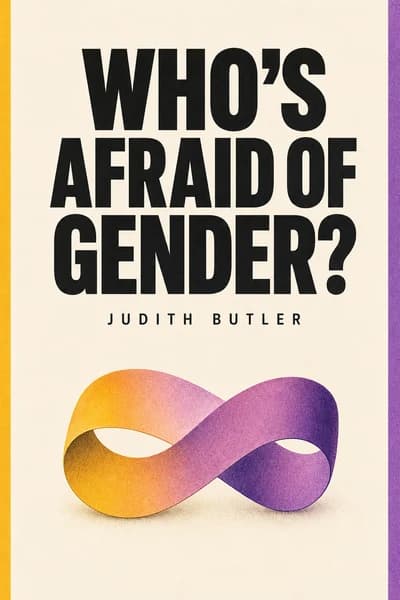
Judith Butler confronts the global anti-gender movement, exposing how Pope Francis and Putin weaponize "gender" to undermine rights. Named a National Bestseller, this "urgent intervention" (Naomi Klein) challenges authoritarianism while imagining a world where we can "love without fear" (Christina Sharpe).
Judith Pamela Butler is a renowned feminist philosopher and pioneering gender theorist, and the author of Who’s Afraid of Gender?, a critical examination of contemporary gender politics and global resistance to LGBTQ+ rights. Butler is a professor at the University of California, Berkeley, and holds the Hannah Arendt Chair at the European Graduate School.
Butler has shaped discourse on identity, power, and social justice through seminal works like Gender Trouble: Feminism and the Subversion of Identity and Bodies That Matter: On the Discursive Limits of Sex. Their exploration of gender performativity redefined feminist and queer theory, emphasizing how societal norms construct bodies and identities.
Who’s Afraid of Gender? extends their decades-long critique of systemic inequality, informed by activism and academic rigor. Butler’s other influential titles, including Undoing Gender and The Force of Nonviolence, further dissect the intersections of ethics, politics, and marginalized communities. Translated into over 20 languages, their works remain foundational in gender studies curricula worldwide.
Who’s Afraid of Gender? examines the global "gender panic" fueled by conservative religious and political movements, arguing that anti-gender rhetoric weaponizes fear to undermine LGBTQ+ rights. Butler traces how institutions like the Vatican and far-right groups frame gender ideology as a threat to societal stability, deconstructing these claims through a lens of performative identity and power dynamics.
This book is ideal for academics, activists, and readers interested in queer theory, feminism, or political philosophy. Its dense, academic style suits those familiar with Butler’s prior work (e.g., Gender Trouble) or engaged in debates about gender identity, cultural backlash, and human rights.
Yes, for readers seeking a rigorous analysis of anti-gender movements. While less accessible than Butler’s earlier works, it offers critical insights into how fear-mongering shapes policy and public discourse. However, those looking for practical advocacy tools may find its theoretical focus challenging.
Butler argues that "gender panic" is a political strategy to consolidate power by framing gender diversity as existential threats. They critique the Vatican’s role in spreading anti-gender rhetoric and emphasize how such narratives erase transgender lived experiences while reinforcing authoritarianism.
It expands on Butler’s theory of gender performativity (introduced in Gender Trouble) but shifts focus to contemporary backlash. Unlike earlier abstract philosophy, this book directly engages modern political crises, linking gender norms to global authoritarian trends.
Butler critiques the Vatican for framing gender theory as an attack on "natural family values," arguing this rhetoric fuels global anti-LGBTQ+ policies. They highlight how the Church’s influence amplifies fear-based narratives, despite lacking empirical grounding.
Critics note its dense academic prose limits accessibility, and some argue Butler overlooks grassroots anti-gender activism outside institutional frameworks. Others suggest the book’s focus on Western discourse underrepresents Global South perspectives.
As gender-based legislation intensifies globally (e.g., bans on healthcare access), Butler’s analysis provides a framework to understand systemic oppression. The book clarifies how fear-driven rhetoric enables erosion of democratic institutions.
While theoretical, Butler urges solidarity among marginalized groups to resist authoritarian co-optation. They advocate for coalition-building across feminist, queer, and racial justice movements to counter fear-based politics.
Gender Trouble revolutionized gender theory by deconstructing binary norms, while Who’s Afraid of Gender? addresses real-world backlash. The newer work is more politically urgent but less foundational in academic discourse.
Pair with Kate Manne’s Entitled (on misogyny’s political roots) or Shon Faye’s The Transgender Issue for grassroots perspectives. For Butler’s foundational theories, read Gender Trouble alongside.
The book blends philosophical analysis, case studies (e.g., Vatican documents), and critiques of “gender-critical” feminism. Chapters systematically dismantle anti-gender rhetoric’s logical fallacies and historical contradictions.
저자의 목소리로 책을 느껴보세요
지식을 흥미롭고 예시가 풍부한 인사이트로 전환
핵심 아이디어를 빠르게 캡처하여 신속하게 학습
재미있고 매력적인 방식으로 책을 즐기세요
The anti-gender movement represents a profound authoritarian impulse at its core.
How does moral sadism masquerade as virtue?
Gender became equated with civilizational collapse?
Gender is divinely ordained and exclusively constituted by God.
Who's Afraid of Gender?의 핵심 아이디어를 이해하기 쉬운 포인트로 분해하여 혁신적인 팀이 어떻게 창조하고, 협력하고, 성장하는지 이해합니다.
Who's Afraid of Gender?을 빠른 기억 단서로 압축하여 솔직함, 팀워크, 창의적 회복력의 핵심 원칙을 강조합니다.

생생한 스토리텔링을 통해 Who's Afraid of Gender?을 경험하고, 혁신 교훈을 기억에 남고 적용할 수 있는 순간으로 바꿉니다.
무엇이든 물어보고, 목소리를 선택하고, 진정으로 공감되는 인사이트를 함께 만들어보세요.

샌프란시스코에서 컬럼비아 대학교 동문들이 만들었습니다
"Instead of endless scrolling, I just hit play on BeFreed. It saves me so much time."
"I never knew where to start with nonfiction—BeFreed’s book lists turned into podcasts gave me a clear path."
"Perfect balance between learning and entertainment. Finished ‘Thinking, Fast and Slow’ on my commute this week."
"Crazy how much I learned while walking the dog. BeFreed = small habits → big gains."
"Reading used to feel like a chore. Now it’s just part of my lifestyle."
"Feels effortless compared to reading. I’ve finished 6 books this month already."
"BeFreed turned my guilty doomscrolling into something that feels productive and inspiring."
"BeFreed turned my commute into learning time. 20-min podcasts are perfect for finishing books I never had time for."
"BeFreed replaced my podcast queue. Imagine Spotify for books — that’s it. 🙌"
"It is great for me to learn something from the book without reading it."
"The themed book list podcasts help me connect ideas across authors—like a guided audio journey."
"Makes me feel smarter every time before going to work"
샌프란시스코에서 컬럼비아 대학교 동문들이 만들었습니다

Who's Afraid of Gender? 요약을 무료 PDF 또는 EPUB으로 받으세요. 인쇄하거나 오프라인에서 언제든 읽을 수 있습니다.
What if the greatest threat to civilization wasn't climate change, nuclear war, or economic collapse-but a single word? Across the globe, from Texas school boards to Vatican councils, from Hungarian parliament to Italian political rallies, one term has been elevated to existential menace: "gender." This isn't hyperbole. Legislation is being drafted, rights are being stripped, and lives are being destroyed-all in the name of protecting society from what amounts to an academic concept. How did we arrive at a moment where acknowledging that gender exists as something distinct from biological sex became tantamount to civilizational suicide? The answer reveals less about gender itself and more about the authoritarian impulses lurking beneath the surface of contemporary politics, waiting for the right phantom to animate them into action.